
자료
세계시민교육에 대한 이해를 넓히고 연구, 옹호 활동, 교수, 학습 등을 향상시킬 수 있는 다양하고 유용한 자료를 찾아보세요.
276 건의 결과가 검색되었습니다
 Entering the World of a Holocaust Victim: Schoolchildren Discuss a Ghetto Memoir – a Case Study Despite Adorno's famous dictum, the memory of the Shoah features prominently in the cultural legacy of the 20th century and beyond. It has led to a proliferation of works of representation and re-memorialization which have brought in their wake concerns about a 'holocaust industry' and banalization. This volume sheds fresh light on some of the issues, such as the question of silence and denial, of the formation of contemporary identities — German, East European, Jewish or Israeli, the consequences of the legacy of the Shoah for survivors and for the 'second generation,' and the political, ideological, and professional implications of Shoah historiography. One of the conclusions to be drawn from this volume is that the 'Auschwitz code’, invoked in relation to all 'unspeakable' catastrophes, has impoverished our vocabulary; it does not help us remember the Shoah and its victims, but rather erases that memory. (By the author) Methods of Teaching the Holocaust to Secondary Students as Implemented by Tennessee Recipients of the Belz-Lipman Holocaust Educator of the Year Awards The purpose of this qualitative study was to explore methods of teaching Holocaust education in a variety of subject areas to secondary students in grades 7 through 12, as implemented by recipients of Tennessee’s Belz-Lipman Holocaust Educator of the Year Awards. These individuals have been recognized, through an application and committee selection process, as outstanding and successful teachers in this field. The findings of this study included the importance of teacher training in this area; participants spoke of regularly attending sessions offered by reputable Holocaust organizations. This study also found commonalities in resources and materials used, such as specific titles of poetry, literature, and movie selections. Additionally, instructional methods such as group discussions, writing assignments, student project activities, and assessment strategies were frequently discussed. The importance of personalizing Holocaust history was emphasized throughout the study. The results indicate that students and teachers benefited from these lessons. While the findings of this study significantly contribute to the field of Holocaust education in Tennessee, the need for additional research is also addressed. To ensure successful, meaningful, pedagogically sound lessons, attention to this topic must be an on-going endeavour. (By the author)
  Die Bedeutung des Holocaust und der Gedenkstättenpädagogik im Unterricht. Ein historisch-pädagogischer Vergleich zwischen Österreich und Bayern In the centre of this research project is a content-oriented comparison based on categories regarding the thematization of the Holocaust in 46 history textbooks for the first stage of secondary education since the beginning of the Second Republic and the new foundation of the Free State of Bavaria in the year of 1945. Based on this thematic constraint, three research questions emerge: 1.How has the representation of the Holocaust in the textbooks changed since the beginning of the Second Republic? What has changed? What has remained the same? 2. What can be deduced from the textbooks concerning the political discourse about the Holocaust? 3. To what extent are the content and the pedagogical-didactical concepts prescribed by the curricula implemented in the textbooks? (By the publisher) Quelques constats à propos de la transmission scolaire de la Shoah en Suisse This study is based on interviews conducted among teachers from the French-speaking cantons of Switzerland to determine how the history and memory of the Shoah are transmitted in the schools: it is at the intersection of the teaching of history and of social perception. The interviews reveal the high standards the teachers set for themselves. Consequently, they are caught between their own perception of the uniqueness of the Shoah and their concern that its exceptional nature might not be shared by their students. Thus, the combination of the exceptional nature of the subject and the teachers’ concern becomes a veritable pedagogical leitmotif that translates both the strength of their conviction and their difficulty in expressing it through effective teaching strategies. It is one of the factors that lead certain teachers to compare the Shoah with other genocides. And yet, when these teachers broach the subject of genocide in a comparative way, the uniqueness of the Shoah stands out, in their eyes, and is reinforced by the strong identification that a majority of them feel with the victims. (By the author) Multicultural education: Israeli and German adolescents' knowledge and views regarding the Holocaust This study probes a unique case of multicultural education of Israeli and German students regarding the Holocaust. Their knowledge level of German history leading to the rise of Hitler and the Nazi party to power, knowledge about the Holocaust, the relation between their knowledge of attitudes toward the "other" (German/Israeli) group, and their reaction to a racist-dictatorial regime are explored. The findings were that German adolescents’ (high school students’) knowledge regarding the events leading to the rise of the Nazi party was greater than that of the Israeli adolescents. However, the knowledge of Israelis was greater regarding the Holocaust. A positive correlation was found between the knowledge levels and their attitudes toward the other groups (German/Israeli) and toward resistance to the possible rise of a dictatorial regime. The findings point to the fact that multicultural education, which combines attitudinal, cognitive and instrumental goals, can succeed in promoting non-racist views. (By the author)
  Jewish Studies and Holocaust Education in Poland This volume examines how people in Poland learn about Jewish life, culture and history, including the Holocaust. The main text provides background on concepts such as culture, identity and stereotypes, as well as on specific topics such as Holocaust education and curriculum, various educational institutions, and the connection of arts and cultural festivals to identity and culture. It also gives a brief overview of Polish history and Jewish history in Poland, as well as providing insight into how the Holocaust and Jewish life and culture are viewed and taught in present-day Poland. This background material is supported by essays by Poles who have been active in the changes that have taken place in Poland since 1989. A young Jewish-Polish man gives insight into what it is like to grow up in contemporary Poland, and a Jewish-Polish woman who was musical director and conductor of the Jewish choir Tslil gives her view of learning through the arts. Essays by Polish scholars active in Holocaust education and curriculum design give past, present and future perspectives of learning about Jewish history and culture. (By the publisher)
  Auschwitz in museums - Representing and teaching the Holocaust in the twenty-first century 발행 연도: 2007 저자: S.Lassig | K.H.Pohl 'Auschwitz' in Museums: Representing and Teaching the Holocaust in the Twenty-first is a select extract from the book "How the Holocaust Looks Now International Perspectives". The book offers a series of essays that explore the historical culture the holocaust has engendered in Europe, Israel and the USA, the politics of its reception and representation, the motivations for and effectiveness of commemorating it, and the creative and didactic practices it has generated in contemporary literature, art, and thought.
  Powerful and Authentic Digital Media and Strategies for Teaching about Genocide and the Holocaust The continued prominence of genocide and Holocaust education, along with the movement toward the affective in social studies curricula, the advent of the Internet, and continued scholarship in the field, has led to the availability of a staggering array of digital resources for teachers (D. S. Symer 2001). These resources have the potential to enhance genocide and Holocaust education by providing robust content resources and interactive opportunities for students to develop new skills and understanding. In this article, the authors identify new digital media resources and strategies that engage students in authentic learning experiences about genocide and the Holocaust. They use F. W. Newmann and G. G. Wehlage's (1993) framework for "authentic instruction." Using this framework, the authors identify digital media that engage students in moral and ethical valuing, emphasize historical inquiry, and are relevant to the world outside of school. (By the author)
 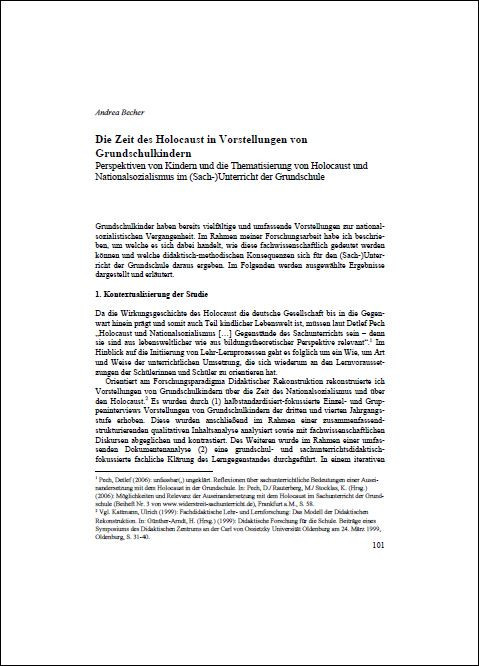 The Time Period of the Holocaust in the Beliefs of Primary School Children – Children’s Perspectives and the Thematization of the Holocaust and National Socialism in Primary-School Instruction (in General Subjects) 발행 연도: 2012 저자: Andrea Becher The original title: Die Zeit des Holocaust in Vorstellungen von Grundschulkindern – Perspektiven von Kindern und die Thematisierung von Holocaust und Nationalsozialismus im (Sach-)Unterricht der Grundschule(In I. Enzenbach, C. Klätte, & D. Pech, (Eds.). Kinder und Zeitgeschichte: Jüdische Geschichte und Gegenwart, Nationalsozialismus und Antisemitismus, Supplement, 8, pp. 101–120) This is a summary of a study of German primary school children’s beliefs about the Holocaust, based on interviews conducted in two classes in 2005. The author finds that the children almost exclusively focus on Hitler; that one can find “latent anti-Semitic fragments” in their statements; that, even without formal education, the pupils still possess knowledge about the Holocaust; and their main source of information about Nazi Germany seems to be family members. However, the family narratives mainly touch upon everyday-life and avoid the topic of the Holocaust. From these findings, the author argues that one could and should teach the Holocaust already in the German primary school. The above abstract is taken from the International Holocaust Remembrance Alliance Education Research Project. Please also consult the full list of abstracts in 15 languages and the accompanying publication Research in Teaching and Learning about the Holocaust: A Dialogue Beyond Borders. Ed: IHRA, Monique Eckmann, Doyle Stevick, Jolanta Ambrosewicz-Jacobs, 2017, Metropol Verlag.
  Teaching the history of the Holocaust 단체 저자: Mémorial de la Shoah | Ministère de l'Education nationale, de l'Enseignement supérieur et de la Recherche This website, hosted by the Mémorial de la Shoah and the French Ministry of Education is a perfect guide for primary or secondary teachers in their work on the Holocaust. With a collection of literature and film reviews, and an inventory of the different museums or memorials to visit, this platform encourages the educational staff to approach this issuein an interactive way such as the organization of thematic exhibitions or class-participation in national contests.