
자료
세계시민교육에 대한 이해를 넓히고 연구, 옹호 활동, 교수, 학습 등을 향상시킬 수 있는 다양하고 유용한 자료를 찾아보세요.
83 건의 결과가 검색되었습니다
 مسؤولية المدرسة في تنمية الوعي بحقوق الانسان في ضوء التربية الإسلامية 발행 연도: 2017 저자: Asaad Al Hussein 단체 저자: Cairo University انطلاقا من أهمية تنمية الوعي بحقوق الانسان وما تهدف اليه من تنمية قيم الحرية والمساواة والتعاون وتعزيز الحقوق والواجبات، فإن هذه الورقة تبحث في مسؤولية المدرسة في تنمية الوعي بحقوق الانسان في ضوء التربية الإسلامية. وتعتبر المدرسة أهم المؤسسات التربوية المنوط بها تعزيز الوعي بحقوق الانسان. The Responsibility of the School in Developing Awareness of Human Rights in the Light of Islamic Education 발행 연도: 2017 저자: Asaad Al Hussein 단체 저자: Cairo University Based on the importance of developing awareness of human rights and what it aims to achieve in developing the values of freedom, equality, cooperation and promoting rights and duties, this paper examines the responsibility of the school in developing awareness of human rights in the light of Islamic education. The school is considered the most important educational institution entrusted with promoting awareness of human rights.
 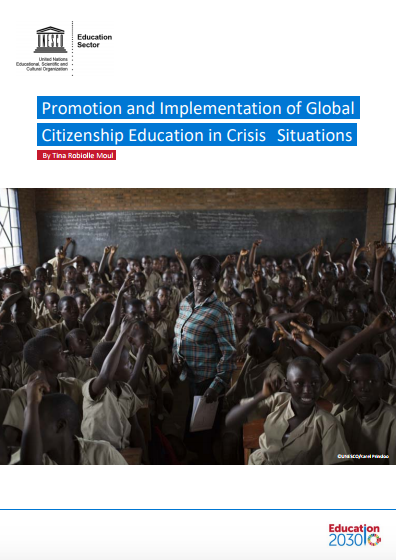 Promotion and implementation of global citizenship education in crisis situations 발행 연도: 2017 저자: Robiolle Moul, Tina 단체 저자: UNESCO Crisis situations affect the realization of human rights of many people and communities across all regions of the world. Within UNESCO’s relevant areas of work, GCED is a powerful approach to education that can empower people to recover from crises and transform their communities into peaceful and sustainable societies. UNESCO commissioned a desk study that aimed at reviewing existing research on the promotion and implementation of GCED and related programs in countries affected by crisis situations, with particular attention to initiatives benefiting the refugee population. This study unveils the key challenges these programs encounter in such contexts, as well as promising practices that can guide the design and implementation of future GCED in crisis situations.This report is a synthesis of this desk study and supports the evidence that, after analyzing the context and the available means, GCED and related programs can and should be systematically adapted and implemented in crisis situations, including in response to refugee crises. Promotion and implementation of global citizenship education in crisis situations 발행 연도: 2017 저자: Robiolle Moul, Tina 단체 저자: UNESCO Crisis situations affect the realization of human rights of many people and communities across all regions of the world. Within UNESCO’s relevant areas of work, GCED is a powerful approach to education that can empower people to recover from crises and transform their communities into peaceful and sustainable societies. UNESCO commissioned a desk study that aimed at reviewing existing research on the promotion and implementation of GCED and related programs in countries affected by crisis situations, with particular attention to initiatives benefiting the refugee population. This study unveils the key challenges these programs encounter in such contexts, as well as promising practices that can guide the design and implementation of future GCED in crisis situations. This report is a synthesis of this desk study and supports the evidence that, after analyzing the context and the available means, GCED and related programs can and should be systematically adapted and implemented in crisis situations, including in response to refugee crises. Promotion and implementation of global citizenship education in crisis situations 발행 연도: 2017 저자: Robiolle Moul, Tina 단체 저자: UNESCO Crisis situations affect the realization of human rights of many people and communities across all regions of the world. Within UNESCO’s relevant areas of work, GCED is a powerful approach to education that can empower people to recover from crises and transform their communities into peaceful and sustainable societies. UNESCO commissioned a desk study that aimed at reviewing existing research on the promotion and implementation of GCED and related programs in countries affected by crisis situations, with particular attention to initiatives benefiting the refugee population. This study unveils the key challenges these programs encounter in such contexts, as well as promising practices that can guide the design and implementation of future GCED in crisis situations. This report is a synthesis of this desk study and supports the evidence that, after analyzing the context and the available means, GCED and related programs can and should be systematically adapted and implemented in crisis situations, including in response to refugee crises.
  Guide on Human Rights Education Curriculum Development 발행 연도: 2021 저자: Cecilia Decara | Carol Rask | Felisa Tibbitts 단체 저자: Danish Institute for Human Rights This document aims to bring conceptual clarity on human rights education and curriculum development and provide concrete suggestions on how to build human rights curricula ft for 21st century human rights challenges, while contributing to the realisation of the SDG goals and targets set by the international community.
  Revised Recommendation Concerning Education for International Understanding, Co-operation and Peace and Education Relating to Human Rights and Fundamental Freedoms ('1974 Recommendation') 발행 연도: 2022 단체 저자: UNESCO The revision of the 1974 Recommendation provides the international community with the opportunity to strengthen the instrument so that it can support the design and implementation of effective educational policies and programmes, which can put the world on a pathway to lasting peace and sustainable development for all, in line with the requirements of the 2030 Agenda and the body of international legal norms adopted since 1974. Recommandation révisée sur l’éducation pour la compréhension, la coopération et la paix internationales et l’éducation relative aux droits de l’homme et aux libertés fondamentales (« Recommandation de 1974 ») 발행 연도: 2022 단체 저자: UNESCO La révision de la Recommandation de 1974 offre à la communauté internationale l'occasion de renforcer l'instrument afin qu'il puisse soutenir la conception et la mise en œuvre de politiques et de programmes éducatifs efficaces, susceptibles de mettre le monde sur la voie d'une paix durable et du développement durable pour tous, conformément aux exigences de l'Agenda 2030 et à l'ensemble des normes juridiques internationales adoptées depuis 1974.
  교사. 인권교육. 하다: 교사를 위한 학교 인권교육 안내서 발행 연도: 2021 단체 저자: 국가인권위원회 이 자료는 「초·중등 학교 인권교육 내용 체계화 및 개정 교육과정 적용 방안 연구」 보고서 내용을 바탕으로, 교육 현장에서 인권교육을 실천하고 있거나 해보려는 많은 교사를 위해 학교 인권교육에 관한 이해를 높이고 실천 방법에 대한 유용한 정보를 제공하기 위해 만든 발간물로서 인권 과목의 지향점 및 교육과정 내용 체계 등을 간명하게 보여 줌으로써, 인권 과목을 통한 인권교육을 구체화할 수 있도록 했다. 또한 인권교육을 처음 시도하는 교사들이 부담 없이 접근할 수 있도록 읽을거리, 볼거리, 생각할 거리 등 다양한 자료를 제공한다.
  Implementing the Right to Education: a Compendium of Practical Examples 발행 연도: 2016 단체 저자: UNESCO This publication is a compilation of practical examples of measures taken by Member States in implementing the provisions of the UNESCO Convention and Recommendation against Discrimination in Education. These examples are taken from national reports submitted to UNESCO for the Eighth Consultation of Member States on the implementation of these two international standard-setting instruments. The Convention and the Recommendation celebrated their fi fty-fi fth anniversary in 2015. Both express the fundamental principles of non-discrimination and equality of educational opportunities enshrined in UNESCO’'s Constitution. Since these fundamental principles were essential in the process of Education for All, the instruments have naturally become the cornerstone of this important domain.The Education 2030 development agenda will provide further opportunity to mobilise the Convention and the Recommendation in guiding Member States in the effective realization of the right to education. This compendium seeks to provide an overview of promising measures taken to ensure equality of educational opportunities and non-discrimination, while also serving as a tool for information sharing and advocacy in connection with the right to education.