
자료
세계시민교육에 대한 이해를 넓히고 연구, 옹호 활동, 교수, 학습 등을 향상시킬 수 있는 다양하고 유용한 자료를 찾아보세요.
51 건의 결과가 검색되었습니다
 Global Media and Information Literacy Assessment Framework: Country Readiness and Competencies 발행 연도: 2013 단체 저자: UNESCO The MIL Assessment Framework can foster lifelong learning initiatives by building on the relationship between information, media, digital, and ICT literacies, along with societal transformations, education, workforce, policy and decision making processes, economic growth and democracy. The overall goal of the publication is to guide UNESCO’s Member States throughout the assessment of country readiness and competencies regarding the media and information literacy of citizens, in particular teachers in service and in training. The document is particularly aimed at the following stakeholders: policy makers and decision makers; national officers responsible for statistical data collection and analysis; educational policy makers and planners working in formal and informal education settings; teacher training institutions and teachers. It is also of relevance to the professional information and communication community, and has wide applicability for civil society at large.
 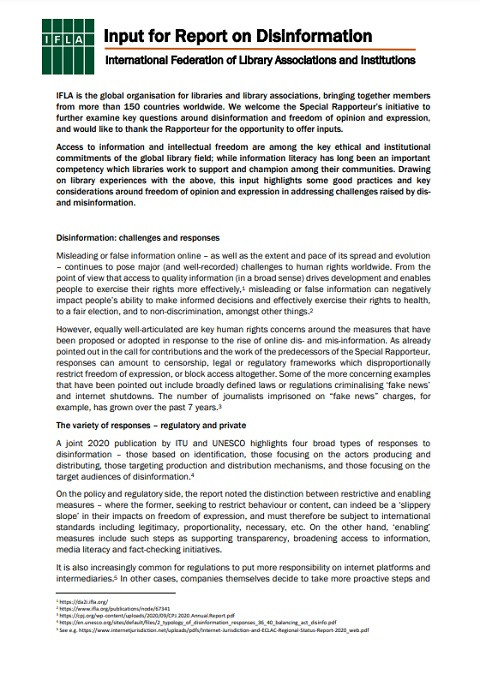 Input for Report on Disinformation 발행 연도: 2021 단체 저자: International Federation of Library Associations and Institutions (IFLA) IFLA responded to a call for inputs about human rights impacts of measures against disinformation, issued by the United Nations Special Rapporteur on the promotion and protection of the right to freedom of opinion and expression. Concerns over – and dialogue about ways to address – the negative impacts of false and misleading information online have remained high on the agenda over the past months, particularly in light of prominent examples of health and electoral dis- and mis-information.Disinformation, uniquely challenging in the increasingly dense and complex digital information environment, interferes with individuals’ ability to make informed decisions and realise their essential human rights. However, the new call for inputs by the UN Special Rapporteur also draws attention to the concerns about human rights impacts of measures which different stakeholders – from states to online platforms, human rights organisations and others – take to combat disinformation.These include, of course, the impacts of broadly- or vaguely-defined “fake news” laws on freedom of expression and opinion; or internet shutdowns that bear a heavy cost on people’s access to information as a driver of development and rights.In light of this, IFLA’s submission highlights the potential of media and information literacy interventions to help address the challenges of mis- and dis-information. Drawing on the global library field’s experiences, it points to some possible good practices and insights from the ongoing work and research in this field – from targeted and tailored outreach initiatives that can help reach those who are not currently in formal education, to scalability and replicability of interventions.Of course, this is an emerging field. Our understanding of how media and information literacy interventions can be effectively leveraged against disinformation, pitfalls to avoid and ways to maximise impact, continues to evolve. That’s why the submission emphasises the need for more research and cross-stakeholder collaboration – and libraries can and do offer valuable practical and theoretical insights for this ongoing discussion.
  Artificial Intelligence: Media and Information Literacy, Human Rights and Freedom of Expression 발행 연도: 2020 저자: Igor Shnurenko | Tatiana Murovana | Ibrahim Kushchu 단체 저자: UNESCO Institute for Information Technologies in Education (IITE) | TheNextMinds The collection of papers “Artificial Intelligence: Media and Information Literacy, Human Rights and Freedom of Expression” continues the UNESCO IITE’s series of publications entitled “Digital Transformation of Education”.The publication describes the fundamentals of artificial intelligence and AI-based technologies, their impact on the modern information and media environment, new challenges in the field of media and information literacy associated with the growing automation of the processes of creating, disseminating and accessing information, the use of AI in decision-making and control systems in various areas. There is a strong focus on the growing risks of reducing individual agency, people’s ability to interpret reality autonomously and to act according to their own agenda.These issues are more relevant now than ever before for education undergoing digital transformation. The publication seeks to contribute to a critical understanding of the digital environment in which learning and teaching unfold, and strategies and tactics for the use of new technologies and the digitalization of educational interactions.
 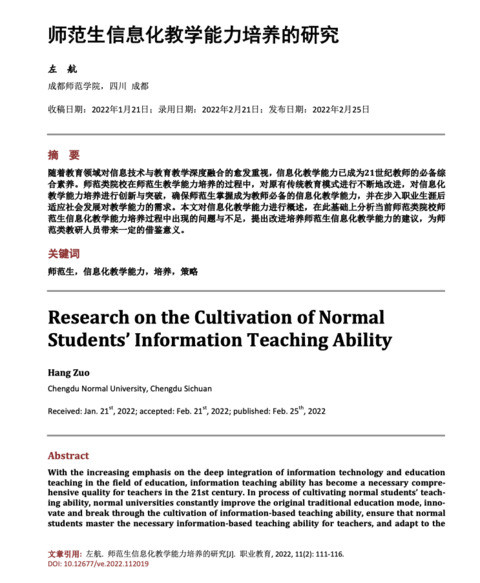 Research on the Cultivation of Normal Students’ Information Teaching Ability (Vocational Education; Vol.11, No.2) 발행 연도: 2022 저자: 左航 With the increasing emphasis on the deep integration of information technology and education teaching in the field of education, information teaching ability has become a necessary comprehensive quality for teachers in the 21st century. In process of cultivating normal students’ teaching ability, normal universities constantly improve the original traditional education mode, innovate and break through the cultivation of information-based teaching ability, ensure that normal students master the necessary information-based teaching ability for teachers, and adapt to the needs of social development for teaching ability after entering their career. This paper summarizes the information teaching ability, and analyzes the problems and deficiencies in the cultivation of information teaching ability of normal students in normal universities, and puts forward some suggestions to improve the training of information teaching ability of normal students, which will bring some reference significance to normal teaching and research personnel. 师范生信息化教学能力培养的研究 (职业教育; Vol.11, No.2) 발행 연도: 2022 저자: 左航 随着教育领域对信息技术与教育教学深度融合的愈发重视,信息化教学能力已成为21世纪教师的必备综合素养。师范类院校在师范生教学能力培养的过程中,对原有传统教育模式进行不断地改进,对信息化教学能力培养进行创新与突破,确保师范生掌握成为教师必备的信息化教学能力,并在步入职业生涯后适应社会发展对教学能力的需求。本文对信息化教学能力进行概述,在此基础上分析当前师范类院校师范生信息化教学能力培养过程中出现的问题与不足,提出改进培养师范生信息化教学能力的建议,为师范类教研人员带来一定的借鉴意义。
 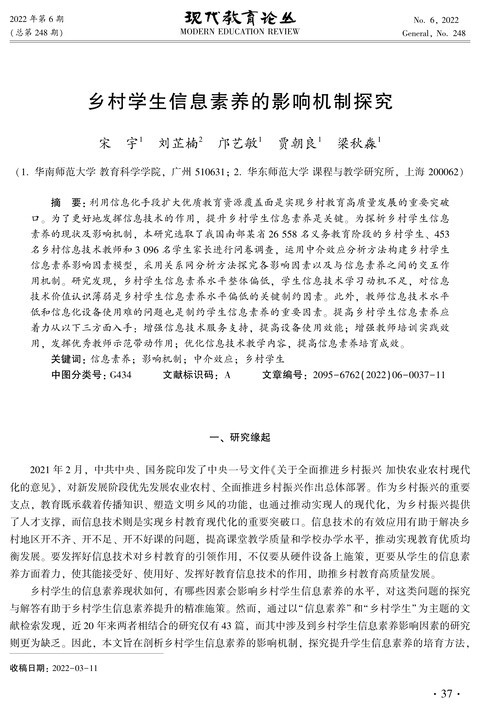 The Influence Mechanism of Students' Information Literacy in Rural Areas (Modern Education Review; No.6, 2022) 발행 연도: 2022 저자: 宋宇 | 刘芷楠 | 邝艺敏 | 贾朝良 | 梁秋淼 Using information technology to expand the coverage of good education resources is an important breakthrough to realize the high-quality development of rural education. Improving the information literacy of rural students is the key to better play the role of information technology. In order to explore the current situation and influence mechanism of rural students' information literacy, this study selected 26558 rural students of compulsory education, 453 rural information technology teachers and 3096 parents from a province in south China for questionnaire survey, Using the mediating effect analysis method to construct the influencing factor model of rural students' information literacy and the network analysis method was used to explore the interaction mechanism between the influencing factors and information literacy. The results show a low level of rural students' information literacy and insufficient motivation for learning information technology. The weak understanding of the value of information technology mainly limits the improvement of rural students' information literacy. Besides, teachers' low level of information technology and difficulties in using information equipment are constraints to students' information literacy. To improve the information literacy of rural students, efforts should be made in the following three aspects:enhance information technology service support and improve the using efficiency of equipment, enhance the practical efficiency of teacher training and give full play to the exemplary and leading role of excellent teachers, optimize the teaching content of information technology, and improve the cultivation effect of information literacy. 乡村学生信息素养的影响机制探究 (现代教育论丛; No.6, 2022) 발행 연도: 2022 저자: 宋宇 | 刘芷楠 | 邝艺敏 | 贾朝良 | 梁秋淼 利用信息化手段扩大优质教育资源覆盖面是实现乡村教育高质量发展的重要突破口。为了更好地发挥信息技术的作用,提升乡村学生信息素养是关键。为探析乡村学生信息素养的现状及影响机制,本研究选取了我国南部某省26558名义务教育阶段的乡村学生、453名乡村信息技术教师和3096名学生家长进行问卷调查,运用中介效应分析方法构建乡村学生信息素养影响因素模型,采用关系网分析方法探究各影响因素以及与信息素养之间的交互作用机制。研究发现,乡村学生信息素养水平整体偏低,学生信息技术学习动机不足,对信息技术价值认识薄弱是乡村学生信息素养水平偏低的关键制约因素。此外,教师信息技术水平低和信息化设备使用难的问题也是制约学生信息素养的重要因素。提高乡村学生信息素养应着力从以下三方面入手:增强信息技术服务支持,提高设备使用效能;增强教师培训实践效用,发挥优秀教师示范带动作用;优化信息技术教学内容,提高信息素养培育成效。
 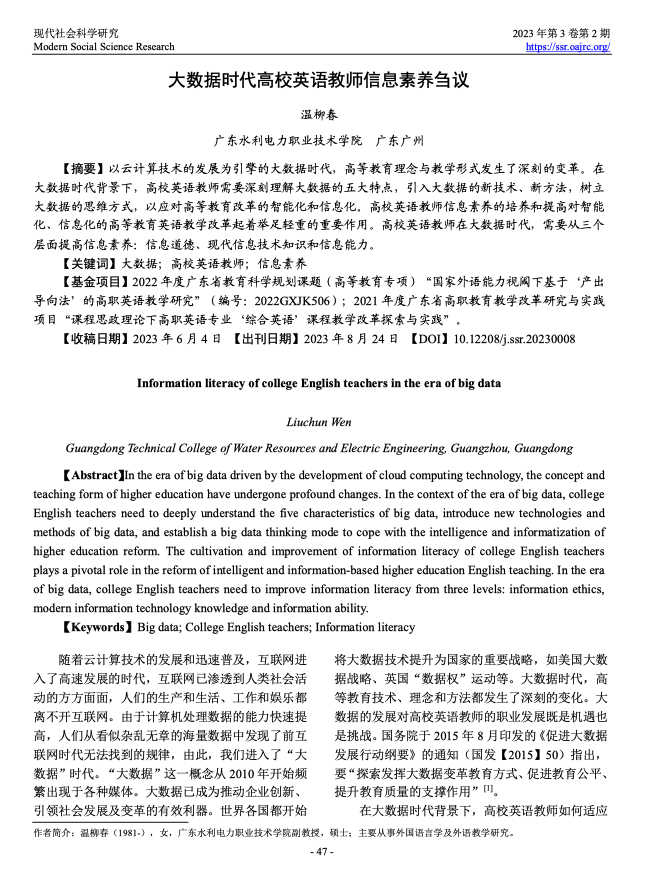 大数据时代高校英语教师信息素养刍议 발행 연도: 2023 저자: 温柳春 以云计算技术的发展为引擎的大数据时代,高等教育理念与教学形式发生了深刻的变革。在大数据时代背景下,高校英语教师需要深刻理解大数据的五大特点,引入大数据的新技术、新方法,树立大数据的思维方式,以应对高等教育改革的智能化和信息化。高校英语教师信息素养的培养和提高对智能化、信息化的高等教育英语教学改革起着举足轻重的重要作用。高校英语教师在大数据时代,需要从三个层面提高信息素养:信息道德、现代信息技术知识和信息能力。
  Global Research Policy & Practices Report: Advancing Artificial Intelligence-Supported Global Digital Citizenship Education 발행 연도: 2022 단체 저자: UNESCO Institute for Information Technologies in Education (IITE) | Shanghai Open University The UNESCO Institute for Information Technologies in Education (IITE) was established as an integral part of UNESCO by the General Conference of UNESCO at its 29th session November 1997) and is located in Moscow, Russian Federation. IITE is the only UNESCO Category 1 Institute that holds a global mandate for ICT in education.In line with the new Education 2030 Agenda, IITE has developed its strategic priority areas to meet new demands and tasks ahead. The mission of IITE in the new era is promoting the innovative use of ICT and serving as facilitator and enabler for achieving Sustainable Development Goal 4 (SDG 4) through ICT-enabled solutions and best practices. This report, supported by the Online Learning Consortium (OLC), is published in partnership with Shanghai Open University (SOU) to help amplify best practices regarding artificial ntelligence, digital literacy, and digital citizenship instruction for lifelong learning and success. 全球政策与实钱研究报告: 以人工智能为支撑,推动全球数字公民教育 발행 연도: 2022 단체 저자: UNESCO Institute for Information Technologies in Education (IITE) | Shanghai Open University 1997年11月,联合国教科文组织大会在第二十九届会议上设立联合国教科文组织教育信息技术研究所(以下简称 “本研究所),确定其办公地点在俄罗斯联邦莫斯科。本研究所是联合国教科文组织一类机构中唯一在教育领域拥 有信息与通信技术全球授权的机构,并根据新的《2030 年教育议程》, 确定了战略优先领域,以满足未来的新需求 和新任务。其在新时代的使命是以信息与通信技术为支撑,制订解决方案,形成最佳实践,加强创新使用信息与通 信技术,促进和推动实现可持续发展目标 4。在线学习联盟对本工具包给予支持,并与上海开放大学合作将其发布, 旨在帮助推广有关人工智能、数字素养和数字公民教育的最佳实践,以实现终身学习和取得成功,并为政策制定者 和执业者提供一个评估框架和评价工具,以衡量支持学习和参与实践在设计、交付和实施方面所取得的重大进步。