
자료
세계시민교육에 대한 이해를 넓히고 연구, 옹호 활동, 교수, 학습 등을 향상시킬 수 있는 다양하고 유용한 자료를 찾아보세요.
371 건의 결과가 검색되었습니다
 Éducation aux Valeurs par le Sport 발행 연도: 2016 단체 저자: UNESCO Éducation innovante pour le développementL'éducation au 21e siècle reconnaît de plus en plus le rôle des valeurs et des compétences sociales pour relever les défis mondiaux, tels que l'inactivité, l'obésité, le chômage et les conflits. Cette approche est au cœur de l'objectif de développement durable 4 sur l'éducation de qualité, qui milite pour des possibilités d'apprentissage inclusifs et la livraison de contenu innovant. Les formulaires dynamiques de l'éducation fondée sur les valeurs en utilisant le sport peuvent être introduits dans les écoles pour aider les enseignants offrent des programmes activement et en collaboration.Quelles sont les valeurs du sport?Le sport peut enseigner des valeurs telles que l'équité, teambuilding, l'égalité, la discipline, l'inclusion, la persévérance et le respect. Le sport a le pouvoir de fournir un cadre universel pour les valeurs d'apprentissage, contribuant ainsi au développement des compétences générales nécessaires à la citoyenneté responsable. Que peut l'éducation aux valeurs par offre de Sport?Valeurs éducation par le sport (VEPS) programmes appuient l'apprentissage actif, compléter les compétences cognitives et donner aux étudiants les montants de responsabilité de plus en plus, et d'améliorer leur niveau de concentration et de participation. programmes VEPS sont flexibles et ont un fort potentiel transdisciplinaire: ils peuvent renforcer les programmes existants et peuvent être écoutés sur différents sujets, y compris l'éducation physique, l'éducation civique et morale, la nutrition, la biologie, les arts. En fin de compte, ces programmes aident les élèves à transférer et de mettre les valeurs en action en dehors du milieu scolaire, en s'engagés dans leurs communautés, prendre des décisions éclairées, étant sensible et en respectant les autres et l'environnement. VEPS contribue au développement de la confiance en soi, des choix de vie sains et actifs, et une compréhension des droits, soutenir la transition délicate à l'indépendance de l'âge adulte.
 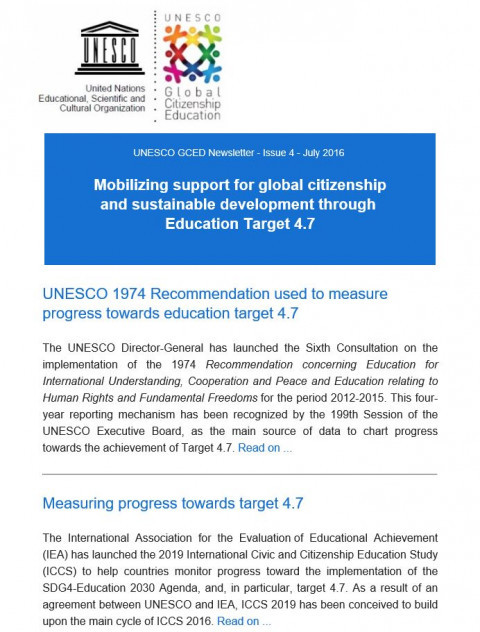 UNESCO GCED eNewsletter Issue 4 발행 연도: 2016 단체 저자: UNESCO Feature: Mobilizing support for global citizenship and sustainable development through Education Target 4.7 UNESCO 1974 Recommendation used to measure progress towards education target 4.7 Measuring progress towards 4.7 Gyeongju Action Plan: NGOs join UNESCO Global capacity-building workshop on GCED organized by APCEIU Southern Africa Regional Meeting on GCED convened in Johannesburg, South Africa UNESCO launches Teacher's Guide on the Prevention of Violent Extremism Expert meeting on the Prevention of Violent Extremism through Education European ministers back education for democracy to counter extremism and racaism UN discusses innovative solutions to prevent violent extremism through education UNESCO's YESPeace Network taps the power of youth worldwide to change the future GCED Topics and Learning Objectives available in seven languages.
 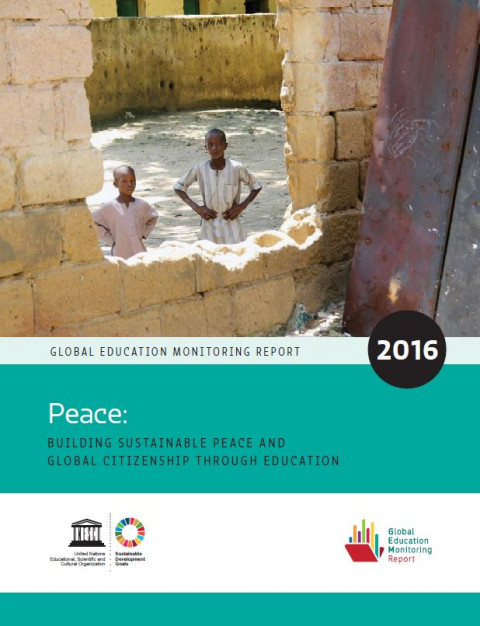 Peace: building sustainable peace and global citizenship through education;Global education monitoring report summary 2016 발행 연도: 2017 단체 저자: UNESCO The 2016 GEM Report, the first of a new 15-year series, shows that education will not deliver its full potential to catapult the world forward unless rates of improvement dramatically shift, and education systems consider sustainable development in the way services are delivered. This Peace: Building sustainable peace and global citizenship through education publication is a select extract from the full 2016 Global Education Monitoring (GEM) Report: Education for people and planet: Creating sustainable futures for all. It contains two chapters from that full Report – one on peace, political participation and access to justice and the other on education for global citizenship and sustainable development — , along with the associated policy recommendations and a short section of a recent GEM Report Policy Paper Textbooks pave the way to sustainable development.
  Non-formal and Informal Programs and Activities that Promote the Acquisition of Knowledge and Skills in Areas of Global Citizenship Education (GCED) and Education for Sustainable Development (ESD) 발행 연도: 2016 저자: Ashley Stepanek Lockhart 단체 저자: UNESCO This study will examine the nature of, and how, non-formal and informal programs and activities contribute to the acquisition of knowledge and skills for children, adolescents, youth and adults in precise areas of Target 4.7. This will be done by highlighting different definitions, conceptual approaches and history, along with policies of GCED and ESD and non-formal education and informal learning, comparing attempts to operationalize GCED and ESD to indicators for measurement and monitoring and challenges therein, and by identifying relevant sample programs and activities from around the world to analyze and consider using as data sources. How non-formal and informal provision related to GCED and ESD links to formal education will be considered, along with its connection to the larger notion of lifelong learning.
  Towards the development of an international module for assessing learning in Global Citizenship Education (GCE) and Education for Sustainable Development (ESD): a critical review of current measurement strategies 발행 연도: 2016 저자: Bryony Hoskins 단체 저자: UNESCO The aim of the study is to support the development of an indicator for target 4.7 of the UN sustainable development goals (STG). The study provides a conceptual framework for measuring the competences from global citizenship education (GCE) and education for sustainable development (ESD) from a review of the literature and then an audit of the different aspects of these competences. The study establishes the extent that these competences can be measured using existing data. The results of this analysis show that most dimensions of GCE can to some extent be measured by the existing IEA ICCS 2009 and 2016 datasets and an outline of how this data can be used to develop an initial indicator or set of indicators for target 4.7 is given. However, in contrast, the study finds that existing data is much more limited on measuring ESD and the existing data does not provide enough coverage for indicator development at the moment. The study recommends that in order to provide a more comprehensive measure of both these competences it would be necessary to develop a new module on GCE and ESD. After considering the options, it is concluded that the most realistic option is for this module to be attached to the existing IEA ICCS survey. The study concludes that an indicator of all citizens across the whole world is probably unrealistic considering the challenges faced, but what could be achievable is an indicator covering some countries from each region from around the world. To make this a reality considerable political effort and search for funding would be required to engage new regions to the ICCS survey, for example, from Africa and the Middle East
  Developing a Monitoring Instrument to Measure Extracurricular and Non-formal Activities which Promote Global Citizenship Education (GCED) and Education for Sustainable Development (ESD) 발행 연도: 2016 저자: Bassel Akar 단체 저자: UNESCO The goal on Education is 1 of 17 Sustainable Development Goals that comprises a target to ensure all learners around the world have an opportunity to develop the competencies to promote sustainable approaches to living, including appreciating of cultural diversity, non-violence, and gender equality. Extracurricular activities and non-formal education (ENA) provides a non-traditional space for learning global citizenship and sustainable development. Around the world, communities have organized education programs and activities for youth outside school to learn the values and practices of being global citizens. Research shows, however, that most efforts to review and improve ENA for global citizenship and sustainable development have focused on summative evaluations with little attention to formative approaches of monitoring. Drawing on basic principles of action research, sustainable professional development, and education quality enhancement, a monitoring framework emerges to support organizations around the world in measuring progress towards education for global citizenship and sustainable development. This framework also suggests (1) inclusive monitoring spaces like internal reviews and online social networking platforms, (2) roles of stakeholders like donor agencies in institutionalizing monitoring practices, (3) instruments and measurable scales to facilitate dialogues that review program objectives and action plans, and (4) challenges in inclusive and sustainable monitoring tools and approaches.
  Education for Global Citizenship Education & Sustainable Development: Content in Social Science Textbooks 발행 연도: 2016 저자: Patrica Bromley | Julia Lerch | Jeremy Jimenez 단체 저자: UNESCO In times of violence and egregious destruction of human lives and the natural world, our recognition of the need for education that promotes peace and justice becomes particularly pressing. This background report reviews the state of existing research and data on relevant sustainable development content in social science education in countries around the world. Specifically, it examines the extent to which textbook content could help learners acquire the knowledge, skills, and values needed to meet goal 4.7 of the United Nation’s Sustainable Development Goals: “By 2030, ensure that all learners acquire the knowledge and skills needed to promote sustainable development, including, among others, through education for sustainable development and sustainable lifestyles, human rights, gender equality, promotion of a culture of peace and non-violence, global citizenship and appreciation of cultural diversity and of culture’s contribution to sustainable development.” It reviews relevant literature and analyzes three cross-national, longitudinal databases containing information coded from textbook content to assess the current state of knowledge. The paper concludes by indicating where future research efforts are most needed, identifying geographic and substantive needs, and considering monitoring mechanisms that could encourage on-going evaluation and monitoring of textbook content.
  UNESCO's Role and Responsibilities in Implementing Global Citizenship Education and Promoting Peace and Human Rights Eudcation and Education for Sustainable Development 발행 연도: 2015 단체 저자: UNESCO This document is an addendum to document 196 EX/32. This item was included in the provisional agenda of the 196th session of the Executive Board at the request of Austria and Italy Rôle et responsabilités de l'UNESCO dans la mise en oeuvre de l'éducation à la citoyenneté mondiale et la promotion de l'éducation relative à la paix et aux droits de l'homme et de l'éducation en vue du développement durable 발행 연도: 2015 단체 저자: UNESCO This document is an addendum to document 196 EX/32. This item was included in the provisional agenda of the 196th session of the Executive Board at the request of Austria and Italy Función y responsabilidades de la UNESCO en la realización de la educación para la ciudadanía mundial y la promoción de la educación para la paz y los derechos humanos y la educación para el desarrollo sostenible 발행 연도: 2015 단체 저자: UNESCO This document is an addendum to document 196 EX/32. This item was included in the provisional agenda of the 196th session of the Executive Board at the request of Austria and Italy