
자료
세계시민교육에 대한 이해를 넓히고 연구, 옹호 활동, 교수, 학습 등을 향상시킬 수 있는 다양하고 유용한 자료를 찾아보세요.
61 건의 결과가 검색되었습니다
 التعليم متعدد الثقافات بين النمذجة التنظيرية وإشكالية الممارسات : دراسة مقارنة بين مصر وفرنسا واليابان 발행 연도: 2006 저자: Ahmed Aidrous | Mohammed Awad 단체 저자: Zagazig University تركز هذه الورقة على دراسة التعددية الثقافية كمفهوم والنظريات والأطر والنماذج التطبيقية المرتبطة بها. وتستعرض الدراسة خبرة كلا من فرنسا واليابان ومصر، وتضع مقارنات بينها. تنتهي الدراسة بوضع تصور مقترح للتعليم متعدد الثقافات في ضوء الخبرات المعروضة.
  Cultural Diversity and Interculturality in Higher Education. Experiences in Latin America 발행 연도: 2008 저자: Daniel Mato 단체 저자: UNESCO International Institute for Higher Education in Latin America and the Caribbean (IESALC) The work that we present below under the title Cultural Diversity and Interculturality in Higher Education. Experiences in Latin America offers a documented and novel analysis on the subject, accompanied by more than thirty studies on concrete experiences that allow to appreciate the richness and vitality that this field exhibits in Latin America, as well as the problems and challenges it faces. The volume brings together thirty-six studies of experiences of the types mentioned, each of which identifies achievements, obstacles and learning, and culminates in offering recommendations. This collection of texts is preceded by a study of regional scope that analyzes significant contextual elements, as well as salient aspects of the studied experiences, evaluates problems, challenges and opportunities, and offers a set of recommendations. Diversidad Cultural e Interculturalidad en Educación Superior. Experiencias en América Latina 발행 연도: 2008 저자: Daniel Mato 단체 저자: UNESCO International Institute for Higher Education in Latin America and the Caribbean (IESALC) La obra que a continuación presentamos bajo el título Diversidad Cultural e Interculturalidad en Educación Superior. Experiencias en América Latina ofrece un documentado y novedoso análisis sobre el tema, acompañado de más de treinta estudios sobre experiencias concretas que permiten apreciar la riqueza y vitalidad que este campo exhibe en América Latina, así como los problemas y desafíos que enfrenta. El volumen reúne treinta y seis estudios de experiencias de los tipos mencionados, cada uno de los cuales identifica logros, obstáculos y aprendizajes, y culmina ofreciendo recomendaciones. Esa colección de textos es precedida por un estudio de alcance regional que analiza elementos contextuales significativos, así como aspectos salientes de las experiencias estudiadas, evalúa problemas, retos y oportunidades, y ofrece un conjunto de recomendaciones.
 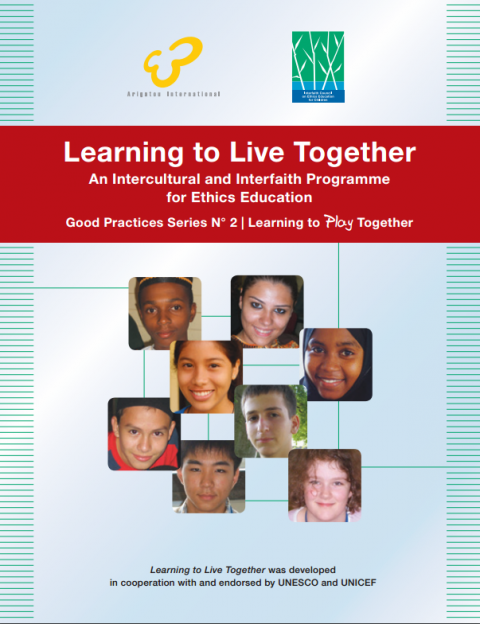 Learning to live together: an intercultural and interfaith programme for ethics education; Good Practices Series 2; Learning to Play Together 발행 연도: 2014 단체 저자: United Nations Children's Fund (UNICEF) | Interfaith Council on Ethics Education for Children | Arigatou Foundation Learning to live together: an intercultural and interfaith programme for ethics education; Good Practices Series 2; Learning to Play Together Aprender a vivir juntos Un programa intercultural e interreligioso para la educación ética: Series de Buenas Prácticas 2; Aprender a jugar juntos 발행 연도: 2014 단체 저자: United Nations Children's Fund (UNICEF) | Interfaith Council on Ethics Education for Children | Arigatou Foundation Aprender a vivir juntos Un programa intercultural e interreligioso para la educación ética: Series de Buenas Prácticas 2; Aprender a jugar juntos
 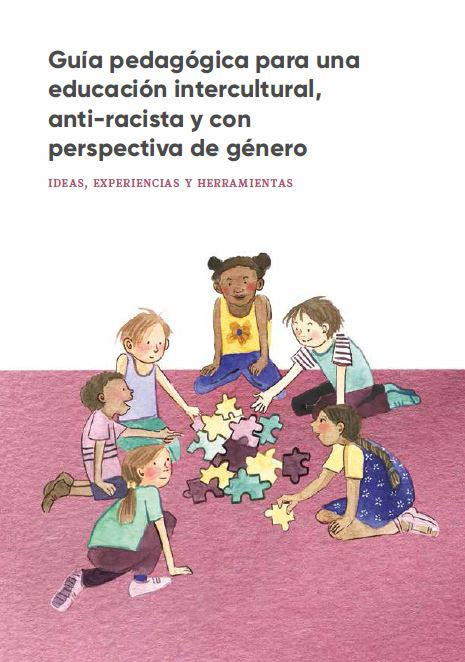 Pedagogical Guide for an Intercultural, Anti-racist and Gender Perspective Education: Ideas, Experiences and Tools 발행 연도: 2017 저자: Carolina Stefoni | Andrea Riedemann | Fernanda Stang | Andrea Guerrero | Antonia Garcés | Marta Camarena 단체 저자: Programa Interdisciplinario de Estudios Migratorios (PRIEM) | Universidad Alberto Hurtado | Fundación para la Superación de la Pobreza (FUSUPO) The main purpose of this Guide is, then, to share some ideas, tools and experiences that can help build and walk the path towards an intercultural, anti-racist and gender perspective education in various educational spaces. It is directed primarily - though not exclusively, of course - to all those people who are part of formal and informal teaching-learning processes. It is important to emphasize that the Guide does not pretend to be a recipe for a mechanical application, but a tool box that each educational community can use considering its specific context, its particular needs and its potentialities. Guía pedagógica para una educación intercultural, anti-racista y con perspectiva de género: ideas, experiencias y herramientas 발행 연도: 2017 저자: Carolina Stefoni | Andrea Riedemann | Fernanda Stang | Andrea Guerrero | Antonia Garcés | Marta Camarena 단체 저자: Programa Interdisciplinario de Estudios Migratorios (PRIEM) | Universidad Alberto Hurtado | Fundación para la Superación de la Pobreza (FUSUPO) El propósito principal de esta Guía es, entonces, compartir algunas ideas, herramientas y experiencias que puedan ayudar a construir y andar el camino hacia una educación intercultural, anti-racista y con perspectiva de género en diversos espacios educativos. Está dirigida principalmente -aunque no de manera exclusiva, por supuesto- a todas aquellas personas que sean parte de procesos de enseñanza-aprendizaje formales e informales. Es importante enfatizar que la Guía no pretende ser un recetario para una aplicación mecánica, sino una caja de herramientas que cada comunidad educativa puede usar considerando su contexto específico, sus necesidades particulares y sus potencialidades. Multicultural Education between Theoretical Modeling and Problematic Practices: A Comparative Study between Egypt, France, and Japan 발행 연도: 2006 저자: Ahmed Aidrous | Mohammed Awad 단체 저자: Zagazig University This paper focuses on studying multiculturalism as a concept, theories, frameworks and associated applied models. The study reviews the experience of France, Japan and Egypt, and makes comparisons between them. The study ends with a proposed vision for multicultural education in light of the experiences presented.
 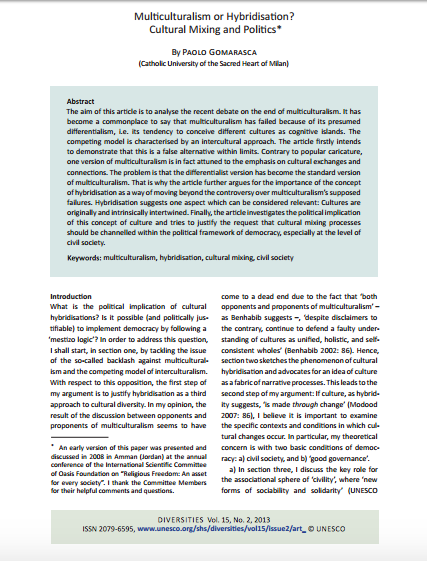 Multiculturalism or Hybridisation?: Cultural Mixing and Politics 발행 연도: 2013 저자: Paolo Gomarasca The aim of this article is to analyse the recent debate on the end of multiculturalism. It has become a commonplace to say that multiculturalism has failed because of its presumed differentialism, i.e. its tendency to conceive different cultures as cognitive islands. The competing model is characterised by an intercultural approach. The article firstly intends to demonstrate that this is a false alternative within limits. Contrary to popular caricature, one version of multiculturalism is in fact attuned to the emphasis on cultural exchanges and connections. The problem is that the differentialist version has become the standard version of multiculturalism. That is why the article further argues for the importance of the concept of hybridisation as a way of moving beyond the controversy over multiculturalism’s supposed failures. Hybridisation suggests one aspect which can be considered relevant: Cultures are originally and intrinsically intertwined. Finally, the article investigates the political implication of this concept of culture and tries to justify the request that cultural mixing processes should be channelled within the political framework of democracy, especially at the level of civil society.
 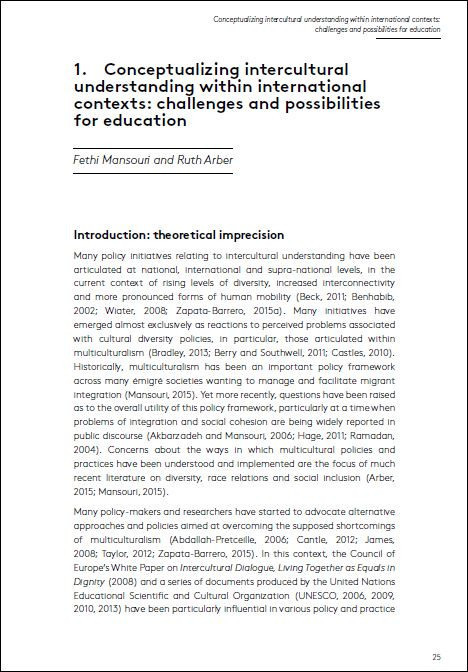 Conceptualizing Intercultural Understanding within International Contexts: Challenges and Possibilities for Education 발행 연도: 2017 저자: Fethi Mansouri, Ruth Arber 단체 저자: UNESCO This chapter interrogates the ways in which intercultural conception has been defined in diverse contexts, providing the framing context for policy and curriculum measures to work with the manifestations of global population movement, diversity and change. It asks questions the ways in which conversations about intercultural understanding can be broadened to consider how entrenched systemic inequalities, the underlying notional and institutional frameworks that support them, and the mono-cultural and specific privileges and oppression, which are so often their enduring outcome, can be dismantled. To that end, it examines how policy and notional and practical work, in relation to intercultural understanding, can better encompass structural and cultural change regarding the ways in which cross cultural encounters and intercultural relations are shaped and take place.