
자료
세계시민교육에 대한 이해를 넓히고 연구, 옹호 활동, 교수, 학습 등을 향상시킬 수 있는 다양하고 유용한 자료를 찾아보세요.
10 건의 결과가 검색되었습니다
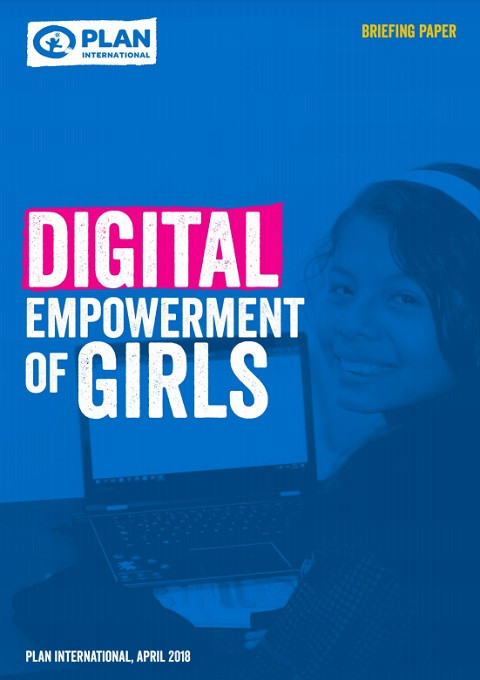 Digital Empowerment of Girls 발행 연도: 2018 단체 저자: Plan International Despite the accumulated efforts and commitments of the past 20 years, today’s women and girls continue to face gender-based barriers that prevent them from accessing and utilising technology and digital tools at the same level as boys and men.Girls are 5 times less likely to consider a career in tech than boys.Equality of education is essential to redress the digital gender gap – which is sadly growing – but it’s not the only method.We must make tech safe, affordable and accessible to girls – wherever they live. We must tackle the ingrained gender norms that prevent girls from seeing digital roles as accessible career paths.Rather than making assumptions about what girls want and need from technology, we must work with them to create solutions for the issues that affect them by enabling them to learn digital skills.Technology can be a powerful tool for girls’ voices to become even louder and reach even further.This briefing paper provides recommendations for closing the digital gender gap that will enable girls to participate in and contribute to our increasingly digital future.Despite the accumulated efforts and commitments of the past 20 years, today’s women and girls continue to face gender-based barriers that prevent them from accessing and utilising technology and digital tools at the same level as boys and men.Promoting girls’ digital literacy and closing the digital gender gap will play an important role in achieving gender equality and promoting the rights of girls and women worldwide.Plan International strives to build a world in which girls have the tools and the power to shape their own futures and influence decision making and policy processes at local and global levels. Technology is not a prerequisite for being a change agent or a leader, but it can be a powerful tool for girls’ voices to become even louder and reach even further. Similarly, social media can be used as a vehicle to spread inspirational stories of female leaders and connect activists and changemakers across the world.Digital technologies have a strong potential to empower girls and women economically and socially. Girls feel safer and more connected when they have a mobile phone, and they use mobile phones to save time and money and access educational opportunities. Yet girls and women are, on average, less likely than men to own a mobile phone, use mobile data, social media apps or SMS. There is also a stark gender disparity in access to the Internet, which limits the ability of girls and women to benefit from many innovations of the digital economy, such as digital payments and mobile money. The gender disparity in access to technology is compounded by a significant gender divide in terms of career and academic aspirations related to ICTs.Advancing digital equality for girlsThis briefing paper argues that promoting girls’ digital literacy and closing the digital gender gap will play an important role in achieving gender equality and promoting the rights of girls and women worldwide. Indeed, bridging the digital gender divide is essential in ensuring girls and women are not left behind in an increasingly digital future.The paper also argues that actions promoting girls’ digital empowerment should be guided by the principle of engaging girls and women as active, capable partners in our work, not merely passive recipients or targets. Rather than making assumptions about what girls want and need from technology, it is important to work together with girls to strengthen and develop their use and creation of technology and digital tools. Empoderamiento digital de las niñas 발행 연도: 2018 단체 저자: Plan International Este documento informativo argumenta que mediante la promoción de la alfabetización digital de las niñas y el cierre de la brecha digital de género se podrá conseguir importantes logros con respecto a la igualdad de género y la promoción de los derechos de las niñas y mujeres en todo el mundo.
 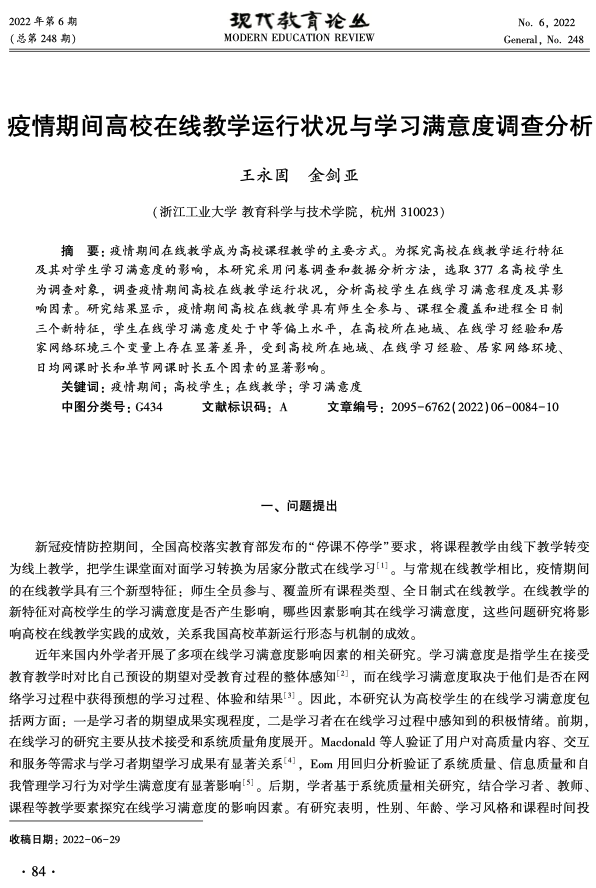 疫情期间高校在线教学运行状况与学习满意度调查分析 발행 연도: 2022 저자: 王永固 | 金剑亚 疫情期间在线教学成为高校课程教学的主要方式。为探究高校在线教学运行特征及其对学生学习满意度的影响,本研究采用问卷调查和数据分析方法,选取377名高校学生为调查对象,调查疫情期间高校在线教学运行状况,分析高校学生在线学习满意程度及其影响因素。研究结果显示,疫情期间高校在线教学具有师生全参与、课程全覆盖和进程全日制三个新特征,学生在线学习满意度处于中等偏上水平,在高校所在地域、在线学习经验和居家网络环境三个变量上存在显著差异,受到高校所在地域、在线学习经验、居家网络环境、日均网课时长和单节网课时长五个因素的显著影响。
  ICT융합교육 글로벌 동향: 초·중등교육 글로벌 동향 (2020년 5호 통권 128호) 발행 연도: 2020 저자: 김민 | 이민주 | 윤환선 단체 저자: 한국교육학술정보원 이 자료는 코로나 19로 인한 학교 폐쇄와 재개에 대한 글로벌동향과 사례를 미주, 유럽, 아시아 등 각 지역별로 나누어 정리하고 학교 재개에 대하여 국제기구가 제시하는 프레임 워크에 대해서 설명하고 있다. 또한 코로나 19에 대응하는 교육대책으로 ICT를 활용한 온라인 교육과 원격 수업에 대한 방안과 현황을 제시한다.
  Responding to Covid-19: Online Classes in Korea - A Challenge Toward the Future of Education 발행 연도: 2020 단체 저자: Korea R. Ministry of Education Korea is effectively responding to the outbreak of COVID-19 by adopting a whole-of-government approach, under the leadership of the Central Disaster and Safety Countermeasures Headquarters to prevent and contain the pandemic with the principle of “openness, transparency and democratic process.” The nationwide introduction of the online classes to respond to COVID-19 was a huge challenge and a path that we have never trodden before. The Ministry of Education of the Republic of Korea introduced Korean education with the world in response to COVID-19 and shared experiences and challenges of distance learning and online education. COVID-19 is a universal challenge which requires joint response, and the global community should be committed to strong solidarity and close cooperation to overcome this crisis and take a leap forward to a brighter future. 코로나19 대응: 한국의 온라인개학 - 미래교육을 위한 도전 발행 연도: 2020 단체 저자: Korea R. Ministry of Education 대한민국 교육부가 한국의 온라인 개학을 통한 교육분야의 코로나19 대응을 해외에 소개하고 경험을 공유하기 위해 발간한 자료로 원격교육과 온라인 교육의 사례와 미래교육이 당면한 도전과제에 대해서 다루고 있다. 코로나19는 세계가 함께 극복해 나가야 할 공동 과제로서 모든 국가가 상호 연대와 협력을 통해 난관을 극복하고 도약할 수 있을 것이라고 전망한다.
 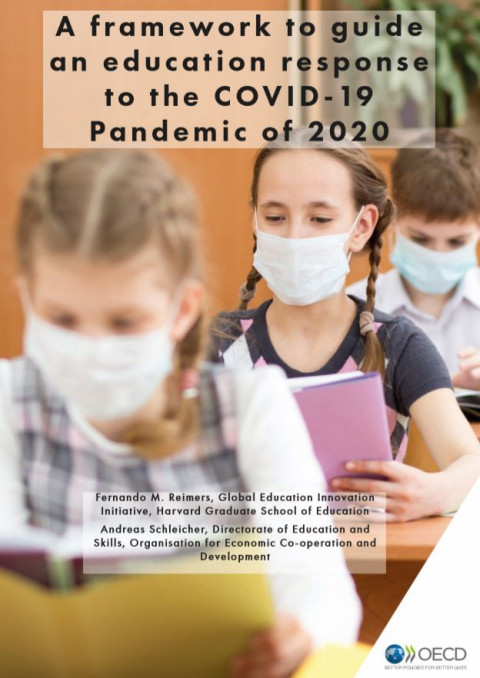 A Framework to Guide an Education Response to the COVID-19 Pandemic of 2020 발행 연도: 2020 저자: Fernando Reimers | Andreas Schleicher 단체 저자: Organisation for Economic Co-operation and Development (OECD) This report aims at supporting education decision making to develop and implement effective education responses to the COVID-19 Pandemic. The report explains why the necessary social isolation measures will disrupt school-based education for several months in most countries around the world. Absent an intentional and effective strategy to protect opportunity to learn during this period, this disruption will cause severe learning losses for students.The report proposes that leaders of education systems and organizations develop plans for the continuation of education through alternate modalities, during the period of necessary social isolation. It offers a framework of areas to be covered by such plans. Un cadre pour guider une réponse éducative à la Covid-19 en cas de pandémie de 2020 발행 연도: 2020 저자: Fernando Reimers | Andreas Schleicher 단체 저자: Organisation for Economic Co-operation and Development (OECD) Ce rapport vise à appuyer la décision de l'éducation faisant de développer et mettre en œuvre des réponses éducatives efficaces au Covid-19 en cas de pandémie. Le rapport explique pourquoi les mesures d'isolement social nécessaires perturberont l'éducation en milieu scolaire pendant plusieurs mois dans la plupart des pays à travers le monde. En l'absence d'une stratégie délibérée et efficace pour protéger l'occasion d'apprendre au cours de cette période, cette perturbation entraîne des pertes sévères d'apprentissage pour les étudiants.Le rapport propose que les dirigeants des systèmes d'éducation et les organisations à élaborer des plans pour la poursuite de l'éducation des modalités alternatives, au cours de la période d'isolement social nécessaire. Il offre un cadre de zones à couvrir par ces plans.
 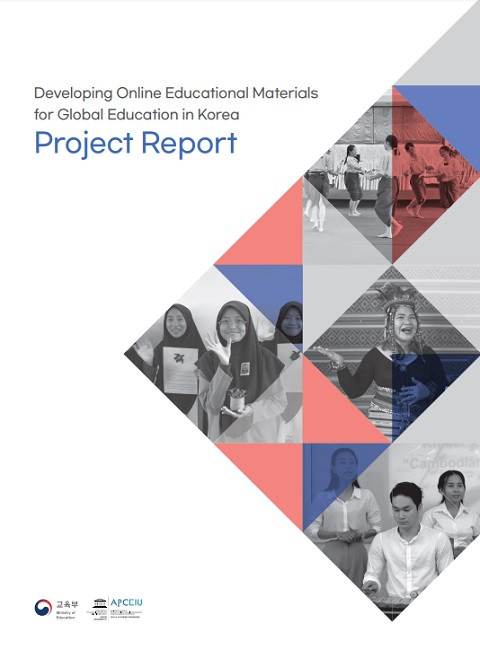 Developing Online Educational Materials for Global Education in Korea: Project Report 발행 연도: 2020 단체 저자: APCEIU | Korea R. Ministry of Education This project aims to enhance the intercultural understanding of Korean teachers and students by utilizing global education and Global Citizenship Education(GCED) materials produced by partner countries’ teachers. Simultaneously, for the teachers from partner countries, the project is expected to enhance their educational competency, global competency, and online teaching competency required in this pandemic era. The project also aims to establish an online teaching and learning model by using online educational materials in Korean classrooms and accumulate and expand educational achievements in response to the spread of online exchange.
  National Distance Learning Programmes in Response to the COVID-19 Education Disruption: Case Study of the Republic of Korea 발행 연도: 2022 단체 저자: UNESCO This document is one of several case studies on national distance learning programmes in response to the COVID-19 education disruptions. The case of the Republic of Korea was drawn from the 2020 edition of Mobile Learning Week, organized online in October 2020 under the theme of 'Beyond Disruption: Technology Enabled Learning Futures'. Envisaged to be a continuously enriched mechanism for knowledge sharing and dissemination, the case studies aim to surface best practices worldwide in leveraging digital technology to build inclusive and crisis-resilient learning systems, and to inform the planning of digital transformation of education towards SDG 4 and the futures of learning. Each case study documents governance and funding mechanisms, needs-driven planning of distance learning solutions, evaluation of digital learning’s effects on mitigating disruptions and ensuring inclusion, and pedagogical innovations to maintain or improve the quality of learning.