
자료
세계시민교육에 대한 이해를 넓히고 연구, 옹호 활동, 교수, 학습 등을 향상시킬 수 있는 다양하고 유용한 자료를 찾아보세요.
96 건의 결과가 검색되었습니다
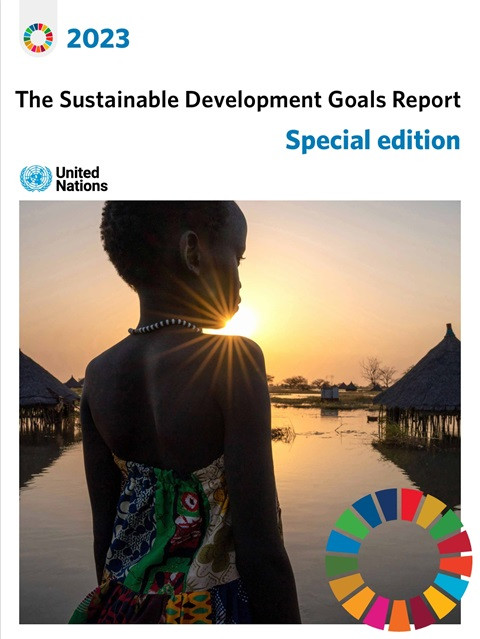 The Sustainable Development Goals Report 2023: Special Edition 발행 연도: 2023 단체 저자: UN. Department of Economic and Social Affairs (UN. DESA) The annual report, a joint effort of the global statistical community, was launched during the UN High-level Political Forum on Sustainable Development as leaders from governments and different sectors of society gathered to chart strategies and efforts to fully implement the SDGs. The report provides essential data that allows decision-makers to guide efforts toward a sustainable recovery.
  Teachers Guide on the SDGs 발행 연도: 2022 단체 저자: United Nations (UN) This teaching guide, aimed at grade level K-12, gives an introduction and historical background to the SDGs. Key questions along with primary resources are provided to facilitate comprehension and engage students critically. Through analysis of the Preamble to the 2030 Agenda for Sustainable Development, the connection will be made to the Millenium Development Goals and Human Rights, to demonstrate continuity and evolution of certain principle values held by the international community. Focus then shifts to SDG 4, quality education, so that students can ore clearly analyze the progress that has been made regarding this topic on a micro level.
 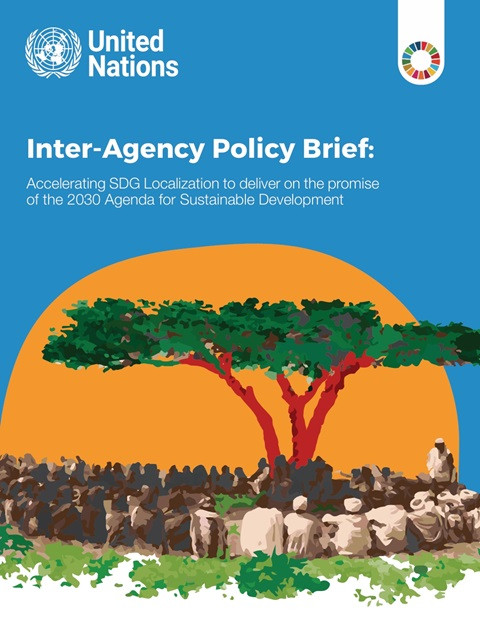 Inter-Agency Policy Brief: Accelerating SDG Localization to Deliver on the Promise of the 2030 Agenda for Sustainable Development 발행 연도: 2024 단체 저자: United Nations Centre for Human Settlement Programme (UN Habitat) | UN. Department of Economic and Social Affairs (UN. DESA) | United Nations Development Programme (UNDP) SDG localization is the process of adapting and customizing the SDGs and translating them into local development plans and strategies that fit the needs, context, and priorities of a particular region or locality, in coherence with national frameworks. It means placing local communities at the center of sustainable development and anchoring development action on the principles of inclusion, partnership, and multilevel governance, with adequate data and financing availability at the local level. This inter-agency policy brief examines the critical role of local and regional governments in accelerating achievement of the 2030 Agenda and provides policy recommendations to help advance the essential work of localizing SDG action. This policy brief was prepared by UNDESA, UN Habitat and UNDP in close collaboration with the Global Taskforce of Local and Regional Governments and United Cities and Local Governments, with input from the United Nations Regional Commissions: UNECA, UNECE, UNECLAC, UNESCAP, and UNESCWA.
 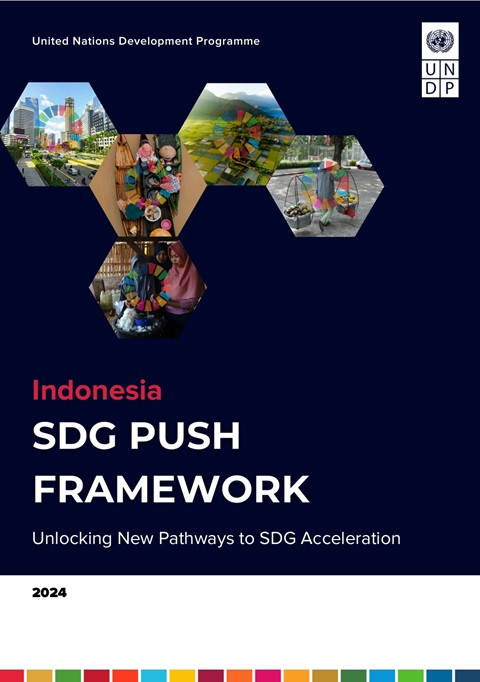 Indonesia SDG Push Framework: Unlocking New Pathways to SDG Acceleration 발행 연도: 2024 단체 저자: United Nations Development Programme (UNDP) SDG Push is about realizing development ambition and redefining how we build acceleration pathways. It helps pinpoint policy choices that ‘move the needle’ towards the achievement of the Sustainable Development Goals. A UNDP flagship initiative, SDG Push uses digital and data innovation, systems thinking, and futures approaches to provide a comprehensive and country-specific tool to plan and implement SDG breakthroughs in a variety of development contexts. SDG Acceleration Pathways, specific to context and need, were co-created in collaboration with Indonesia, Moldova, Namibia, Peru and South Africa. These pilots helped to refine the SDG Push approach and the digital SDG Push Diagnostic and formed the foundation of the Integrated SDG Insights Reports, presented at the 2023 SDG Summit. This integrated, modular approach includes the analysis of development trends and priorities with data visualization, integrating generative dialogue, foresight methods and economic modelling to assess the impact of potential accelerators.
  NISSEM Global Briefs (Volume II): Educating for the Social, the Emotional and the Sustainable; Pedagogy, Practice and Materials 발행 연도: 2020 저자: Andy Smart | Margaret Sinclair 단체 저자: Networking to Integrate SDG Target 4.7 and SEL skills into Educational Materials (NISSEM) The timeframe for achieving the Sustainable Development Goals (SDGs) is tight, and the world also faces the consequences of Covid-19. NISSEM Global Briefs aim to show how SDG Target 4.7 themes and social and emotional learning (SEL) can be embedded in education policies, programs, curricula, materials, and practice, to help make progress towards sustainable development.
  The 29th Arab Scout Conference 발행 연도: 2019 단체 저자: Arab Scout Organization The conference book reviews scouting and the sustainable development goals. The book deals with a range of issues in the field of Scouting and its role in achieving the Sustainable Development Goals. الموؤتمر الكشفي العربي ال 29 발행 연도: 2019 단체 저자: Arab Scout Organization يستعرض كتاب المؤتمر الكشفية وأهداف التنمية المستدامة. ويعالج الكتاب مجموعة من القضايا في مجال الكشفية ودورها في تحقيق أهداف التنمية المستدامة.
  Reimagining Life Skills and Citizenship Education in the Middle East and North Africa: A Four-Dimensional and Systems Approach to 21st Century Skills; Conceptual and Programmatic Framework 발행 연도: 2017 단체 저자: UNICEF Middle East and North Africa The situation of learning in MENA calls for a holistic, lifelong and rights-based vision of education that maximizes the potential of all children and youth in the region and better equips them to create meaning out of knowledge and to face the transitions from childhood to adulthood, from education to work, and from unreflective development to responsible and active citizenship. This is what drives the MENA Life Skills and Citizenship Education (LSCE) Initiative, kicked off in 2015 with the aim of supporting the countries of the region – conceptually, programmatically and technically – to improve learning and to better invest such learning in individual, social and economic development.The LSCE Conceptual and Programmatic Framework (CPF) puts forth a roadmap to guide policies, strategies and programmes on life skills and citizenship education supporting the region-wide efforts to provide children and youth with opportunities to learn, transition from childhood to adulthood, move from school to work settings, and become responsible and active citizens of their communities.A set of twelve core life skills for MENA has been identified using the four-dimensional learning model: ‘Learning to Know’ (Cognitive Dimension), ‘Learning to Do’ (Instrumental Dimension), ‘Learning to Be’ (Individual Dimension), and ‘Learning to Live Together’ (Social Dimension). The twelve core life skills are life-long, and they build on evidence that underlines the importance of skills acquisition from an early age. Furthermore, the twelve core life skills are acquired and sustained through all forms of learning in a systems approach that recognizes multiple pathways of learning, formal, non-formal and informal. Réimaginer l’éducation aux compétences de vie et à la citoyenneté au Moyen-Orient et en Afrique du Nord : Une approche à quatre dimensions et systémique des compétences pour le XXIe siècle ; Cadre programmatique et conceptuel 발행 연도: 2017 단체 저자: UNICEF Middle East and North Africa L’Initiative pour l’éducation aux compétences de vie et à la citoyenneté de la région MENA (LSCE) représente un effort de collaboration étatique et régional en faveur de la réalisation de l’objectif de développement durable (ODD) 4 – Assurer l’accès de tous à une éducation de qualité, sur un pied d’égalité, et promouvoir les possibilités d’apprentissage tout au long de la vie. Elle cherche à reformuler la compréhension traditionnelle de l’éducation aux compétences de vie et à la citoyenneté dans la région, tout en rappelant les questions fondamentales au sujet du but et du rôle de l’éducation dans le développement sociétal qui sont pertinentes dans le contexte actuel.L’Initiative LSCE se concentre sur trois défis interdépendants :Une société du savoir inaccessible, résultat de la mauvaise qualité de l’éducation, du bas niveau des résultats scolaires et d’une équité et inclusion limitées.Une croissance économique en déclin, résultat d’un manque d’aptitudes à l’employabilité, du haut taux de chômage chez les jeunes, de l’inégalité des sexes face à l’accès au marché du travail, du manque de création d’emplois, et d’un environnement économique faible.Une faible cohésion sociale, résultat de l’escalade de la violence et de la radicalisation tout autant que d’un faible engagement civique.
  Global Learning in Subject Teaching: Framework and Toolkit 발행 연도: 2020 단체 저자: Center for Citizenship Education (CCE) | Global Issues, Global Subjects (GIGS) The brochure 'Global Learning in Subject Teaching: Framework and Toolkit' has been developed as a proposal for teachers, educators and educational institutions on how to reach pupils with Global Learning. In its practical part, the brochure provides the reader with a toolkit of 20 ready-to-use lesson plans for subject lessons where the subject curriculum topics are linked with global issues such as migration, climate change and gender equality.