
자료
세계시민교육에 대한 이해를 넓히고 연구, 옹호 활동, 교수, 학습 등을 향상시킬 수 있는 다양하고 유용한 자료를 찾아보세요.
5 건의 결과가 검색되었습니다
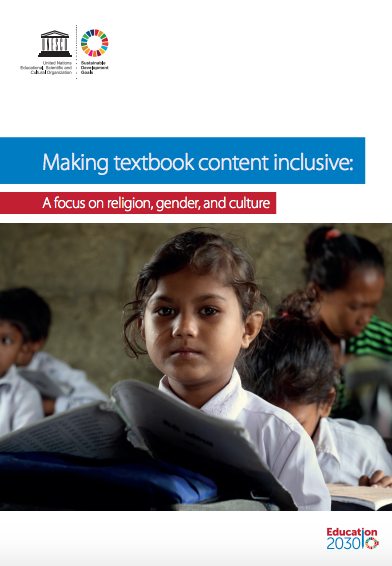 Making Textbook Content Inclusive: A Focus on Religion, Gender, and Culture 발행 연도: 2017 단체 저자: UNESCO UNESCO has been working on textbook development issues since its inception in 1945 as part of its fundamental mandate to “build peace in the minds of men and women.” The present guide’s primary task is to enable its users to address and counter stereotypes in a variety of educational contexts, through teaching and learning materials. The three key issues – religion, gender and culture – were chosen for their common link to the concept of human diversity. These three potentially controversial topics are important aspects of inclusive education because they help shape the learning environment of a school as well as its educational practices.The guide was intentionally written in a simple, practical style so as to be immediately accessible to textbook developers, adopters, and users, even those who are working on their own. Although it is designed primarily for textbook authors, curriculum developers, and teachers, it might also be particularly useful for publishers, political stakeholders, and teacher educators. Pour des manuels scolaires au contenu inclusif 발행 연도: 2017 단체 저자: UNESCO UNESCO has been working on textbook development issues since its inception in 1945 as part of its fundamental mandate to “build peace in the minds of men and women.” The present guide’s primary task is to enable its users to address and counter stereotypes in a variety of educational contexts, through teaching and learning materials. The three key issues – religion, gender and culture – were chosen for their common link to the concept of human diversity. These three potentially controversial topics are important aspects of inclusive education because they help shape the learning environment of a school as well as its educational practices.The guide was intentionally written in a simple, practical style so as to be immediately accessible to textbook developers, adopters, and users, even those who are working on their own. Although it is designed primarily for textbook authors, curriculum developers, and teachers, it might also be particularly useful for publishers, political stakeholders, and teacher educators.
  Unmasking Racism: Guidelines for Educational Materials 발행 연도: 2024 단체 저자: UNESCO These Guidelines developed by UNESCO provide recommendations on how to combat racism in textbooks and to develop learning materials that are free of prejudice and bias and do not perpetuate stereotypes or legitimize unequal social structures. Through a comprehensive analysis of recent studies of textbooks and other educational materials, the guide also demonstrates how countries around the world address racism and racialization. It increases awareness and improves our understanding of how racism manifests in educational materials, and aims to support education stakeholders to promote just, peaceful and multicultural societies.
  The Representation of Jews, Judaism and Antisemitism in School Textbooks and Curricula in Europe 발행 연도: 2025 단체 저자: UNESCO Jewish communities have been integral to Europe’s social fabric for centuries, preserving rich religious and cultural traditions while facing recurring periods of exclusion, persecution, and resilience. School textbooks are important vantage points to understand how this history and heritage is represented, (de)constructed and embedded into a shared historical and cultural memory. They are also important practical tools used daily by students, teachers, and parents.This comprehensive research, carried out by UNESCO in collaboration with the Georg-Eckert-Institute and supported by funding from the European Commission, examines the ways in which Jewish culture, history, life, and anti-Jewish prejudice are represented in secondary school materials across eight European nations.The publication highlights opportunities within curricula to address Jewish experiences and antisemitism, reviews how these themes are incorporated into textbooks, and analyzes the narratives and portrayals that arise. The study also looks at the use of visual sources and assesses whether Jewish viewpoints and agency are sufficiently reflected. The findings highlight both recurring stereotypes and promising practices. By showcasing these contrasts, the study provides targeted recommendations to guide the creation of more inclusive educational materials.
 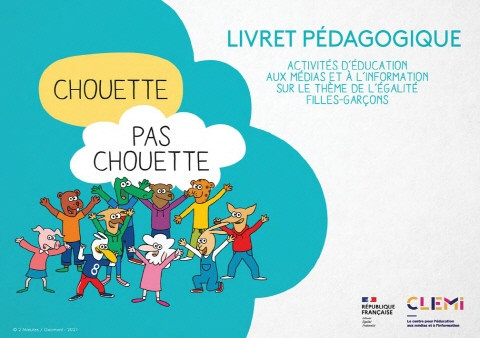 Chouette, pas chouette, déconstrure les stéréotypes sexistes, ça s'apprend ! 발행 연도: 2021 저자: Anne Lechaudel | Séverine Poncet-Ollivier | Séverin Ledru-Milon 단체 저자: Centre pour l’éducation aux médias et à l’information (CLEMI) Ce livret propose des activités pédagogiques sur le thème de l’égalité filles/garçons, pour apprendre à questionner et déconstruire les stéréotypes sexistes.Il est réalisé dans l’univers graphique et avec les personnages de la série Chouette, pas chouette ! une série de 16 programmes courts animés pour sensibiliser les 4-6 ans aux stéréotypes sexistes. Les activités proposées dans le livret permettent de soutenir l’expression des élèves, d’aborder le quotidien des relations filles - garçons, et plus largement du vivre-ensemble, de manière concrète et créative. Trois entrées thématiques par niveau et des pistes d’activités adaptées en éducation aux médias et à l’information sont proposées:- L’apparence. « À quoi doit ressembler une fille ou un garçon ? » (cycle 1, 4-5 ans)- Le comportement. « Fais-le comme une fille, comme un garçon » (cycle 2, 6-7-8 ans)- Le devenir et les désirs d’orientation. C ’est quoi un "métier de femme", un "métier d’homme" ? (cycle 3, 9-10 ans)Des épisodes de la série « Chouette, pas chouette ! » ont été identifiés pour chacune des entrées thématiques.Le livret est accompagné de ressources pédagogiques pour aller plus loin. This booklet offers educational activities on the theme of equality between girls and boys, to help children question and deconstruct sexist stereotypes.It is based on the graphics and characters of Chouette, pas chouette! a series of 16 short animated programs designed to raise awareness of sexist stereotypes among 4-6 year-olds. The activities in the booklet are designed to support pupils' self-expression, and address the day-to-day issues of boy-girl relationships and, more broadly, living together, in a concrete, creative way. The booklet features three thematic entries for each grade level, along with suggestions for activities adapted to media and information literacy:- Appearance. "What should a boy or a girl look like?" (cycle 1, 4-5 years old)- Behavior. "Do it like a girl, do it like a boy" (cycle 2 6-7-8 years old)- Becoming and career aspirations. What's a "woman's job", what's a "man's job"? (cycle 3, 9-10 years old)Episodes from the "Chouette, pas chouette!" series have been identified for each of these themes.The booklet is accompanied by teaching resources for further reading.