
자료
세계시민교육에 대한 이해를 넓히고 연구, 옹호 활동, 교수, 학습 등을 향상시킬 수 있는 다양하고 유용한 자료를 찾아보세요.
191 건의 결과가 검색되었습니다
 Paris Agreement 발행 연도: 2015 단체 저자: United Nations (UN) The Paris Agreement is a legally binding international treaty on climate change. It was adopted by 196 Parties at the UN Climate Change Conference (COP21) in Paris, France, on 12 December 2015. It entered into force on 4 November 2016.Its overarching goal is to hold “the increase in the global average temperature to well below 2°C above pre-industrial levels” and pursue efforts “to limit the temperature increase to 1.5°C above pre-industrial levels.” 巴黎协定 발행 연도: 2015 단체 저자: United Nations (UN) 《巴黎协定》是一项具有法律约束力的气候变化国际条约。2015年12月12日,该协定在巴黎举行的《联合国气候变化框架公约》第二十一次缔约方会议上获得196个缔约方通过,并于2016年11月4日生效。其目标是将全球气温升幅控制在工业化前水平以上低于2℃,最好是1.5℃之内。
 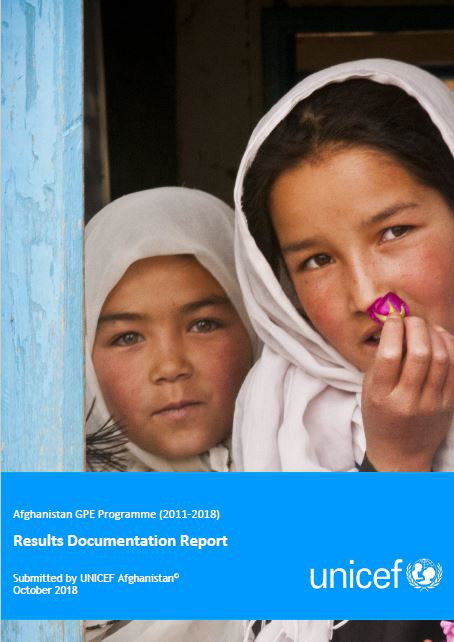 2018 grant completion report. Afghanistan 발행 연도: 2019 단체 저자: UNICEF Afghanistan This is the completion report of GPE’s program in Afghanistan, which ran from 2012 to 2018. Overall, it appears education access and equity has been improved in target districts, and some of these effects promise to persist beyond the program period.Community engagement in schooling has also improved, as well as school performance. Target schools have safer and more conducive learning environments for children, and monitoring of education pathways has also improved.Schools have been reopened, and numbers of female teachers in target areas have grown. Finally, the Ministry of Education and national education sectors have seen advances in institutional capacity, and national aid coordination mechanisms also seem to have improved.
  Integrating sustainable development in technical and vocational education and training: six case studies from Southern and Eastern Africa 발행 연도: 2010 저자: Roland Dubois | Koontee Balgobin | Modesto Sylvester Gomani | Joy Kasandi Kelemba | Gabriel S. Konayuma | Matthews Lebogang Phiri | John W. Simiyu 단체 저자: UNESCO International Centre for Technical and Vocational Education and Training (UNEVOC) The case studies in Southern and Eastern Africa were commissioned in Botswana, Kenya, Malawi, Mauritius and Zambia. They were carried out by writers connected with the UNEVOC Network as part of capacity building and of contributing to knowledge building and sharing. They have described and have analysed experiences, practices relating to integrating ESD in TVET programmes, primarily. Also, they have identified gaps for additional action so that the integration can be satisfactorily done. Through the case studies it is intended to build a pool of resources and tools of what works as part of the UNESCO-UNEVOC International Centre’s clearinghouse. Repositioning and reconceptualizing the curriculum for the effective realization of Sustainable Development Goal Four, for holistic development and sustainable ways of living 발행 연도: 2015 단체 저자: UNESCO International Bureau of Education (IBE) The purpose of this discussion paper is two-fold, it is to reposition curriculum at the center of the national and the global development dialogue and to highlight its power to give effect to national and to global aspirational statements on the role of education in holistic development. When well designed and effectively enacted, curriculum determines the quality, inclusiveness and development-relevance of education.Second, is to reconceptualize curriculum as a fundamental force of integration of education systems and as an operational tool for giving effect to policies on lifelong learning. Curriculum leads all core aspects of education that are known to determine quality, inclusion, and relevance such as content, learning, teaching, assessment and the teaching and learning environments among others. Its horizontal and vertical articulation, as well as its articulation across learning settings is what gives effect to lifelong learning policies.This paper therefore seeks to reposition curriculum as an indispensable tool for giving effect to SDG Goal 4. Education and national sustainable development strategies 발행 연도: 2009 단체 저자: UNESCO Since the Rio Earth Summit in 1992 countries around the world have been developing and implementing National Sustainable Development Strategies (NSDS). Sustainable Development competes with many deeply entrenched values and therefore progress has been slow. Tensions between long term and short term thinking, and between economic growth and social and environmental sustainability, are not easy to resolve. The NSDS process has gained impetus following the 2002 World Summit on Sustainable Development, where it was agreed that countries need to take immediate steps to elaborate and formulate NSDS systems that can continuously improve. The UN Guidance Document describes an NSDS as a comprehensive, adaptable, continuous and long term undertaking that helps a country to achieve economic prosperity and higher levels of social welfare, while at the same time preserving the environment. An NSDS is not just something that can be put together in a document and be promulgated. Development of an NSDS requires multi-stakeholder participation, partnerships, country ownership, shared vision with a commitment to continuous improvement, capacity development and the ability to build on existing knowledge and processes and a clear focus on outcomes. Education is a central dimension of achieving sustainable development, and needs to be incorporated into the NSDS process. Learning is central to the process of NSDS development and implementation.
  Reflections on Progress, Sustainable Development and Global Citizenship 발행 연도: 2013 저자: Georges Haddad 단체 저자: UNESCO The arguments developed in this concise presentation demonstrate that sustainable development, progress and global citizenship, efficiently embedded in the context of the Knowledge Society, undeniably participate in the development of the New Humanism promoted by the Director-General of UNESCO, and which we all agree to consider essential for the wealth and prosperity of Humanity in an agreeable, peaceful and friendly common environment.
  Quality Physical Education (QPE): guidelines for policy makers 발행 연도: 2015 저자: Nancy, McLennan | Jannine, Thompson 단체 저자: UNESCO A key feature of the Post-2015 Development Agenda is sustainable development. Sustainable development starts with safe, healthy, well-educated children. Participation in quality physical education (QPE), as part of a rounded syllabus, enhances young peoples’ civic engagement, decreases violence and negative patterns of behaviour, and improves health awareness. The UNESCO QPE Policy Package is an original piece of work, which draws upon results from extensive global research (including the Worldwide Survey of School Physical Education). These guidelines, designed for global application and local adaptation, provide a means of analysing current policy through practical guidance and a ‘how-to’ approach. The materials have been developed in consultation with key partners including the European Commission, the International Council for Sport Science and Physical Education (ICSSPE), UNDP, UNICEF, UNOSDP and WHO.
 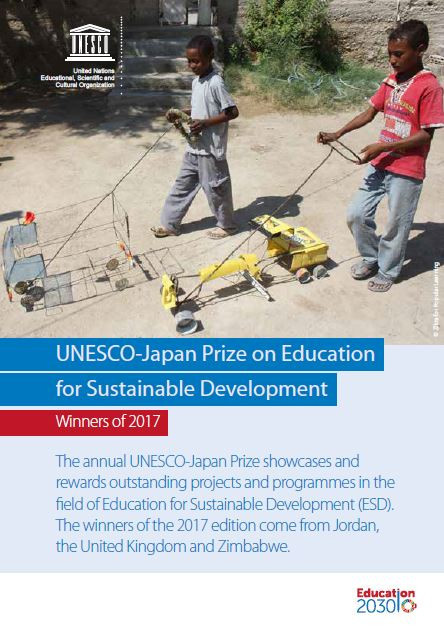 UNESCO-Japan Prize on Education for Sustainable Development: Winners of 2017 발행 연도: 2017 단체 저자: UNESCO The annual UNESCO-Japan Prize showcases and rewards outstanding projects and programmes in the field of Education for Sustainable Development (ESD).The winners of the 2017 edition come from Jordan, the United Kingdom and Zimbabwe.Among this year’s winners are a school, business and a non-profit organization, promoting ESD, respectively, at the local, regional and global level: Sihlengeni Primary School from the Republic of Zimbabwe; the social enterprise Zikra from the Hashemite Kingdom of Jordan; and the Hard Rain Project from the United Kingdom of Great Britain and Northern Ireland. Each of them will receive an award of USD 50,000.The Director-General of UNESCO and the Japanese Minister of Education will award the Prize to the three laureates in a ceremony at UNESCO Headquarters in Paris on 3 November 2017, during the 39th session of the General Conference.
 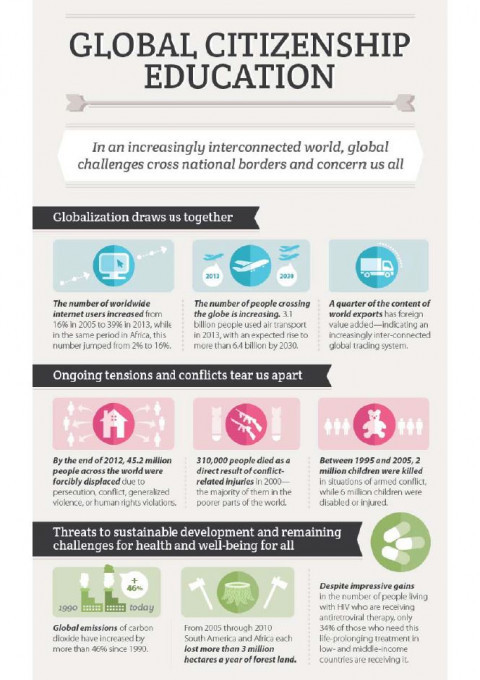 Global Citizenship Education infographic 발행 연도: 2014 단체 저자: UNESCO In an increasingly interconnected world, global challenges cross national borders and concern us all. With issues like these threatening human and environmental well-being, we need to re-think the role and relevance of education. We need Global Citizenship Education. Global Citizenship Education is transformative. What are the barriers to this kind of education? What needs to change in education? What is UNESCO doing? What can you do?