
자료
세계시민교육에 대한 이해를 넓히고 연구, 옹호 활동, 교수, 학습 등을 향상시킬 수 있는 다양하고 유용한 자료를 찾아보세요.
340 건의 결과가 검색되었습니다
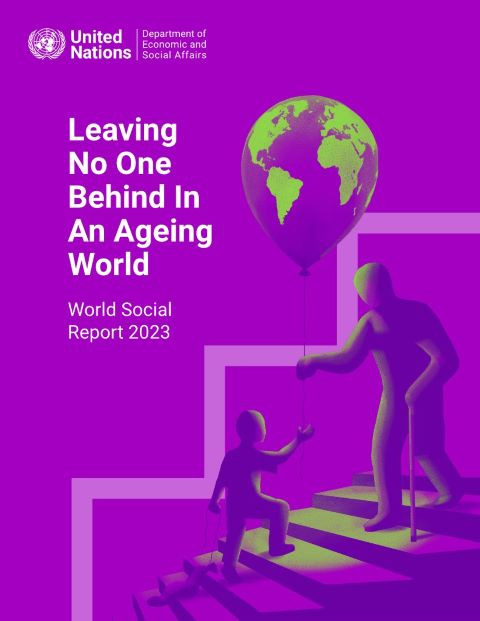 World Social Report 2023 : Leaving No One Behind in an Ageing World 발행 연도: 2023 단체 저자: UN. Department of Economic and Social Affairs (UN. DESA) Population ageing is a defining global trend of our time. People are living longer, and more are older than ever before. Spectacular improvements in health and survival and reductions in fertility have driven this momentous shift, which has begun or is expected to begin soon in all countries and areas. This change brings both challenges and opportunities as countries strive to achieve the Sustainable Development Goals (SDGs). In 2022, the world marked the twentieth anniversary of the adoption of the Madrid International Plan of Action on Ageing. To commemorate this landmark, the World Social Report 2023 explores the economic and social implications of the ageing of the human population. It builds on the Plan of Action’s framework for national policies to create equitable, inclusive societies for people of all ages, providing recommendations to put the rights and well-being of older persons at the centre, across the life course. Population ageing is an inevitable result of the demographic transition towards longer lives and smaller families. While the shift towards older populations is largely irreversible, collective actions and policy decisions shape its path and consequences. Postponing critical measures that allow societies to benefit from and adapt to population ageing would impose high social, economic, fiscal and health-related costs, for both current and future generations. By contrast, with appropriate foresight and planning, Governments can manage the challenges from population ageing while enhancing opportunities for all people to thrive and ensuring that no one is left behind. As elaborated in this report, population ageing needs to be widely understood as more than just a set of discrete concerns mainly for one group of people who have advanced beyond a given age. Ageing touches all parts of economies and societies, from health care and education to employment and taxation. Each stage of life can contribute to or detract from well-being at older ages.
  Education, Development and Citizenship in Latin America: Proposals for the Debate 발행 연도: 2011 저자: Alicia Barcena | Narcis Serra 단체 저자: Naciones Unidas. Comisión Económica para América Latina y el Caribe (CEPAL) | Centro de Estudios y Documentación Internacionales de Barcelona (CIDOB) Through ADI, an initiative promoted by CIDOB, the Ibero-American General Secretariat (SEGIB) and the Economic Commission for Latin America and the Caribbean (ECLAC), with the support of various sponsoring companies, it is intended to encourage academic debate along with the political debate on diverse issues crucial for the region. Through a rigorous analysis of the social, economic and political reality carried out by academics, public policymakers and other key actors in the development process in Latin America, the aim is to offer recommendations that make economic growth compatible with well-being of the majorities. This publication constitutes the fifth volume of the series and is the result of the willingness of the participating institutions to disseminate, as much as possible, the ideas and discussions that emerged in the seminar. Its reading is a fundamental element to understand the current state of education in the region, as well as the possibilities that exist in this area to continue advancing in inclusion and development. Educación, Desarrollo y Ciudadanía en América Latina: Propuestas para el Debate 발행 연도: 2011 저자: Alicia Barcena | Narcis Serra 단체 저자: Naciones Unidas. Comisión Económica para América Latina y el Caribe (CEPAL) | Centro de Estudios y Documentación Internacionales de Barcelona (CIDOB) Mediante la ADI, iniciativa impulsada por CIDOB, la Secretaría General Iberoamericana (SEGIB) y la Comisión Económica para América Latina y el Caribe (CEPAL), con el apoyo de diversas empresas patrocinadoras, se pretende alentar el debate académico junto con el debate político en diversos temas cruciales para la región. A través del análisis riguroso de la realidad social, económica y política realizado por los académicos, los encargados de formular políticas públicas y otros actores clave en el proceso de desarrollo de América Latina, se pretende ofrecer recomendaciones que hagan compatible el crecimiento económico y el bienestar de las mayorías. Esta publicación constituye el quinto volumen de la serie y es fruto de la voluntad de las instituciones participantes de difundir, en la mayor medida posible, las ideas y discusiones surgidas en el seminario. Su lectura supone un elemento fundamental para comprender el estado actual de la educación en la región, así como las posibilidades que existen en este ámbito para seguir avanzando en la inclusión y el desarrollo.
  Le rôle de l'UNESCO pour la décennie des Nations Unies pour l'éducation au service du développement durable (2005-2014): visions et défis 발행 연도: 2006 단체 저자: UNESCO This document elaborates on UNESCO's role in guiding the Decade of Education for Sustainable Development (DESD), its vision and challenges for the DESD. Education and national sustainable development strategies 발행 연도: 2009 단체 저자: UNESCO Since the Rio Earth Summit in 1992 countries around the world have been developing and implementing National Sustainable Development Strategies (NSDS). Sustainable Development competes with many deeply entrenched values and therefore progress has been slow. Tensions between long term and short term thinking, and between economic growth and social and environmental sustainability, are not easy to resolve. The NSDS process has gained impetus following the 2002 World Summit on Sustainable Development, where it was agreed that countries need to take immediate steps to elaborate and formulate NSDS systems that can continuously improve. The UN Guidance Document describes an NSDS as a comprehensive, adaptable, continuous and long term undertaking that helps a country to achieve economic prosperity and higher levels of social welfare, while at the same time preserving the environment. An NSDS is not just something that can be put together in a document and be promulgated. Development of an NSDS requires multi-stakeholder participation, partnerships, country ownership, shared vision with a commitment to continuous improvement, capacity development and the ability to build on existing knowledge and processes and a clear focus on outcomes. Education is a central dimension of achieving sustainable development, and needs to be incorporated into the NSDS process. Learning is central to the process of NSDS development and implementation. Éducation et stratégies nationales de développement durable 발행 연도: 2009 단체 저자: UNESCO Depuis le Sommet de la Terre de Rio en 1992, les pays du monde entier élaborent et mettent en œuvre des Stratégies Nationales de Développement Durable (SNDD). Le développement durable est en concurrence avec de nombreuses valeurs profondément enracinées et les progrès ont donc été lents. Les tensions entre la pensée à long terme et à court terme et entre la croissance économique et la durabilité sociale et environnementale ne sont pas faciles à résoudre. Le processus des SNDD a pris de l'ampleur à la suite du Sommet mondial sur le développement durable de 2002, où il a été convenu que les pays devaient prendre des mesures immédiates pour élaborer et formuler des systèmes de SNDD susceptibles d'être continuellement améliorés. Le Document d'orientation des Nations Unies décrit une SNDD comme une entreprise globale, adaptable, continue et à long terme qui aide un pays à atteindre une prospérité économique et des niveaux supérieurs de bien-être social tout en préservant l'environnement. Une SNDD n'est pas seulement quelque chose qui peut être rassemblée dans un document et être promulguée. Le développement d'une SNDD requiert la participation de plusieurs parties prenantes, des partenariats, l'appropriation par les pays, une vision partagée avec un engagement à l'amélioration continue, le renforcement des capacités et la capacité de s'appuyer sur les connaissances et les processus existants. L'éducation est une dimension centrale de la réalisation du développement durable et doit être intégrée au processus des SNDD. L'apprentissage est au cœur du processus de développement et de mise en œuvre de la SNDD. La contribución de la educación inicial para una sociedad sustentable 발행 연도: 2009 단체 저자: UNESCO This report originates from the international workshop, ‘The Role of Early Childhood Education for a Sustainable Society’, jointly organized in Göteborg, Sweden, by Göteborg University, Chalmers University of Technology and the City of Göteborg, from 2 to 4 May 2007. It was attended by thirty-five participants from sixteen different countries (see ‘List of Participants’). The workshop was a follow-up to the international conference on education for sustainable development, ‘Learning to Change Our World’, held in May 2004, in Göteborg. It was one of four preparatory workshops leading to another international conference on education for sustainable development, to be organized in 2008 or 2009, in the same city. The aim of the four workshops is to discuss promoters and barriers related to learning for sustainability, and to propose recommendations for the upcoming international conference. The present workshop was conceived for the following reasons. First, our societies urgently require new kinds of education that can help prevent further degradation of our planet, and that foster caring and responsible citizens genuinely concerned with and capable of contributing to a just and peaceful world. Second, these new kinds of education must be available to all – not only a handful of people – and take place in various settings, including families and communities. Third, they must begin in early childhood, as the values, attitudes, behaviours and skills acquired in this period may have a long-lasting impact in later life. Thus, early childhood education clearly has an important place in the efforts to bring about sustainable development.
 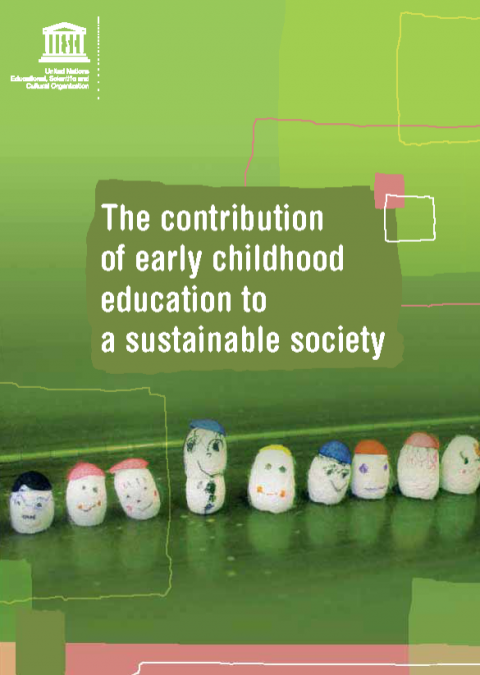 The contribution of early childhood education to a sustainable society 발행 연도: 2008 단체 저자: UNESCO This report originates from the international workshop, ‘The Role of Early Childhood Education for a Sustainable Society’, jointly organized in Göteborg, Sweden, by Göteborg University, Chalmers University of Technology and the City of Göteborg, from 2 to 4 May 2007. It was attended by thirty-five participants from sixteen different countries (see ‘List of Participants’). The workshop was a follow-up to the international conference on education for sustainable development, ‘Learning to Change Our World’, held in May 2004, in Göteborg. It was one of four preparatory workshops leading to another international conference on education for sustainable development, to be organized in 2008 or 2009, in the same city. The aim of the four workshops is to discuss promoters and barriers related to learning for sustainability, and to propose recommendations for the upcoming international conference. The present workshop was conceived for the following reasons. First, our societies urgently require new kinds of education that can help prevent further degradation of our planet, and that foster caring and responsible citizens genuinely concerned with and capable of contributing to a just and peaceful world. Second, these new kinds of education must be available to all – not only a handful of people – and take place in various settings, including families and communities. Third, they must begin in early childhood, as the values, attitudes, behaviours and skills acquired in this period may have a long-lasting impact in later life. Thus, early childhood education clearly has an important place in the efforts to bring about sustainable development. La contribution de l'éducation de la petite enfance à une société durable 발행 연도: 2008 단체 저자: UNESCO Ce rapport provient de l'atelier international, «Le rôle de l'éducation de la petite enfance pour une société durable», organisé conjointement à Göteborg, en Suède, par l'Université de Göteborg, Chalmers University of Technology et la ville de Göteborg, du 2 au 4 mai 2007. Il a réuni trente-cinq participants de seize pays différents (voir «Liste des participants»). L'atelier a été suivi à l'éducation de internationalconférenceon pour le développement durable, «Apprendre à changer notre monde», tenue en mai 2004, à Göteborg. Il était l'un des quatre ateliers préparatoires menant à une autre éducation internationalconférenceon pour le développement durable, qui sera organisée en 2008 ou 2009, dans la même ville. L'objectif des quatre ateliers est de discuter des promoteurs et des obstacles liés à l'apprentissage de la durabilité, et de proposer des recommandations pour la prochaine conférence internationale. Le présent atelier a été conçu pour les raisons suivantes. Tout d'abord, nos sociétés ont un besoin urgent de nouveaux types d'éducation qui peuvent aider à prévenir une nouvelle dégradation de notre planète, et qui favorisent les soins et les citoyens responsables véritablement concernés par et capables de contribuer à un monde juste et pacifique. Deuxièmement, ces nouvelles formes d'éducation doivent être aCECssibles à tous - non seulement une poignée de gens - et se déroulent dans divers milieux, y compris les familles et les communautés. Troisièmement, ils doivent commencer au début de l'enfance, comme les valeurs, les attitudes, les comportements et les compétences acquises dans cette période peuvent avoir un impact durable dans la vie plus tard. Ainsi, l'éducation de la petite enfance a clairement une place importante dans les efforts pour parvenir à un développement durable. Quelques réflexions sur le progrès, le développement durable et la citoyenneté globale 발행 연도: 2013 저자: Georges Haddad 단체 저자: UNESCO The arguments developed in this concise presentation demonstrate that sustainable development, progress and global citizenship, efficiently embedded in the context of the Knowledge Society, undeniably participate in the development of the New Humanism promoted by the Director-General of UNESCO, and which we all agree to consider essential for the wealth and prosperity of Humanity in an agreeable, peaceful and friendly common environment.