
자료
세계시민교육에 대한 이해를 넓히고 연구, 옹호 활동, 교수, 학습 등을 향상시킬 수 있는 다양하고 유용한 자료를 찾아보세요.
139 건의 결과가 검색되었습니다
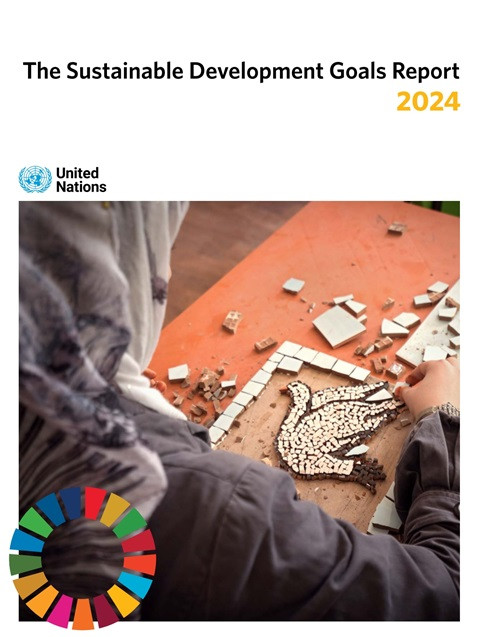 The Sustainable Development Goals Report 2024 발행 연도: 2024 단체 저자: United Nations (UN) The Sustainable Development Goals Report 2024 details the significant challenges the world is facing in making substantial strides towards achieving the SDGs based on the latest data and estimates. It features areas with setbacks while also showcasing where tangible progress has been made, for instance, in reducing global child mortality, preventing HIV infection, and access to energy and mobile broadband. The report also highlights where action must accelerate, particularly in critical areas undermining SDG progress - climate change, peace and security, inequalities among and between countries, among others. According to the report, with just six years remaining, current progress falls far short of what is required to meet the SDGs. Without massive investment and scaled up action, the achievement of the SDGs — the blueprint for a more resilient and prosperous world and the roadmap out of current global crises — will remain elusive. The lingering impacts of the COVID-19 pandemic, escalating conflicts, geopolitical tensions and growing climate chaos have severely hindered progress. The report details the urgent priorities and areas needed for stronger and more effective action to ensure the 2030 promise to end poverty, protect the planet and leave no one behind.
 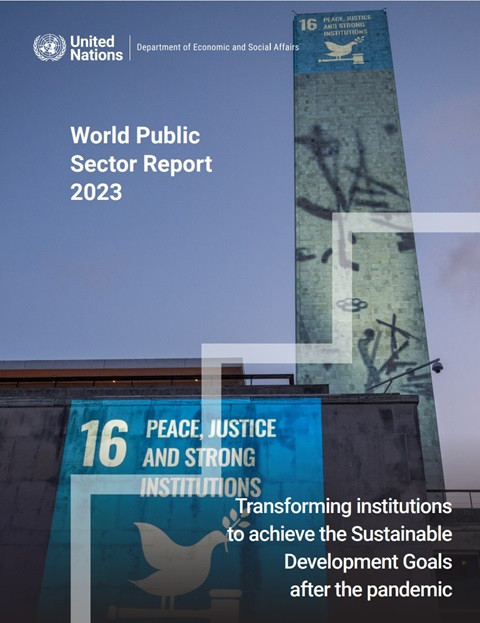 World Public Sector Report 2023: Transforming Institutions to Achieve the Sustainable Development Goals After the Pandemic 발행 연도: 2023 단체 저자: United Nations (UN) The World Public Sector Report 2023 examines the role that national institutional and governance innovations and changes that emerged during the COVID-19 pandemic can play in advancing progress towards the 2030 Agenda for Sustainable Development. The report focuses on three main questions: How can Governments reshape their relationship with people and other actors to enhance trust and promote the changes required for more sustainable and peaceful societies? How can Governments assess competing priorities and address difficult policy trade-offs that have emerged since 2020? What assets and innovations can Governments mobilize to transform the public sector and achieve the SDGs? The report addresses them in chapters composed of short overviews followed by a set of in-depth contributions from a wide range of experts which examine institutional changes observed in different contexts, sectors and policy processes and explore the potential of those with a positive impact on the achievement of the SDGs to be sustained beyond the pandemic. The report aims to draw attention to institutional change as a key component of the societal transformations required to realize the 2030 Agenda for Sustainable Development.
  Including Education in the Pact for the Future: An SDG 4 Youth & Student Network Contribution 발행 연도: 2024 저자: Laeek Siddiqui | Juliette Gudknecht | Daniela Moreno Farfán | Azkha Mikdhar 단체 저자: SDG 4 Youth & Student Network | UNESCO Inclusion is the promise towards a fair and equitable education for all. It is critical to ensuring that every youth and student succeeds. Highlighted by UNESCO in the 2020 Global Education Monitoring Report, striving towards inclusive education is non-negotiable, as education is a human right. With the current challenges of our world highlighted in the 2030 Agenda, specifically in the areas of poverty, armed conflict and digital transformation, inclusion must be an essential imperative in all policies. The Summit of the Future (SOTF) convenes on the 22 to 23 of September at the United Nations Headquarters in New York, United States. One of its outcomes, if inter-governmentally agreed-upon, would be the Pact for the Future. The Pact is action-oriented, including a chapeau followed by 5 chapters: 1) sustainable development and financing for development; 2) international peace and security; 3) science, technology and innovation and digital cooperation; 4) youth and future generations; and 5) transforming global governance. Along with the Pact are two annexures: the Global Digital Compact and the Declaration on Future Generations. This document introduces the advocacy of the SDG 4 Youth & Student Network – a network hosted by the United Nations Educational, Scientific and Cultural Organization (UNESCO) as the Global Education Cooperation Mechanisms Inter-Agency Secretariat – for inclusive and equitable education at the SOTF, to uphold peace, sustainable development, youth and future generations. It is essential to #IncludeEducation in the Pact and the outcomes of the SOTF for our #InclusiveFuture, to ensure that no one is left behind. It brings attention to how education is essential to global cooperation and empowering future generations, calling upon you to join us in supporting inclusive education systems, with the Global Education Meeting convened by UNESCO side by side with the G20 meeting on 31 October and 1 November 2024 in Fortaleza, Brazil.
  Guidelines for Contributing to the United Nations Sustainable Development Goals 발행 연도: 2024 단체 저자: International Organization for Standardization (ISO) | UNDP The International Organization for Standardization (ISO) and United Nations Development Programme (UNDP) Guidelines for contributing to the Sustainable Development Goals (SDGs) offer a practical guidance on how organizations and businesses can manage and enhance their contributions to the SDGs. The guidelines draw on global expertise and best practices, complementing existing sustainability standards for aligning organizational strategies and operations with the SDGs as a whole. While other standards may address specific aspects of sustainable development, these guidelines emphasize a holistic approach and provide practical tools to enhance business performance, while at the same time optimizing the impact of all organizational activities on both people and the planet.
  SDG Pulse 2024: The Pulse of Progress Towards the Sustainable Development Goals 발행 연도: 2024 단체 저자: United Nations Conference on Trade and Development (UNCTAD) The SDG Pulse reveals progress in various areas, but setbacks continue to undermine momentum. Economic and social distress, particularly for those most in need, is exacerbated by the war in Ukraine, and in Gaza, leading to longer and more expensive trade routes, increased hunger and food insecurity, and rising CO2 emissions, impacting developing countries’ ability to meet the SDGs, and the need for reliable information becomes even more critical. SDG Pulse serves three main purposes: firstly, to update on the evolution of selected official SDG indicators and complementary data and statistics; second, to report on progress in developing new concepts and methodologies for SDG indicators for which UNCTAD is a global custodian; and third, to showcase UNCTAD’s support to member States in implementing the 2030 Agenda. Building on the previous edition, SDG Pulse continues to track progress according to four transformations identified at UNCTAD’s intergovernmental meeting in Bridgetown (UNCTAD, 2021). The report also delves into thematic issues relevant to the 2030 Agenda bringing to the forefront key messages related to trade and multilateralism, development finance, economic diversification, and sustainability and resilience. This year’s In-Focus topic explores gender equality in trade. Despite global advancements, gender inequality persists, affecting women's lives through economic participation, education, health, and political empowerment worldwide. UNCTAD’s new gender equality in trade indicator set helps illuminate gender gaps in trade to inform effective policy actions and accelerate just and equal development. This overview provides a glance at recent developments and analysis related to sustainable development.
  Pursuing the Sustainable Development Goals in a World Reshaped by COVID-19: Foundational Research Report 발행 연도: 2021 저자: Barry B. Hughes | Taylor Hanna | Kaylin McNeil | David K. Bohl | Jonathan D. Moyer 단체 저자: United Nations Development Programme (UNDP) | Frederick S. Pardee Center for International Futures This report advances existing monitoring and forecasting initiatives in three ways. First, it provides, for selected goals and targets, especially those related to human development, projections for the path of progress that the world seemed to be on prior to the outbreak of the COVID-19 pandemic. Second, despite the still very high levels of uncertainty around the ultimate course of the pandemic, it considers the possible impact on longer-term progress. Third, it explores the potential impact of a broad and integrated program of initiatives intended to move us more quickly toward achieving the goals.The SDG Push scenario successfully increases the rate of progress toward the targets sufficiently to overcome the global losses of even the High Damage COVID scenario before 2030 for most target variables. On top of the baseline COVID scenario it greatly increases the number of countries reaching target levels by 2030 and 2050.
 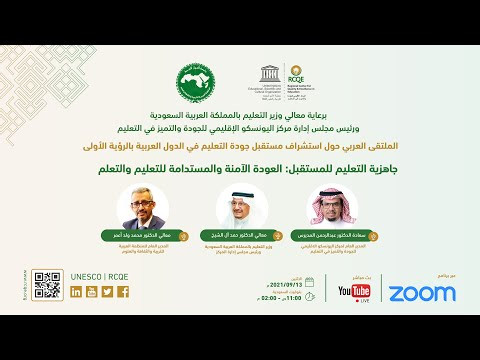 جاهزية التعليم للمستقبل: العودة الآمنة والمستدامة للتعليم والتعلم 발행 연도: 2021 단체 저자: Regional Center for Quality and Excellence in Education (RCQE) التنبؤ بمستقبل جودة التعليم عملية معقدة إلا أنها ضرورة حتمية، والتحسب والاستعداد لكل مستجد ومتغير يجب أن يكون غاية التربية في حاضرها ومستقبلها. اليوم يواجه التعليم في جميع دول العالم تحديات غير مسبوقة أبرزها جائحة كورونا Covid-19 بتزامن مع تحديات سابقة من تسارع في التطور المعرفي والتكنولوجي، وكذلك أزمات اقتصادية وصراعات في بعض الدول، سياقات غير مألوفة جعلت من عملية تستعرض هذه الندوة قضية التعليم والعودة الامنة له بعد جائحة كورونا. Readiness for Education for the Future: A Safe and Sustainable Return to Teaching and Learning 발행 연도: 2021 단체 저자: Regional Center for Quality and Excellence in Education (RCQE) Predicting the future of quality education is a complex process, but it is an inevitable necessity, and anticipation and preparation for every new and changing must be the goal of education in its present and future. Today, education in all countries of the world faces unprecedented challenges, most notably the Corona pandemic, Covid-19, in conjunction with previous challenges of acceleration in knowledge and technological development, as well as economic crises and conflicts in some countries, unfamiliar contexts that made this symposium review the issue of education and its safe return to it after Corona pandemic.
  The SDG second half: Ideas for doing things differently 발행 연도: 2023 저자: Amar Bhattacharya | Margaret Biggs | Matthew Bishop | Caren Grown | George Ingram | Homi Kharas | John W. Mcarthur | Sarah E. Mendelson | Jane Nelson | Tony Pipa | Naheed Sarabi | Jacob Taylor | Priya Vora | Rebecca Winthrop 단체 저자: Center for Sustainable Development at Brookings This short compendium captures a cross section of SDG-focused insights and recommendations from CSD-affiliated scholars. Each brief essay describes something with the potential to be done differently during the second half of the SDG era. Across a dozen contributions, topics range from reframing media coverage of the SDGs to measuring and elevating the role of the private sector; from participatory approaches to transforming education systems to new learning paradigms for human rights; from better risk-taking in fragile countries to improving infrastructure and services for care; from fit-for-purpose multilateral development banks to a purpose-driven fund to end extreme poverty; from turbo-charged Canadian SDG approaches to renewed American SDG leadership; from breakthroughs in digital public infrastructure to innovative frontiers in the digitally empowered methods of collective behavior science.
  UNESCO Strategy for Youth and Adult Literacy and its Action Plan (2020-2025) 발행 연도: 2023 단체 저자: UNESCO I. Introduction1. The international community has set an ambitious 2030 Agenda for Sustainable Development1, with education and learning central to its achievement. The vision of the Incheon Declaration2, Education 2030, is fully captured by Sustainable Development Goal 4 (SDG4) “ensure inclusive and equitable quality education and promote lifelong learning opportunities for all”. Education 2030 devotes considerable attention to literacy and adult learning including through Target 4.6 and related indicative strategies.2. By 205 EX/Decision 6.III, the Executive Board requested the Director-General to review, update and improve the vision and strategy for literacy to contribute to SDG 4 – Education 2030, and to present it at its 207th session, with a view to transmitting it to the General Conference at its 40th session. The present document therefore contains the draft UNESCO Strategy for Youth and Adult Literacy (2020- 2025). The Strategy was developed through an inclusive and participatory process, including research and analysis of key trends, online consultation of Member States and expert meetings.