
자료
세계시민교육에 대한 이해를 넓히고 연구, 옹호 활동, 교수, 학습 등을 향상시킬 수 있는 다양하고 유용한 자료를 찾아보세요.
139 건의 결과가 검색되었습니다
 Peru SDG Push Framework: Unlocking New Pathways to SDG Acceleration 발행 연도: 2024 단체 저자: United Nations Development Programme (UNDP) SDG Push is about realizing development ambition and redefining how we build acceleration pathways. It helps pinpoint policy choices that ‘move the needle’ towards the achievement of the Sustainable Development Goals. A UNDP flagship initiative, SDG Push uses digital and data innovation, systems thinking, and futures approaches to provide a comprehensive and country-specific tool to plan and implement SDG breakthroughs in a variety of development contexts. SDG Acceleration Pathways, specific to context and need, were co-created in collaboration with Indonesia, Moldova, Namibia, Peru and South Africa. These pilots helped to refine the SDG Push approach and the digital SDG Push Diagnostic and formed the foundation of the Integrated SDG Insights Reports, presented at the 2023 SDG Summit. This integrated, modular approach includes the analysis of development trends and priorities with data visualization, integrating generative dialogue, foresight methods and economic modelling to assess the impact of potential accelerators.
  South Africa SDG Push Framework: Unlocking New Pathways to SDG Acceleration 발행 연도: 2024 단체 저자: United Nations Development Programme (UNDP) SDG Push is about realizing development ambition and redefining how we build acceleration pathways. It helps pinpoint policy choices that ‘move the needle’ towards the achievement of the Sustainable Development Goals. A UNDP flagship initiative, SDG Push uses digital and data innovation, systems thinking, and futures approaches to provide a comprehensive and country-specific tool to plan and implement SDG breakthroughs in a variety of development contexts. SDG Acceleration Pathways, specific to context and need, were co-created in collaboration with Indonesia, Moldova, Namibia, Peru and South Africa. These pilots helped to refine the SDG Push approach and the digital SDG Push Diagnostic and formed the foundation of the Integrated SDG Insights Reports, presented at the 2023 SDG Summit. This integrated, modular approach includes the analysis of development trends and priorities with data visualization, integrating generative dialogue, foresight methods and economic modelling to assess the impact of potential accelerators.
  Teachers Guide on the SDGs 발행 연도: 2022 단체 저자: United Nations (UN) This teaching guide, aimed at grade level K-12, gives an introduction and historical background to the SDGs. Key questions along with primary resources are provided to facilitate comprehension and engage students critically. Through analysis of the Preamble to the 2030 Agenda for Sustainable Development, the connection will be made to the Millenium Development Goals and Human Rights, to demonstrate continuity and evolution of certain principle values held by the international community. Focus then shifts to SDG 4, quality education, so that students can ore clearly analyze the progress that has been made regarding this topic on a micro level.
  Third Global Conference on Strengthening Synergies Between the Paris Agreement and the 2030 Agenda for Sustainable Development: Building the Evidence Base for Synergistic Action in Support of Raising Climate and SDGs Ambition 발행 연도: 2022 단체 저자: UN. Department of Economic and Social Affairs (UN. DESA) The Third Global Conference on Strengthening Synergies Between the Paris Agreement and the 2030 Agenda For Sustainable Development was co-convened by the United Nations Department of Economic and Social Affairs (UNDESA) and the Secretariat of the United Nations Framework Convention on Climate Change (UNFCCC), and it was hosted by the Ministry of the Environment of Japan, in partnership with the United Nations University (UNU) and the Institute for Global Environmental Strategies (IGES).
 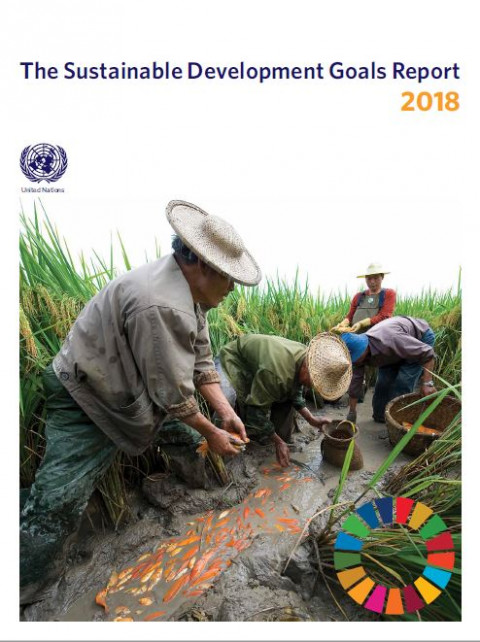 تقرير أهداف التنمية المستدامة 2018 발행 연도: 2018 저자: United Nations 단체 저자: United Nations (UN) يستعرض التقرير التقدم المحرز في تحقيق أهداف التنمية 2030 المستدامة في عامها الثالث من التطبيق. وهذا التقرير يمثل نظرة عامة على التقدم المحرز والفجوات التي تواجه الدول في الاهداف السبعة عشر، وهذا التحليل المعروض في التقرير مبني استنادا على أحدث البيانات المتاحة من إدارة الشؤون الاجتماعية والاقتصادية بالأمانة العامة للأمم المتحدة، وشارك ايضا في توفير البيانات خبراء إجصائيون من دول كثيرة. عموما يعتبر هذا التقرير مرجعا للمهتمين بمتابعة تحقيق العالم لأهداف التنمية المستدامة. The Sustainable Development Goals Report 2018 발행 연도: 2018 단체 저자: United Nations (UN) The 2030 Agenda for Sustainable Development provides a global blueprint for dignity, peace and prosperity for people and the planet, now and in the future. Three years into the implementation of the Agenda, countries are translating this shared vision into national development plans and strategies.
  Unpacking Sustainable Development Goal 4 Education 2030: Guide 발행 연도: 2017 단체 저자: UNESCO This guide, organized around a set of questions and answers to “unpack” SDG4, provides overall guidance for a deeper understanding of SDG4 within the 2030 Agenda for Sustainable Development, in order to support its effective implementation. The guide outlines the key features of SDG4-Education 2030 and the global commitments expressed in the SDG4 targets as articulated in the Incheon Declaration and the Education 2030 Framework for Action. The guide also examines the implications of translating these global commitments within, and through, national education development efforts. This guide supplements the UNESCO technical guidelines (2016) for Mainstreaming SDG4-Education 2030 into sector-wide policy and planning. It was developed by Sobhi Tawil, Margarete Sachs-Israel, Huong Le Thu, and Matthias Eck of the UNESCO Section of Partnerships, Cooperation and Research (PCR) within the Division for Education 2030 Support and Coordination. Comprendre l'Objectif de développement durable 4: Education 2030, guide 발행 연도: 2017 단체 저자: UNESCO Le présent guide, qui s’articule autour d’une série de questions et de réponses pour « décoder » l’ODD4, contient des indications générales permettant de mieux comprendre sa place dans le Programme pour le développement durable à l’horizon 2030 et d’assurer sa mise en œuvre efficace. Il met en avant les principales caractéristiques de l’ODD4-Education 2030 et les engagements pris au niveau mondial, manifestés dans les cibles de l’ODD4 telles que formulées par la Déclaration d’Incheon et le Cadre d’action Education 2030.Ce guide complète les principes directeurs techniques de l’UNESCO (2016) pour l’intégration de l’ODD4-Education 2030 au sein de la politique et de la planification sectorielles. Il a été élaboré par Sobhi Tawil, Margarete Sachs-Israel, Huong Le Thu et Matthias Eck de la Section Partenariats, Coopération et Recherche (PCR) de l’UNESCO au sein de la Division d’appui et de coordination d’Éducation 2030.Qu’est-ce que le Programme de développement durable à l’horizon 2030 ?Le Programme de développement durable à l’horizon 2030 est un engagement intergouvernemental et un « plan d’action pour l’humanité, la planète et la prospérité ». Il se compose de 17 Objectifs de développement durable (ODD) « intégrés et indissociables qui concilient les trois dimensions du développement durable : économique, sociale et environnementale », démontrant par ailleurs l’ampleur et l’ambition de ce nouveau Programme universel. Ils ressortent de ce qui a été sans nul doute le processus de consultation le plus inclusif de toute l’histoire des Nations Unies, le fruit de la contribution substantielle de tous les secteurs de la société, de tous les acteurs de la communauté internationale et de toutes les régions du monde. Tous les États membres, l’ensemble du système des Nations Unies, les experts et les représentants de la société civile, du monde des entreprises et, le plus important, des millions de personnes du monde entier, ont pris l’engagement de concrétiser ce large programme qui s’attaque aux préoccupations communes de la planète toute entière et de promouvoir le bien public.
  Historical efforts to implement the UNESCO 1974 Recommendation on Education in light of 3 SDGs Targets 발행 연도: 2017 단체 저자: UNESCO This paper presents an analytical overview of historical efforts by Member States of the United Nations Educational, Scientific and Cultural Organization (UNESCO) to implement the 1974 Recommendation concerning education for international understanding, cooperation and peace education relating to human rights and fundamental freedoms. The author of the review was hired in April 2016 to undertake an analysis of Member States’ progress reports submitted for the fourth (2008) and fifth (2012) consultations on implementation of the 1974 Recommendation. The main purpose of the review was to provide a historical overview of efforts to achieve Sustainable Development Goal (SDG) Targets 4.7, 12.8 and 13.3 and their proposed measurement indicators, based on states’ historical reporting on the Recommendation. A total of 94 country reports were reviewed for the exercise: 37 from the 4th Consultation (2008); and 57 from the 5th Consultation (2012). The coding involved retrofitting the content of reportsto conceptsthat may have been developed at a later date for the Sustainable Development Agenda and coding for data that was not explicitly requested in the Consultations. Following the coding, a quantitative and qualitative analysis was undertaken and is presented in the following report.
 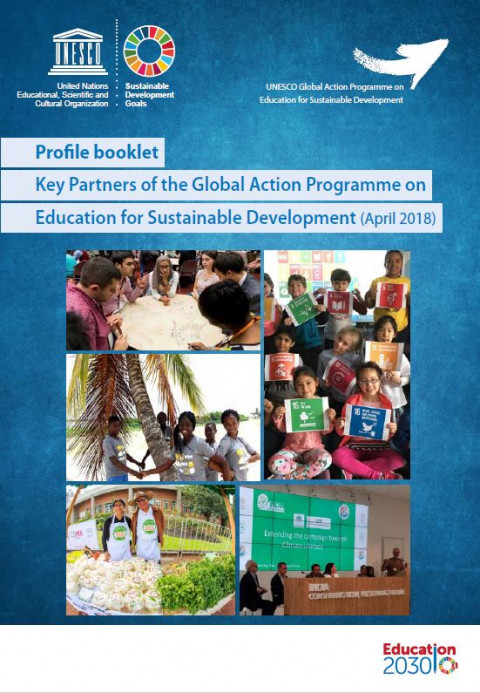 Profile booklet: key partners of the Global Action Programme on Education for Sustainable Development (April 2018) 발행 연도: 2018 UNESCO’s Global Action Programme (GAP) was launched at the World Conference on Education for Sustainable Development (ESD) in November 2014 in Aichi-Nagoya, Japan as a follow-up programme to the Decade of ESD (2005-2014). This booklet contains profiles of the current 96 members (also called Key Partners) of the GAP Partner Networks. Each Key Partner is listed in alphabetical order within one of the five Partner Networks. Each profile presents the main objective of their work, their GAP launch commitment and specific activities that contribute to the GAP, as well as related website links and contact information for the organization’s focal point.