
자료
세계시민교육에 대한 이해를 넓히고 연구, 옹호 활동, 교수, 학습 등을 향상시킬 수 있는 다양하고 유용한 자료를 찾아보세요.
6 건의 결과가 검색되었습니다
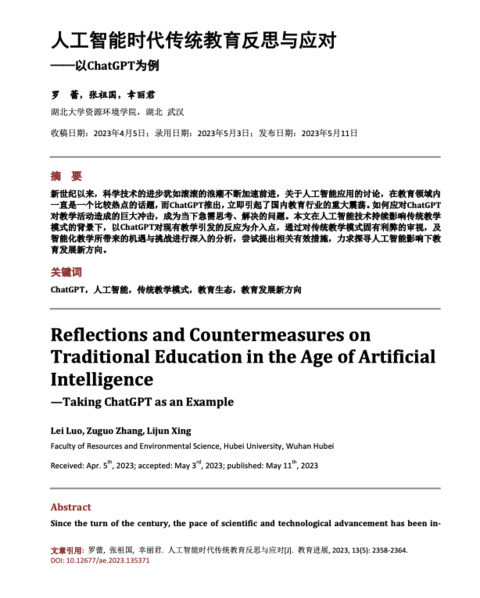 Reflections and Countermeasures on Traditional Education in the Age of Artificial Intelligence: Taking ChatGPT as an Example (Advances in Education; Vol.13, No.5) 발행 연도: 2023 저자: 罗蕾 | 张祖国 | 幸丽君 Since the turn of the century, the pace of scientific and technological advancement has been increasing rapidly, like a rolling wave gaining momentum. As a result, the topic of artificial intelli-gence and its potential applications has remained a hot topic in the field of education. The introduction of ChatGPT had an immediate and significant impact on the domestic education industry. Addressing how to manage this impact on teaching activities has become an urgent issue that requires prompt consideration and resolution. In light of the ongoing impact of artificial intelligence technology on traditional teaching methods, this article focuses on ChatGPT’s response as an intervention point, delving into a thorough analysis of the inherent strengths and weaknesses of traditional teaching modes, as well as the opportunities and challenges presented by intelligent teaching. Through our analysis of artificial intelligence, we aim to propose effective measures and explore new directions for the development of education in its influence. 人工智能时代传统教育反思与应对: 以ChatGPT为例 (教育进展; Vol.13, No.5) 발행 연도: 2023 저자: 罗蕾 | 张祖国 | 幸丽君 新世纪以来,科学技术的进步犹如滚滚的浪潮不断加速前进,关于人工智能应用的讨论,在教育领域内一直是一个比较热点的话题,而ChatGPT推出,立即引起了国内教育行业的重大震荡。如何应对ChatGPT对教学活动造成的巨大冲击,成为当下急需思考、解决的问题。本文在人工智能技术持续影响传统教学模式的背景下,以ChatGPT对现有教学引发的反应为介入点,通过对传统教学模式固有利弊的审视,及智能化教学所带来的机遇与挑战进行深入的分析,尝试提出相关有效措施,力求探寻人工智能影响下教育发展新方向。
 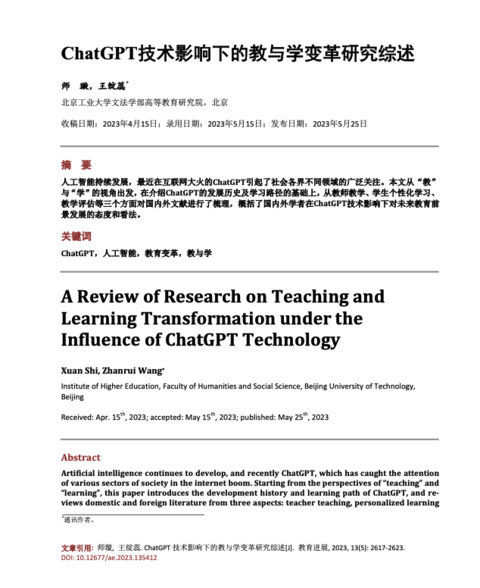 A Review of Research on Teaching and Learning Transformation under the Influence of ChatGPT Technology (Advances in Education; Vol.13, No.5) 발행 연도: 2023 저자: 师璇 | 王绽蕊 Artificial intelligence continues to develop, and recently ChatGPT, which has caught the attention of various sectors of society in the internet boom. Starting from the perspectives of “teaching” and “learning”, this paper introduces the development history and learning path of ChatGPT, and reviews domestic and foreign literature from three aspects: teacher teaching, personalized learning for students, and teaching evaluation. It summarizes the attitudes and views of domestic and foreign scholars on the future development of education under the influence of ChatGPT technology. ChatGPT技术影响下的教与学变革研究综述 (教育进展; Vol.13, No.5) 발행 연도: 2023 저자: 师璇 | 王绽蕊 人工智能持续发展,最近在互联网大火的ChatGPT引起了社会各界不同领域的广泛关注。本文从“教”与“学”的视角出发,在介绍ChatGPT的发展历史及学习路径的基础上,从教师教学、学生个性化学习、教学评估等三个方面对国内外文献进行了梳理,概括了国内外学者在ChatGPT技术影响下对未来教育前景发展的态度和看法。
 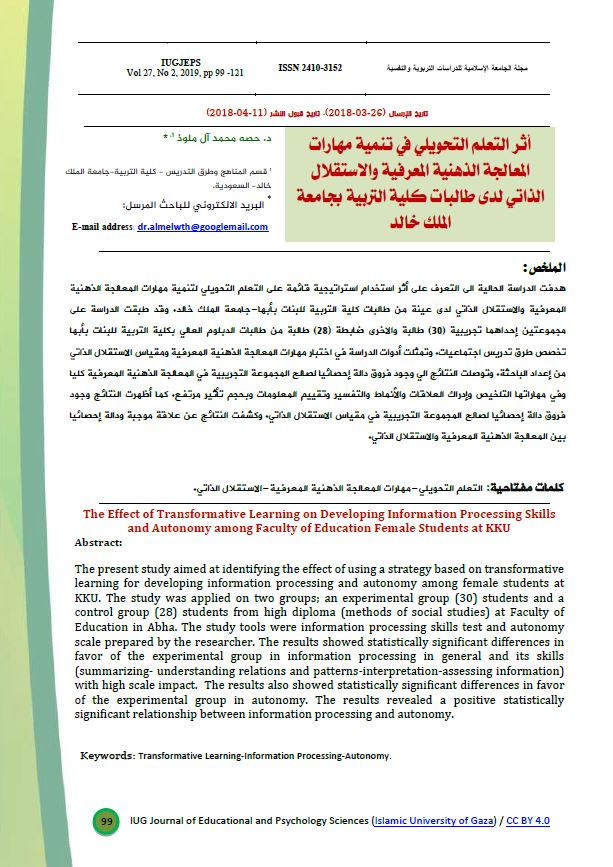 أثر التعلم التحويلي في تنمية مهارات المعالجة الذهنية المعرفية والاستقلال الذاتي لدى طالبات كلية التربية بجامعة الملك خالد 발행 연도: 2019 저자: Hessa Muhammad Al Malaz 단체 저자: Islamic University of Gaza هدفت الدراسة الى التعرف على أثر استخدام استراتيجية قائمة على التعلم التحويلي لتنمية مهارات المعالجة الذهنية المعرفية. استخدمت الدراسة عينة من طالبات كلية التربية للبنات بجامعة الملك خالد. كشفت الدراسة عن علاقة موجبة ودالة احصائيا بين المعالجة الذهنية المعرفية والاستقلال الذاتي. The Effect of Transformative Learning on Developing Information Processing Skills and Autonomy among Faculty of Education Female Students at KKU 발행 연도: 2019 저자: Hessa Muhammad Al Malaz 단체 저자: Islamic University of Gaza The study aimed to identify the effect of using a strategy based on transformational learning to develop cognitive mental processing skills. The study used a sample of students from the College of Education for Girls at King Khalid University. The study revealed a positive and statistically significant relationship between cognitive mental processing and autonomy.