
자료
세계시민교육에 대한 이해를 넓히고 연구, 옹호 활동, 교수, 학습 등을 향상시킬 수 있는 다양하고 유용한 자료를 찾아보세요.
1,329 건의 결과가 검색되었습니다
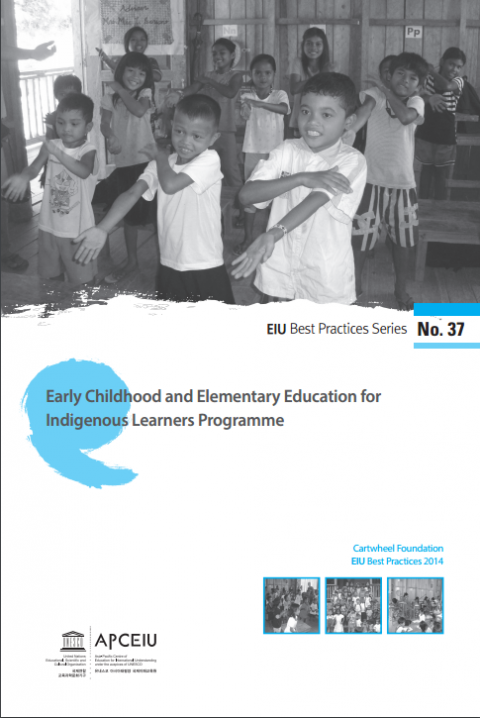 EIU Best Practices Series No. 37: Early Childhood and Elementary Education for Indigenous Learners Programme 발행 연도: 2014 저자: Bricks Sabella Sintaon 단체 저자: APCEIU This monograph is one of APCEIU's EIU Best Practices Series, which aims to encourage educators, scholars, and activists to implement and share local initiatives on EIU. The Series No.37 introduces the Early Childhood and Elementary Education (ECEE) for Indigenous Learners Programme initiated in the Philippines. The indigenous peoples (IP) reside in the mountainous regions, away from basic social services and struggling with poverty, malnutrition, and lack of proper education. The aim of ECEE is to facilitate access to quality and culturally-relevant early childhood and elementary education for the Higaonon indigenous children. To achieve this, activities such as curriculum indigenization and teacher training are provided in collaboration with the community members. As the program creates learning process for all through openness, sharing, and collaboration, this is an exemplary case of EIU/GCED pedagogical approach.
 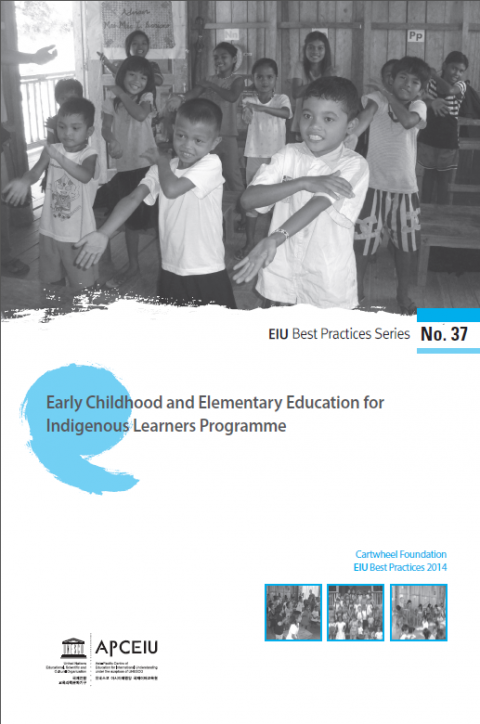 EIU Best Practices Series No.37: Early Childhood and Elementary Education for Indigenous Learners Programme 발행 연도: 2014 단체 저자: APCEIU This monograph is one of APCEIU's EIU Best Practices Series, which aims to encourage educators, scholars, and activists to implement and share local initiatives on EIU. The Series No.37 introduces the Early Childhood and Elementary Education (ECEE) for Indigenous Learners Programme initiated in the Philippines. The indigenous peoples (IP) reside in the mountainous regions, away from basic social services and struggling with poverty, malnutrition, and lack of proper education. The aim of ECEE is to facilitate access to quality and culturally-relevant early childhood and elementary education for the Higaonon indigenous children. To achieve this, activities such as curriculum indigenization and teacher training are provided in collaboration with the community members. As the program creates learning process for all through openness, sharing, and collaboration, this is an exemplary case of EIU/GCED pedagogical approach.
  2022 Youth Leaders’ Mentorship & Local GCED Projects: Activity Report 발행 연도: 2022 단체 저자: APCEIU This report summarizes 15 GCED projects implemented in different parts of the world by the alumni of APCEIU’s Youth Leadership Workshop on GCED in 2022. Ranging from community advocacy for global citizenship to girls’ empowerment projects, 15 GCED initiatives have been taken by the team of 15 young leaders in their own communities in Asia, Europe, Africa, Latin America, and the Caribbean. APCEIU offers GCED training programmes targeting youth leaders around the globe to encourage them to achieve the SDGs through global citizenship and GCED. Since 2015, the Youth Leadership Workshop on GCED has been held every year in the Republic of Korea, inviting 50 young global leaders to take part in an intensive training programme where they share their actions, deepen their knowledge on global/local issues, enhance their motivation to take actions for a change, and establish the young leaders’ network on GCED. Since 2021, it has been shifted to a comprehensive training programme composed of online training workshops, mentorship, and local project implementation.
  Educator's Guide to Global Citizenship Education: From Asia-Pacific Perspectives 발행 연도: 2025 저자: Athapol Anunthavorasakul | Keith C. Barton | Sicong Chen | Suzanne S. Choo | Thippapan Chuosavasdi | Li-Ching Ho | Aigul Kulnazarova | Mousumi Mukherjee | Mousumi Roy | Tania Saeed | Tanya Wendt Samu | Kyujoo Seol | Jun Teng 단체 저자: APCEIU Educators’ Guide to Global Citizenship Education from Asia-Pacific Perspectives is designed to translate rich discussions from Rethinking Global Citizenship Education from Asia-Pacific Perspectives (2024) into a more accessible resource for educators. This Guide supports educators by presenting scholarly insights in practical and actionable ways. Serving as a bridge between theory and practice, it helps educators grasp key ideas of global citizenship education (GCED) from Asia-Pacific perspectives, reflect on their relevance to their own contexts, and apply them through concrete activities, stories, cases examples, and instructional strategies. This Guide, which is grounded in the diverse philosophies, religions, and lived realities of the Asia-Pacific region, is intended to serve as a practical companion that helps educators understand GCED from a decolonial perspective, adapt its ideas to their own contexts, and translate it all into meaningful learning experiences for their learners. It is our sincere hope that this Guide fosters ongoing dialogue, experimentation, and collaboration, and that it contributes to nurturing learners who think critically, act with empathy and justice, and participate responsibly in shaping a more harmonious and sustainable world.
 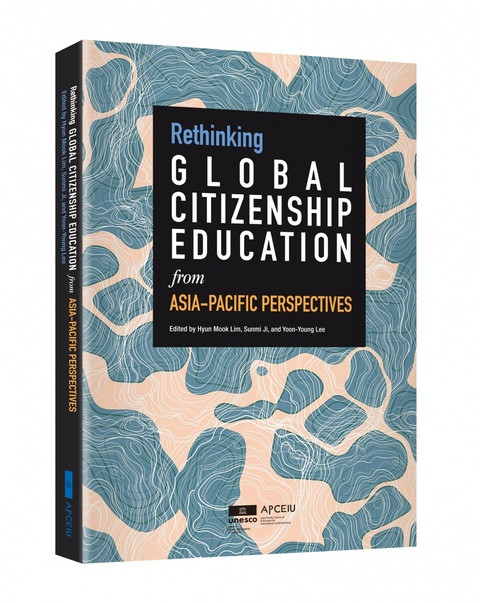 Rethinking Global Citizenship Education: From Asia-Pacific Perspectives 발행 연도: 2024 저자: Sicong Chen | Suzanne S. Choo | Thippapan Chuosavasdi | Aigul Kulnazarova | Mousumi Mukherjee | Tania Saeed | Tanya Wendt Samu | Kyujoo Seol | Jun Teng 단체 저자: APCEIU Rethinking Global Citizenship Education from Asia-Pacific Perspectives aims to rethink and reinterpret global citizenship and GCED in light of the cultural and historical contexts and political and economic conditions of the Asia-Pacific region. The edited volume offers an in-depth exploration of global citizenship and GCED through the contributions of nine scholars who examine the subject from a range of cultural, historical, and theoretical perspectives. Each chapter brings to light the complexities involved in fostering global citizenship in an era defined by both growing interconnectedness and intensifying political, social, and economic divides.This book is structured into three parts. The first part examines how various philosophical traditions from the Asia-Pacific region, such as Confucian cosmopolitanism, Tagore’s mindset, Pacific indigenous wisdom, and the Tianxia system, can inform and enrich the concept of GCED. The second part delves into the foundational ideas of global citizenship embedded within Asian religious and spiritual traditions, including Buddhist and Sufi perspectives. The third part provides case studies from Central and East Asia, highlighting the practical application of GCED in local contexts such as Kazakhstan, China, Japan, and South Korea. Together, these chapters offer a comprehensive analysis of the evolving challenges, opportunities, and innovations within GCED from Asia-Pacific viewpoints, emphasising the need for education systems to adapt and respond to the multifaceted nature of global citizenship.
 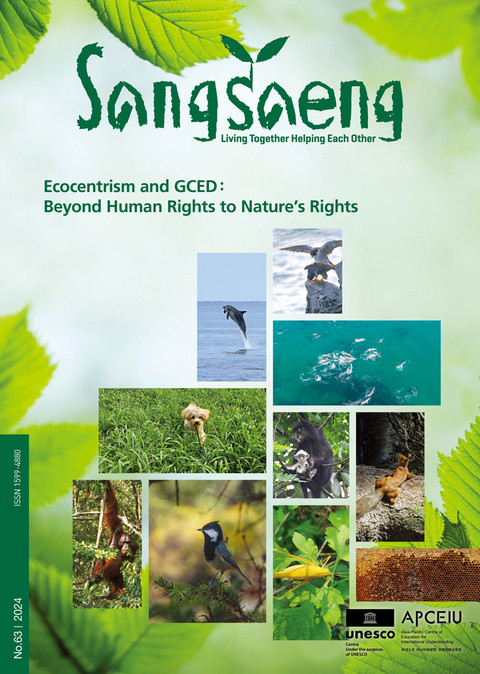 Ecocentrism and GCED : Beyond Human Rights to Nature’s Rights (SangSaeng; No.63, 2024) 발행 연도: 2024 단체 저자: APCEIU In the context of Sustainable Development Goal (SDG) 4, global citizenship and sustainability are spotlighted through SDG Target 4.7, which underscores the importance of harmonising cultural and biological diversity.To address the urgent need for harmony between humanity and the nature, ecocentrism needs to be explored as a guiding principle for fostering ethical and sustainable coexistence.In this light, Issue 63 of SangSaeng delves into Ecocentrism—a perspective advocating for the ethical treatment of all beings and recognising their intrinsic value—alongside Global Citizenship Education (GCED). Contents 03 Editor's Note 04 Special Column- Creating Respectful, Valued Society — Strengthening Global Citizenship Education (GCED) to Combat Hate, Racism, and Discrimination Worldwide / Peter K. Ngure 08 FOCUS Ecocentrism and GCED: Beyond Human Rights to Nature’s Rights- Getting Over Ourselves — Ecocentrism: The Importance of Earth Jurisprudence, Compassionate Conservation, and Personal Rewilding / Marc Bekoff- Combating Decline of Nature’s Diversity — Global Citizenship Education for Geodiversity, Biodiversity Conservation / Eunhee Lee- Ecocentrism and Global Citizenship Education — Fostering Coexistence with Critically Endangered Primates through Citizen Science / Andie Ang- Dolphins Dream of Peace: Beyond Human Rights to Nature’s Rights / Interview with Seungmok Oh 23 Special Report- Small Actions, Global Ripples — How GCED is Revitalizing Peace / Micha Aime 26 Best Practices- What’s Good for the Community — GCED in Action Fosters Culture of Bulungi Bwansi in Uganda / Barbara Nakijoba- Sharing Emotional Sensibility in Education — Practicing Arts Opens up the Spirit of Global Citizenship / Seoyoung Bae - Teaching GCED through Liberation History — Working to Eradicate Entrenched Racism, Intolerance, Xenophobia / Charles Chikunda 36 GCED YOUTH NETWORK- How Youth Leaders Redefine Advocacy, Leading Global Change to Shape our Future — Deep Dive into South Asian Youth Declaration on GCED, Facilitation Techniques for Empowered Youth / Noora Elkenawi 39 Peace in My Memory- Pathway to Inner Peace — Journey is Interconnected with Relationships and Environment / Itseng Kwelagobe 42 Story Time- From Drops to Waves — Power of Poetry-telling in Times of Crisis / Kalpani Dambagolla & Alessia Marzano 45 Understanding the Asia Pacific Region- Central Asian Heart of Culture — Legacy of Horsemanship from Tradition to Modernity / Gulzhan Kabysheva 48 Letter- Raising a Global Citizen / Nelly Aluanga Omino 50 APCEIU in Action
  7th Meeting of UNESCO Category 2 Centres in Education: Meeting Report 발행 연도: 2023 단체 저자: APCEIU This meeting report provides the summary of the 7th Meeting of UNESCO Category 2 Centres in Education held on 7 November 2023 in Paris, France. It offers an overview of the presentations delivered by Category 2 Centres in Education, outlining their programmes and activities for the upcoming years, specifically for 2024.
 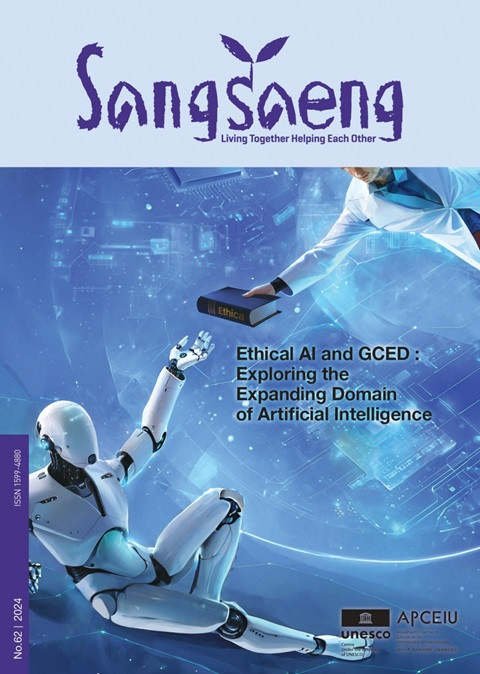 Ethical AI and GCED: Exploring the Expanding Domain of Artificial Intelligence (SangSaeng; No. 62, 2024) 발행 연도: 2024 단체 저자: APCEIU The 62nd issue of SangSaeng has been published with the theme of “Ethical AI and GCED: Exploring the Expanding Domain of Artificial Intelligence.” AI has never been as pervasive and influential as it is in today’s rapidly changing world. Despite the convenience and cutting-edge technology AI has offered us, it has the potential to pose a threat to humanity. This is where ethics for AI should come forward. In this regard, this issue will lead readers to the alarming side of AI as well as its future developments, focusing on the importance of GCED and AI ethics in tackling any potential problems. Contents03 Editor's Note 04 Special ColumnEmbracing Change to Cultivate Success — Integrating Global Citizenship Education into Tertiary Education / Dendev Badarch 08 FOCUS: Ethical AI and GCED: Exploring the Expanding Domain of Artificial IntelligenceRole of Ethics in the Era of AI — Protecting and Guiding AI Processes for Humanity to Flourish / Emma Ruttkamp-BloemPaying Attention to AI Ethics — An Avenue for a New Competitive Edge in Business / Myoungshin KimDriving Innovative Education — Balancing Future Possibilities and Ethical Concerns: How GCED Can be Used to Address AI Issues / Angelique Southern 20 Special ReportEmpowering a Climate Generation — From Classrooms to Climate Frontlines: The Transformative Role of Education highlighted at COP28 / Djian Sadadou 22 Best PracticesNavigating an AI Future — Ethical AI and the Importance of Critical Thought / Hannah GrantGLACE Brings the World to a City — Empowering Youth as Global Citizens: Lessons from Navotas City’s Project GLAC / Marco D. MedurandaLowering Eco-Anxiety — Teaching Climate Change Through Media and Information Literacy / Laetitia Legrand 33 GCED YOUTH NETWORK New Wave of Youth Advocacy — Role of AI in Youth Advocacy and its Ethical Implications to Global Citizenship / Oshan M. Gunathilake and Diego Manrique 36 Understanding the Asia Pacific RegionDiscovering Auroville — Where Boundaries Fade, Nature Thrives, and Global Minds Unite / Akanksha Arya 39 Peace in My MemoryHappiness without Violence — Mindanao Peace ForumCelebrates Building a Culture of Peace / Ludivina Borja-DekitPeace Scholar Passes Away Amidst Turbulent Times / Kwang-Hyun KIM 45 Story TimeThe Right Footing — My Life Has Purpose Thanks to Football / Hajar Abulfazl 48 LetterShared Challenges of Global Citizens / Natsuki Nagata 50 APCEIU in Action
 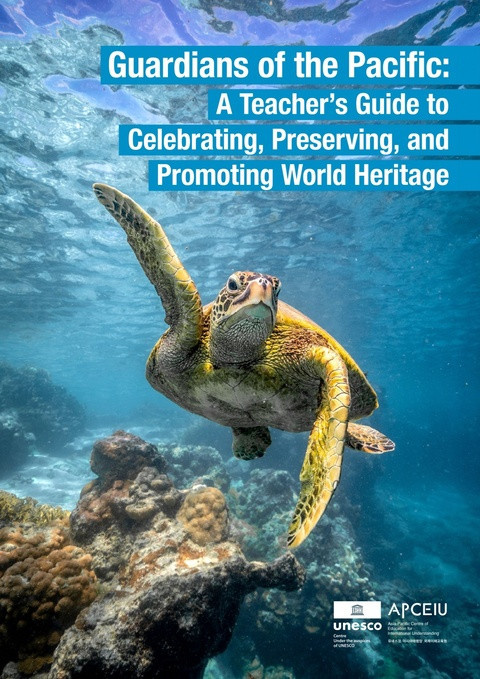 Guardians of the Pacific: A Teacher’s Guide to Celebrating, Preserving, and Promoting World Heritage 발행 연도: 2024 저자: Karena Menzie-Ballantyne | Nanise J. Young Okotai | Adi Meretui Tuvou Ratunabuabua 단체 저자: APCEIU Guardians of the Pacific: A Teacher’s Guide to Celebrating, Preserving, and Promoting World Heritage is an APCEIU initiative dedicated to advancing Global Citizenship Education (GCED) worldwide. Anchored in the principles of the Sustainable Development Goals (SDGs) and UNESCO World Heritage, the guide places a special emphasis on the rich and diverse heritage of the Pacific region. This Guide reflects GCED’s integrative approach, which encompasses three interconnected dimensions of learning: cognitive, socio-emotional, and behavioral. It encourages critical thinking about heritage and sustainability, fosters empathy by deepening understanding of the Pacific's unique cultural and natural environments, and inspires meaningful actions to protect and preserve local heritage. Tailored for educators working with students in upper primary (grades 4–6) and lower secondary (grades 7–9), the Guide provides step-by-step instructions and practical resources for incorporating Pacific World Heritage into classroom lessons and extracurricular activities. It is a valuable tool for nurturing awareness, appreciation, and stewardship of the Pacific region’s irreplaceable heritage in schools worldwide. <Table of Contents>ForewordHow to Use This GuideSection 1. Learning Framework Rationale Section 2. What Makes a Place Special?Section 3. The 2030 Agenda, Five Pillars and SDGsSection 4. Protecting People: Levuka Historical Port Town (Cultural Site)Section 5. Preserving the Planet: Phoenix Islands Protected Area (Natural Site)Section 6. Ensuring Prosperity: Rock Islands Southern Lagoon (Mixed Site)Section 7. Promoting Peace: Bikini Atoll Nuclear Test Site (Cultural Site)Section 8. Partnerships to Protect the Environment: East Rennell (Natural Site)Section 9. Taking Action to Promote and Protect a Special PlaceReferences WorksheetsPhoto Cards
 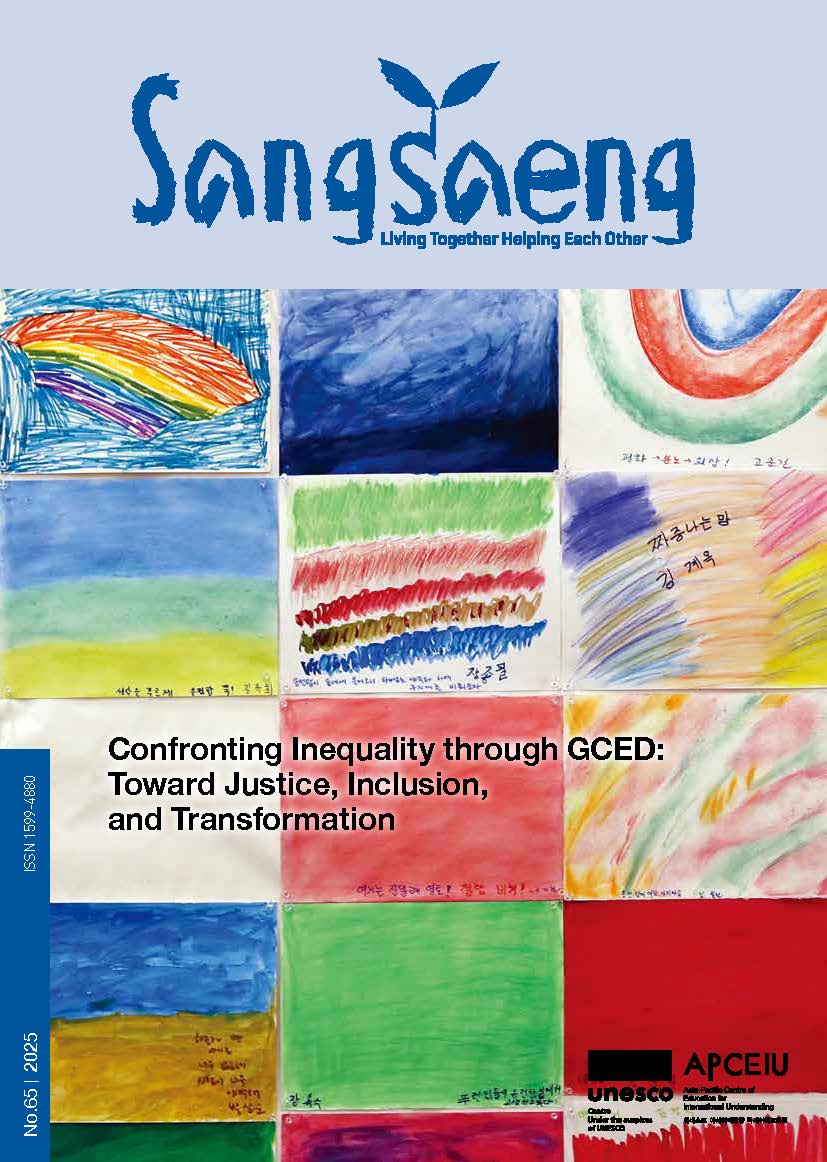 Confronting Inequality through GCED: Toward Justice, Inclusion, and Transformation (SangSaeng; No.65, 2025) 발행 연도: 2025 단체 저자: APCEIU The 62nd issue of SangSaeng has been published with the theme of “Ethical AI and GCED: Exploring the Expanding Domain of Artificial Intelligence.”AI has never been as pervasive and influential as it is in today’s rapidly changing world. Despite the convenience and cutting-edge technology AI has offered us, it has the potential to pose a threat to humanity. This is where ethics for AI should come forward. In this regard, this issue will lead readers to the alarming side of AI as well as its future developments, focusing on the importance of GCED and AI ethics in tackling any potential problems.Contents03 Editor's Note 04 Special ColumnEmbracing Change to Cultivate Success — Integrating Global Citizenship Education into Tertiary Education / Dendev Badarch08 FOCUS Ethical AI and GCED: Exploring the Expanding Domain of Artificial IntelligenceRole of Ethics in the Era of AI — Protecting and Guiding AI Processes for Humanity to Flourish / Emma Ruttkamp-BloemPayingAttention to AI Ethics — An Avenue for a New Competitive Edge in Business / Myoungshin KimDriving Innovative Education — Balancing Future Possibilities and Ethical Concerns: How GCED Can be Used to Address AI Issues / Angelique Southern 20 Special ReportEmpowering a Climate Generation — From Classrooms to Climate Frontlines : The Transformative Role of Education highlighted at COP28 / Djian Sadadou 22 Best PracticesNavigating an AI Future — Ethical AI and the Importance of Critical Thought / Hannah GrantGLACE Brings the World to a City — Empowering Youth as Global Citizens: Lessons from Navotas City’s Project GLAC / Marco D. MedurandaLowering Eco-Anxiety — Teaching Climate Change Through Media and Information Literacy / Laetitia Legrand 33 GCED YOUTH NETWORKNew Wave of Youth Advocacy — Role of AI in Youth Advocacy and its Ethical Implications to Global Citizenship / Oshan M. Gunathilake and Diego Manrique36 Understanding the Asia Pacific RegionDiscovering Auroville — Where Boundaries Fade, Nature Thrives, and Global Minds Unite / Akanksha Arya 39 Peace in My MemoryHappiness without Violence — Mindanao Peace Forum Celebrates Building a Culture of Peace / Ludivina Borja-DekitPeace Scholar Passes Away Amidst Turbulent Times / Kwang-Hyun KIM 45 Story TimeThe Right Footing — My Life Has Purpose Thanks to Football / Hajar Abulfazl 48 LetterShared Challenges of Global Citizens / Natsuki Nagata 50 APCEIU in Action