
자료
세계시민교육에 대한 이해를 넓히고 연구, 옹호 활동, 교수, 학습 등을 향상시킬 수 있는 다양하고 유용한 자료를 찾아보세요.
3,126 건의 결과가 검색되었습니다
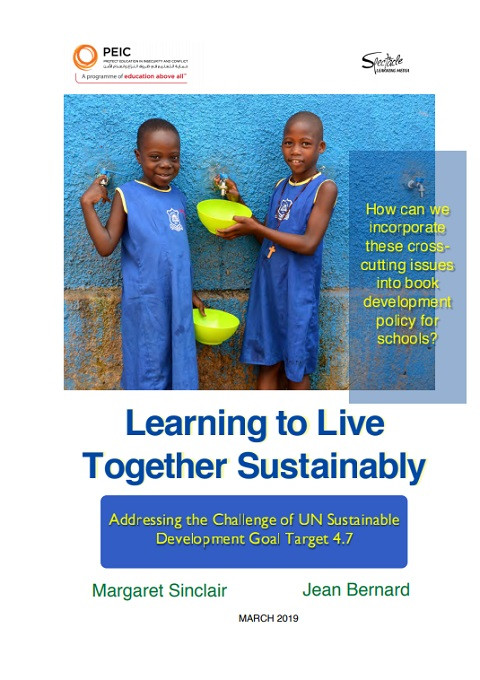 Learning to Live Together Sustainably: Addressing the Challenge of UN Sustainable Development Goal Target 4.7 발행 연도: 2019 저자: Margaret Sinclair | Jean Bernard 단체 저자: Protect Education in Conflict and Insecurity (PEIC) | Spectacle Learning Media The practical advice and guidelines in this book help support learning to live together, conflict transformation and peace at the individual, group and community levels. The framework for developing widely accessible, high quality learning materials supports the UN Sustainable Development Goals and is relevant to formal and non-formal education activities and projects. This document also raises important issues about the professional responsibilities of policy-makers at global and national level, who determine what content is addressed in the classroom. In particular, it addresses the need for education materials that support cross-cutting issues such as learning to live together, global citizenship education, and education for sustainable development.
  Addressing Anti-semitism in Schools: Training Curriculum for Primary Education Teachers 발행 연도: 2020 단체 저자: UNESCO | OSCE. Office for Democratic Institutions and Human Rights (ODIHR) This OSCE/ODIHR and UNESCO co-publication aims to help primary school teachers to prevent and respond to anti-Semitism. The curriculum, intended for teacher trainers, is designed to be comprehensive, robust, practical and adaptable. It suggests concrete ways to address anti-Semitism and counter prejudice in and through education, while promoting human rights, global citizenship education, and gender equality.The co-publication is part of a series of four training curricula, designed for trainers of (1) primary school teachers, (2) secondary school teachers, (3) vocational school teachers, and (4) school directors.
  Asia-Pacific Education 2030: SDG 4 Midterm Review 발행 연도: 2024 단체 저자: UNESCO Institute for Statistics (UIS) | UNESCO Bangkok This publication marks the conclusion of the collaborative national midterm reviews of SDG 4 achievement in the Asia-Pacific. More importantly, it represents the beginning of the final sprint to the 2030 finish line. It also serves as a comprehensive analytical and policymaking tool for all stakeholders in the region to reflect and be better prepared for the second half of the journey. At the midway point of implementing the Education 2030 Agenda, we are observing both challenges and progress in achieving Sustainable Development Goal 4 (SDG 4) in the Asia-Pacific. The region, overall, has made advances in reaching the globally and regionally most important targets under SDG 4, yet it is still far from delivering the common commitment of the Education 2030 Agenda, to ‘ensure inclusive and equitable quality education and promote lifelong learning opportunities for all’. Eight years into implementation, the Asia-Pacific has shown progress, especially in improving access to lower levels of basic education, as well as expanding early childhood education (ECE). Across most subregions of Asia and the Pacific, over 95% of primary school students complete primary education within the expected timeframe, while more than 80% of children one year before the official primary entry age are enrolled in organized early childhood education. However, participation in education is only one part of the puzzle, and the quality of learning, evidenced by limited data for the Asia-Pacific region on learning outcomes, remains concerning. More than half of students in Eastern and South-Eastern Asia do not reach the minimum proficiency level in mathematics at the end of lower secondary education. Overall and from a regional perspective, with priorities having accelerated in ECE, primary education reaching universal participation, and higher education being consistently regarded as prestigious to accomplish, secondary education is currently the weakest link apart from the chronically undervalued technical vocational education and training path. Fulfilling our commitment to the Education 2030 Agenda and leaving no one behind is not an easy endeavour and we need everyone on board in this unprecedented, yet necessary feat. This publication is meant to facilitate taking stock of the current situation and accelerate focused advances on the most relevant education topics for the Asia-Pacific region.
  Opening new windows to sow peace: building citizenship 발행 연도: 2015 저자: Tatiana Zuluaga Zapata | Carlos Humberto Vélez Ocampo | Laura Juliana Pachón Rodríguez | María Julieta Ortiz Fernández 단체 저자: Bogotá. Secretaría de Educación del Distrito (SED) This document aims to help students come with innovative ideas to generate transformations for peace and citizenship in Colombia. It is aimed at creating a conscious mobilization every April 9, during the commemoration of the victims and the missing in Colombia, and has the intention of motivating citizens to fill the streets with joy, raise their voices and commit to peace. Ouvrez de nouvelles fenêtres pour semer la paix: la construction de la citoyenneté ... 발행 연도: 2015 저자: Tatiana Zuluaga Zapata | Carlos Humberto Vélez Ocampo | Laura Juliana Pachón Rodríguez | María Julieta Ortiz Fernández 단체 저자: Bogotá. Secretaría de Educación del Distrito (SED) Ce document vise à aider les élèves à venir avec des idées novatrices pour générer des transformations pour la paix et la citoyenneté en Colombie. Il est destiné à créer une mobilisation consciente le 9 Avril, lors de la commémoration des victimes et des disparus en Colombie, et a l'intention des citoyens de motivation pour remplir les rues avec joie, faire entendre leur voix et engager à la paix. Abrir nuevas ventanas para sembrar la paz: una ciudadanía que construye… 발행 연도: 2015 저자: Tatiana Zuluaga Zapata | Carlos Humberto Vélez Ocampo | Laura Juliana Pachón Rodríguez | María Julieta Ortiz Fernández 단체 저자: Bogotá. Secretaría de Educación del Distrito (SED) This document aims to help students come with innovative ideas to generate transformations for peace and citizenship in Colombia. It is aimed at creating a conscious mobilization every April 9, during the commemoration of the victims and the missing in Colombia, and has the intention of motivating citizens to fill the streets with joy, raise their voices and commit to peace.
  Guide on Human Rights Education Curriculum Development 발행 연도: 2021 저자: Cecilia Decara | Carol Rask | Felisa Tibbitts 단체 저자: Danish Institute for Human Rights This document aims to bring conceptual clarity on human rights education and curriculum development and provide concrete suggestions on how to build human rights curricula ft for 21st century human rights challenges, while contributing to the realisation of the SDG goals and targets set by the international community.
 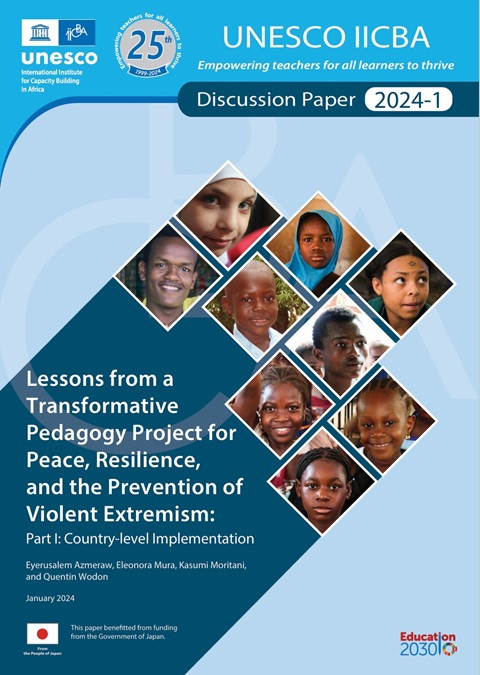 Lessons from a Transformative Pedagogy Project for Peace, Resilience, and the Prevention of Violent Extremism: Part I; Country-Level Implementation 발행 연도: 2024 저자: Eyerusalem Azmeraw | Quentin Wodon | Eleonora Mura | Kasumi Moritani 단체 저자: UNESCO International Institute for Capacity-Building in Africa (IICBA) From 2017 to 2022, UNESCO’s International Institute for Capacity Building in Africa (IICBA) led a series of projects for peacebuilding and the prevention of violent extremism through education with support from the Government of Japan. This two-part paper draws lessons from the projects. The first part of the paper briefly explains the transformative pedagogy approach that guided project implementation and provides examples of changes that were implemented at the country level under the projects. The analysis is qualitative, with the aim being to outline, through country examples, what can be achieved through such projects. Lessons on factors contributing to impact are also outlined.
 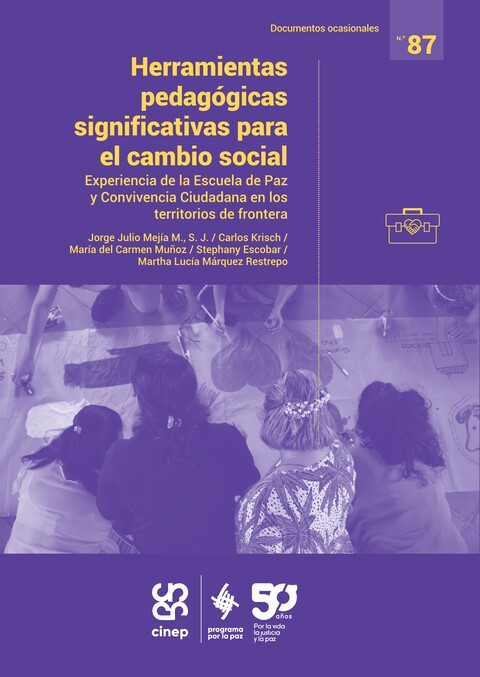 Significant Pedagogical Tools for Social Change 발행 연도: 2023 저자: Jorge Julio Mejía | Carlos Krisch | Sthepany Escobar | Martha Lucía | Márquez Restrepo | María Del Carmen Muñoz 단체 저자: Center for Research and Popular Education / Program for Peace (CINEP/PPP) This document includes significant pedagogical tools to promote processes of social change through training experiences for twelve years in territories on the Colombian-Venezuelan border. Through workshops and activities, participants have experienced transformations in attitudes and practices that have been useful for understanding the border as a shared space. Herramientas pedagógicas significativas para el cambio social 발행 연도: 2023 저자: Jorge Julio Mejía | Carlos Krisch | Sthepany Escobar | Martha Lucía | Márquez Restrepo | María Del Carmen Muñoz 단체 저자: Center for Research and Popular Education / Program for Peace (CINEP/PPP) En este documento se recogen las herramientas pedagógicas significativas para promover procesos de cambio social a través de experiencias formativas durante doce años en territorios de la frontera colombo-venezolana. Mediante talleres y actividades, los participantes han experimentado transformaciones en actitudes y prácticas que les han resultado útiles para comprender la frontera como un espacio compartido.