
자료
세계시민교육에 대한 이해를 넓히고 연구, 옹호 활동, 교수, 학습 등을 향상시킬 수 있는 다양하고 유용한 자료를 찾아보세요.
3,158 건의 결과가 검색되었습니다
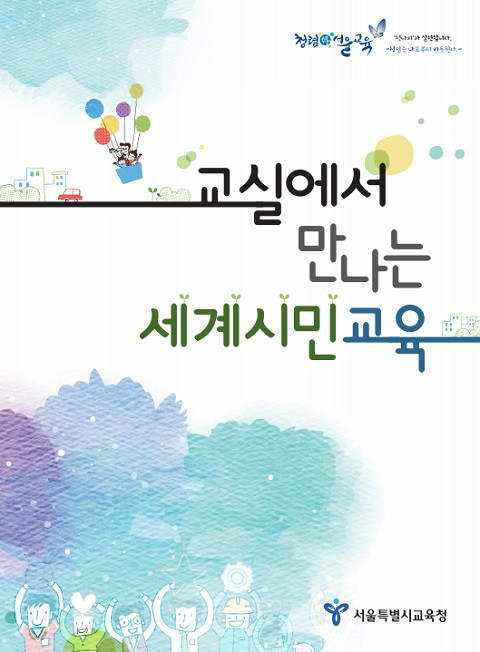 교실에서 만나는 세계시민교육 발행 연도: 2016 저자: 정애경 | 윤지아 | 정혜선 | 이근화 | 공석범 | 주예진 | 이원용 | 정용민 단체 저자: 서울특별시교육청 본 자료는 학습자로 하여금 인류가 공동으로 직면하고 있는 문제들에 대해 이해하고 지구촌 공동체에 대한 소속감과 연대감을 키워 지구촌의 문제들을 해결할 수 있는 다양한 실천적이고 협력적인 능력을 키우는데 그 목적을 두고 있으며, 직접 교실 현장에서 활용할 수 있도록 교수학습과정안의 형식으로 구성되어 있다. 학습주제로 제시된 것은 국제이해교육과 세계시민교육에서 공통으로 다루는 인권과 평화, 다문화를 비롯하여 2030년까지의 인류 공동의 목표인 지속가능발전의 환경과 사회와 경제 부분, 그리고 세계시민교육의 배경인 세계화와 미래사회의 지향점인 국제협력 다섯 영역이다.
 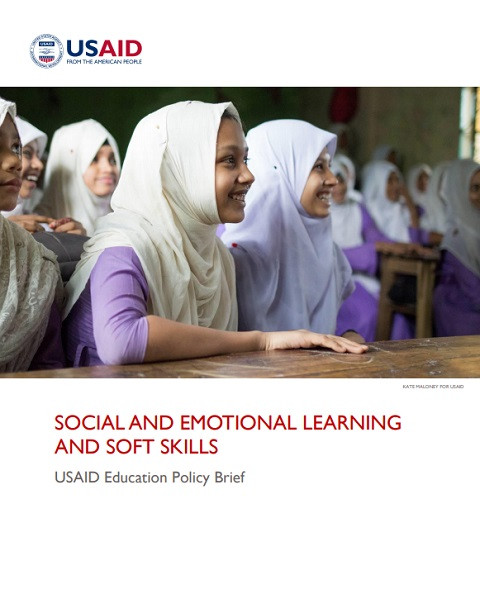 Social and Emotional Learning and Soft Skills: USAID Education Policy Brief 발행 연도: 2019 저자: Kalene Resler | Anjuli Shivshanker | Samantha Alvis | Chris Capacci-Carneal | Melissa Chiappetta | Lauren Greubel | Julie Hanson Swanson | Ashley Henderson | Josh Josa | Laura Lartigue | Rebeca Martinez | Leah Maxson | Olga Merchan | Yolande Miller-Grandvaux | Sandy Oleksy-Ojikutu | Rebecca Pagel | Nancy Taggart | Nina Weisenhorn | Wendy Wheaton 단체 저자: United States Agency for International Development (USAID) Both the 2018 USG Strategy on International Basic Education and the 2018 USAID Education Policy emphasize the importance of social and emotional skills or soft skills in assuring the long-term success of children and youth. Through the Strategy and Policy, USAID is providing new opportunities to systematically design, measure, implement, and understand the impact of programs that build social and emotional skills or soft skills for children and youth.To support USAID staff and implementing partners in this work, this brief: Provides an introductory understanding of what USAID means by the terms “social and emotional skills” and “soft skills” and how to communicate about them. Specifies the desired outcomes and quality standards for programming that teach social and emotional skills or soft skills. Identifies areas in which evidence and best practices still have gaps, and areas in which we should consider investing in further learning.
  Educación para la ciudanía y la convivencia: parceras y parceros por la paz (en 140 caracteres); ciclo tres (quinto, sexto y séptimo) 발행 연도: 2015 단체 저자: Secretaría de Educación del Distrito (SED) | Fe y Alegría These twelve modules make reference to a series of activities that focus on how children from all the educative grades understand and live citizenship, strengthening and facilitating the learning processes based on autonomy. This educative materials, which are aimed at being implemented inside the classrooms, attempt to serve as input resources for educators and other agents that work on or are interested in working with citizenship education and coexistence. The overall objective is to provide quality education.
 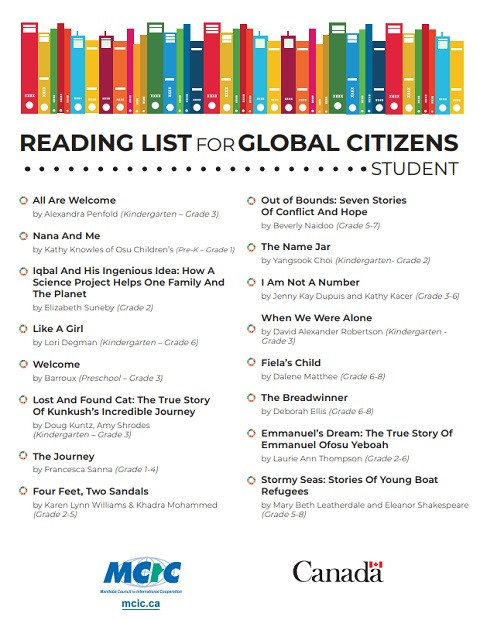 Reading List for Global Citizens: Student 발행 연도: 2020 단체 저자: Manitoba Council for International Cooperation (MCIC) | Global Affairs Canada (GAC) This is a reading list for global citizens from Kindergarten to Grade 12. These books will inspire students to take action whether they are passionate about food security, ending poverty, supporting women’s rights, or protecting the environment.
  A Comparative Analysis on Content Elements of Global Citizenship Education in 2009 and 2015 Revised Middle School Social Studies Curriculum (Education Research; Vol. 74) 발행 연도: 2019 저자: Kyunghee Sung | Soyeon Lee 단체 저자: Sungshin Women's University Educational Research Institute This study is a follow-up study of the 2017 research which analyzed content elements of global citizenship education in elementary school Social Studies. Based on the global citizenship education index, the content elements of are analyzed in the 2009 and 2015 revised middle school Social Studies curriculum, and then it was compared to the results of previous research in elementary school. As a result, it can be found that the content elements of global citizenship education in the middle school Social Studies are not increased or strengthened. In terms of 'strong connection', there was almost no change in the proportion of the cognitive domain and the socio-emotional domain, but rather it decreased in the behavioral domain. Compared with the results of elementary school, it is appeared that elementary school showed a larger increase than the middle school in the proportion of content elements depending on the change of curriculum. Through this, it can be confirmed that the global citizenship education was strengthened in elementary school in the 2015 revised Social Studies curriculum. At the time of next curriculum revision, it will be necessary to consider adding and revising the content elements related to global citizenship education to meet the needs of international community. 2009 개정과 2015 개정 중학교 ‘사회’ 교육과정에 나타난 세계시민교육 내용요소 비교 분석 (교육연구; Vol. 74) 발행 연도: 2019 저자: Kyunghee Sung | Soyeon Lee 단체 저자: Sungshin Women's University Educational Research Institute 본 연구는 초등학교 ‘사회’ 교육과정의 세계시민교육 내용요소를 분석한2017년 연구의 후속 연구로, 세계시민교육 지표에 근거하여 2009 개정 및 2015 개정중학교 ‘사회’ 교육과정에 나타난 내용요소를 분석하고, 나아가 이전의 초등학교 연구결과와도 비교⋅분석을 수행하였다. 분석 결과, 2009 개정 대비 2015 개정의 중학교‘사회’에서 세계시민교육 내용요소의 비중이 증가하거나 강화되는 모습을 발견할 수없었다. 강한 관련성을 중심으로 영역별로 살펴보면, 인지 영역과 사회⋅정서적 영역의비중 변화는 거의 없었으며, 행동적 영역에서는 오히려 감소하였다. 초등학교 ‘사회’ 분석 결과와 비교하면, 교육과정 변화에 따른 내용요소 비중의 증가 폭과 내용 심화가중학교급보다 초등학교급이 더 큰 것으로 나타났다. 이를 통해 2015 개정 교육과정에서는 초등학교급에서 세계시민교육이 강화되었음을 확인할 수 있었다. 향후 세계시민교육 차원에서 중학교 ‘사회’가 시대의 흐름 및 국제사회의 요구에 부응할 수 있도록차기 교육과정 개편 시 내용요소 추가 및 수정이 고려될 필요가 있을 것이다.
  可欲且可行的全球公民教育实践路径: 苏格兰“全球故事情节法”探析 (外国教育研究; Vol. 47, No. 3) 발행 연도: 2020 저자: Rao Shuqi 단체 저자: Northeast Normal University 研究发现,全球公民教育的热度不高与其实践层面的三重困境有关。“全球故事情节法”之所以成为苏格兰实施全球公民教育的最有效路径,正是源自于其对实践困境的有效回应:其一,政府对全球公民教育的倡导营造了相对宽松的政策环境,“全球故事情节法”与现有课程体系相融合获得了灵活的实践空间,实现了安全的课程地位。其二,通过对“故事情节法”和教育戏剧的运用,使全球社会和全球议题通俗化,实现了学生的体验式学习,弥合了学生认知能力和认知需求间的矛盾。其三,西苏格兰发展教育中心通过职业培训传播了理论知识和实践能力,构建了围绕全球公民教育的共同体,为教师提供了教学支持。
 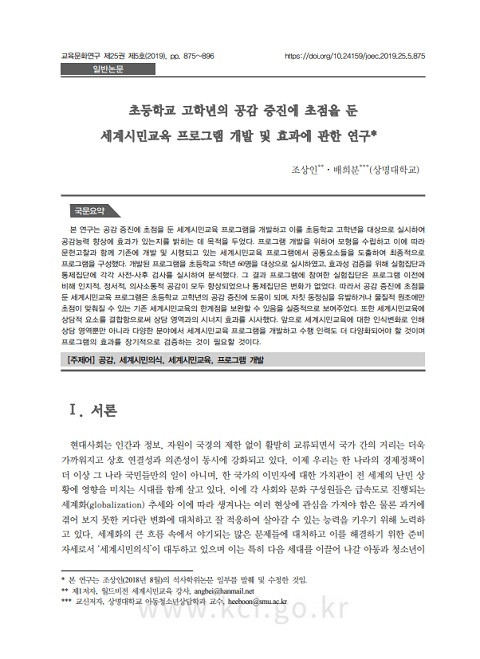 A Study on the Development and Effects of the Global Citizenship Education Program Focusing on Improving Empathic Ability of Higher Grade Elementary School Students (Journal of Education & Culture; Vol. 25, No. 5) 발행 연도: 2019 저자: Cho Sangin | Bae Heeboon 단체 저자: Inha University. Education Research Institute This study aims to develop a global citizenship education program focused on empathy enhancement, apply it to Elementary School Students in Higher Grade, and reveal whether it has an effect on empathic ability improvement. A program development model was established for program development and along with literary review and common elements were drawn from global citizenship education programs that had previously been developed and applied to construct the final program. The developed program was applied to 60 fifth grade students and for effectiveness verification, pre and post tests were conducted on both the test group and control group. As a result, the test group participating in the program displayed more improvement in cognitive, emotional, and communicative empathy than the group before participating the program but the control group showed no change. Therefore, it was empirically shown that global citizenship education programs focusing on empathy enhancement do help to enhance the empathy of higher grade elementary school students and that they overcome the limitations of previous global citizenship education that simply provokes sympathy or only focuses on material support. Also, by combining counseling elements with global citizenship education, it implied synergy effects with counseling domains. 초등학교 고학년의 공감 증진에 초점을 둔 세계시민교육 프로그램 개발 및 효과에 관한 연구 (교육문화연구; Vol. 25, No. 5) 발행 연도: 2019 저자: 조상인 | 배희분 단체 저자: 인하대학교 교육연구소 본 연구는 공감 증진에 초점을 둔 세계시민교육 프로그램을 개발하고 이를 초등학교 고학년을 대상으로 실시하여 공감능력 향상에 효과가 있는지를 밝히는 데 목적을 두었다. 프로그램 개발을 위하여 모형을 수립하고 이에 따라 문헌고찰과 함께 기존에 개발 및 시행되고 있는 세계시민교육 프로그램에서 공통요소들을 도출하여 최종적으로 프로그램을 구성했다. 개발된 프로그램을 초등학교 5학년 60명을 대상으로 실시하였고, 효과성 검증을 위해 실험집단과 통제집단에 각각 사전-사후 검사를 실시하여 분석했다. 그 결과 프로그램에 참여한 실험집단은 프로그램 이전에 비해 인지적, 정서적, 의사소통적 공감이 모두 향상되었으나 통제집단은 변화가 없었다. 따라서 공감 증진에 초점을둔 세계시민교육 프로그램은 초등학교 고학년의 공감 증진에 도움이 되며, 자칫 동정심을 유발하거나 물질적 원조에만 초점이 맞춰질 수 있는 기존 세계시민교육의 한계점을 보완할 수 있음을 실증적으로 보여주었다. 또한 세계시민교육에 상담적 요소를 결합함으로써 상담 영역과의 시너지 효과를 시사했다. 앞으로 세계시민교육에 대한 인식변화로 인해 상담 영역뿐만 아니라 다양한 분야에서 세계시민교육 프로그램을 개발하고 수행 인력도 더 다양화 되어야 할 것이며 프로그램의 효과를 장기적으로 검증하는 것이 필요할 것이다.
 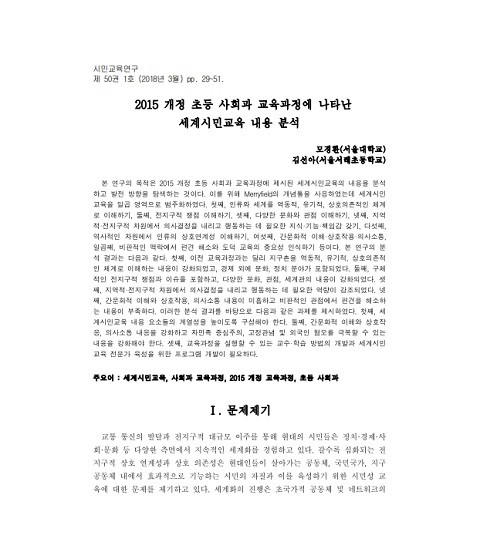 A Critical Analysis of Global Citizenship in 2015 Revised Elementary Social Studies Curriculum (Theory and Research in Citizenship Education; Vol. 50, No. 1) 발행 연도: 2018 저자: Kyunghwan Mo | Sunah Kim 단체 저자: Korea Association of Social Education The purpose of this study was to examine how global citizenship is reflected in the 2015 revised social studies curriculum. The study used the conceptual framework of Merryfield(1998) to analyze the national curriculum. The results of the analysis are as follows. First, in terms of understanding of the world as interdependent systems, contents on politics and culture as well as economy increased. Second, more global issues and problems were included. Third, contents on sustainable development increased. Fourth, the scope of diversity expanded. Fifth, interconnectedness of humans through time was inadequately reflected in the current social studies curriculum. Sixth, contents on values and attitudes, and actions were strengtened. Sixth, contents of cross-cultural understanding, interaction, and communication are not adequately included. The elementary social studies curriculum should strengthen cross-cultural understanding and interaction and prejudice reduction. Also, more instructional methods for global citizenship education should be developed and teacher education programs should be overhauled.