
자료
세계시민교육에 대한 이해를 넓히고 연구, 옹호 활동, 교수, 학습 등을 향상시킬 수 있는 다양하고 유용한 자료를 찾아보세요.
3,126 건의 결과가 검색되었습니다
 Recommandation sur l’éducation pour la paix, les droits de l’homme et le développement durable: un guide de mise en oeuvre 발행 연도: 2025 단체 저자: UNESCO Il n’y a pas de paix sans éducation. Face à la multiplication des conflits sur de nombreux fronts, jamais la nécessité d’une éducation transformée, orientée vers la construction et le maintien de la paix, n’a été aussi pressante. La Recommandation sur l’éducation pour la paix et les droits de l’homme, la compréhension internationale, la coopération, les libertés fondamentales, la citoyenneté mondiale et le développement durable, adoptée en 2023 par l’ensemble des 194 États membres de l’UNESCO, exprime une vision humaniste et transformatrice de l’éducation, capable de répondre aux défis actuels et futurs à la paix. Ces défis vont de la résurgence de conflits alimentés par les inégalités et injustices systémiques, à la montée et la diffusion des discours de haine, du racisme et de la discrimination – notamment en ligne – en passant par les effets négatifs des technologies numériques et la menace existentielle que constitue le changement climatique. L’UNESCO a élaboré le présent Guide comme le premier d’une série d’outils destinés à aider les États membres à comprendre et à mettre pleinement en œuvre la Recommandation de 2023. Le Guide développe son contenu, en intégrant la perspective transdisciplinaire de la Recommandation afin de relier concepts et enjeux clés. Il propose également des pistes concrètes et des ressources sélectionnées pour 2 milliards de personnes – un quart de l’humanité – vivent dans des zones touchées par des conflits l’action à différents niveaux et dans divers types d’éducation, tout en appelant à une approche multi-acteurs et à l’échelle de la société, qui inclut toutes et tous et s’appuie sur les efforts positifs déjà entrepris. Le Guide constitue une ressource collective opportune pour mettre pleinement en œuvre la Recommandation de 2023 et promouvoir une éducation véritablement transformatrice au service d’un monde plus juste et pacifique.
  Recomendación sobre la educación para la paz, los derechos humanos y el desarrollo sostenible: guía de implementación 발행 연도: 2026 단체 저자: UNESCO Sin educación no hay paz. Una educación transformadora, orientada a la construcción y el mantenimiento de la paz es más urgente que nunca, dado el aumento de los conflictos en diversos frentes.La Recomendación sobre la Educación para la Paz y los Derechos Humanos, la Comprensión Internacional, la Cooperación, las Libertades Fundamentales, la Ciudadanía Mundial y el Desarrollo Sostenible, que fue adoptada por los 194 Estados Miembros de la UNESCO en 2023, articula la visión humanista y transformadora de la educación que ayuda a abordar los actuales y futuros agravios a la paz. Estos desafíos abarcan desde el resurgimiento de conflictos impulsados por desigualdades e injusticias sistémicas, el auge y la propagación del discurso de odio, el racismo y la discriminación—especialmente en línea—, hasta los efectos adversos de las tecnologías digitales y la amenaza existencial del cambio climático.La UNESCO ha elaborado esta Guía como la primera de varias herramientas que ayudarán a los Estados miembro a comprender e implementar plenamente la Recomendación de 2023. Su contenido ha sido desarrollado integrando la perspectiva transdisciplinaria para conectar conceptos y cuestiones clave de la Recomendación de 2023. Además, proporciona ideas concretas y recursos seleccionados para la acción en distintos niveles y tipos de educación. Asimismo, promueve un enfoque multisectorial que parte de las iniciativas positivas ya en marcha y busca la inclusión de todas las personas.Esta Guía es una incorporación oportuna al conjunto de recursos colectivos disponibles para implementar plenamente la Recomendación de 2023 y promover así una educación transformadora para un mundo justo y pacífico.
  Addressing Violent Pasts through Education: A Policy Guide 발행 연도: 2025 단체 저자: UNESCO Teaching about violent pasts and their legacies is a powerful way to foster sustainable peace.Education can build a nuanced understanding of complex histories, raise awareness of the roots and legacies of violence, nationally and internationally, and sensitize learners for their own agency as actors of change for reconciliation and conflict prevention.Educating about violent pasts is a challenging yet critical endeavour for policy-makers globally. It entails tailored approaches and an important support for educators to address traumatic pasts sensitively and to navigate related emotions and narratives successfully.Building on UNESCO’s programme on Global Citizenship Education, this guide offers education policy-makers a set of strategies, principles, and education practices to effectively integrate education about violent pasts into local education systems. It suggests a comprehensive approach that spans formal and informal education and aligns with the 2023 Recommendation on Education for Peace, Human Rights and Sustainable Development, opening new perspectives on history education, dialogue, and conflict transformation.
 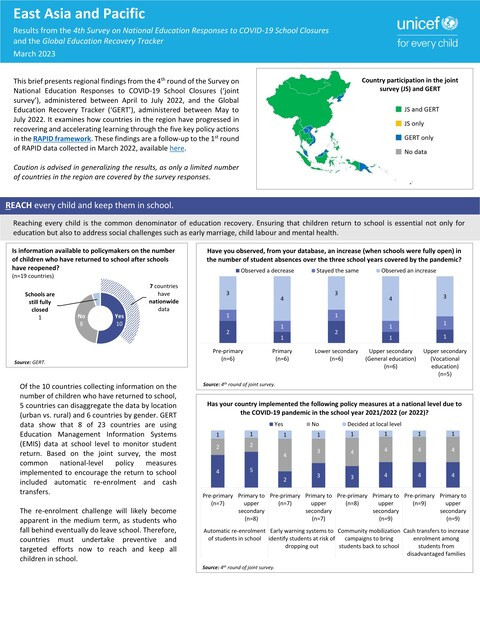 Education in a Post-COVID World: Towards a Rapid Transformation; East Asia and Pacific Regional Brief 발행 연도: 2023 단체 저자: United Nations Children's Fund (UNICEF) On March 11, 2020, the World Health Organization declared COVID-19 a global pandemic, resulting in disruptions to education at an unprecedented scale. In response to the urgent need to recover learning losses, countries worldwide have taken RAPID actions to: Reach every child and keep them in school; Assess learning levels regularly; Prioritize teaching the fundamentals; Increase the efficiency of instruction; and Develop psychosocial health and wellbeing. This brief presents regional findings from the 4th round of the Survey on National Education Responses to COVID-19 School Closures (‘joint survey’), administered between April to July 2022, and the Global Education Recovery Tracker (‘GERT’), administered between May to July 2022. It examines how countries in the region have progressed in recovering and accelerating learning through the five key policy actions in the RAPID framework. These findings are a follow-up to the 1st round of RAPID data collected in March 2022.
 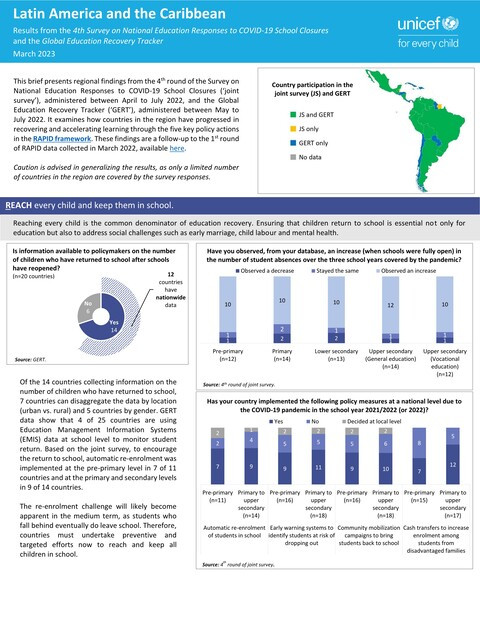 Education in a Post-COVID World: Towards a Rapid Transformation; Latin America and the Caribbean Regional Brief 발행 연도: 2023 단체 저자: United Nations Children's Fund (UNICEF) On March 11, 2020, the World Health Organization declared COVID-19 a global pandemic, resulting in disruptions to education at an unprecedented scale. In response to the urgent need to recover learning losses, countries worldwide have taken RAPID actions to: Reach every child and keep them in school; Assess learning levels regularly; Prioritize teaching the fundamentals; Increase the efficiency of instruction; and Develop psychosocial health and wellbeing. This brief presents regional findings from the 4th round of the Survey on National Education Responses to COVID-19 School Closures (‘joint survey’), administered between April to July 2022, and the Global Education Recovery Tracker (‘GERT’), administered between May to July 2022. It examines how countries in the region have progressed in recovering and accelerating learning through the five key policy actions in the RAPID framework. These findings are a follow-up to the 1st round of RAPID data collected in March 2022.
 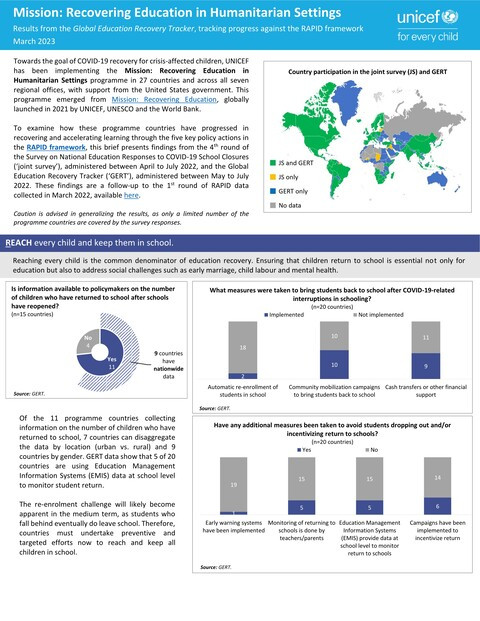 Education in a Post-COVID World: Towards a Rapid Transformation; Mission Recovering Education in Humanitarian Settings Brief 발행 연도: 2023 단체 저자: United Nations Children's Fund (UNICEF) Towards the goal of COVID-19 recovery for crisis-affected children, UNICEF has been implementing the Mission: Recovering Education in Humanitarian Settings programme in 27 countries and across all seven regional offices, with support from the United States government. This programme emerged from Mission: Recovering Education, globally launched in 2021 by UNICEF, UNESCO and the World Bank. To examine how these programme countries have progressed in recovering and accelerating learning through the five key policy actions in the RAPID framework, this brief presents findings from the 4th round of the Survey on National Education Responses to COVID-19 School Closures (‘joint survey’), administered between April to July 2022, and the Global Education Recovery Tracker (‘GERT’), administered between May to July 2022. These findings are a follow-up to the 1st round of RAPID data collected in March 2022.
 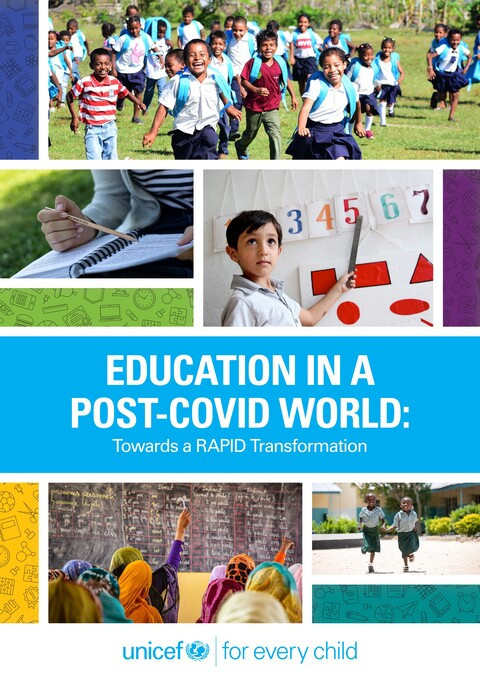 Education in a Post-COVID World: Towards a Rapid Transformation; Main Report 발행 연도: 2023 단체 저자: United Nations Children's Fund (UNICEF) On March 11, 2020, the World Health Organization declared COVID-19 a global pandemic, resulting in disruptions to education at an unprecedented scale. In response to the urgent need to recover learning losses, countries worldwide have taken RAPID actions to: Reach every child and keep them in school; Assess learning levels regularly; Prioritize teaching the fundamentals; Increase the efficiency of instruction; and Develop psychosocial health and wellbeing. Marking three years since the onset of the pandemic, this report looks back at policy measures taken during school closures and reopening based on country survey data, initiatives implemented by countries and regions to recover and accelerate learning, and their emerging lessons within each RAPID action. With schools now reopened worldwide, this report also looks ahead to longer-term education transformation, offering policy recommendations to build more resilient, effective and equitable education systems.
 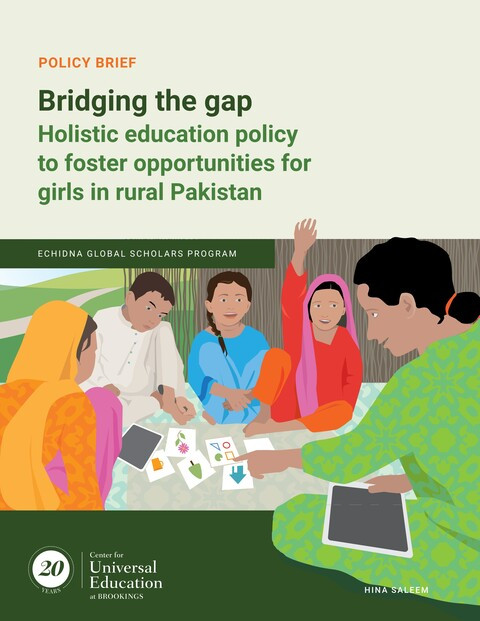 Bridging the Gap: Holistic Education Policy to Foster Opportunities for Girls in Rural Pakistan 발행 연도: 2023 저자: Hina Saleem 단체 저자: Center for Universal Education at Brookings Seven out of ten girls in rural Sindh are excluded from schooling. This happens for a myriad of reasons and occurs both in the presence and absence of operational school buildings. When schools are present, the challenges that children—especially girls—face due to their economic and social context often go unaddressed; children who are able to enroll in school often find their learning affected by classroom design and practices and experiences that mirror the exclusion they experience outside of school. At the broader level, this exclusion is reflected in limited representation of the needs and aspirations of sizable rural populations in Pakistan’s formal education system and the pathways beyond it. This policy brief presents findings from on-the-ground research in rural settlements in Sindh province that explores the disparities between boys and girls in enrollment and continuation of schooling in addition to overall inadequate education outcomes. It also provides policy recommendations to support all children and particularly girls in meeting their education needs and aspirations. Education policy must respond to these challenges of unmet education needs and aspirations by taking a holistic, welfare-based approach that supports children to overcome the effects of exclusionary conditions to meet their education needs. However, the benefits of such an approach can only be realized if teaching practices and learning experiences are contextualized, build a connection with local knowledge, question root causes of exclusion and support and prepare all children in negotiating pathways beyond education.
 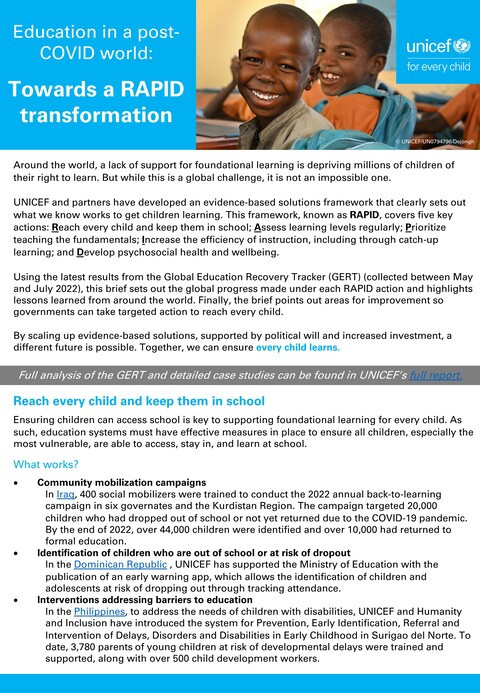 Education in a Post-COVID World: Towards a Rapid Transformation; Advocacy Brief 발행 연도: 2023 단체 저자: United Nations Children's Fund (UNICEF) Around the world, a lack of support for foundational learning is depriving millions of children of their right to learn. But while this is a global challenge, it is not an impossible one. UNICEF and partners have developed an evidence-based solutions framework that clearly sets out what we know works to get children learning. This framework, known as RAPID, covers five key actions: Reach every child and keep them in school; Assess learning levels regularly; Prioritize teaching the fundamentals; Increase the efficiency of instruction, including through catch-up learning; and Develop psychosocial health and wellbeing. Using the latest results from the Global Education Recovery Tracker (GERT) (collected between May and July 2022), this brief sets out the global progress made under each RAPID action and highlights lessons learned from around the world. Finally, the brief points out areas for improvement so governments can take targeted action to reach every child.
 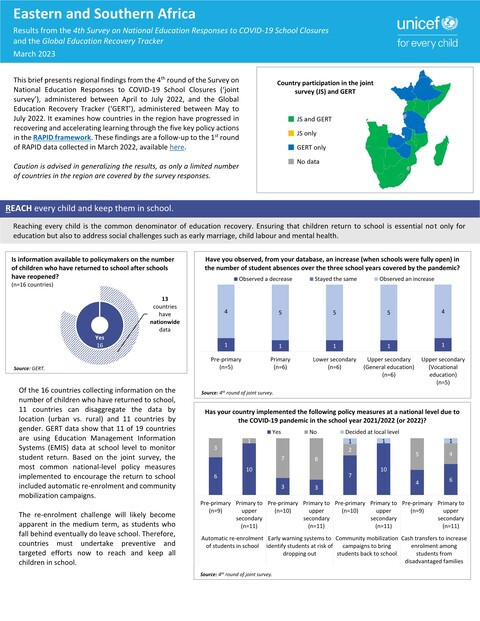 Education in a Post-COVID World: Towards a Rapid Transformation; Eastern and Southern Africa Regional Brief 발행 연도: 2023 단체 저자: United Nations Children's Fund (UNICEF) On March 11, 2020, the World Health Organization declared COVID-19 a global pandemic, resulting in disruptions to education at an unprecedented scale. In response to the urgent need to recover learning losses, countries worldwide have taken RAPID actions to: Reach every child and keep them in school; Assess learning levels regularly; Prioritize teaching the fundamentals; Increase the efficiency of instruction; and Develop psychosocial health and wellbeing. This brief presents regional findings from the 4th round of the Survey on National Education Responses to COVID-19 School Closures (‘joint survey’), administered between April to July 2022, and the Global Education Recovery Tracker (‘GERT’), administered between May to July 2022. It examines how countries in the region have progressed in recovering and accelerating learning through the five key policy actions in the RAPID framework. These findings are a follow-up to the 1st roundof RAPID data collected in March 2022.