
자료
세계시민교육에 대한 이해를 넓히고 연구, 옹호 활동, 교수, 학습 등을 향상시킬 수 있는 다양하고 유용한 자료를 찾아보세요.
3,158 건의 결과가 검색되었습니다
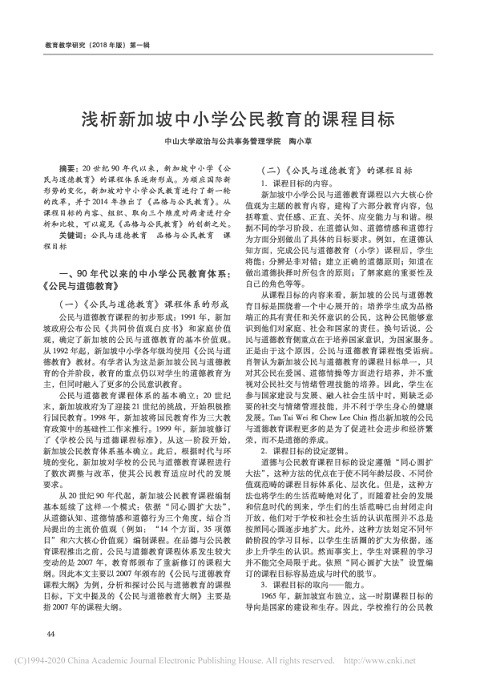 A Brief Analysis of the Curriculum Objectives of Citizenship Education in Primary and Secondary Schools in Singapore 발행 연도: 2018 저자: Tao Xiaocao 단체 저자: Guangdong Chenyue Education Development Since the 1990s, the curriculum system of Citizenship and Moral Education has gradually taken shape in Singapore’s primary and secondary schools. In order to adapt to the new international situation, Singapore has carried out a new round of reform on citizenship education in primary and secondary schools, and launched character and Citizenship Education in 2014. From course objectives to content, organization. By analyzing and comparing the two in the three dimensions of orientation, we can see the innovation of Citizenship and Moral Education. 浅析新加坡中小学公民教育的课程目标 발행 연도: 2018 저자: Tao Xiaocao 단체 저자: Guangdong Chenyue Education Development 20 世纪 90 年代以来 , 新加坡中小学 《 公 民 与 道德教育 》 的课程体系逐渐形成 。 为顺应国际新形势的变化 , 新加坡对中小学公民教育进行了新一轮的改革 , 并于 2014 年推出了 《 品格与公民教育 》 。 从课程 目标的内容 、 组织 、取向三个维度对两者进行分析和比较 , 可以 窥见 《 品格与 公民 教育 》 的创新之处 。
  Global Education in Estonia: The European Global Education Peer Review Process; National Report on Global Education in Estonia 발행 연도: 2019 단체 저자: Global Education Network Europe (GENE) | European Union (EU) This National Report contains the findings from the Peer Review of Global Education in Estonia that took place during 2019. It provides an overview of Global Education in the country and includes observations and recommendations intended to assist Estonian Global Education actors to further improve and increase provision in the country.
  The State of Global Education in Europe 2019 발행 연도: 2020 단체 저자: Global Education Network Europe (GENE) | European Union (EU) This fourth edition of the State of Global Education in Europe has been developed to provide an updated account of current key issues, policy priorities, funding trends and activities inGlobal Education in Europe, among the Ministries and Agencies that participate in GENE. This report explores key trends, policy themes and budgetary information for Global Education in European countries, drawing on information provided by GENE member Ministries and Agencies during 2018 and 2019.
  Measuring What Matters: Citizenship Domain 발행 연도: 2014 저자: Alan Sears 단체 저자: People for Education This report examines why citizenship is a core value for long term success for students and a cohesive, democratic society.
  Primary schools and Prevent 발행 연도: 2008 단체 저자: United Kingdom. Department for Children, Schools and Families This resource pack has been created to reduce the likelihood of young people becoming radicalized and then engaging in any form of violent extremism. The aim of ‘Prevent’ is to stop people becoming or supporting terrorists and to do this by challenging ideologies, protecting vulnerable individuals and supporting institutions, such as schools. It is part of the National Counter Terrorism Strategy known as CONTEST. Primary schools and Prevent 발행 연도: 2008 단체 저자: United Kingdom. Department for Children, Schools and Families Cet ensemble de ressources a été élaboré afin d’empêcher, autant que possible, les jeunes de se radicaliser et de s’engager ensuite sur la voie de l’extrémisme violent. En effet, l’objectif d’une action préventive est d’empêcher les individus de rejoindre ou de supporter les groupes terroristes, en poussant à la remise en question de ces idéologies, en protégeant les personnes vulnérables et en soutenant les institutions en première ligne telles que les écoles. Cet outil participe ainsi à la Stratégie Nationale britannique de lutte contre le terrorisme, appelée CONTEST.
 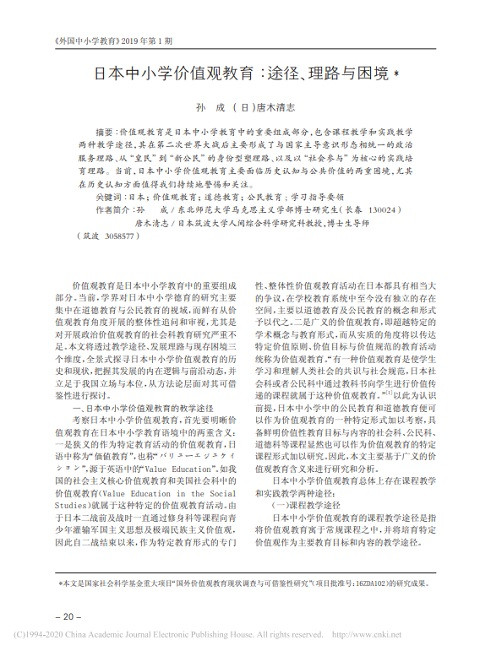 Values Education in Primary and Secondary School of Japan: Approach, Orderliness and Dilemma (Primary & Secondary Schooling Abroad; No. 1) 발행 연도: 2019 저자: Sun Cheng | Karaki Kiyoshi 단체 저자: Shanghai Normal University Values education is an important part of primary and secondary education in Japan. It has two teaching approaches: curriculum teaching and practical teaching. After the Second World War, it has formed a political service orderliness which is unified with the national dominant ideology, a cultivating orderliness which is from the “Imperial People” to the “New Citizen”, a practical orderliness which is developing around the “Social Participation”. At present, Japan’s values education in primary and secondary schools mainly faces the dual dilemma of historical cognition and public value, especially in the aspect of historical cognition, which deserves our constant vigilance and attention. 日本中小学价值观教育:途径、理路与困境 (外国中小学教育; No. 1) 발행 연도: 2019 저자: Sun Cheng | Karaki Kiyoshi 단체 저자: Shanghai Normal University 价值观教育是日本中小学教育中的重要组成部分,包含课程教学和实践教学 两种教学途径,其在第二次世界大战后主要形成了与国家主导意识形态相统一的政治 服务理路、从“皇民”到“新公民”的身份型塑理路、以及以“社会参与”为核心的实践培 育理路。当前,日本中小学价值观教育主要面临历史认知与公共价值的两重困境,尤其 在历史认知方面值得我们持续地警惕和关注。
 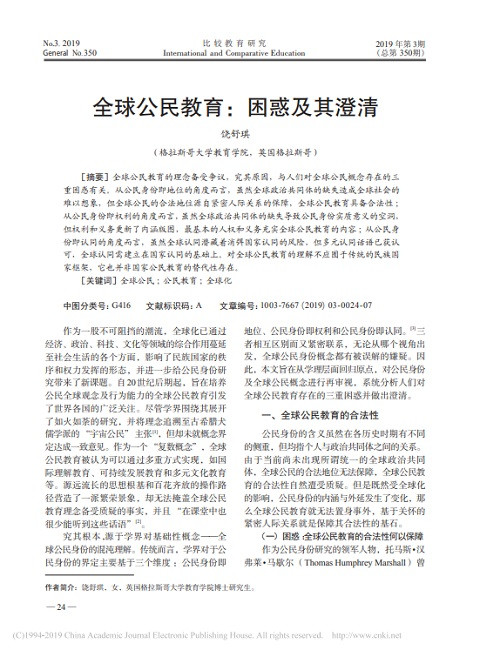 Global Citizenship Education: Confusion and Clarification (International and Comparative Education; No. 3) 발행 연도: 2019 저자: Rao Shuqi 단체 저자: Beijing Normal University As a debatable and controversial area, global citizenship education has not been elevated to the center of practical agenda due to three confusion surround the term. From the aspect of regarding citizenship as status, the absence of global political community makes global society unimaginable. However, as the legal status of global citizen originates from the confirmation of intimate interpersonal relationship, global citizenship education enjoys legitimacy. From the aspect of conceiving citizenship as rights, the absence of global political community leads to global citizenship vacuous in essence. However, as the landscape of rights and responsibilities has been transformed, the contents of global citizenship education are enriched by pervasive human rights and responsibilities. From the aspect of considering citizenship as identity, global identity runs a risk of diminishing the need for national identity. However, given the consensus concerning the discourse of multidimensional identity, global identity should be developed on the basis of national identity. The perception of global citizenship education should not be confined within the traditional nation-state framework. Global citizenship education is not an alternative to national citizenship education.