
자료
세계시민교육에 대한 이해를 넓히고 연구, 옹호 활동, 교수, 학습 등을 향상시킬 수 있는 다양하고 유용한 자료를 찾아보세요.
3,158 건의 결과가 검색되었습니다
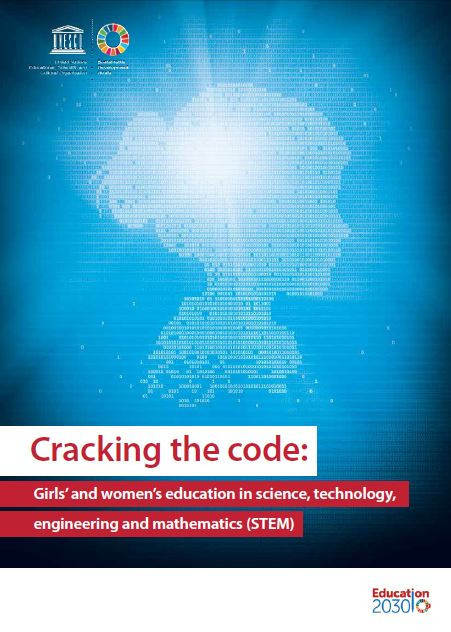 Cracking The Code: Girls’ and Women’s Education in Science, Technology, Engineering and Mathematics (STEM) 발행 연도: 2017 단체 저자: UNESCO Despite significant improvements in recent decades, education is not universally available and gender inequalities persist. A major concern in many countriesis not only limited numbers of girls going to school, but also limited educational pathways for those that step into the classroom. This includes, more specifically,how to address the lower participation and learning achievement of girls in science, technology, engineering and mathematics (STEM) education. STEM underpins the 2030 Agenda for Sustainable Development, and STEM education can provide learners with the knowledge, skills, attitudes and behavioursrequired for inclusive and sustainable societies. Leaving out girls and women in STEM education and careers is a loss for all. This report aims to ‘crack the code’, or to decipher the factors that hinder or facilitate girls’ and women’s participation, achievement and continuation in STEMeducation, and what can be done by the education sector to promote girls’ and women’s interest in, and engagement with, STEM. Déchiffrer le Code: L'Éducation des Filles et des Femmes aux Sciences, Technologie, Ingénierie et Mathématiques (STEM) 발행 연도: 2017 단체 저자: Organisation des Nations Unies pour l'éducation, la science et la culture (UNESCO) Malgrédes améiorations notables ces dernièes déennies, l’éucation n’est pas universellement disponible et les inéalité entre les genres persistent, souvent en déaveur des filles. Des facteurs socio-culturels et éonomiques complexes et lié entre eux pèent non seulement sur les possibilité de scolarisation des filles mais aussi sur la qualitéde l’éucation qu’elles recevront, les éudes qu’elles suivront et, au bout du chemin, leurs carrièes et leurs parcours de vie. Une préccupation majeure tient àla faiblesse de la participation et des réultats des filles dans les éudes de sciences, technologie, ingéierie et mathéatiques (STEM). Les STEM sous-tendent le Programme de déeloppement durable àl’horizon 2030 et l’éucation aux STEM peut apporter aux apprenants les connaissances, les compéences et les comportements néessaires àdes sociéé inclusives et durables. Laisser les filles et les femmes àl’éart de l’éucation et des professions des STEM non seulement les prive de la possibilitéde contribuer aux STEM et d’en bééicier, mais aussi perpéue le fosséentre les sexes et, plus gééalement, les inéalité sociales et éonomiques. Le présent rapport vise à« déhiffrer le code » en déryptant les facteurs qui entravent ou facilitent la participation, la réssite et la réention des filles et des femmes dans l’éucation aux STEM et, en particulier, ce que peut faire le secteur de l’éucation pour promouvoir l’intéê et l’engagement des filles et des femmes dans l’éucation aux STEM et finalement dans les carrièes des STEM. Il entend constituer une ressource pour les parties prenantes de l’éucation et autres personnes qui travaillent àpromouvoir l’éalitédes genres.
  UNESCO at COP23: Climate Change Education 발행 연도: 2017 단체 저자: UNESCO This brochure contains information about UNESCO's role of education in climate change through ESD(Education for Sustainable Development). Education for Sustainable Development (ESD) is increasingly recognized around the world as an effective enabler for a more sustainable future. Building climate change awareness and building capacities for adaptation and mitigation are critical dimensions of ESD. The critical role of education in climate change responses was clearly recognized at the Paris Climate Conference (COP21) in December 2015. COP22 in Marrakesh and COP23 in Bonn reiterate the importance of climate change education in achieving the global agendas.
  From insult to inclusion: Asia-Pacific report on school bullying, violence and discrimination on the basis of sexual orientation and gender identity 발행 연도: 2015 단체 저자: UNESCO This review recognises the complexity in terminology globally, and within the region, on sex, sexuality and gender. For simplicity, ‘SOGIE-based bullying, violence and discrimination’ is used to refer to the various anifestations of violence and exclusion based on gender discrimination, gender role expectations and stereotypes, intersex prejudice, and societal expectations for heterosexual relationships. This is sometimes referred to as homophobic or transphobic bullying, violence and discrimination. This report considers violence experienced by children and young people because of actual or perceived sexual orientation and gender identity or expression, or because their bodies differ from typical definitions of male or female. The term ‘LGBTI people/youth’ is used in this report when inclusive of intersex persons, and LGBT when the situation or needs of intersex people/ youth have not been considered. Local terms and those from original studies are also included, and the glossary provides information for readers on concepts and terms in this report. De l'insulte à l'inclusion: Rapport sur l'Asie-Pacifique sur les brimades à l'école, la violence et la discrimination sur la base de l'orientation sexuelle et l'identité de genre 발행 연도: 2015 단체 저자: Organisation des Nations Unies pour l'éducation, la science et la culture (UNESCO) Cet avis reconnaît la complexité de la terminologie au niveau mondial, et dans la région, sur le sexe, la sexualité et le genre. Par souci de simplicité, ‘sur la base Sogie l'intimidation, la violence et la discrimination’ est utilisé pour désigner les différents anifestations de violence et d'exclusion fondées sur la discrimination entre les sexes, les attentes de rôle de genre et les stéréotypes, les préjugés intersexe et attentes de la société pour les relations hétérosexuelles. Ceci est parfois désigné comme homosexuels ou les transsexuels intimidation, la violence et la discrimination. Ce rapport considère la violence vécue par les enfants et les jeunes en raison de l'orientation et l'identité ou l'expression sexuelle réelle ou perçue, ou parce que leurs corps diffèrent des définitions typiques de sexe masculin ou féminin. Le terme «personnes LGBTI / jeunesse» est utilisé dans ce rapport lorsque compris les personnes intersexuées et LGBT lorsque la situation ou les besoins des personnes intersexuées / jeunes n'ont pas été pris en considération. Les termes locaux et ceux des études originales sont également inclus, et le glossaire fournit des informations pour les lecteurs sur les concepts et termes utilisés dans ce rapport.
  Survey on Privacy in Media and Information Literacy with Youth Perspectives 발행 연도: 2017 저자: Sherri Hope Culver | Alton Grizzle 단체 저자: UNESCO Media and information literate individuals are more empowered to make informed decisions about their privacy online and offline, among other things. Accordingly, governments and policy-makers who are committed to ensuring that the privacy of citizens is respected should also be committed to media and information literacy (MIL) for all. If they are not, then their efforts will be less sustainable. Equally, private and public enterprises that genuinely want to respect the privacy of citizens should purposefully contribute to MIL awareness among users qua citizens. Two research surveys are referenced in this report. The first investigated youth attitudes towards MIL and social and democratic discourses. One of the seven themes addressed in the context of social and democratic discourses was privacy. The research was carried out by UNESCO. The second survey studied privacy in MIL courses globally and was conducted for UNESCO by the UNESCO-UNAOC University Network on Media and Information Literacy and Intercultural dialogue (MILID Network), and members of the Global Alliance for Partnerships in Media and Information Literacy (GAPMIL). The report responds to UNESCO’s efforts to stimulate global research into privacy in MIL. Ultimately, this report aims to provide conceptual, development and policy recommendations to foster privacy in MIL, while enabling the critical engagement of people, including young women and men, in an environment conducive to sustainable development and to freedom of expression online and offline. It seeks to provide clarity on the complex issue of how MIL and privacy intersect.
 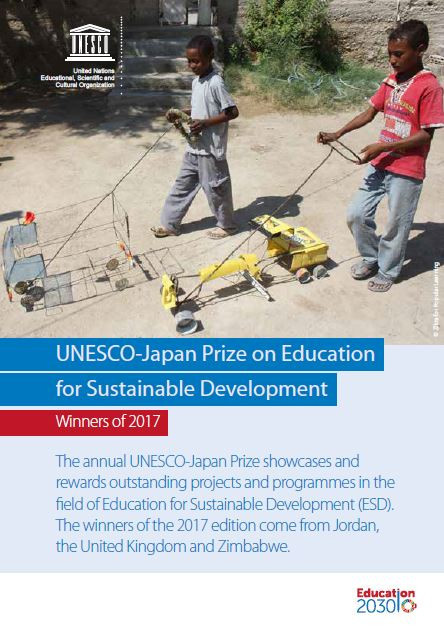 Prix UNESCO-Japon D'éducation en vue du Développement Durable: Lauréats de 2017 발행 연도: 2017 단체 저자: Organisation des Nations Unies pour l'éducation, la science et la culture (UNESCO) L’année 2017 marque la troisième édition du Prix UNESCO-Japon. Les lauréats ont été sélectionnés parmi plus de 100 candidatures présentées par des gouvernements d’États membres de l’UNESCO et par des organisations non gouvernementales en partenariat officiel avec l'UNESCO. Les candidatures ont été évaluées par un jury indépendant composé de cinq experts internationaux de l’EDD, qui ont recommandé les trois lauréats à la Directrice générale de l’UNESCO.Parmi les lauréats de cette année figurent une école, une entreprise et une organisation à but non lucratif oeuvrant à la promotion de l’EDD, respectivement à l’échelle locale, régionale et internationale : l’école primaire Sihlengeni (République du Zimbabwe) ; l’entreprise sociale Zikra (Royaume hachémite de Jordanie) ; et le projet Hard Rain (Royaume-Uni de Grande-Bretagne et d'Irlande du Nord). Chaque lauréat recevra une récompense d’un montant de 50,000 dollars des États-Unis.La Directrice générale de l’UNESCO et le Ministre de l’éducation japonais remettront le Prix aux trois lauréats au cours d’une cérémonie qui se tiendra le 3 novembre 2017 au Siège de l’UNESCO à Paris, lors de la 39e session de la Conférence générale. Premio UNESCO-Japon de Educacion para el Desarrollo Sostenible: Galardonados de 2017 발행 연도: 2017 단체 저자: Organización de las Naciones Unidas para la Educación, la Ciencia y la Cultura (UNESCO) En 2017 el Premio UNESCO-Japon llegaba a su tercera edicion. Los galardonados fueron elegidos de entre las mas de 100 candidaturas presentadas por gobiernos de Estados Miembros de la UNESCO y organizaciones no gubernamentales quecolaboran oficialmente con la Organizacion. Tras examinar las candidaturas, un jurado independiente formado por cinco especialistas internacionales en EDS recomendo los tres galardonados a la Directora General de la UNESCO.Este ano se ha concedido el premio a una escuela, una empresa y una organizacion sin animo de lucro que promueven la EDS a escala local, regional y mundial respectivamente: la escuela de primaria Sihlengeni, de la Republica de Zimbabwe; Zikra por el Aprendizaje Popular, del Reino Hachemita de Jordania; y el Proyecto Hard Rain, del Reino Unido de Gran Bretana e Irlanda del Norte. Cada una de estas entidades recibira un premio en metalico de 50,000 dolares estadounidenses.La Directora General de la UNESCO y el Ministro de Educacion del Japon haran entrega del Premio a los tres galardonados en el curso de una ceremonia que tendra lugar en la Sede de la UNESCO (Paris) el 3 de noviembre de 2017, coincidiendo con la celebracion de la 39ª reunion de la Conferencia General.
  Human rights education in the school systems of Europe, Central Asia and North America: a compendium of good practice 발행 연도: 2009 단체 저자: Council of Europe | UNESCO | UN. Office of the United Nations High Commissioner for Human Rights (UN. OHCHR) | OSCE. Office for Democratic Institutions and Human Rights (ODIHR) “Human Rights Education in the School Systems of Europe, Central Asia and North America: A Compendium of Good Practice” is a compilation of 101 examples of good practice in human rights education in primary schools, secondary schools and teacher training institutions in the Organization for Security and Co-operation in Europe (OSCE) area, which is also covered by the United Nations Educational, Scientific and Cultural Organization (UNESCO), the Office of the United Nations High Commissioner for Human Rights (OHCHR) and, partially, the geographical mandate of the Council of Europe (CoE).The term “human rights education” is often used in this resource in a broader sense, to also include educationfor democratic citizenship and education for mutual respect and understanding, which are all based on internationally agreed human rights standards. These three areas are seen as interconnected and essential within educational systems in order to prepare youth to be active, responsible and caring participants in their communities, as well as at the national and global levels.Human rights education has been defined as education, training and information aimed at building a universal culture of human rights. A comprehensive education in human rights not only provides knowledge about human rights and the mechanisms that protect them, but also imparts the skills needed to promote, defend and apply human rights in daily life. Education for democratic citizenship focuses on educational practices and activities designed to help young people and adults to play an active part in democratic life and exercise their rights and responsibilities in society. Education for mutual respect and understanding highlights self-respect, respect for others, and the improvement of relationships between people of differing cultural traditions.This book aims to support quality teaching in these areas and to inspire educational policymakers (those working in education ministries and local school boards) and administrators, teachers, teacher trainers, non-formal educators and all other interested actors, as well as to facilitate networking and the exchange of experience among education professionals.
  Stopping violence in schools: a guide for teachers 발행 연도: 2014 단체 저자: UNESCO “Stopping Violence in Schools: A Guide for Teachers” examines various forms of violence that take place in schools, and offers practical suggestions as to what teachers can do to prevent them. Ten action areas are proposed, each with specific examples that teachers can adapt to address and prevent violence. Excerpts from relevant international normative instruments as well as a list of links to online resources for stopping violence in schools are annexed at the end of the book.