
자료
세계시민교육에 대한 이해를 넓히고 연구, 옹호 활동, 교수, 학습 등을 향상시킬 수 있는 다양하고 유용한 자료를 찾아보세요.
3,548 건의 결과가 검색되었습니다
 Beyond Access: Toolkit for Integrating Gender-based Violent Prevention and Response into Education Projects 발행 연도: 2015 단체 저자: United States Agency for International Development (USAID) This toolkit was developed to support implementation of the U.S. Strategy to Prevent and Respond to Gender-based Violence Globally. It provides guidance and resources for USAID technical and program officers working on education to increase understanding of GBV in the education context and strengthen integration of a gender-based violence (GBV) response into projects and activities. Because reducing school-related GBV is a high priority for USAID in all school systems globally, this toolkit includes school-related GBV, but the overall focus is GBV in the education context broadly.The Toolkit provides:The United States government definition of GBV and USAID’s definition of school-related GBVExplanation for why integrating GBV prevention and response improves education outcomes, and the evidence on the prevalence of GBV in the education sectorGuiding principles to ensure the well-being of those at risk for, and survivors of, GBVIllustrative GBV prevention and response activities by the USAID Education Strategy GoalsGuidance on how to integrate GBV prevention and response throughout theUSAID Program Cycle to be able to monitor, evaluate, learn, and adapt education projects and activities accordingly, and it includes illustrative indicators for measuringGBV prevention and response for each of the USAID Education Strategy goals.
 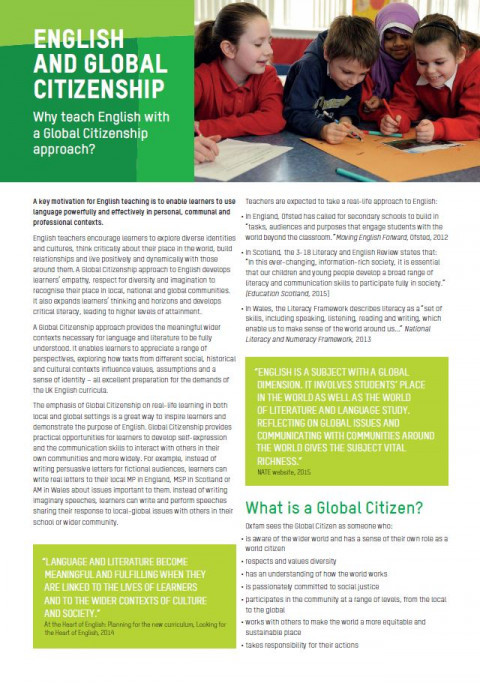 English and Global Citizenship 단체 저자: Oxfam GB English lessons are an opportunity for your learners to explore new and diverse cultures, hone their language skills and develop empathy.This guide includes ideas for learning about the world whilst improving speaking and listening, reading, writing and media literacy skills. It also contains handy links to further resources and ideas for books which can help capture your learners' imaginations.
  Global Digital Citizenship: Quick Start Guide 단체 저자: Global Digital Citizen Foundation What does it mean to be a Global Digital Citizen? Who is this person and what do they stand for? What makes them true global leaders and creators? The journey to understanding begins here, with the Global Digital Citizen Quickstart Guide.This is the final book in the GDCF's Fluency Quickstart series. This guide explores the skills and practices that make an exemplary Global Digital Citizen.With this Quickstart Guide you can: Explore the tenets of global citizenship Develop unique skills and mindsets Measure student progress Create challenging PBL lessons Become a great global digital citizen
  Project Based Learning Ideas Guide: K-12 Learners 단체 저자: Global Digital Citizen Foundation Project-based learning is a big part of today’s modern learning environments. It takes students on a cool journey of creativity, exploration, and true real-world relevance. What does PBL look like in action in your classroom?Solution Fluency provides the building blocks for PBL. It’s a way for students to learn good problem-solving skills and to become successful with any challenge.This PBL Ideas Book will help them do exactly that. Inside are classroom project ideas for years K–12. There are 9 awesome projects to choose from with choices for primary, middle, and senior grades. But wait—what if the scenario idea you like isn’t for your specific grade?No problem at all. These PBL ideas are customizable and scalable for any grade level. They’re also cross-curricular in nature, and can be adapted to other subject areas.Explore these scenarios and think creatively about how you can bring them to life for your students.
 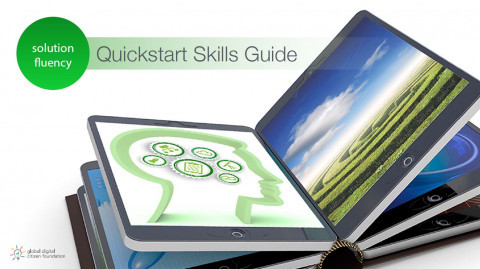 Solution Fluency Quickstart Skills Guide 단체 저자: Global Digital Citizen Foundation What is Solution Fluency? What are the specific skills it develops? Why are they important? The answers are right here in the Solution Fluency Quickstart Skills Guide.In this free guide, we’ll introduce you to the basics of Solution Fluency. You'll learn about the 6Ds process, the skills each phase develops, and why Solution Fluency skills are a crucial part of modern learning.With this free Quickstarter Guide you can: Get to know Solution Fluency skillsets Develop them with students Cultivate critical thinking Give students problem-solving superpowers
 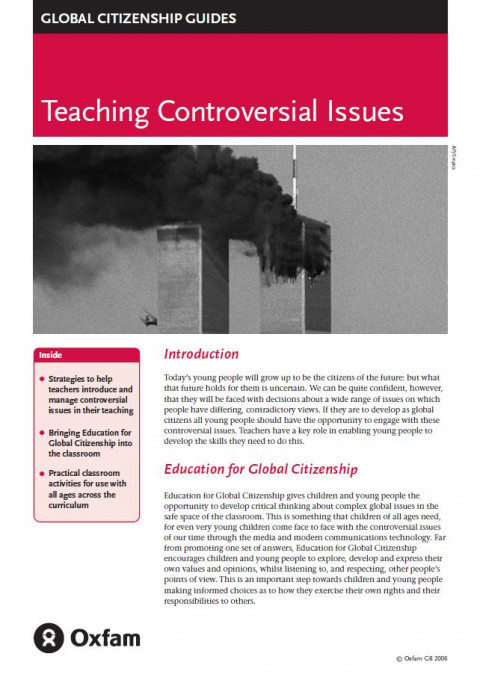 Global Citizenship Guides: Teaching Controversial Issues 발행 연도: 2006 단체 저자: Oxfam GB This guide aims to demonstrate how, by enhancing young people’s ability to handle controversial issues, teachers can support and develop them as global citizens.This guide explores:what controversial issues arewhy controversial issues should be taughtwhy some issues are, or can become, controversialwhat guidance exists for handling controversial issuesclassroom strategies for handling and exploring controversial issuessome practical activities for teaching controversial issues.
  Enseigner l'histoire et la prévention des génocides - Peut on prévenir les crimes contre l'humanité ? The question of barbarism dominates remembrance issues. The study of the prevention of crimes against humanity constitutes another major challenge. But these sensitive and complex debates are problematic. All fields are concerned : history, memory, law, philosophy, politics. How can schools tackle them ? Two solutions : opting for a comparative study of genocides, particularly the Holocaust and the Tutsis in Rwanda; and using the "universal/particular" dialectic, institutions and individuals. Recollections of the past and edification of the future, this book gives meaning to education and presents a sensitive reflection of the challenges of history and the contemporary world. (By the author - Translation) Enseigner l'histoire et la prévention des génocides - Peut on prévenir les crimes contre l'humanité ? La question de la barbarie domine les questions commémoratives. L'étude de la prévention des crimes contre l'humanité constitue un autre défi majeur. Mais ces débats délicats et complexes sont problématiques. Tous les champs sont concernés: l'histoire, la mémoire, le droit, la philosophie, la politique. Comment les écoles peuvent les aborder? Deux solutions: opter pour une étude comparative des génocides, en particulier l'Holocauste et les Tutsis au Rwanda; et en utilisant les « particuliers/universels» dialectiques, les institutions et les individus. Recollections du passé et de l'édification de l'avenir, ce livre donne un sens à l'éducation et présente une réflexion sensible des défis de l'histoire et le monde contemporain. (Par l'auteur - traduction)
 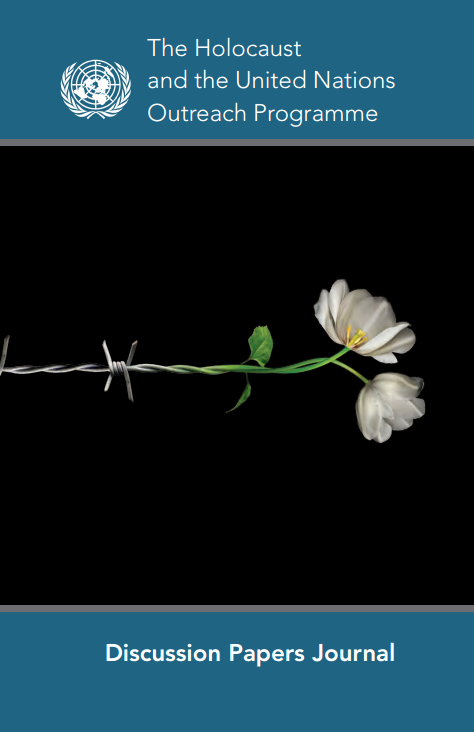 Discussion Papers Journal (Vol 1) In Volume I, students are introduced to the subject of the Holocaust and its implications through the writings of experts in this field of study and testimonies from survivors. German Professor Monika Richarz provides the reader with historical context and insight into Jewish culture before the war and French-born Holocaust survivor Simone Veil gives a first-hand account of experiencing the Holocaust as a Jew. Hungarian writer László Teleki talks about the Roma experience and how this group was similarly targeted by the Nazis. Historian and Professor Yehuda Bauer (Israel) explains how the Holocaust evolved from a utopian ideology that involved hatred of Jews, while Nobel Laureate and Holocaust survivor Elie Wiesel (USA) challenges the reader with the question “Why hate?” Other contributors include Professor Xu Xin (China), Professor Ben Kiernan (Australia), Professor Edward Kissi (South Africa), and Francis Deng (former Special Adviser to the United Nations Secretary-General on the Prevention of Genocide and today Permanent Representative of South Sudan to the United Nations). (By the publisher) Discussion Papers Journal (Vol 1) Dans le volume I, les élèves sont initiés au sujet de l'Holocauste et de ses implications à travers les écrits d'experts dans ce domaine d'étude et des témoignages de survivants. Professeur allemand Monika Richarz fournit au lecteur le contexte historique et un aperçu de la culture juive avant la guerre et survivant de l'Holocauste d'origine française Simone Veil donne un compte rendu de première main de l'expérience de l'Holocauste en tant que Juif. L’ écrivain hongrois László Teleki parle de l'expérience des Roms et la façon dont ce groupe a été ciblé de façon similaire par les nazis. Professeur Yehuda Bauer (Israël), historien, explique comment l'Holocauste a évolué à partir d'une idéologie utopiste qui a impliqué la haine des Juifs, alors que le prix Nobel et survivant de l'Holocauste Elie Wiesel (USA) défie le lecteur avec la question «Pourquoi la haine? » Parmi les autres contributeurs Professeur Xu Xin (Chine), le professeur Ben Kiernan (Australie), le professeur Edward Kissi (Afrique du Sud), et Francis Deng (ancien Conseiller spécial du Secrétaire général des Nations Unies sur la prévention du génocide et aujourd'hui Représentant permanent du Soudan du Sud auprès des Nations Unies ). (Par l'éditeur)