
자료
세계시민교육에 대한 이해를 넓히고 연구, 옹호 활동, 교수, 학습 등을 향상시킬 수 있는 다양하고 유용한 자료를 찾아보세요.
3,560 건의 결과가 검색되었습니다
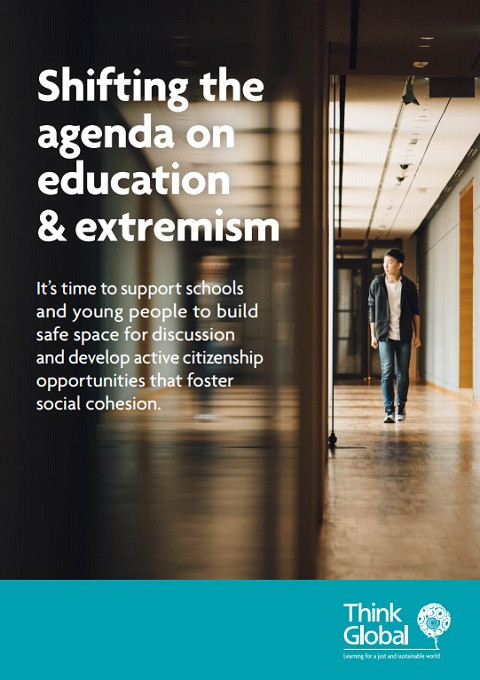 Shifting the Agenda on Education & Extremism 발행 연도: 2018 단체 저자: Think Global This research report aims to build an understanding of young people’s idea of diversity, identity and extremism as well as how schools and young people can be better supported to promote social cohesion and engage in active citizenship opportunities.
 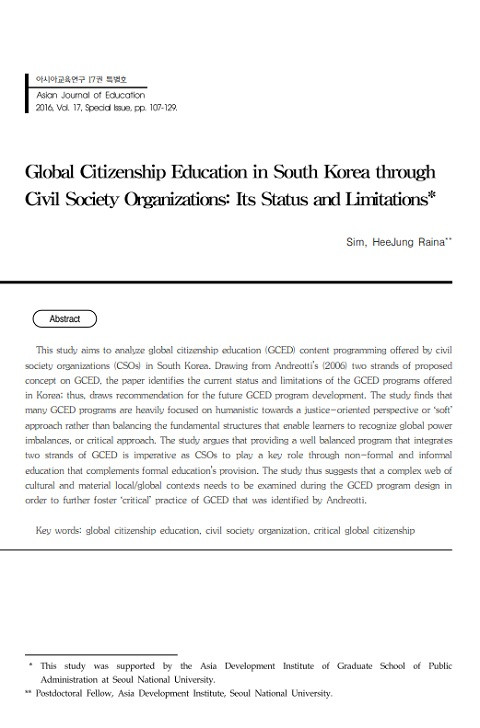 Global Citizenship Education in South Korea through Civil Society Organizations: Its Status and Limitation (Asian Journal of Education, Vol.17, Special Issue) 발행 연도: 2016 저자: HeeJung Raina Sim 단체 저자: Asia Development Institute of Seoul National University This study aims to analyze global citizenship education (GCED) content programming offered by civil society organizations (CSOs) in South Korea. Drawing from Andreotti’s (2006) two strands of proposed concept on GCED, the paper identifies the current status and limitations of the GCED programs offered in Korea; thus, draws recommendation for the future GCED program development. The study finds that many GCED programs are heavily focused on humanistic towards a justice-oriented perspective or ‘soft’ approach rather than balancing the fundamental structures that enable learners to recognize global power imbalances, or critical approach. The study argues that providing a well balanced program that integrates two strands of GCED is imperative as CSOs to play a key role through non-formal and informal education that complements formal education’s provision. The study thus suggests that a complex web of cultural and material local/global contexts needs to be examined during the GCED program design in order to further foster ‘critical’ practice of GCED that was identified by Andreotti.
 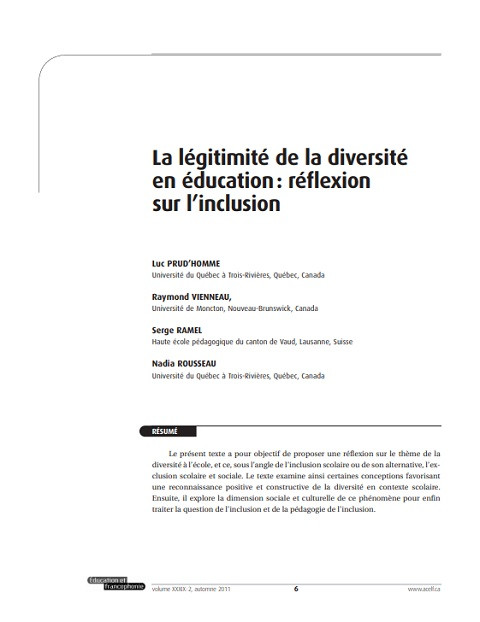 The Legitimacy of Diversity in Education: A Reflection on Inclusion 발행 연도: 2011 저자: Luc Prud’homme | Raymond Vienneau | Serge Ramel | Nadia Rousseau 단체 저자: Éducation et francophonie | Association canadienne d’éducation de langue française The objective of this article is to explore the theme of diversity in the classroom from the perspective of scholastic inclusion, or its alternative, scholastic and social exclusion. The article examines concepts that foster the positive and constructive recognition of diversity in the school setting, along with the social and cultural dimension of inclusion and the pedagogy of inclusion. La légitimité de la diversité en éducation : réflexion sur l’inclusion 발행 연도: 2011 저자: Luc Prud’homme | Raymond Vienneau | Serge Ramel | Nadia Rousseau 단체 저자: Éducation et francophonie | Association canadienne d’éducation de langue française Le présent texte a pour objectif de proposer une réflexion sur le thème de la diversité à l’école, et ce, sous l’angle de l’inclusion scolaire ou de son alternative, l’exclusion scolaire et sociale. Le texte examine ainsi certaines conceptions favorisant une reconnaissance positive et constructive de la diversité en contexte scolaire. Ensuite, il explore la dimension sociale et culturelle de ce phénomène pour enfin traiter la question de l’inclusion et de la pédagogie de l’inclusion.
 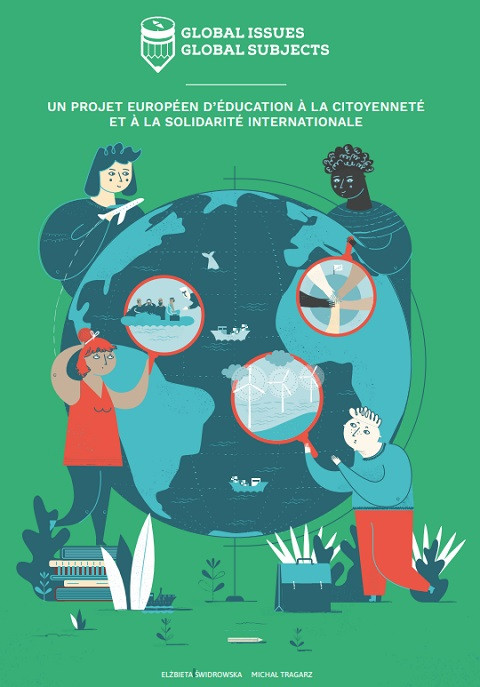 Un projet européen d’éducation à la citoyenneté et à la solidarité internationale 발행 연도: 2020 저자: Elżbieta Swidrowska | Michał Tragarz 단체 저자: Le Partenariat | Global Issues, Global Subjects (GIGS) | Union européenne Cette brochure nous permet de prendre conscience de l’importance d’une démarche citoyenne ayant pour but de favoriser une solidarité entre les territoires, les générations, les groupes sociaux et d’agir pour la construction d’un monde solidaire.
  Education à la citoyenneté et à la solidarité internationale en anglais 발행 연도: 2020 저자: Morgane Boscher | Michael Lionne | Bénédicte Feys 단체 저자: Le Partenariat | Global Issues, Global Subjects (GIGS) | Union européenne Afin de promouvoir la démarche d'Education à la Citoyenneté et à la Solidarité Internationale et les Objectifs de Développement Durable dans l'enseignement secondaire, des groupes de travail d’enseignants ont conçu cette ressources pédagogique à destination de leurs collègues d’anglais.
 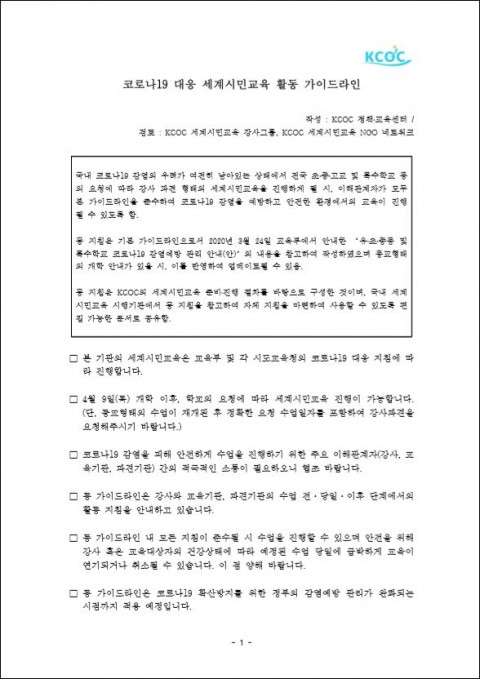 코로나19 대응 세계시민교육 활동 가이드라인 발행 연도: 2020 단체 저자: 국제개발협력민간협의회 (KCOC) 국내 코로나19 감염의 우려가 여전히 남아있는 상태에서 전국 초·중·고교 및 특수학교 등의 요청에 따라 강사 파견 형태의 세계시민교육을 재개하게 될 시 안전한 환경에서 세계시민교육을 진행할 수 있도록 작성한 세계시민교육 담당자와 강사들을 위한 활동지침서이다.
  세계시민교육 실시기관 가이드북 발행 연도: 2019 단체 저자: KOICA ODA 교육원 | 국제개발협력민간협의회 다양한 기관과 NGO 등에서 운영하고 있는 다채로운 세계시민교육 프로그램과 각 기관에 대한 소개 및 교재와 교구 등 참고자료를 수록하고 있다.이 가이드북은 단순히 세계시민교육을 제공하는 기관의 리스트가 아니라 기관의 특성과 운영 프로그램 · 교육 대상을 담고 있다는 점에서 세계시민교육과 세계시민교육 프로그램에 관심 있는 이들에게 유용한 안내서가 될 것이다.
 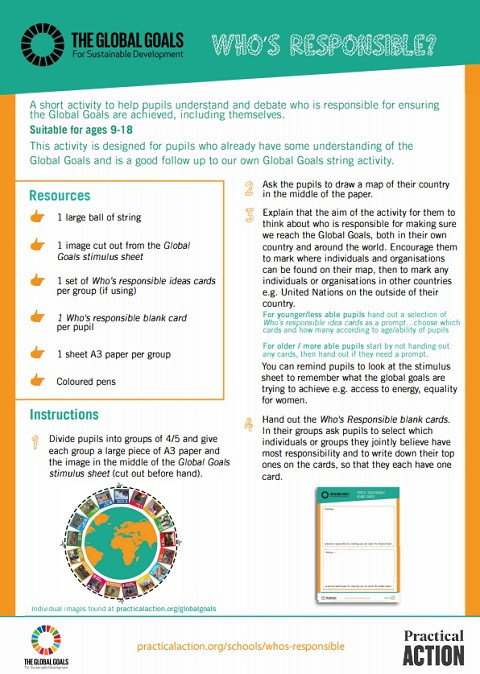 Who’s Responsible?: The Global Goals for Sustainable Development 발행 연도: 2018 단체 저자: Practical Action This 30 minute activity encourages pupils to consider who is responsible for ensuring we achieve the Global Goals (also known as the Sustainable Development Goals, SDGs). It is suitable for pupils 9-18 it stimulates discussion and debate, and help pupils recognize the role they themselves have to play.
  Creativity, Resilience and Global Citizenship: Activity Toolkit 발행 연도: 2015 단체 저자: CIT Crawford College of Art and Design | Youth Work Ireland This publication is a step by step guide to a range of activities exploring the themes of Creativity, Resilience & Global Citizenship through a wide range of workshops, sharing creative methods and tools. It has been co-developed by the Fast Forward training programme which brought together young people and youth workers from Ireland, Hungary, Italy and UK in Cork, Ireland in January 2015. It was developed with thirty young people: youth workers, artists and educators who are passionate about supporting young people to grow as global citizens. It is useful to provide a context for anyone engaging others in the creative activities presented in this toolkit.