
자료
세계시민교육에 대한 이해를 넓히고 연구, 옹호 활동, 교수, 학습 등을 향상시킬 수 있는 다양하고 유용한 자료를 찾아보세요.
3,500 건의 결과가 검색되었습니다
 Rapport mondial de suivi sur l'éducation 2024/5, Leadership dans l'éducation : diriger pour apprendre 발행 연도: 2025 단체 저자: Global Education Monitoring Report Team Le Rapport mondial de suivi sur l'éducation 2024/5 évalue les progrès accomplis dans la réalisation des objectifs du Programme 2030 et montre que, si le nombre d'enfants scolarisés et achevant l'enseignement secondaire n'a jamais été aussi élevé, de nombreux domaines connaissent une stagnation. Le leadership joue un rôle central pour y remédier. Aucune école n’améliore les résultats des élèves sans un bon leader pour montrer la voie. Sur la base d’un examen des lois et politiques concernant la sélection, la préparation et les conditions de travail des chefs d'établissement de 211 systèmes éducatifs, le rapport analyse les leviers stratégiques permettant d'attirer et de retenir des leaders de talent.Les possibilités d’exercer un leadership ne se limitent pas aux dirigeants des écoles, elles s’étendent à des personnes qui occupent d’autres postes dans le système éducatif et en dehors de celui-ci, telles que les directeurs adjoints, les enseignants et les élèves lorsque le leadership est partagé, les responsables politiques, la société civile, les organisations internationales, les syndicats et les médias, qui contribuent à définir les objectifs en matière d’éducation.Le rapport préconise que des efforts soient faits pour former des leaders dans quatre dimensions essentielles : fixer des objectifs, donner la priorité à l’apprentissage, encourager la collaboration et faire évoluer les personnes. Pour que ces dimensions se concrétisent, il faut faire confiance aux personnes occupant des postes de direction et leur donner les moyens d’agir ; il faut les recruter grâce à des pratiques d’embauche équitables ; les soutenir dans leur évolution ; et les encourager à mettre en place une culture de collaboration. Le rapport appelle également à investir dans la capacité des responsables de l'éducation à jouer un rôle de leader au sein du système, en mettant particulièrement l'accent sur la direction pédagogique et l'assurance qualité
  Informe de seguimiento de la educación en el mundo, 2024/5: Liderazgo en la educación: liderar por el aprendizaje 발행 연도: 2025 단체 저자: Global Education Monitoring Report Team El Informe de seguimiento de la educación en el mundo 2024-2025 evalúa los avances hacia el logro de las metas de 2030 y muestra que, aunque hay más niños escolarizados y que finalizan la educación secundaria que nunca, en muchos ámbitos hay estancamientos. El liderazgo es fundamental para abordar esta cuestión. Ninguna escuela puede mejorar los resultados de los alumnos sin un buen líder que muestre el camino a seguir. Partiendo de un examen de la legislación y las políticas relativas a la selección, preparación y condiciones laborales de los directores de escuela de 211 sistemas educativos, el informe analiza instrumentos de política para atraer y retener a líderes talentosos.El potencial de liderazgo no se limita a los líderes escolares, sino que abarca también a las personas que ocupan otros puestos en el sistema educativo, así como fuera de él, desde subdirectores, docentes y alumnos, cuando el liderazgo es compartido, hasta líderes políticos, la sociedad civil, organizaciones internacionales, sindicatos y medios de comunicación, que contribuyen a definir los objetivos de la educación.El informe insta a adoptar medidas para que los líderes desarrollen sus capacidades en las cuatro dimensiones fundamentales del liderazgo: establecer expectativas, centrarse en el aprendizaje, fomentar la colaboración y favorecer el perfeccionamiento personal. Para llevar a la práctica estas dimensiones, es esencial confiar en quienes ocupan puestos de liderazgo y empoderarlos; reclutarlos mediante prácticas de contratación justas; brindarles apoyo para que se perfeccionen; y motivarlos a fomentar culturas de colaboración. Asimismo, el informe pide que se invierta en fortalecer las capacidades de los funcionarios de educación para que actúen como líderes del sistema, especialmente en el liderazgo pedagógico y la garantía de la calidad.
  [Summary] Global Education Monitoring Report Summary 2024/5: Leadership in Education; Lead for Learning 발행 연도: 2024 단체 저자: Global Education Monitoring Report Team The 2024/5 Global Education Monitoring Report assesses progress towards the 2030 targets and shows that, while more children are in school and completing secondary education than ever before, there is stagnation in many areas. Leadership is central to addressing this. There are no schools that improve student outcomes without a good leader showing the way. Building on a review of legislation and policies on the selection, preparation and working conditions of school principals in 211 education systems, the report discusses policy levers to attract and retain talented leaders.Leadership’s potential is not limited to school leaders: it extends to individuals in positions elsewhere in the education system as well as outside of it, from assistant principals, teachers and students, when leadership is shared, to political leaders, civil society, international organizations, unions and the media, who help shape education goals.The report calls for efforts to develop leaders in four key leadership dimensions so that they can set expectations, focus on learning, foster collaboration and develop people. For these dimensions to be realized, people in leadership positions should be trusted and empowered; recruited through fair hiring practices; supported to grow; and encouraged to develop collaborative cultures. The report also calls for investment in education officials’ capacity to serve as system leaders, with a particular emphasis on instructional leadership and quality assurance.
 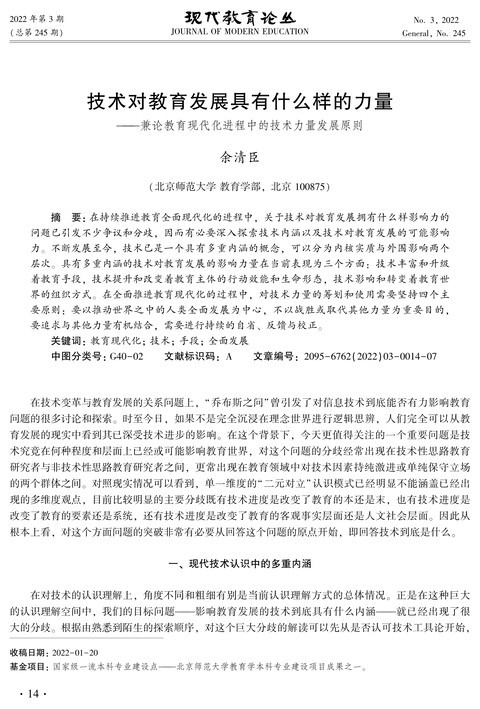 What Kind of Power Does Technology Have on the Development of Education: On the Development Principle of Technical Force in the Process of Educational Modernization (Modern Education Review; No.3, 2022) 발행 연도: 2022 저자: 余清臣 In the process of continuously promoting the comprehensive modernization of education, the issue of what influence technology has on the development of education has caused many debates and disputes. Therefore, it is necessary to deeply explore the connotation of technology and the possible influence of technology on the development of education. Up to now, technology has been a concept with multiple connotations, which can be divided into two levels:core essence and peripheral influence. At present, the influence of technology with multiple connotations on educational development is manifested in three aspects:technology enriches and upgrades educational means, promotes and changes the action efficiency and life form of educational subjects, and influences and changes the way the educational world is organized. In the process of comprehensively promoting the modernization of education, the planning and application of technological forces in education should focus on promoting the all-round development of mankind in the world, not on defeating or replacing other forces, and pursue the organic combination with other forces. In addition, continuous introspection, feedback and correction are also very important. 技术对教育发展具有什么样的力量: 兼论教育现代化进程中的技术力量发展原则 (现代教育论丛; No.3, 2022) 발행 연도: 2022 저자: 余清臣 在持续推进教育全面现代化的进程中,关于技术对教育发展拥有什么样影响力的问题已引发不少争议和分歧,因而有必要深入探索技术内涵以及技术对教育发展的可能影响力。不断发展至今,技术已是一个具有多重内涵的概念,可以分为内核实质与外围影响两个层次。具有多重内涵的技术对教育发展的影响力量在当前表现为三个方面:技术丰富和升级着教育手段,技术提升和改变着教育主体的行动效能和生命形态,技术影响和转变着教育世界的组织方式。在全面推进教育现代化的过程中,对技术力量的筹划和使用需要坚持四个主要原则:要以推动世界之中的人类全面发展为中心,不以战胜或取代其他力量为重要目的,要追求与其他力量有机结合,需要进行持续的自省、反馈与校正。
 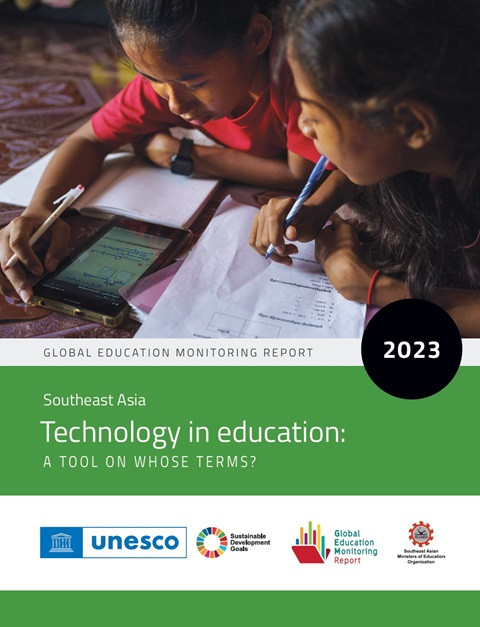 Global Education Monitoring Report 2023, Southeast Asia: Technology in Education; A Tool on Whose Terms? 발행 연도: 2023 단체 저자: Global Education Monitoring Report Team | Southeast Asian Ministers of Education Organization (SEAMEO) Developed in partnership with the Southeast Asia Ministers of Education Organization (SEAMEO), and with the contribution of EdTech Hub, the fifth regional report focuses on technology in education in Southeast Asia. Characterized by a variety of contexts and resources, Southeast Asia has experienced a rapid growth in digital technology applications. In education, digital technologies have been identified for their potential to transform education and meet the region’s development aspirations. The regional report investigates both challenges and potentials, which technology as a tool and as a process can potentially contribute to, across and within countries, and education levels. The regional report on Southeast Asia covers 11 countries, Brunei Darussalam, Cambodia, Lao PDR, Indonesia, Malaysia, Myanmar, Philippines, Singapore, Thailand, Timor-Leste and Viet Nam. Extensive background research informs the regional analysis: 9 country case-studies compiled by local research teams and independent experts; 5 thematic studies produced by SEAMEO centers on open and distance learning, technology for students with disabilities, integration of technology in teaching practices, key policies issues in ICT in education; technology in technical and vocational education and training, and 3 research inputs on ICT in education practices produced by SEAMEO affiliate members and partners.
  미래교육시대의 인간교사와 인공지능(AI) 교사의 역할 및 기능 정립 방향 탐색 연구 발행 연도: 2021 저자: 전제상 단체 저자: 한국교육정책연구소 이 연구는 인공지능의 급격한 발전과 사회의 변화로 교육 현장에 점차 도입될 인공지능이 어떤 모습으로 존재해야 하는지 그리고 어떤 방식으로 학생들에게 도움을 줄 수 있는지 길을 찾고자 하였다. 이를 위하여 인공지능의 현재 상황과 선행연구를 분석하는 것으로 시작하여 인공지능(AI) 교사에 대한 현장 교사들의 인식을 양적, 질적으로 살펴보았다. 이를 토대로 미래교육시대의 교사와 인공지능(AI) 교사의 역할과 기능을 정립하고 상호보완적인 협업 방안을 모색한 후 인공지능(AI) 교사 도입에 따른 제도적, 법적, 윤리적 기준을 확인하였다.인공지능 기반의 미래 사회가 도래했다고 하여 인간교사의 역할이 크게 바뀌지는 않는다. 기존의 해오던 여러 수업과 업무 중에 우선순위의 변화가 생길 수 있고, 수업보다 행정에 할애했던 시간을 수업과 학생지도, 상담 등에 집중할 수 있게 될 것으로 기대한다. 다만 인공지능(AI) 교사 도입에 따라 야기될 윤리적 문제를 해결하기 위해서는 도입 단계부터 준비하여 지속적인 확인과 점검, 성찰을 통해 협업 과정이 목적에 알맞게 기능하도록 모든 요소에 대해 철저하게 대비하고 점검하여야 한다.
 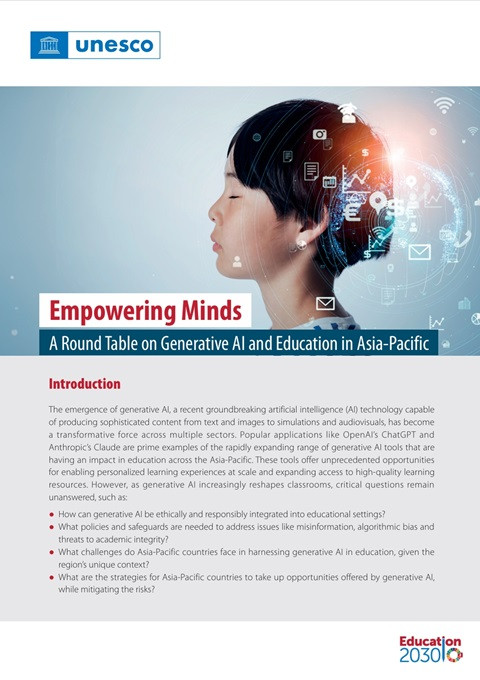 Empowering Minds: A Round Table on Generative AI and Education in Asia-Pacific 발행 연도: 2023 단체 저자: UNESCO Bangkok The emergence of generative AI, a recent groundbreaking artificial intelligence (AI) technology capable of producing sophisticated content from text and images to simulations and audiovisuals, has become a transformative force across multiple sectors. Popular applications like OpenAI’s ChatGPT and Anthropic’s Claude are prime examples of the rapidly expanding range of generative AI tools that are having an impact in education across the Asia-Pacific. These tools offer unprecedented opportunities for enabling personalized learning experiences at scale and expanding access to high-quality learning resources. However, as generative AI increasingly reshapes classrooms, critical questions remain unanswered, such as:- How can generative AI be ethically and responsibly integrated into educational settings?- What policies and safeguards are needed to address issues like misinformation, algorithmic bias and threats to academic integrity?- What challenges do Asia-Pacific countries face in harnessing generative AI in education, given the region’s unique context?- What are the strategies for Asia-Pacific countries to take up opportunities offered by generative AI, while mitigating the risks? In response to these questions and emerging challenges in the region, the UNESCO Regional Office in Bangkok (UNESCO Bangkok), in collaboration with The Southeast Asian Ministers of Education Organization (SEAMEO), organized the regional experts meeting on 7-9 November 2023 in Bangkok, Thailand. This hybrid meeting, titled ‘Empowering Minds: A Round Table on Generative AI and Education in Asia-Pacific’, explored the implications of generative AI for teacher training and development. It served as an important platform to leverage opportunities and mitigate risks of generative AI in education across the Asia-Pacific region.
  Tools for a More Inclusive Education 발행 연도: 2020 단체 저자: Chile. Ministry of Education This document presents a conceptual framework to help the different educational teams deployed at the national level to devise and implement inclusive practices in their daily management, in their ways of living together and in their teaching-learning processes. This, within the framework of the promulgation of Law 20,845, modifies the General Education Law (N°20,370/2009) in its article 4, adding that “It is the duty of the State to strive to ensure quality inclusive education for all people. Herramientas para una educación más inclusiva 발행 연도: 2020 단체 저자: Chile. Ministry of Education En este documento se presenta un marco técnico conceptual para contribuir a que los distintos equipos educativos desplegados a nivel nacional puedan idear e implementar prácticas inclusivas en su gestión cotidiana, en sus modos de convivir y en sus procesos de enseñanza – aprendizaje. Esto, en el marco de la promulgación de la Ley 20.845 modifica la Ley General de Educación (N°20.370/2009) en su artículo 4° agregando que “Es deber del Estado propender a asegurar a todas las personas una educación inclusiva de calidad.”