
자료
세계시민교육에 대한 이해를 넓히고 연구, 옹호 활동, 교수, 학습 등을 향상시킬 수 있는 다양하고 유용한 자료를 찾아보세요.
3,530 건의 결과가 검색되었습니다
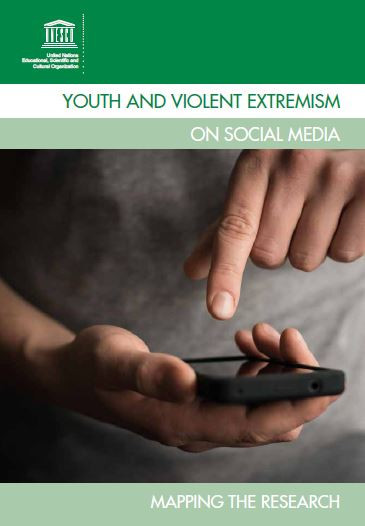 Youth and Violent Extremism on Social Media: Mapping the Research 발행 연도: 2017 저자: Séraphin Alava | Divina Frau-Meigs | Ghayda Hassan 단체 저자: UNESCO Does social media lead vulnerable individuals to resort to violence? Many people believe it does. And they respond with online censorship, surveillance and counter-speech. But what do we really know about the Internet as a cause, and what do we know about the impact of these reactions? All over the world, governments and Internet companies are making decisions on the basis of assumptions about the causes and remedies to violent attacks. The challenge is to have analysis and responses firmly grounded. The need is for a policy that is constructed on the basis of facts and evidence, and not founded on hunches or driven by panic and fearmongering. It is in this context that UNESCO has commissioned the study titled Youth and Violent Extremism on Social Media: Mapping the Research. This work provides a global mapping of research (mainly during 2012-16) about the assumed roles played by social media in violent radicalization processes, especially when they affect youth and women. The research responds to the belief that the Internet at large is an active vector for violent radicalization that facilitates the proliferation of violent extremist ideologies. Les jeunes et l’extrémisme violent dans les médias sociaux inventaire des recherches: Inventaire des recherches 발행 연도: 2017 저자: Séraphin Alava | Divina Frau-Meigs | Ghayda Hassan 단체 저자: Organisation des Nations Unies pour l'éducation, la science et la culture (UNESCO) Les médias sociaux incitent-ils des personnes vulnérables à recourir à la violence? Beaucoup le pensent et cherchent à y remédier par la censure, la surveillance des échanges en ligne et la diffusion de contre-discours. Mais que savons-nous réellement des effets de l’Internet et de l’impact de ces contre-mesures ? Partout dans le monde, les gouvernements et les opérateurs d’Internet prennent des décisions en s’appuyant sur de simples hypothèses en ce qui concerne les causes des actes de violence et les remèdes possibles. La question est de savoir si ces analyses et ces réponses reposent bien sur des bases solides. Il est essentiel que les politiques soient ancrées dans les faits et les données d’observation, et non fondées sur des intuitions ou dictées par la panique ou les efforts pour semer la peur. C’est dans ce contexte que l’UNESCO a commandé la présente étude intitulée Les jeunes et l’extrémisme violent dans les médias sociaux – Inventaire des recherches, qui propose un tour d’horizon mondial des recherches menées (principalement entre 2012 et 2016) sur les rôles que les médias sociaux sont supposés jouer dans les processus de radicalisation violente, en particulier ceux qui touchent les jeunes et les femmes. L’étude examine d’un oeil critique l’idée selon laquelle l’Internet en général serait un vecteur actif de radicalisation violente qui faciliterait la prolifération d’idéologies extrémistes violentes.
  Образование в области прав человека в школьной системе Европы, Центральной Азии и Северной Америки: сборник примеров успешных практик 발행 연도: 2009 단체 저자: Council of Europe | Организация Объединенных Наций по вопросам образования, науки и культуры (UNESCO) | UN. Office of the United Nations High Commissioner for Human Rights (UN. OHCHR) | OSCE. Office for Democratic Institutions and Human Rights (ODIHR) Сборник примеров успешных практик «Образование в области прав человека в школьной системе Европы, Центральной Азии и Северной Америки» включает 101 пример успешных практик в сфере образования в области прав человека в начальной, средней школе и в педагогических учебных заведениях в регионе ОБСЕ, на который также распространяются полномочия ЮНЕСКО, УВКПЧ ООН и, частично, географический мандат СЕ.Настоящее издание состоит из пяти основных разделов:Раздел I. Законодательные акты, руководящие принципы и стандарты; Раздел II. Подходы и практики улучшения учебной атмосферы; Раздел III. Учебные пособия для преподавателей и учащихся; Раздел IV. Повышение квалификации преподавателей; Раздел V. Методы оценки.Образование в области прав человека определяют как образование, обучение и информирование, направленное на формирование всеобщей культуры прав человека. Комплексное образование в области прав человека дает не только знания о правах человека и действующих механизмах их защиты, но и навыки, необходимые для продвижения, защиты и реализации прав человека в повседневной жизни. Воспитание демократической гражданственности нацелено на осуществление образовательных практик и мероприятий, призванных помочь молодым людям и взрослым принимать активное участие в жизни общества, основанного на принципах демократии, а также осуществлять свои права и обязанности в обществе. Воспитание в духе взаимного уважения и понимания подчеркивает важность самоуважения, уважения других людей и улучшения отношений между людьми, представляющими различные культурные традиции.Настоящая книга задумана как средство поддержки качества обучения в этих областях, как стимул для лиц, ответственных за формирование политики в области образования (сотрудников министерств образования и местных школьных советов), директоров, учителей, преподавателей педагогических учебных заведений, преподавателей, специалистов неформальной сферы образования и всех других заинтересованных лиц, а также как инструмент, содействующий формированию сетей и обмену опытом между специалистами в сфере образования. L'éducation aux droits de l'homme dans les systèmes scolaires d'Europe, d'Asie centrale et en Amérique du Nord: un recueil de bonnes pratiques 발행 연도: 2009 단체 저자: Conseil de l'Europe | Organisation des Nations Unies pour l'éducation, la science et la culture (UNESCO) | UN. Office of the United Nations High Commissioner for Human Rights (UN. OHCHR) | OSCE. Office for Democratic Institutions and Human Rights (ODIHR) “L'Éducation aux Droits de l'Homme dans les systèmes scolaires de l'Europe, l'Asie centrale et en Amérique du Nord: Un Recueil de Bonnes Pratiques" est une compilation de 101 exemples de bonnes pratiques dans l'éducation aux droits de l'homme dans les écoles primaires, les écoles secondaires et les établissements de formation des enseignants de l'Organisation pour Sécurité et la Coopération dans la zone Europe (OSCE), qui est également couvert par l'Organisation des Nations Unies pour l'éducation, la science et la culture (UNESCO), le Bureau du Haut Commissariat des Nations Unies aux Droits de l'Homme (HCDH) et, en partie, la situation géographique mandat du Conseil de l'Europe (CoE). Le terme «éducation aux droits de l'homme» est souvent utilisé dans cette ressource dans un sens plus large, pour inclure également l'éducation à la citoyenneté démocratique et l'éducation pour le respect et la compréhension mutuelle, qui sont toutes basées sur les normes des droits humains internationalement convenus. Ces trois domaines sont considérés comme interconnectés et essentiel dans les systèmes éducatifs afin de préparer les jeunes à être des participants actifs, responsables et dans leur communautés, ainsi qu'aux niveaux national et mondial. L'éducation aux droits de l'homme a été défini comme l'éducation, la formation et de l'information visant à la construction d'une culture universelle des droits de l'homme. Une formation approfondie dans les droits de l'homme fournit non seulement des connaissances sur les droits humains et les mécanismes qui les protègent, mais confère également les compétences nécessaires pour promouvoir, défendre et appliquer les droits de l'homme dans la vie quotidienne. L'éducation à la citoyenneté démocratique met l'aCECnt sur les pratiques et les activités visant à aider les jeunes et les adultes à jouer un rôle actif dans la vie démocratique et à exercer leurs droits et responsabilités dans la société de l'éducation. L'éducation pour le respect et la compréhension mutuelle met en évidence le respect de soi, respect des autres, et l'amélioration des relations entre les gens de différentes traditions culturelles. Ce livre vise à soutenir l'enseignement de qualité dans ces domaines et d'inspirer les décideurs éducatifs (ceux qui travaillent dans les ministères de l'éducation et les conseils scolaires locaux) et les administrateurs, les enseignants, les formateurs d'enseignants, les éducateurs non formels et tous les autres acteurs intéressés, ainsi que pour faciliter la mise en réseau et l'échange d'expériences entre les professionnels de l'éducation.
 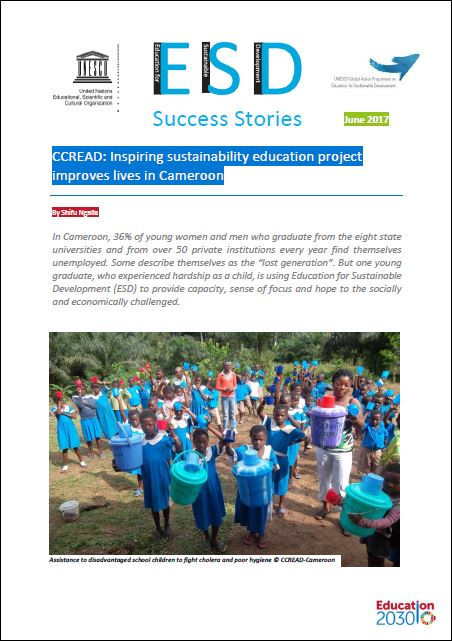 CCREAD: Inspiring Sustainability Education Project Improves Lives in Cameroon 발행 연도: 2017 저자: Shifu Ngalla 단체 저자: UNESCO This article is about sustainability education project in Cameroon. In Cameroon, 36% of young women and men who graduate from the eight state universities and from over 50 private institutions every year find themselves unemployed. Some describe themselves as the “lost generation”. But one young graduate, who experienced hardship as a child, is using Education for Sustainable Development (ESD) to provide capacity, sense of focus and hope to the socially and economically challenged. CCREAD: Un Projet d’éducation au Développement Durable Améliore des Vies au Cameroun 발행 연도: 2017 저자: Shifu Ngalla 단체 저자: Organisation des Nations Unies pour l'éducation, la science et la culture (UNESCO) Ceci est un article sur le projet d'éducation à la durabilité au Cameroun.Chaque année au Cameroun, 36% des jeunes femmes et hommes qui obtiennent leur diplôme dans l’une des huit universités d’État et dans plus de 50 institutions privées se retrouvent sans-emploi. Certains d'entre eux se décrivent comme une « génération perdue ». Cependant, un jeune diplômé qui a vécu une expérience douloureuse pendant son enfance utilise l’Éducation au Développement Durable (EDD) afin de former et redonner de l’espoir aux jeunes défavorisés au niveau social et économique. CCREAD: Un Estimulante Proyecto Sobre Educación para la Sostenibilidad Mejora la Vida en el Camerún 발행 연도: 2017 저자: Shifu Ngalla 단체 저자: Organización de las Naciones Unidas para la Educación, la Ciencia y la Cultura (UNESCO) Este es un artículo acerca de proyecto sobre el educación para la sostenibilidad en Camerún.En el Camerún, 36% de las mujeres y de los hombres jóvenes que se gradúan anualmente en alguna de las ocho universidades estatales o en alguna de las 50 instituciones privadas se encuentran sin empleo. Algunos se describen a sí mismos como la “generación perdida”. Pero un joven diplomado que experimentó dificultades cuando era niño está utilizando la educación para el desarrollo sostenible (EDS) como un medio para proporcionar capacidades, centrar mejor las prioridades y dar esperanza a las personas social y económicamente desfavorecidas.
  La enseñanza del Holocausto en América Latina - Los desafios para los educadores y legisladores 발행 연도: 2015 단체 저자: UNESCO The Holocaust has become a point of reference worldwide to raise awareness about violations of human rights and state violence. What is the importance of Holocaust education in regions of the world that have no direct relation to the history of the Jewish people and the crimes of Nazism, especially in Latin America? Is there a rise of relevant educational practices internationally as a result of the expansion of education about the Holocaust ? How can educators address a subject so complex and emotionally charged in changing multicultural societies ? This UNESCO publication brings together the contributions of important historians and educators around the world and frames current debates in the field, emphasizing the issues that educators in Latin America are facing and revealing the reasons why it is vital to continue teaching Holocaust history in the world today, regardless of where we live. (By the publisher - Translation) La enseñanza del Holocausto en América Latina - Los desafios para los educadores y legisladores 발행 연도: 2015 단체 저자: Organisation des Nations Unies pour l'éducation, la science et la culture (UNESCO) L'Holocauste est devenu un point de référence dans le monde entier afin de sensibiliser sur les violations des droits de l'homme et de la violence de l'État. Quelle est l'importance de l'enseignement de l'Holocauste dans les régions du monde qui ont aucun rapport direct avec l'histoire du peuple juif et les crimes du nazisme, en particulier en Amérique latine? Y at-il une augmentation des pratiques éducatives pertinentes au niveau international en raison de l'expansion de l'éducation sur l'Holocauste? Comment les enseignants peuvent aborder un sujet si complexe et chargé d'émotion dans l'évolution des sociétés multiculturelles? Cette publication de l'UNESCO rassemble les contributions d'historiens et éducateurs du monde entier et les cadres débats actuels dans le domaine importants, en insistant sur les questions que les éducateurs en Amérique latine sont confrontés et révéler les raisons pour lesquelles il est essentiel de continuer à enseigner l'histoire de l'Holocauste dans le monde aujourd'hui , peu importe où nous vivons. (Par l'éditeur - traduction)
  The International status of education about the Holocaust : A global mapping of textbooks and curricula 발행 연도: 2015 단체 저자: UNESCO This publication by UNESCO and the Georg Eckert Institute documents ways in which the Holocaust is presented in secondary school level history and social studies curricula worldwide, and conceptualized and narrated in textbooks from twenty-six countries, with all continents represented. Historical understandings of the Holocaust are defined in terms of the spatial and temporal scales with which the event is portrayed, the protagonists involved, interpretative patterns (according to definitions, comprehensiveness, causes, relativization or banalization), narrative techniques and viewpoints, didactic methods, and national idiosyncrasies. The study is based on 272 currently valid curricula from 135 countries, and on 89 textbooks published in 26 countries since 2000. The aim of the study is primarily to document information in such a way that it reflects local understandings of the Holocaust, principally by recording concepts and narratives of the Holocaust found in educational media currently in use in schools. The findings show both convergence and divergence in the representations analysed. The Holocaust is subject to shared patterns of representation, which include selectivity, personalization, appropriation, screening and omission. It is also subject to narrative idiosyncrasies. One of the main trends worldwide is domestication, a process whereby countries place emphasis on the local significance of the event or appropriate them in the interests of local populations. Drawing on such national and international patterns of representation, the publication concludes by formulating recommendations for future curricula and textbook narratives about the Holocaust. These recommendations relate to such issues as the use of terms, the comprehensiveness of historical facts, the definition of causes, the combination of universal and local approaches, and the development of historical literacy. (By the publisher)