
자료
세계시민교육에 대한 이해를 넓히고 연구, 옹호 활동, 교수, 학습 등을 향상시킬 수 있는 다양하고 유용한 자료를 찾아보세요.
3,530 건의 결과가 검색되었습니다
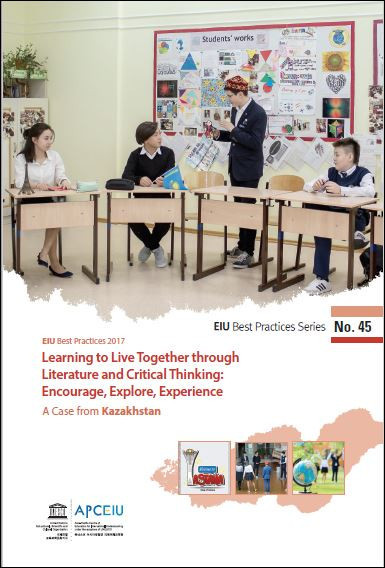 EIU Best Practices Series No.45: Learning to Live Together through Literature and Critical Thinking: Encourage, Explore, Experience 발행 연도: 2017 단체 저자: APCEIU This monograph is one of APCEIU's EIU Best Practices Series, which aims to encourage educators, scholars, and activists to implement and share local initiatives on EIU. The Series No. 45 introduces a programme called “Learning to Live Together through Literature and Critical Thinking: Encourage, Explore, Experience.” With critical thinking at its heart, students learn the concepts of GCED through the perspectives of literary masterpieces, diverse cultural traditions, and teambuilding activities. By guiding students through the 3 Es, this exemplary programme motivates and equips students to demonstrate their global citizenship by launching useful projects for the city community.
  GCED Curriculum Development and Integration Project (Sri Lanka): 2021 Final Report 발행 연도: 2021 단체 저자: National Institute of Education (Sri Lanka) | APCEIU This resource is a compiled documentation of the final outcomes of the Sri Lankan National Institute of Education (NIE) and APCEIU’s joint partnership to develop the GCED curriculum, particularly for the secondary school level. The report includes the materials created and used to evaluate, monitor, and execute the GCED curriculum, as well as the documentation of the process of its creation. It is written in both English and Sinhalese. In the compilation, you may find:- Introduction to the project (ENG)- Annexure of evaluative materials (ENG, SNH)- GCED Framework (ENG)- GCED Learning ModulesGrade 6 English (ENG)Grade 6 Sound Test (SNH)Grade 8 (SNH)Grade 8 English World of Work (ENG)Grade 8 School Try Out (SNH)
  GCED Curriculum Development and Integration Project (Lebanon): 2021 Final Report 발행 연도: 2021 단체 저자: Center for Educational Research and Development (CRDP) | APCEIU This resource is a compiled documentation of the final outcomes of the Center for Educational Research and Development (CRDP), Lebanon and APCEIU’s joint partnership to develop the GCED curriculum across both primary and secondary school levels. The report includes the materials created and used to evaluate, monitor, and execute the GCED curriculum, as well as the documentation of the process of its creation. It is written in both English and Arabic.In the compilation, you may find:- Report on the Implementation of the Project Stages- Digital Activities for GCED Integration in the Civics and National Education Curriculum: Grade 1 - 12 (ARA)- Digital Activities for GCED Integration in the Civics and National Education Curriculum: Grade 1 - 12 (ENG)- Teacher’s Guide: Grade 1 - 12 (ARA)- Teacher’s Guide: Grade 1 - 12 (ENG)- Training of Trainers (TOT): TOT Materials (ENG; ARA)- The Project of Training the Trainers on Global Citizenship Education and Integrating it into the Pre-university Educational Curricula: Preamble (ENG)- Technical Cards (ENG; ARA)
 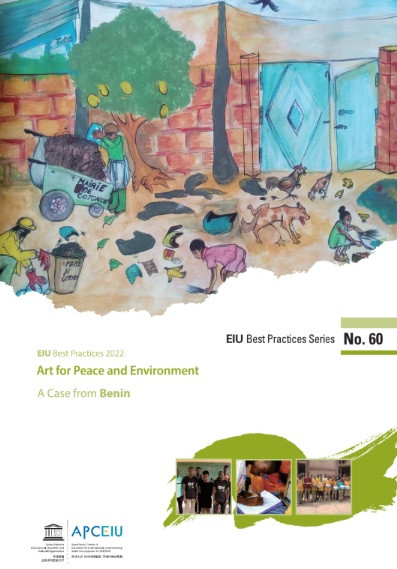 EIU Best Practices 2022: Art for Peace and Environment; A Case from Benin (EIU Best Practices Series; no.60) 발행 연도: 2022 저자: Constant Odounfa 단체 저자: Centre Asie-Pacifique d'éducation pour la compréhension internationale (APCEIU) This monograph is one of APCEIU's EIU Best Practices Series, which aims to encourage educators, scholars, and activists to implement and share local initiatives on EIU. The Series No.60 is focusing on increasing people’s awareness regarding the importance of open-mindedness, empathy as well as the effects of their bad behaviour on the environment and their own lives, calling for the necessity of change.
 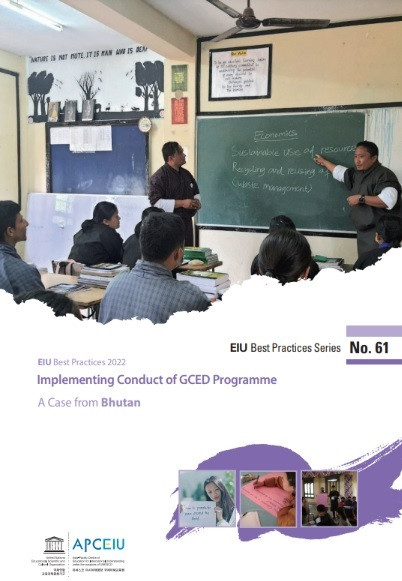 EIU Best Practices 2022: Implementing Conduct of GCED Programme; A Case from Bhutan (EIU Best Practices Series; no.61) 발행 연도: 2022 저자: Santosh Kumar Biswa 단체 저자: Centre Asie-Pacifique d'éducation pour la compréhension internationale (APCEIU) This monograph is one of APCEIU's EIU Best Practices Series, which aims to encourage educators, scholars, and activists to implement and share local initiatives on EIU. The Series No.61 is focusing on equipping youths, teachers and people around the world with the concept of GCED through his capacity-building and familiarization programme in schools and communities.
 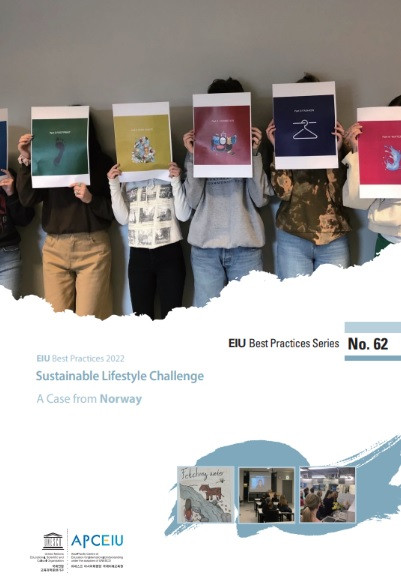 EIU Best Practices 2022: Sustainable Lifestyle Challenge; A Case from Norway (EIU Best Practices Series; no.62) 발행 연도: 2022 저자: Barbara Anna Zielonka 단체 저자: 亚太地区促进国际理解教育中心 (APCEIU) This monograph is one of APCEIU's EIU Best Practices Series, which aims to encourage educators, scholars, and activists to implement and share local initiatives on EIU. The Series No.61 is focusing on providing opportunity for teachers and students worldwide to learn about environmentally friendly alternatives by changing their lifestyles and engaging with the world through the lens of sustainability.
  [Summary] Global Citizenship Education Forum: Sharing Stories of Empowering Citizens to Tackle Global-Local Challenges 발행 연도: 2022 단체 저자: Permanent Delegation of the Republic of Korea to UNESCO | Group of Friends for Solidarity and Inclusion with Global Citizenship Education | APCEIU This report shares the overview of the Global Citizenship Education Forum held under the theme ‘Sharing Stories of Empowering Citizens to Tackle Global-Local Challenges’ on Friday, 13 May 2022. The event was co-organized by the Permanent Delegation of the Republic of Korea to UNESCO and the Asia-Pacific Centre of Education for International Understanding (APCEIU) in collaboration with the Group of Friends for Solidarity and Inclusion with GCED (Afghanistan, Armenia, Austria, Bangladesh, Canada, Colombia, Italy, Jordan, Kenya, Kuwait, Philippines, Republic of Korea, Saudi Arabia, Senegal and Serbia). This report shares the summary of the event, particularly the presentations on GCED activities implemented by practitioners from Armenia, Austria, Colombia, Jordan, Kenya and the Philippines to influence more GCED programmes/initiatives on various contexts and backgrounds.
  다문화가정대상국가와의 교육교류사업 후속활동 길라잡이 발행 연도: 2023 단체 저자: APCEIU The Asia-Pacific Teacher Exchange for Global Education(APTE) is a bilateral teacher exchange programme between the Republic of Korea and Asia-Pacific countries, hosted by the Ministry of Education of the Republic of Korea (MOE ROK) and implemented by the Asia-Pacific Centre of Education for International Understanding under the auspices of UNESCO (APCEIU), in collaboration with the Ministries of Education of the partner countries. Since 2012, the Office of International Teacher Exchange of APCEIU has been playing a pivotal role in implementing APTE. APCEIU prepared this book in the hope of spreading the fruits of teachers’ efforts and the seeds of peace in them, which were nurtured on the ground of APTE, to a broader world. <Contents>IntroductionI. Understanding follow-up activitiesII. Types of follow-up activities and model examples1. Types of follow-up activities2. Model examples of follow-up activities- [Real-Time Online Video Class] Starting online international education exchange- [Visiting / Invitational Program] An insight into international exchange programme- [Club-Oriented Inter-School Exchange] Follow-up exchange with invention club activity- [Inter-School Cooperative Agreement] Precious ties- [Participation In Various Support Programs] Heart of Korea, multicultural values: overcoming the limits of the classroomIII. Follow-up activity operation1. The nine-step preparation process for independent operation of educational exchange2. Procedures for independent operation of international exchangeIV. Annex1. Asia-Pacific Teacher Exchange for Global Education2. UNESCO APCEIU: Asia-Pacific Centre of Education for International Understanding under the auspices of UNESCO3. Reference programs for follow-up activities 다문화가정대상국가와의 교육교류사업 후속활동 길라잡이 발행 연도: 2023 단체 저자: 유네스코 아시아태평양 국제이해교육원 다문화가정대상국가와의 교육교류사업(APTE: Asia-Pacific Teacher Exchange for Global Education)은 대한민국 교육부가 주최하고 유네스코 아시아태평양 국제이해교육원이 주관하며, 교류 대상국 교육부가 현지 협력주체로서 함께하는 한국 아태지역 국가 양자 간 교육교류사업입니다. 아태교육원 국제교사교류실은 2012년부터 2022년 현재까지 10년간 APTE 사업 시행을 담당하고 있습니다. 지난 10년간 APTE 사업이라는 터전에서 선생님들께서 맺으신 열매와 그 속에 담긴 평화의 씨앗이 더 널리 퍼지길 기대하며 이 책자를 제작합니다. 목차:머리말I. 후속활동의 이해II. 후속활동 유형 및 우수 사례1. 후속활동 유형 소개2. 후속활동 우수 사례 - [온라인 실시간 화상수업 사례] 온라인 국제교육교류 시작하기 - [방문 및 초청 프로그램 운영 사례] 국제교류프로그램에 대한 고찰 - [동아리 중심 학교 간 교류 사례] 발명 동아리 활동과 함께한 후속교류사업 - [학교 간 협약 체결 사례] 소중한 인연들 - [각종 지원사업 참가 사례] 한마음, 다가치 교실의 경계를 넘다III. 후속활동 운영 방법1. 교육교류 자체 운영을 위한 9단계 준비 과정2. 국제교류 자체 운영의 절차IV. 붙임1. 다문화가정대상국가와의 교육교류사업 소개2. 유네스코아시아태평양국제이해교육원 소개3. 후속교류 시 참고 프로그램
 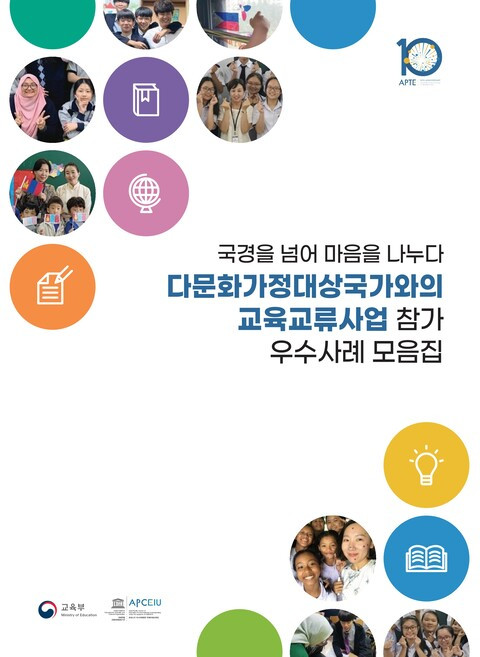 다문화가정대상국가와의 교육교류사업 참가 우수사례 모음집 발행 연도: 2023 단체 저자: APCEIU A carefully curated collection of best practices is presented as part of the 10th-anniversary celebrations of the Asia Pacific Teacher Exchange for Global Education (APTE). Over 30 teachers share their honest and vivid experiences, as well as outstanding follow-up activities. Each story aims to inspire teachers who are interested in the APTE Programme, and to serve as a valuable resource for future participants.