
자료
세계시민교육에 대한 이해를 넓히고 연구, 옹호 활동, 교수, 학습 등을 향상시킬 수 있는 다양하고 유용한 자료를 찾아보세요.
2,813 건의 결과가 검색되었습니다
 Сексуальные домогательства на рабочем месте: вызовы и пути реагирования 발행 연도: 2017 저자: Dase Kavasa Данный отчет содержит информацию о вызовах в области права и политики, связанных с сексуальными домогательствами, и рекомендации по совершенствованию законодательства и практики в Республике Казахстан.
 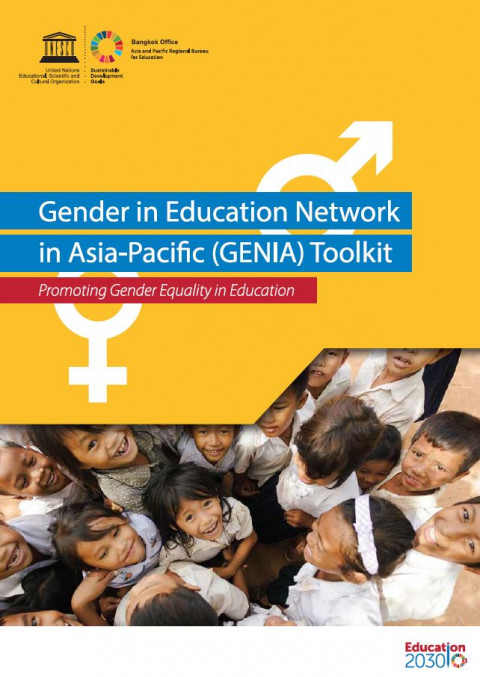 Gender in Education Network in Asia-Pacific (GENIA) Toolkit: Promoting Gender Equality in Education 발행 연도: 2019 단체 저자: UNESCO Bangkok The GENIA Toolkit was originally designed in 2003 when the Gender in Education Network in Asia Pacific was established. The fifth edition of the GENIA Toolkit (25 tools) is designed for use by gender focal points and education planners and implementers. It introduces key concepts and theoretical debates, and outlines practical approaches for mainstreaming gender equality throughout the education system, and within education policy.The toolkit is designed to be used selectively, depending on the user’s needs. It can be used as a self-study tool. Readers can select topics that they have identified as priority learning areas to help them improve their own understanding and practical capacity. The toolkit can also be used by trainers to facilitate training sessions. Trainers can choose tools from the kit that best match the needs of their trainees.
 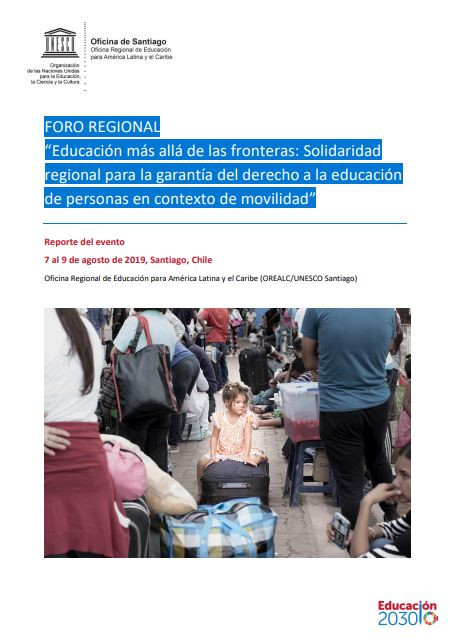 Foro regional: Educación más allá de las Fronteras: Solidaridad Regional para la Garantía del Derecho a la Educación de Personas en Contexto de Movilidad; reporte del evento 발행 연도: 2019 단체 저자: UNESCO Santiago El aumento sustantivo de la movilidad intrarregional, la progresiva transformación de la procedencia de la población en contexto de movilidad y la presencia de flujos masivos de desplazamiento en los últimos años han supuesto importantes desafíos para los Estados. Particularmente, en establecer las maneras en que las personas migrantes, refugiadas, solicitantes de asilo y retornadas puedan ejercer sus derechos fundamentales. Entre estos derechos, el derecho a la educación emerge como una herramienta para proteger la dignidad humana, especialmente considerando su capacidad de promover la garantía de otros derechos y de constituirse, por tanto, en un derecho multiplicador. Un compromiso central de la Agenda 2030 adoptada por los Estados Miembros es “no dejar a nadie atrás”, por lo que considerar las necesidades de protección de las personas en situación de movilidad resulta urgente. El logro de los Objetivos de Desarrollo Sostenible depende de nuestra respuesta a este desafío mundial y regional.
 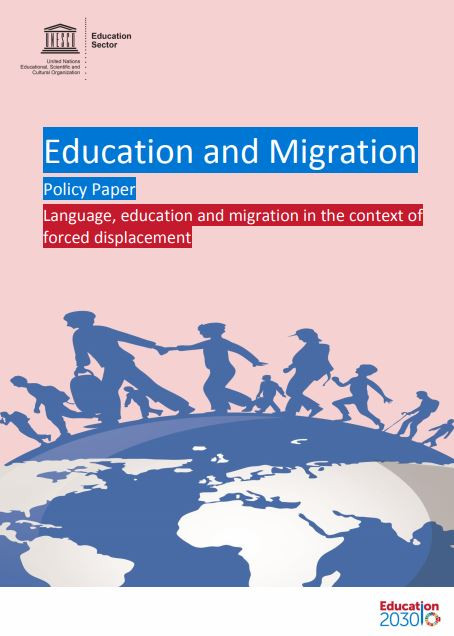 Education and Migration Policy Paper: Language, Education and Migration in the Context of Forced Displacement (Policy Brief Series, no 1) 발행 연도: 2018 저자: Francine Sara Menashy | Zeena Zhakaria A surge in global migration, spurred in part by conflict, emergency, and fragility, has elicited increased attention to the specific needs of migrant and refugee learners. The international community faces an urgent global challenge: more people are now displaced than since the end of the Second World War. Half of those displaced are under the age of 18. Further, while two-thirds of international migrants are in high-income countries, 85% of those displaced by conflict and natural disaster now live in low-income countries. Forced displacement creates particular vulnerabilities, including access to education free from discrimination. Meeting Sustainable Development Goal 4 by 2030 demands that all children, youth, and adults receive an inclusive and equitable quality education. Education is a right that plays a critical role in advancing both sustainable development and peace. Yet refugees, migrants, and asylum seekers encounter numerous barriers to an inclusive andequitable quality education in host countries worldwide.
 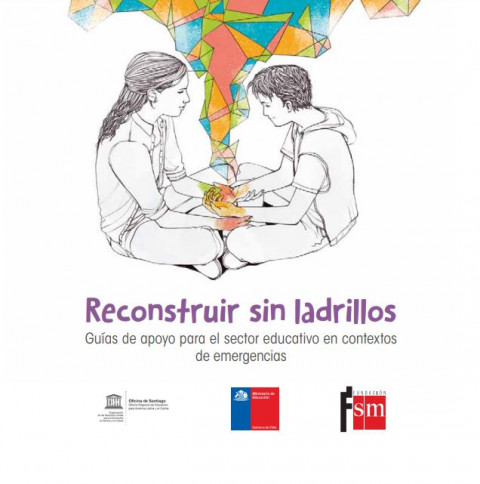 Reconstruir sin ladrillos: guías de apoyo para el sector educativo en contextos de emergencias 발행 연도: 2017 저자: Griselda Amuchástegui | María Isabel del Valle | Henry Renna 단체 저자: UNESCO Santiago La Educación es fundamental para todos los niños, niñas y jóvenes y más aún en situaciones de emergencia. Es una herramienta para el bienestar psico-social de las comunidades en la respuesta, de desarrollo de capacidades para la preparación y reducción del riesgo y de fortalecimiento local en la recuperación de los territorios. La educación es y debe ser un medio para mejorar y transformar las vidas y el hábitat del ser humano. También la Educación es un fin, en su búsqueda y construcción colectiva las personas regeneran relaciones, trazan proyectos comunes y fortalecen su auto-concepto. Ella no sólo contribuye al bienestar, la Educación es por misma un estar-bien colectivo, mejora nuestras habilidades, internaliza valores, contribuye al cambio social, a la salud y la vida sana, la cohesión local. Es un derecho y es también habilitador de otros derechos. Históricamente, ante desastres la Educación ha sido abordada a mediano y largo plazo en lugar de ser activada desde la fase de respuesta a emergencias; la ayuda humanitaria suele enfocarse en la provisión de alimentos, vivienda, agua, albergue, cuestiones imprescindibles pero que deben y pueden ser cruzadas con acciones del sector de Educación desde el primer momento. La Educación no puede esperar a tiempos más estables para su despliegue; debe ser garantizada en todo momento, en todo lugar y de todas las formas posibles como un Derecho Humano Fundamental.
 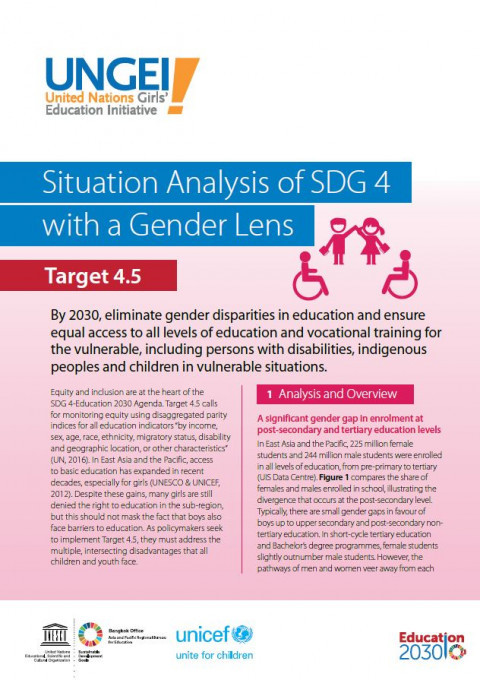 Situation Analysis of SDG 4 with a Gender Lens, Target 4.5 발행 연도: 2018 단체 저자: UNESCO Bangkok Equity and inclusion are at the heart of the SDG 4-Education 2030 Agenda. Target 4.5 calls for monitoring equity using disaggregated parity indices for all education indicators “by income, sex, age, race, ethnicity, migratory status, disability and geographic location, or other characteristics” (UN, 2016). In East Asia and the Pacific, access to basic education has expanded in recent decades, especially for girls (UNESCO & UNICEF, 2012). Despite these gains, many girls are still denied the right to education in the sub-region, but this should not mask the fact that boys also face barriers to education. As policymakers seek to implement Target 4.5, they must address the multiple, intersecting disadvantages that all children and youth face.
 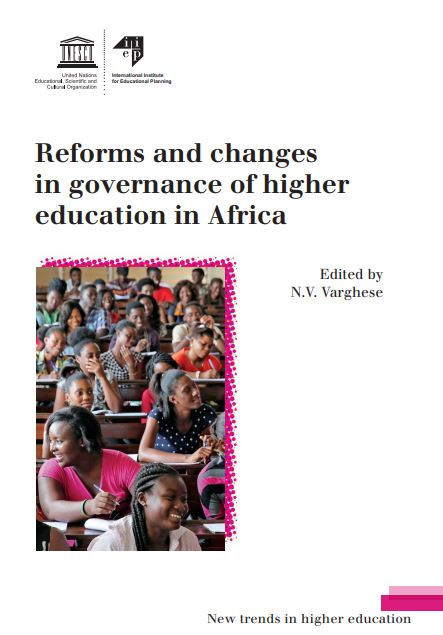 Reforms and Changes in Governance of Higher Education in Africa 발행 연도: 2016 저자: N.V. Varghese 단체 저자: UNESCO International Institute for Educational Planning (IIEP) Higher education in Africa has received favourable political attention and funding support in the period following independence. The rationale for state funding was questioned in the 1980s, and the higher education reforms in the 1990s centred on finding alternative ways of financing and on improving the managerial efficiency of universities. This focus was reflected in the market-friendly reforms that led to the privatization of public institutions and the promotion of private institutions. These reforms resulted in substantial changes in the governance and management of higher education. IIEP initiated a research study to analyse the reforms and to understand their effects on the governance of higher education at institutional and national levels. Based on studies carried out in Ethiopia, Ghana, Kenya, Nigeria, and South Africa, this book shows how the reforms have effected changes in the governance and management of institutions of higher education in Africa.
  Une planète pour nos besoins 발행 연도: 2017 단체 저자: Bruxelles Environnement Ce jeu de rôle permet de comprendre notre dépendance à notre environnement et de réfléchir à la manière dont l’être humain exploite celui-ci pour sa survie et son bien-être. Les élèves devront coopérer pour espérer gagner!
  Tajik cultural identity and multiculturalism 발행 연도: 2014 저자: Khamrokhon Zarifi The article is devoted to issues of history, cultural identity and the heritage of the Tajik people. The issues of preservation and continuity of cultural diversity, as well as the phenomenon of multiculturalism are discussed.
  Language and education in post-Soviet Central Asia 발행 연도: 2008 저자: Monica Perotto In the article, the author tries to assess the dynamics of the changing role of Russian and the titular languages in the post-Soviet republics of Central Asia with reference to demographic and geopolitical data, as well as to determine the consequences of the language policy pursued in these countries.