
자료
세계시민교육에 대한 이해를 넓히고 연구, 옹호 활동, 교수, 학습 등을 향상시킬 수 있는 다양하고 유용한 자료를 찾아보세요.
2,813 건의 결과가 검색되었습니다
 Developing reflective citizens: The role of Holocaust education In what way can we best conceptualize the relationship of Holocaust education to the broader goal of developing reflective citizens? Keeping in mind the diversity of our audience while simultaneously recognizing the traditions of social studies education in the United States, the author argues that Holocaust education should be integrated within the rationale of educating young people to reflect upon issues that have direct relationships to (1) the development of values and (2) the fostering of behaviours emphasizing social responsibility. In short, Holocaust education ‒ meaning the design of curricula, creation of pedagogical strategies and evaluation of student performance ‒ can be a critical component in developing a citizenry who are capable of addressing global problems such as human rights violations and genocide by employing a reflective understanding of history and its relationships to present and future policies and practices, irrespective of national boundaries (By the author) Mémoires à venir - Une enquête sur la mémoire du XXe siècle auprès de 31 172 jeunes de 16 a 29 ans, en 24 langues, dans 31 pays The Foundation for Political Innovation(Fondapol) and the Foundation for the Memory of the Shoah have carried out an international survey of the younger generations that reveals the memories and perceptions of youth regarding the major events of the twentieth and twenty-first centuries. The participants were 31,172 young people aged 16 to 29, surveyed in 24 different languages in 31 countries : Australia , Austria, Belgium , Canada, China , Croatia, Denmark , Estonia , USA , Finland, France , Greece, Hungary , India, Israel, Italy, Japan , Latvia, Lithuania , Netherlands , Poland, Czech Republic, Romania, United Kingdom , Russia, Serbia , Switzerland, Turkey and Ukraine. (By the publisher - Translation) Toward a Philosophy of Holocaust Education: Teaching Values without Imposing Agendas Most teachers hope to make a difference in the lives of their students, but whether they accomplish this with any regularity is often left unclear. With a topic like the Holocaust, the stakes are greatly raised. In this essay, the author discusses the place of the Holocaust in the liberal arts. He argues that the content of Holocaust education must revolve around a methodology that allows students to conjure and experiment with new and deeper self-understanding(s). Teaching the Holocaust effectively means freeing (and urging) students to ask questions about historical epistemology (i.e., the ways in which historians come to know what they do), as well as questions which speak directly to the challenges of the current moment. The idea behind this philosophy is to teach the past in a manner that equips students to see the ramifications of their choices in contrast to the Germans who, by virtue of their own choices, allowed themselves to be fastened in a system designed to achieve national revitalization and racial purification at any and all costs. He stresses that history teachers, as the most recent data show, cannot further their own agendas by using the Holocaust as an instrument for political indoctrination, but they can still lead their students toward new ways of thinking about the world and their place in it. (By the publisher)
 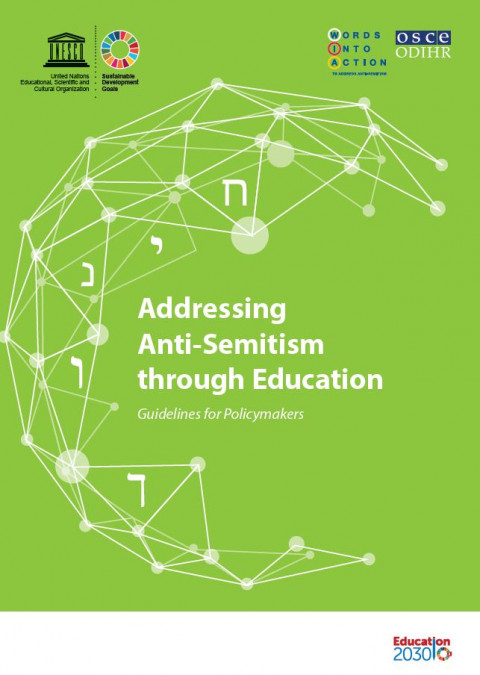 التصدي لمعدات السامية عن طريق التعليم مبادئ تةجيهية لواضعي السياسات 발행 연도: 2018 단체 저자: OSCE. Office for Democratic Institutions and Human Rights (ODIHR) A new UNESCO and OSCE co-publication takes up the challenge of educating learners to resist contemporary anti-Semitism at a time when the issue is becoming ever more crucial around the world. It suggests concrete ways to address anti-Semitism, counter prejudice and promote tolerance through education, by designing programmes based on a human rights framework, global citizenship education, inclusiveness and gender equality.It also provides policymakers with tools and guidance to ensure that education systems build the resilience of young people to anti-Semitic ideas and ideologies, violent extremism and all forms of intolerance and discrimination, through critical thinking and respect for others. Yad Vashem: The world Holocaust remembrance center The world’s largest repository of information on the Holocaust, Yad Vashem’s website provides easy access to digital collections, e-learning for professionals, a database of Shoah victims’ names, and a wealth of historical information in several languages. Yad Vashem: Le centre de commémoration de l'Holocauste dans le monde Le plus grand référentiel au monde de l'information sur l'Holocauste, le site de Yad Vashem offre un accès facile aux collections numériques, e-learning pour les professionnels, une base de données des noms des victimes de la Shoah, et une richesse d'informations historiques en plusieurs langues. Sud-Africain Holocauste et Fondation du Génocide Une initiative unique sur le continent africain, la Fondation sur le génocide sud-africaine de l'Holocauste et est dédié à la création d'une société plus humaine et juste dans laquelle les droits de l'homme et la diversité sont respectés et valorisés. Centres couverts par la Fondation servent de monuments aux six millions de Juifs qui ont été tués dans l'Holocauste et toutes les victimes du nazisme, enseignent sur les conséquences des préjugés, le racisme et la discrimination, et de promouvoir une compréhension des dangers de l'indifférence, l'apathie et le silence.
  Metadata for the Global and Thematic Indicators for the Follow-up and Review of SDG 4 and Education 2030 발행 연도: 2017 단체 저자: UNESCO Institute for Statistics (UIS) This document contains standardised metadata for each of the proposed global and thematic indicators for monitoring Sustainable Development Goal 4 (SDG 4) and the Education 2030 Agenda.The metadata included in this document have been developed by the UIS and are based on the set of thematic indicators approved by the Technical Cooperation Group on SDG 4–Education 2030 Indicators, a group set up in 2016 to provide the technical platform to support the implementation of the thematic indicator framework for the follow-up and review of SDG 4 and the Education 2030 Agenda. Метаданные глобальных и тематических показателей для сопровождения и обзора "ЦУР 4" и программы «Образование-2030" 발행 연도: 2017 단체 저자: UNESCO Institute for Statistics (UIS) Этот документ содержит стандартизованные метаданные для каждого из предлагаемых глобальных и тематических показателей для мониторинга Цели 4 устойчивого развития (SDG 4) и Повестки дня "Образование-2030".Метаданные, включенные в этот документ, были разработаны Институтом статистики ЮНЕСКО и основаны на наборе тематических показателей, одобренных Группой технического сотрудничества по индикаторам ЦУР 4 - "Образование-2030", созданной в 2016 году для предоставления технической платформы по поддержке реализации структуры тематических показателей для последующей деятельности и обзора ЦУР 4 и Повестки дня "Образование-2030".
 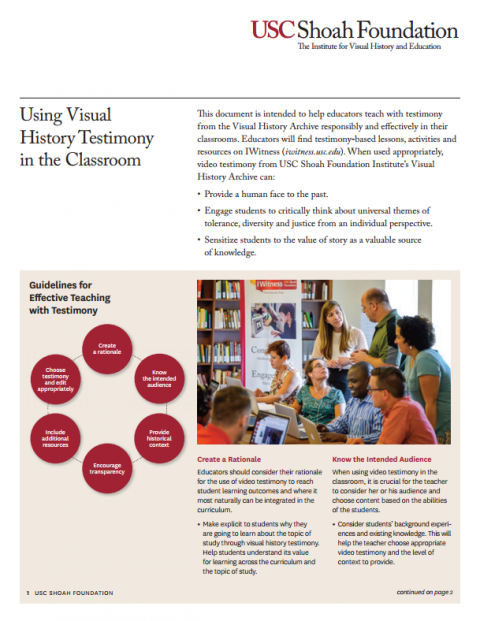 Using Visual History Testimony in the Classroom This short document published by the USC Shoah Foundation gives teachers basic key elements to integrate visual testimonies in class. The 4-page document provides constructive principles of learning applicable to all kind of digital approaches.