
자료
세계시민교육에 대한 이해를 넓히고 연구, 옹호 활동, 교수, 학습 등을 향상시킬 수 있는 다양하고 유용한 자료를 찾아보세요.
2,813 건의 결과가 검색되었습니다
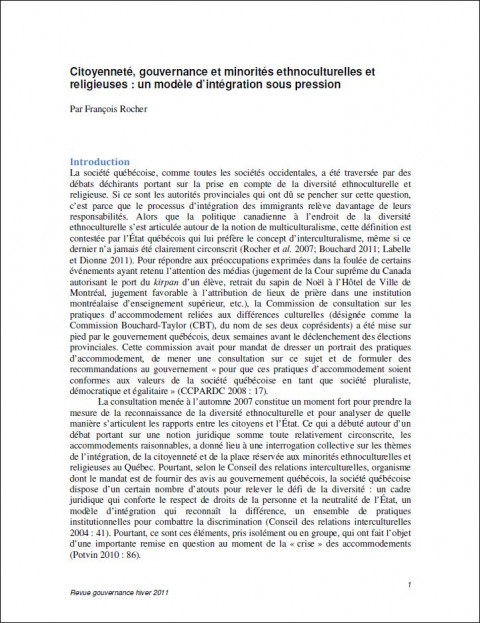 Citoyenneté, gouvernance et minorités ethnoculturelles et religieuses : un modèle d’intégration sous pression 발행 연도: 2011 저자: François Rocher 단체 저자: Revue Gouvernance S’appuyant sur la notion de citoyenneté substantive, cet article vise à mieux cerner les conditions d’inclusion et d’exclusion des minorités ethnoculturelles et religieuses au sein de l’État québécois. Il s’intéresse aussi aux modèles de gouvernance privilégiés par ceux‐ci et examine le rapport entre la participation civique et la gestion des affaires publiques afin de mieux comprendre le type de gouvernance privilégiée par l’État et l’incidence de ce choix sur le rapport qu’entretiennent les minorités face à l’État. Son originalité repose sur un angle d’approche qui demeure peu étudié, notamment le discours des minorités ethnoculturelles et religieuses face à l’État. Au Québec plusieurs moments critiques autour de la question des accommodements raisonnables se sont enchaînés, culminant en la création de la Commission Bouchard‐Taylor en 2007. Ce qui a débuté autour d’un débat portant sur une notion juridique somme toute relativement circonscrite a donné lieu à une interrogation collective sur les thèmes de l’intégration, de la citoyenneté et de la place réservée aux minorités ethnoculturelles et religieuses au Québec. Cette recherche analyse les positions exprimées par les leaders des minorités ethnoculturelles ou religieuses quant aux principes et modalités de participation à la vie publique et aux rapports qu’elles veulent entretenir avec l’État. Elle cherchera à montrer l’hétérogénéité des approches privilégiées et les défis que cela pose sur les différents modèles de gouvernance pouvant être adoptés.
 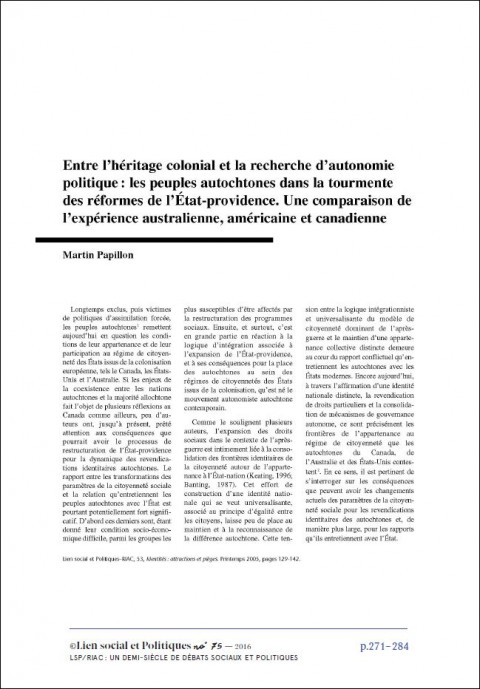 Between Colonial Heritage and Political Autonomy. Comparing the Experience of Australian, American and Canadian Aboriginal Peoples in the Turmoil of Welfare State Reform 발행 연도: 2016 저자: Martin Papillon 단체 저자: Lien social et Politiques Long excluded, then victims of forced assimilation, aboriginal peoples are now evaluating the conditions of their belonging to and participation in citizenship regimes in these three former colonies. The processes of welfare state restructuring may influence the dynamic of identity claims of aboriginal peoples, by modifying the parameters of social citizenship and the relations that aboriginal peoples have with the state. These reforms lean, on the one hand, towards integrated policy with targeted programmes and, on the other hand, towards greater local autonomy in programme management. The post-war citizenship regime in contrast favoured a uniform relationship between citizens and the state, thereby setting up a contradiction between the terms of the citizenship regime and maintenance of a distinct legal regime for aboriginal peoples. The current model seems less likely to constitute a block to recognition of multiplicity and differentiation. Entre l’héritage colonial et la recherche d’autonomie politique: les peuples autochtones dans la tourmente des réformes de l’État-providence. Une comparaison de l’expérience australienne, américaine et canadienne 발행 연도: 2016 저자: Martin Papillon 단체 저자: Lien social et Politiques Longtemps exclus, puis victimes de politiques d’assimilation forcée, les peuples autochtones remettent aujourd’hui en question les conditions de leur appartenance et de leur participation au régime de citoyenneté des États issus de la colonisation européenne. Le processus de restructuration de l’État-providence pourrait influencer la dynamique des revendications identitaires autochtones, en modifiant les paramètres de la citoyenneté sociale et la relation des peuples autochtones avec l’État. On tend aujourd’hui, d’une part, à l’intégration programmatique accompagnée de mesures ciblées et, d’autre part, à une plus grande autonomie locale dans la gestion de ces programmes. Le régime de citoyenneté d’après-guerre favorisait plutôt une uniformisation du rapport entre les citoyens et l’État, et donc posait en contradiction l’intégration à ce régime et le maintien d’un régime statutaire distinct pour les autochtones. Le modèle actuel peut ainsi paraître moins réfractaire à la multiplicité et à la différenciation.
 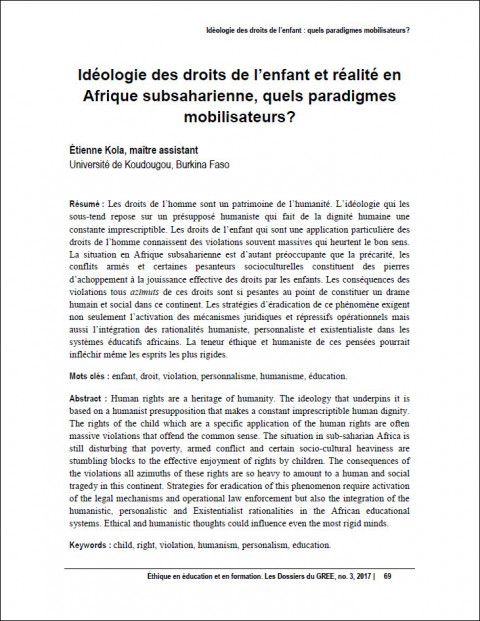 The Ideology of the Rights of Children and the Reality in Sub-Saharan Africa: What Are the Mobilizing Paradigms? 발행 연도: 2017 저자: Étienne Kola 단체 저자: Éthique en éducation et en formation Human rights are a heritage of humanity. The ideology that underpins it is based on a humanist presupposition that makes a constant imprescriptible human dignity. The rights of the child which are a specific application of the human rights are often massive violations that offend the common sense. The situation in sub-saharian Africa is still disturbing that poverty, armed conflict and certain socio-cultural heaviness are stumbling blocks to the effective enjoyment of rights by children. The consequences of the violations all azimuths of these rights are so heavy to amount to a human and social tragedy in this continent. Strategies for eradication of this phenomenon require activation of the legal mechanisms and operational law enforcement but also the integration of the humanistic, personalistic and Existentialist rationalities in the African educational systems. Ethical and humanistic thoughts could influence even the most rigid minds. Idéologie des droits de l’enfant et réalité en Afrique subsaharienne, quels paradigmes mobilisateurs? 발행 연도: 2017 저자: Étienne Kola 단체 저자: Éthique en éducation et en formation Les droits de l’homme sont un patrimoine de l’humanité. L’idéologie qui les sous-tend repose sur un présupposé humaniste qui fait de la dignité humaine une constante imprescriptible. Les droits de l’enfant qui sont une application particulière des droits de l’homme connaissent des violations souvent massives qui heurtent le bon sens. La situation en Afrique subsaharienne est d’autant préoccupante que la précarité, les conflits armés et certaines pesanteurs socioculturelles constituent des pierres d’achoppement à la jouissance effective des droits par les enfants. Les conséquences des violations tous azimuts de ces droits sont si pesantes au point de constituer un drame humain et social dans ce continent. Les stratégies d’éradication de ce phénomène exigent non seulement l’activation des mécanismes juridiques et répressifs opérationnels mais aussi l’intégration des rationalités humaniste, personnaliste et existentialiste dans les systèmes éducatifs africains. La teneur éthique et humaniste de ces pensées pourrait infléchir même les esprits les plus rigides.
 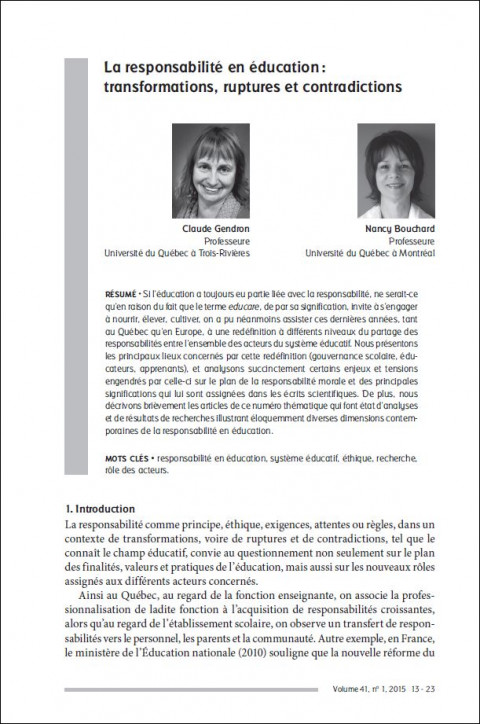 Responsibility in Education: Transformations, Ruptures and Contradictions 발행 연도: 2015 저자: Claude Gendron | Nancy Bouchard 단체 저자: Revue des sciences de l’éducation If education has always been connected with responsibility simply because the word educare by definition involves nourishing, raising, cultivating, the past few years have witnessed, both in Quebec and in Europe, a redefinition in various ways of the sharing of responsibilities among participants in the educational system. This text presents the principal areas concerned by this redefinition (school management, educators, learners) and briefly analyzes certain issues and tensions caused by it in terms of moral responsibility and the main meanings assigned to it in the scientific literature. Moreover, it introduces articles of this special issue that report research analyses and results which eloquently illustrate various contemporary dimensions of responsibility in education. La responsabilité en éducation: transformations, ruptures et contradictions 발행 연도: 2015 저자: Claude Gendron | Nancy Bouchard 단체 저자: Revue des sciences de l’éducation Si l’éducation a toujours eu partie liée avec la responsabilité, ne serait-ce qu’en raison du fait que le terme educare, de par sa signification, invite à s’engager à nourrir, élever, cultiver, on a pu néanmoins assister ces dernières années, tant au Québec qu’en Europe, à une redéfinition à différents niveaux du partage des responsabilités entre l’ensemble des acteurs du système éducatif. Nous présentons les principaux lieux concernés par cette redéfinition (gouvernance scolaire, éducateurs, apprenants), et analysons succinctement certains enjeux et tensions engendrés par celle-ci sur le plan de la responsabilité morale et des principales significations qui lui sont assignées dans les écrits scientifiques. De plus, nous décrivons brièvement les articles de ce numéro thématique qui font état d’analyses et de résultats de recherches illustrant éloquemment diverses dimensions contemporaines de la responsabilité en éducation.
  The Psyche of a Good Citizen: On the Psychology of Civic Virtue 발행 연도: 2015 저자: Shelley Burtt 단체 저자: Les ateliers de l'éthique What are the psychological sources of civic virtue in the republican tradition? This article identifies three: the education of the passions, the manipulation of interests, and the compulsion to duty. The author explores each and concludes that an appreciation of their distinctions suggests possibilities for reviving republican virtue in the modern world. La psyché du bon citoyen : sur la psychologie de la vertu civique 발행 연도: 2015 저자: Shelley Burtt 단체 저자: Les ateliers de l'éthique Quelles sont les sources psychologiques de la vertu civique dans la tradition républicaine? Cet article en identifie trois : l’éducation des passions, la manipulation des intérêts et la contrainte du devoir. L’auteure explore chacune de ces sources et conclut qu’une meilleure appréciation de ce qui les distingue est porteuse de nouvelles possibilités pour raviver la vertu républicaine dans le monde moderne.
  De la diversité ethnoculturelle au vivre ensemble: représentations de futurs enseignants de l’approche multiculturelle en éducation 발행 연도: 2010 저자: Mirela Moldoveanu 단체 저자: McGill University. Faculty of Education Ce texte explore les sens que de futurs enseignants attribuent à l’éducation multiculturelle, afin d’en déceler l’importance et les objectifs dans une perspective de vivre ensemble. Une recherche exploratoire utilisant des données qualitatives a été menée auprès de neuf étudiants-maîtres inscrits au programme de formation initiale à l’enseignement dans une université ontarienne. L’interprétation des résultats a conduit à la construction d’un modèle d’éducation multiculturelle qui essaie de la légitimiser dans le cadre d’une approche pédagogique différenciée.