
자료
세계시민교육에 대한 이해를 넓히고 연구, 옹호 활동, 교수, 학습 등을 향상시킬 수 있는 다양하고 유용한 자료를 찾아보세요.
2,813 건의 결과가 검색되었습니다
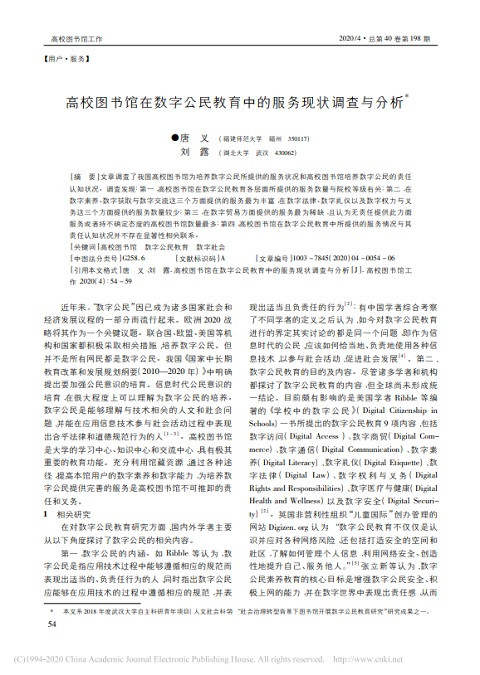 高校图书馆在数字公民教育中的服务现状调查与分析 (高校图书馆工作; No. 4) 발행 연도: 2020 저자: Tangyi | Liulu 단체 저자: College library and Information Committee of Hunan Provincial 文章调查了我国高校图书馆为培养数字公民所提供的服务状况和高校图书馆培养数字公民的责任 认知状况。调查发现: 第一,高校图书馆在数字公民教育各层面所提供的服务数量与院校等级有关; 第二,在 数字素养、数字获取与数字交流这三个方面提供的服务最为丰富,在数字法律、数字礼仪以及数字权力与义 务这三个方面提供的服务数量较少; 第三,在数字贸易方面提供的服务最为稀缺,且认为无责任提供此方面 服务或者持不确定态度的高校图书馆数量最多; 第四,高校图书馆在数字公民教育中所提供的服务情况与其 责任认知状况并不存在显著性相关联系。
 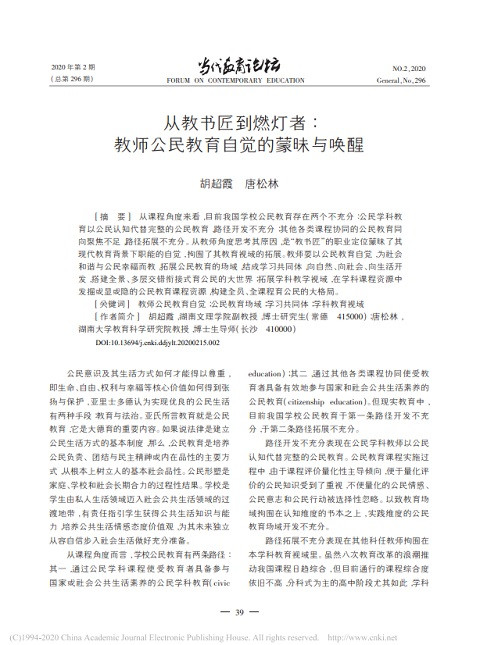 From Teaching Craftsmen to Lamplighters: Ignorance and Recovery of Teachers’ Citizenship Education Consciousness (Forum on Contemporary Education; No. 296) 발행 연도: 2020 저자: Hu Chaoxia | Tang Songlin 단체 저자: Hunan Academy of Educational Science From the perspective of curriculum, there are two major shortcomings of citizenship education in schools in China: civic education replaces complete citizenship education with citizenship cognition, and the path development is inadequate; the concentric focus of citizenship education with other courses is inadequate, and the path expansion is inadequate. From the perspective of teachers, the reason is that the professional orientation of “teaching craftsmen” ignores the self-consciousness of their functions under the background of modern education, which restricts the expansion of their educational horizons. Teachers should be conscious of citizenship education, teach for social harmony and citizen happiness, expand the field of citizenship education, form a learning community, develop toward nature, society and life, build a panoramic, multi-level interlaced world of citizenship education, expand the horizon of disciplinary education, and explore reveal or conceal in subject curriculum resources. The curriculum resources of citizenship education should build a general pattern of citizenship education through the whole staff and the whole curriculum.
  可欲且可行的全球公民教育实践路径: 苏格兰“全球故事情节法”探析 (外国教育研究; Vol. 47, No. 3) 발행 연도: 2020 저자: Rao Shuqi 단체 저자: Northeast Normal University 研究发现,全球公民教育的热度不高与其实践层面的三重困境有关。“全球故事情节法”之所以成为苏格兰实施全球公民教育的最有效路径,正是源自于其对实践困境的有效回应:其一,政府对全球公民教育的倡导营造了相对宽松的政策环境,“全球故事情节法”与现有课程体系相融合获得了灵活的实践空间,实现了安全的课程地位。其二,通过对“故事情节法”和教育戏剧的运用,使全球社会和全球议题通俗化,实现了学生的体验式学习,弥合了学生认知能力和认知需求间的矛盾。其三,西苏格兰发展教育中心通过职业培训传播了理论知识和实践能力,构建了围绕全球公民教育的共同体,为教师提供了教学支持。
  Digital Citizenship Education: The Policy and Practice in Asia-Pacific Region (International and Comparative Education; Vol. 8) 발행 연도: 2019 저자: Zhou Xiaoli | Wang Fangzhou 단체 저자: Beijing Normal University With the advent of the network informational age, digital citizenship has gradually become a concept for in-depth exploration. At the same time, the education of digital citizenship has also increasingly become an important part of the education system of many countries around the world. In Asia-Pacific area, UNESCO Bangkok has started to launch the digital citizenship project, while those member states are actively exploring and working on all aspects of relevant policy and practice. As the countries with high information level, Singapore, Australia and Korea have been carrying out better digital citizenship educations, especially in terms of cyber wellness courses, cyber security education and internet addiction prevention and treatment. The status and experience of the digital citizenship education in Asia-Pacific countries can provide some enlightenment for the future advancements of digital citizenship education in China. 数字公民教育:亚太地区的政策与实践 (比较教育研究; Vol. 8) 발행 연도: 2019 저자: Zhou Xiaoli | Wang Fangzhou 단체 저자: Beijing Normal University 随着网络信息时代的到来,在国际学术界,数字公民已成为一个被深入探讨 的概念 ;在全球教育领域,数字公民教育日益成为世界各国教育体系的重要组成部分。在 亚太地区,联合国教科文组织曼谷办事处已经启动了数字公民培育项目,各成员国在政策 与实践方面正作出积极的探索和努力。作为信息化程度较高的国家,新加坡、澳大利亚和 韩国的数字公民教育开展得较好,尤其在网络健康课程、网络安全教育及网络成瘾预防和 治疗等方面表现更为出色,这些经验可为数字公民教育的推进提供若干启示。
 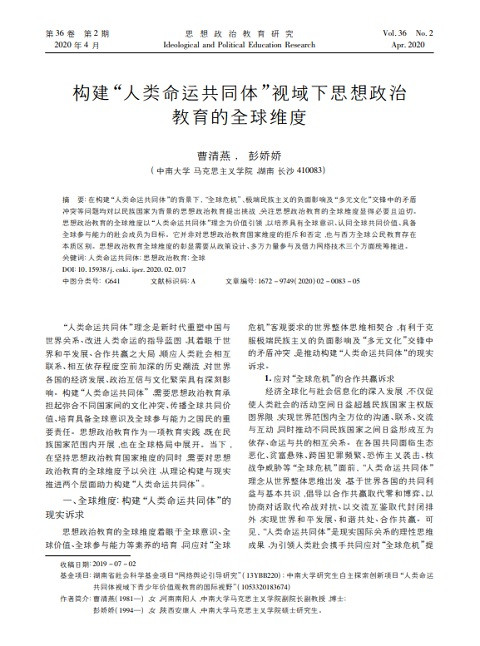 Constructing the Global Dimension of Ideological and Political Education From the Perspective of “Community With a Shared Future for Mankind” (Ideological and Political Education Research; Vol. 36, No. 2) 발행 연도: 2020 저자: Cao Qingyan | Peng Jiaojiao 단체 저자: Harbin University of Science and Technology In the context of building a community with a shared future for mankind, issues such as “global crisis”, the negative impact of ultra-nationalism and the conflicts in the confrontation of “multi-cultures” all challenge the ideological and political education in the context of nation-states. Therefore, it is necessary and urgent to pay attention to the global dimension of ideological and political education. The global dimension of ideological and political education is guided by the concept of “a community with a shared future for mankind” and aims to cultivate social members with global awareness, recognition of global common values and global participation ability. It is not the rejection and denial of the national dimension of ideological and political education, and it is also different from the western global citizenship education in essence. The global dimension of ideological and political education needs to be promoted from three aspects: policy design, multi-force participation and network technology.
 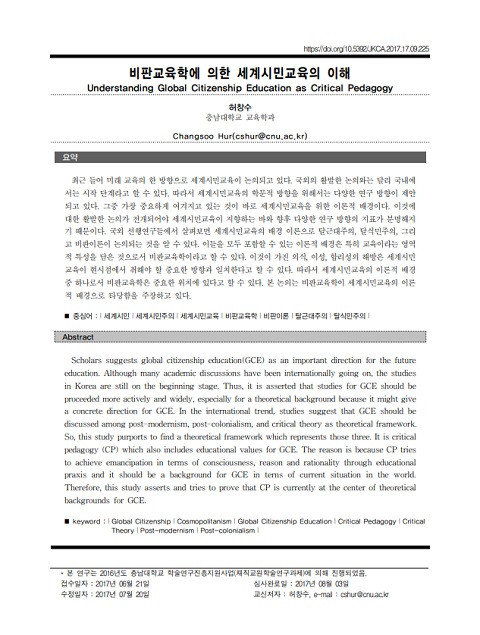 Understanding Global Citizenship Education as Critical Pedagogy (Journal of the Korea Contents Association; Vol. 17, No. 9) 발행 연도: 2017 저자: Changsoo Hur 단체 저자: Korea Contents Association Scholars suggests global citizenship education(GCE) as an important direction for the future education. Although many academic discussions have been internationally going on, the studies in Korea are still on the beginning stage. Thus, it is asserted that studies for GCE should be proceeded more actively and widely, especially for a theoretical background because it might give a concrete direction for GCE. In the international trend, studies suggest that GCE should be discussed among post-modernism, post-colonialism, and critical theory as theoretical framework. So, this study purports to find a theoretical framework which represents those three. It is critical pedagogy (CP) which also includes educational values for GCE. The reason is because CP tries to achieve emancipation in terms of consciousness, reason and rationality through educational praxis and it should be a background for GCE in terns of current situation in the world. Therefore, this study asserts and tries to prove that CP is currently at the center of theoretical backgrounds for GCE. 비판교육학에 의한 세계시민교육의 이해 (한국콘텐츠학회논문지; Vol. 17, No. 9) 발행 연도: 2017 저자: Changsoo Hur 단체 저자: Korea Contents Association 최근 들어 미래 교육의 한 방향으로 세계시민교육이 논의되고 있다. 국외의 활발한 논의와는 달리 국내에 서는 시작 단계라고 할 수 있다. 따라서 세계시민교육의 학문적 방향을 위해서는 다양한 연구 방향이 제안 되고 있다. 그중 가장 중요하게 여겨지고 있는 것이 바로 세계시민교육을 위한 이론적 배경이다. 이것에 대한 활발한 논의가 전개되어야 세계시민교육이 지향하는 바와 향후 다양한 연구 방향의 지표가 분명해지 기 때문이다. 국외 선행연구들에서 살펴보면 세계시민교육의 배경 이론으로 탈근대주의, 탈식민주의, 그리 고 비판이론이 논의되는 것을 알 수 있다. 이들을 모두 포함할 수 있는 이론적 배경은 특히 교육이라는 영역 적 특성을 담은 것으로서 비판교육학이라고 할 수 있다. 이것이 가진 의식, 이성, 합리성의 해방은 세계시민 교육이 현시점에서 취해야 할 중요한 방향과 일치한다고 할 수 있다. 따라서 세계시민교육의 이론적 배경 중 하나로서 비판교육학은 중요한 위치에 있다고 할 수 있다. 본 논의는 비판교육학이 세계시민교육의 이론 적 배경으로 타당함을 주장하고 있다. 构建“人类命运共同体”视域下思想政治 教育的全球维度 (思想政治教育研究; Vol. 36, No. 2) 발행 연도: 2020 저자: Cao Qingyan | Peng Jiaojiao 단체 저자: Harbin University of Science and Technology 在构建“人类命运共同体”的背景下,“全球危机”、极端民族主义的负面影响及“多元文化”交锋中的矛盾 冲突等问题均对以民族国家为背景的思想政治教育提出挑战,关注思想政治教育的全球维度显得必要且迫切。 思想政治教育的全球维度以“人类命运共同体”理念为价值引领,以培养具有全球意识、认同全球共同价值、具备 全球参与能力的社会成员为目标。它并非对思想政治教育国家维度的拒斥和否定,也与西方全球公民教育存在 本质区别。思想政治教育全球维度的彰显需要从政策设计、多方力量参与及借力网络技术三个方面统筹推进。
  Sustainable Foundations: A Guide for Teaching the Sustainable Development Goals 발행 연도: 2018 저자: Keana Rellinger | Grace Van Mil 단체 저자: Manitoba Council for International Cooperation (MCIC) This guide is designed for educators or anyone who would like to teach young people about the United Nations Sustainable Development Goals. The Sustainable Development Goals — also known as the SDGs or the Global Goals —cover a wide range of sustainability issues; highlighting local, national and international priority areas to end poverty and hunger, improve health and education, make cities more sustainable and combat climate change. This guide will provide you with clear information, educational resources and other supports to help you in your efforts to educate and engage young people so that they support the Sustainable Development Goals and are inspired to turn their support into action. This guide will also explore how you can incorporate the different topics covered by each goal into your lessons across multiple subjects.