
자료
세계시민교육에 대한 이해를 넓히고 연구, 옹호 활동, 교수, 학습 등을 향상시킬 수 있는 다양하고 유용한 자료를 찾아보세요.
2,829 건의 결과가 검색되었습니다
 Becoming Citizens in a Changing World: IEA International Civic and Citizenship Education Study 2016 International Report 발행 연도: 2017 저자: Wolfram Schulz, John Ainley, Julian Fraillon, Bruno Losito, Gabriella Agrusti, Tim Friedman 단체 저자: International Association for the Evaluation of Educational Achievement (IEA) The International Civic and Citizenship Education Study 2016 (ICCS 2016) investigated the ways in which young people are prepared to undertake their roles as citizens in a range of countries in the second decade of the 21st century. It studied students’ knowledge and understanding of civics and citizenship as well as students’ attitudes, perceptions, and activities related to civics and citizenship. Based on nationally representative samples of students, the study also examined differences among countries in relation to these outcomes of civic and citizenship education, and explored how cross-national differences relate to student characteristics, school and community contexts, and national characteristics. As the second cycle of this study, ICCS 2016 is a continuation and an extension of ICCS 2009.
  Interrupting Extremism by Creating Educative Turbulence 발행 연도: 2014 저자: Lynn Davies 단체 저자: Curriculum Inquiry This article begins from the premise that it is important to explore how people unlearn, as well as learn, specifically in terms of extremist or violent attitudes. Three different country examples are given of intergroup encounters that interrupt rigidities in attitudes: working across ethnic groups in Sri Lanka, tackling religious divides in Northern Ireland through shared classes, and initiatives to prevent violent extremism in the United Kingdom. Pedagogical implications of unlearning involve working with the four Ds of deradicalization, debiasing, disengagement and desistence. Interrupting Extremism by Creating Educative Turbulence 발행 연도: 2014 저자: Lynn Davies 단체 저자: Curriculum Inquiry Cet article développe l'idée qu'il est important d'analyser les processus de désapprentissage, autant que d'apprentissage, qui conduisent un individu à adopter des attitudes extrémistes ou violentes. Des exemples tirés de trois pays sont mobilisés pour montrer comment des rencontres intergroupes conduisent à infléchir des comportements rigides : le travail entre groupes ethniques au Sri Lanka, la lutte contre les divisions religieuses en Irlande du Nord à l'aide de classes mixtes, et des initiatives visant à prévenir l'extrémisme violent au Royaume-Uni. Les implications pédagogiques d'une approche par le "désapprentissage" nécessitent de mobiliser les quatre "D": déradicalisation, désubjectivation, désengagement et désistance. Education as a Security Issue 저자: Ian Jamison 단체 저자: Tony Blair Faith Foundation The use of education as both tool and target of religious extremists globally is perhaps one of the most important generational challenges we face today. To ensure that the next generation is open to a more pluralistic world, we must ensure that their education equips them to safely encounter the 'Other'. This not only means improving knowledge, understanding and interaction, but also critically requires investment in developing essential soft skills that can ensure these are properly employed. Education as a Security Issue 저자: Ian Jamison 단체 저자: Tony Blair Faith Foundation Le recours des extrémistes religieux à l'éducation comme, à la fois, outil et cible est peut-être l'un des défis les plus importants de cette génération, auquel nous sommes confrontés aujourd'hui dans le monde. Pour que la prochaine génération soit ouverte à un monde plus pluraliste, nous devons veiller à ce que leur éducation les prépare à des échanges pacifiques avec « l’Autre ». Cela signifie non seulement d’améliorer les connaissances, la compréhension et l'interaction, mais aussi d’investir urgemment dans le développement des compétences générales essentielles qui en garantissent une bonne utilisation.
 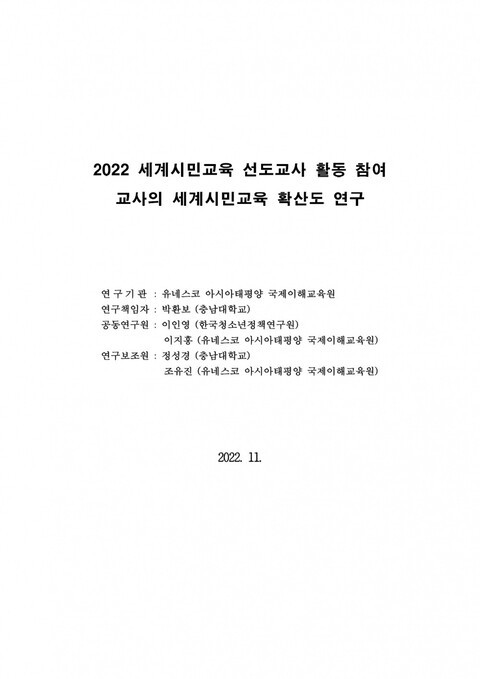 2022 세계시민교육 선도교사 활동 참여 교사의 세계시민교육 확산도 연구 발행 연도: 2022 저자: 박환보 | 이인영 | 이지홍 본 연구는 유네스코 아시아태평양 국제이해교육원이 추진한 ‘세계시민교육 선도교사 사업’ 효과 분석을 목표로 한다. ‘선도교사 활동 참여를 통해 세계시민교육 실천 역량이 향상되었는지’, ‘연수 받은 내용을 학교 현장에서 얼마나 어떻게 확산시키고 있는지’, 그리고 이러한 활동을 통해 ‘학교 현장에서 세계시민교육은 얼마나 확산되고 있는지’ 등을 분석하였다. 이를 토대로 세계시민교육 선도교사 활동의 성과를 보다 종합적으로 이해하고, 향후 성과 확산을 위한 정책적 시사점을 도출하였다. 연구기관: 유네스코 아시아태평양 국제이해교육원연구책임자: 박환보 (충남대학교)공동연구원: 이인영 (한국청소년정책연구원)이지홍 (유네스코 아시아태평양 국제이해교육원)연구보조원: 정성경 (충남대학교)조유진 (유네스코 아시아태평양 국제이해교육원) 목차제1장 서론제2장 세계시민교육 선도교사 활동 성과분석 체계제3장 세계시민교육 선도교사 활동 성과분석제4장 세계시민교육 선도교사의 세계시민교육 확산 사례 분석제5장 세계시민교육 선도교사의 세계시민교육 확산 활동과 확산도 인식제6장 결론참고문헌부록
 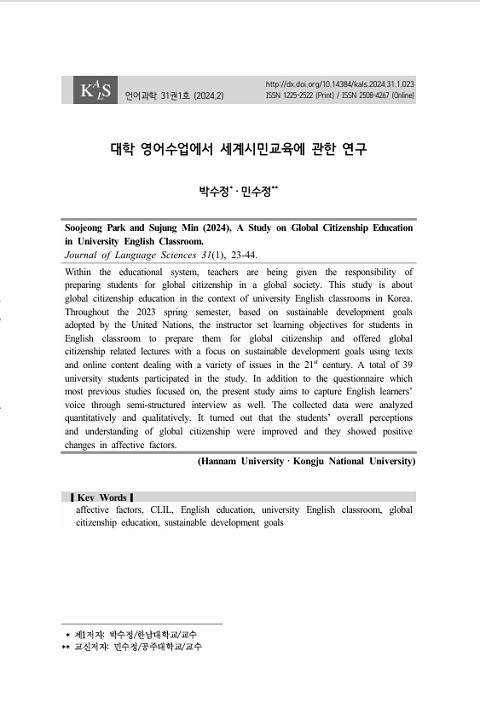 대학 영어수업에서 세계시민교육에 관한 연구 (언어과학 31권 1호) 발행 연도: 2024 저자: 박수정 | 민수정 단체 저자: 한국언어과학회 선행연구들을 살펴보면, 다양한 교과목에서 다양한 연령을 대상으로 세계시민의식의 함양을 위한 교육적 접목이 이뤄지고 있다. 하지만 대학생을 대상으로 한 세계시민의식과 관련된 연구는 미비한 실정이고, 특히 세계시민의식과 접목된 대학 교양영어 수업과 관련된 연구들도 많지 않다. 지속적인 세계시민의식 함양을 위한 교육적 모델 및 교육적 개입에 관한 연구가 충분히 이뤄져야 함에도 그렇지 못한 실정이다. 이에 본 연구에서는 우리나라 대학생들이 어느 정도 세계시민으로서의 역량을 갖추고 있는지 알아보고, 유엔에서 제시한 17개의 지속가능한 발전목표를 적용한 대학 교양영어 수업을 통해 우리나라 대학생들의 세계시민의식 교육 방안을 모색하고자 한다.
 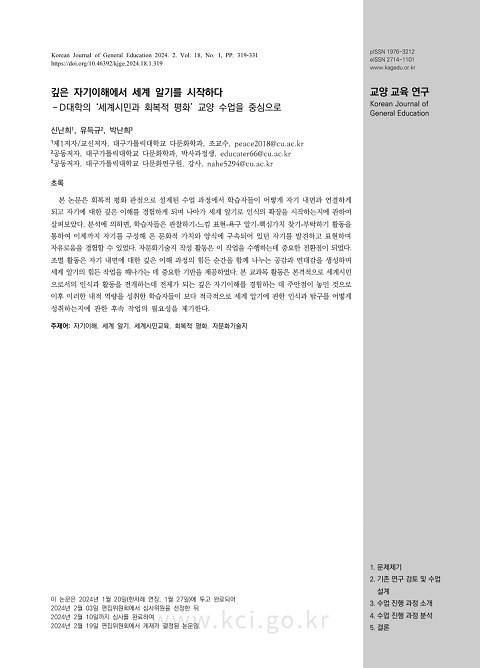 깊은 자기이해에서 세계 알기를 시작하다: D대학의 ‘세계시민과 회복적 평화’ 교양 수업을 중심으로 (교양교육연구; Vol. 18, No. 1) 발행 연도: 2024 저자: 신난희 | 유득규 | 박난희 단체 저자: 한국교양교육학회 본 논문은 회복적 평화 관점으로 설계된 수업 과정에서 학습자들이 어떻게 자기 내면과 연결하게 되고 자기에 대한 깊은 이해를 경험하게 되며 나아가 세계 알기로 인식의 확장을 시작하는지에 관하여 살펴보았다. 분석에 의하면, 학습자들은 관찰하기-느낌 표현-욕구 알기-핵심가치 찾기-부탁하기 활동을 통하여 이제까지 자기를 구성해 온 문화적 가치와 양식에 구속되어 있던 자기를 발견하고 표현하며 자유로움을 경험할 수 있었다. 자문화기술지 작성 활동은 이 작업을 수행하는데 중요한 전환점이 되었다. 조별 활동은 자기 내면에 대한 깊은 이해 과정의 힘든 순간을 함께 나누는 공감과 연대감을 생성하며 세계 알기의 힘든 작업을 해나가는 데 중요한 기반을 제공하였다. 본 교과목 활동은 본격적으로 세계시민으로서의 인식과 활동을 전개하는데 전제가 되는 깊은 자기이해를 경험하는 데 주안점이 놓인 것으로 이후 이러한 내적 역량을 성취한 학습자들이 보다 적극적으로 세계 알기에 관한 인식과 탐구를 어떻게 성취하는지에 관한 후속 작업의 필요성을 제기한다.
  세계시민 양성을 위한 교과 연계 인성교육 방안 탐색: 인문교양 읽기와 스토리텔링을 중심으로 (율곡학연구; Vol. 56) 발행 연도: 2024 저자: 박영민 단체 저자: 율곡학회 이 연구는 자기 삶의 변혁을 바탕으로 세상의 변화를 이끌어 갈 수 있는 세계시민으로서 갖추어야 할 핵심역량을 강화하는 방안에 초점을 맞추었다. 이 연구의 목적은 교양 강좌에서 세계시민의식 함양을 위하여 ‘인문교양 읽기와 스토리텔링’을 적용한 인성교육 방안을 제안하는 것이다. 연구의 이론적 기초로서 미래 사회의 세계시민과 핵심역량, 교과 연계 인성교육을 통한 세계시민의식 강화의 가능성을 중점적으로 고찰하였다. 다음으로 이론적 토대를 바탕으로 미래 사회가 요구하는 역량 개발과 관련하여, 세계시민의식 강화를 위한 교양 교과목 연계 교육프로그램을 예시하였다. 연구 결과를 종합하면 다음과 같다. 첫째, 교양 강좌와 연계한 인성교육에서 세계시민 양성을 위한 ‘인문교양 읽기와 스토리텔링’의 필요성 및 방법을 이론적으로 검토한 후 수업에서의 적용 가능성을 확인하였다. 둘째, 교양 강좌에서 대학생의 세계시민의식 강화를 위한 ‘인문교양 읽기와 스토리텔링’을 적용한 인성교육 교수·학습과정안을 제시하였다. 결론적으로 ‘인문교양 읽기와 스토리텔링’을 적용한 인성교육 프로그램은 대학생의 세계시민의식 함양에 긍정적인 효과가 있을 것으로 판단된다.
  Установки молодежи современного Казахстана на проявление социальной активности 발행 연도: 2018 저자: O.V. Kaldybayeva | F.M. Mussataeva | G.Ye. Okasova В статье поднимается проблема исследования социальной активности среди современной молодежи, от степени которой во многом зависит эффективность реализации многих государственных программ. Выводы основаны на результатах социологического исследования, реализованного Научно-исследовательским центром «Молодежь» во второй половине 2017 г. в Республике Казахстан.