
자료
세계시민교육에 대한 이해를 넓히고 연구, 옹호 활동, 교수, 학습 등을 향상시킬 수 있는 다양하고 유용한 자료를 찾아보세요.
2,823 건의 결과가 검색되었습니다
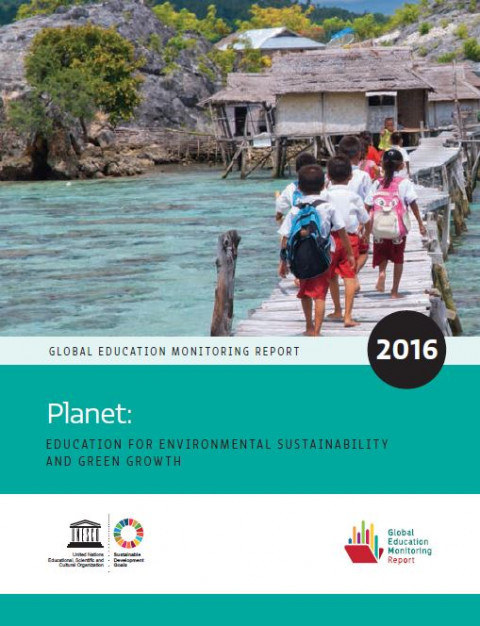 Global Education Monitoring Report, 2016: Planet: Education for Environmental Sustainability and Green Growth 발행 연도: 2016 단체 저자: UNESCO PLANET: Education for environmental sustainability and green growth, a publication taken from the full 2016 Global Education Monitoring Report, explores the knowledge and skills needed for sustainable and inclusive economic growth that does not damage our planet.This publication demonstrates how education can help people understand and respond to environmental issues and climate change. Environmental education can increase green knowledge and build sustainability practices. The publication warns that while education contributes to economic growth, education systems must be careful not to encourage unsustainable lifestyles and all learners must acquire the knowledge and skills needed to promote sustainable development.It also argues that we must continue to learn throughout our lives in order to make production and consumption sustainable, and to provide green skills for green industries. Creating green industries relies on high-skill workers with specific training, yet by 2020 there could be 40 million too few workers with tertiary education relative to demand. Higher education and research should also be oriented towards green innovation and growth; innovation depends on cooperation in higher education and investment in research and development to transform production in vast swaths of the economy.It also recognises that education must change in order to keep up with the changing face of work. Green and transferable skills should be taught in both school and the workplace. The greening of industries requires not only the production of more high-skill workers, but the continued training and education for low and medium skill workers, often on the job. “To ensure the Sustainable Development Goals are implemented, everyone involved needs to think, to work, to organise, to communicate and to report in ways that are completely different from what has been done up till now. Education truly is key to a wide appreciation not just of the SDGs but the new ways of thinking and working that are going to be necessary to fulfil them. So the challenge to all of us is to re-learn, and that does not just apply to educators, but it applies to all of us.”
  Guidelines on Sustainability Science in Research and Education 발행 연도: 2017 단체 저자: UNESCO “Guidelines on Sustainability Science in Research and Education” is the main output of the international UNESCO project “Broadening the Application of the Sustainability Science Approach” initiated in October 2015 with the support of the Japanese Ministry of Education, Culture, Sports, Science and Technology (Japan/MEXT) to identify good practices and develop policy guidelines to help Member States harness the potential of sustainability science in their sustainable development strategies.This project aimed to help UNESCO Member States and other stakeholders introduce or reinforce a sustainability science approach into transdisciplinary research and education, to enable them to better respond to global challenges, through three symposia to foster dialogue and collaboration among experts and policy-makers. Based on the joint efforts of UNESCO’s Natural Sciences Sector, Social and Human Sciences Sector, Education Sector and Regional Science Bureau for Asia and the Pacific in Jakarta, the project benefited from the guidance of a multidisciplinary steering committee and a drafting sub-committee.For further information on Sustainability Science, please visit: https://en.unesco.org/sustainability-science
  Interculturalism at the Crossroads: Comparative Perspectives on Concepts, Policies and Practices 발행 연도: 2017 저자: Fethi Mansouri 단체 저자: UNESCO Today most societies across the world are witnessing rising levels of social and cultural diversity brought about by globalisation and in particular increased human mobility and significant advances in information and communications technologies. The dilemma, therefore, has been how best to manage the resultant diversity and what optimal social policy paradigms to adopt towards this end.Assimilation, multiculturalism and presently interculturalism have all been proposed as possible policy conduits for managing socio-cultural diversity.This book, in focusing on the latter concept, and in particular in its intercultural dialogue manifestation, offers at once theoretical examinations, policy discussion and practical explorations of its uptake across the world. The core argument connecting the book’s three distinct sections is that whilst assimilation in its racist manifestation is no longer a viable option in today’s world, intercultural dialogue within existing multicultural settings has much to offer.
  UNESCO and Gender Equality in Sub-Saharan Africa: Innovative Programmes, Visible Results 단체 저자: UNESCO For over twenty years, UNESCO’s work in Africa has been undertaken in a specific framework with a range of institutional mechanisms designed to help translate into action its priorities: Africa and gender equality. During this period, UNESCO achieved important results in the areas covered by its mandate to promote gender equality.This publication highlights UNESCO’s contribution to the implementation of the African Union’s Agenda 2063 and the 2030 Agenda for Sustainable Development of the United Nations, in the field of gender equality in Africa, through examples of good practice, lessons learnt as well as suggestions and recommendations for the future. L'UNESCO et l'égalité des Genres en Afrique Subsaharienne: Des Programmes Novateurs, des Résultats Perceptibles 단체 저자: Organisation des Nations Unies pour l'éducation, la science et la culture (UNESCO) Depuis plus d’une vingtaine d’années l’UNESCO a inscrit son action dans un cadre spécial assorti d’un ensemble de mécanismes institutionnels conçus pour appuyer l’opérationnalisation de ses Priorités: l’Afrique et l’égalité des genres. Au cours de cette période, l’UNESCO a été à l’origine d’importantes réalisations dans les domaines relevant de son mandat à travers la mise en oeuvre des programmes et activités novateurs.La présente publication met en exergue la contribution de l’UNESCO à la mise en oeuvre de l’Agenda 2063 de l’Union africaine et du Programme de développement durable à l’horizon 2030 dans le domaine de l’égalité des genres en Afrique, à travers des exemples de bonnes pratiques, de leçons apprises ainsi que des suggestions et recommandations pour le futur.
 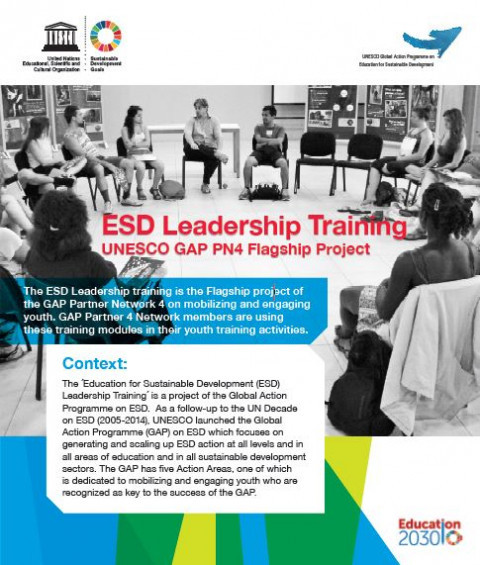 ESD Leadership Training: UNESCO GAP PN4 Flagship Project 발행 연도: 2017 단체 저자: UNESCO The ESD Leadership training is the Flagship project of the GAP Partner Network 4 on mobilizing and engaging youth. GAP Partner 4 Network members are using these training modules in their youth training activities. Formation au Leadership pour l'EDD: Projet phare GAP PN4 de l'UNESCO 발행 연도: 2017 단체 저자: Organisation des Nations Unies pour l'éducation, la science et la culture (UNESCO) La formation au leadership pour l’EDD est le projet phare du réseau de partenaires 4 (PN4) mis en place pour le Programme d’action global en vue d’autonomiser et de mobiliser les jeunes. Les membres de ce réseau utilisent ces modules pour leurs activités de formation des jeunes. التدريب على القيادة في التعليم من أجل التنمية المستدامة المشروع الطليعي للشبكة الشريكة الرابعة في برنامج العمل العالمي لليونسكو 발행 연도: 2017 단체 저자: منظمة الأمم المتحدة للتربية والعلم والثقافة (UNESCO) يُعتبر التدريب على القيادة في مجال التعليم من أجل التنمية المستدامة المشروعالطليعي للشبكة الشريكة الرابعة في برنامج العمل العالمي ويرمي إلى حشدالشباب وتعزيز مشاركتهم. ويستخدم أعضاء الشبكة هذه الوحدات التدريبيةفي الأنشطة التدريبية التي ينظمونها من أجل الشباب.
  Citizenship and Culture of Peace in Educational Reform 발행 연도: 2005 저자: Raúl Zepeda López, María del Rosario Toj, Edgar Florencio Montúfar 단체 저자: UNESCO The concern raised by the themes and contents of civic education and the culture of peace in childhood and youth are issues that are felt in various academic sectors, in social organizations and educational authorities that sometimes translate into articles in the media, where, among other things, one speaks of "the loss of values", generally having as reference to the young generations and making invisible that this loss is mainly present in the adult generations, which are responsible for this situation. These concerns, in spite of that conscious ambiguity, are not gratuitous. They can be a starting point to become aware of the need to develop new capacities and values, the absence of which young Latin Americans identify in their political and social leaders, as has been pointed out in cited studies, carried out by UNICEF for Latin America and for Beatriz de Cazali for Guatemala. The need to respond to this concern is also present in the participants in the dialogues and municipal consensus (2000), as well as among authorities and curriculum developers of MINEDUC in the last five-years. Ciudadanía y cultura de paz en la reforma educativa 발행 연도: 2005 저자: Raúl Zepeda López, María del Rosario Toj, Edgar Florencio Montúfar 단체 저자: Organización de las Naciones Unidas para la Educación, la Ciencia y la Cultura (UNESCO) La preocupación planteada por los temas y contenidos de la formación ciudadana y la cultura de paz en la niñez y la juventud son cuestiones sentidas en diversos sectores académicos, en organizaciones sociales y autoridades educativas que algunas veces se traducen en sendos artículos en los medios de comunicación en donde, entre otras cosas, se habla de “la pérdida de valores” a secas, generalmente teniendo como referencia a las jóvenes generaciones e invisibilizando que esta pérdida principalmente está presente en las generaciones adultas, las cuales son responsables de esta situación. Estas inquietudes, a pesar de aquella consciente ambigüedad, no son gratuitas. Pueden ser punto de partida para tomar conciencia de la necesidad de desarrollo de nuevas capacidades y valores, cuya ausencia, los jóvenes latinoamericanos identifican en sus dirigentes políticos y sociales, como ha quedado antes señalado en estudios citados, realizados por UNICEF para América Latina y por Beatriz de Cazali para Guatemala. La necesidad de responder a esta preocupación está presente, además, en los participantes en los diálogos y consensos municipales (2000), así como entre autoridades y curriculistas del MINEDUC en los últimos quinquenios.