
자료
세계시민교육에 대한 이해를 넓히고 연구, 옹호 활동, 교수, 학습 등을 향상시킬 수 있는 다양하고 유용한 자료를 찾아보세요.
2,813 건의 결과가 검색되었습니다
 21세기 대전환 시대 대학이 나아갈 길: 변혁 역량을 키워주는 세계시민교육 발행 연도: 2023 저자: 강경희 | 김윤철 | 김형숙 | 박순용 | 장준호 | 최윤정 | 한경희 단체 저자: 유네스코 아시아태평양 국제이해교육원 이 책은 대학에서 세계시민교육을 계획하거나 실행하고 있는 교수자가 참고할 만한 내용을 담고 있다. 전공 분야 별로 세계시민교육 수업을 어떻게 설계하고 진행할 수 있는지 등을 포함해 대학 세계시민교육의 방향과 내용에 관한 제안을 실천 사례를 바탕으로 제시하고 있다. 목차:펴내는 글1장. 대학 세계시민교육의 의의와 방향2장. 교양대학의 세계시민교육3장. 대학 사회과학분야의 세계시민교육4장. 대학 공학분야의 세계시민교육5장. 대학 미술분야의 세계시민교육6장. 초등 교사교육의 세계시민교육7장. 중등 교사교육의 세계시민교육: 사회과를 중심으로부록참고문헌
  Being and Becoming Global Citizens: Measuring Progress toward SDG 4.7 (Phase I: Monitoring teacher and school readiness to enact global citizenship in the Asia-Pacific region) 발행 연도: 2023 저자: Rachel Parker | Jennie Chainey | Payal Goundar | Sarah Richardson | Anna Dabrowski | Amy Berry | Claire Scoular 단체 저자: Australian Council for Educational Research (ACER) | APCEIU Since 2022, APCEIU and the Australian Council for Educational Research (ACER) have conducted a study to identify enhanced tools and resources for schools and systems in the Asia-Pacific region to monitor and evaluate GCED in line with SDG 4.7.The Report of the Research for Phase 1 is available in three forms: Full report; Summary; and Policy Brief.
 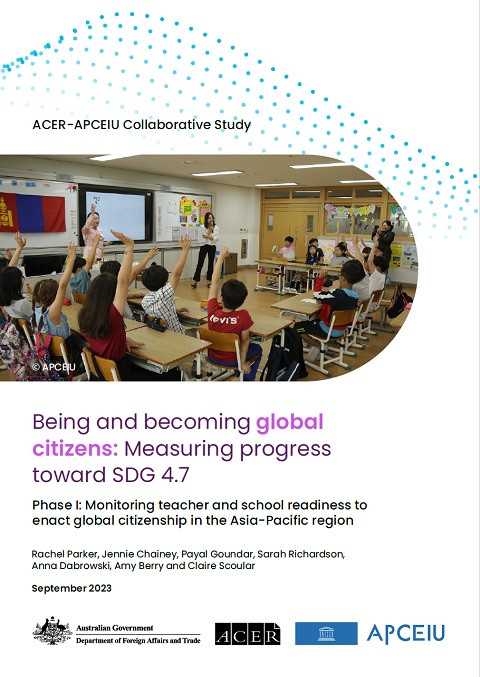 [Summary] Being and Becoming Global Citizens: Measuring Progress toward SDG 4.7 (Phase I: Monitoring teacher and school readiness to enact global citizenship in the Asia-Pacific region) 발행 연도: 2023 저자: Rachel Parker | Jennie Chainey | Payal Goundar | Sarah Richardson | Anna Dabrowski | Amy Berry | Claire Scoular 단체 저자: Australian Council for Educational Research (ACER) | APCEIU This is a summary report of the Being and Becoming Global Citizens: Measuring Progress toward SDG 4.7 (Phase I: Monitoring teacher and school readiness to enact global citizenship in the Asia-Pacific region), conducted by APCEIU and ACER in since 2022.
 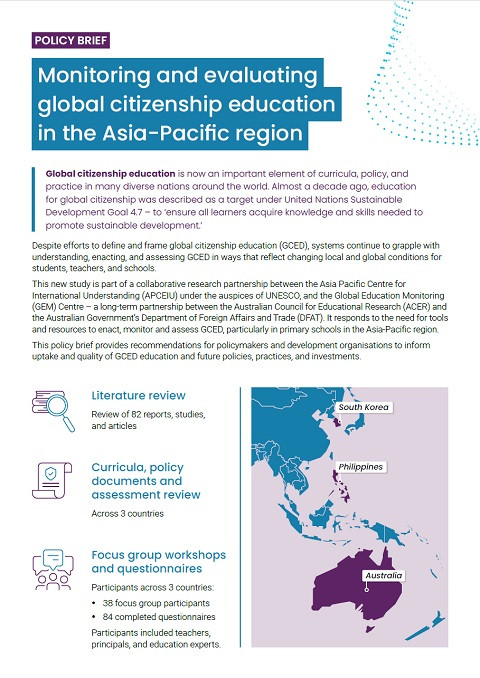 [Policy Brief] Monitoring and Evaluating Global Citizenship Education in the Asia-Pacific Region 발행 연도: 2023 저자: Payal Goundar | Rachel Parker 단체 저자: Australian Council for Educational Research (ACER) | APCEIU This is a policy brief version of the reserach report, Being and Becoming Global Citizens: Measuring Progress toward SDG 4.7 (Phase I: Monitoring teacher and school readiness to enact global citizenship in the Asia-Pacific region), conducted by APCEIU and ACER in since 2022.
 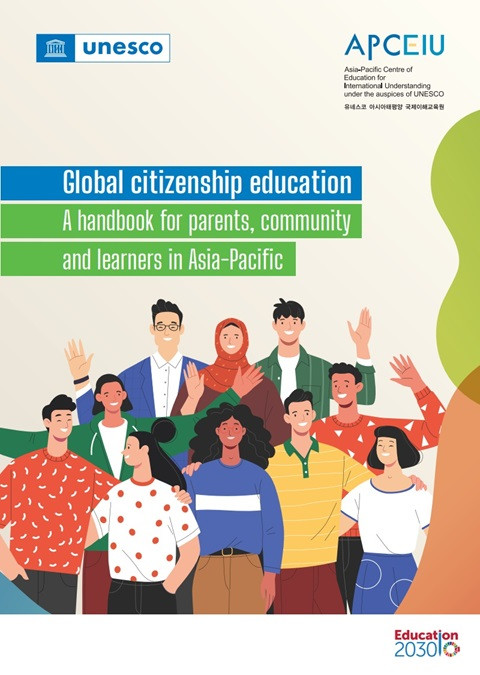 Global Citizenship Education: A Handbook for Parents, Community and Learners in Asia-Pacific 발행 연도: 2023 저자: Darla K. Deardorff | Seek Ling Tan 단체 저자: UNESCO Bangkok | APCEIU This handbook aspires to engage and involve parents, caregivers and the community to join the mission of developing every learner into a global citizen. To achieve this, parents, caregivers and the community will need to be empowered with the necessary GCED knowledge and skills too. In this handbook, GCED related concepts are introduced, alongside adaptable step-by-step action plans and best practices collected across the Asia-Pacific region to support parents and the community to take action in developing GCED competences in learners.
  21st Asia-Pacific Training Workshop on EIU GCED Mentorship Programme - Final Report 발행 연도: 2022 단체 저자: APCEIU This report summarizes 18 GCED projects implemented in the Asia-Pacific region by the alumni of APCEIU’s 21st Asia-Pacific Training Workshop on EIU/GCED (2022).The Mentorship Programme consisted of two tracks.1) Track A: Individual Mentorship with APCEIU’s expert groups (Concretizing the GCED project with guidance from mentors)2) Track B: Developing GCED Training Programme using Design Thinking Strategy with APCEIU & Habi Education LabAsia-Pacific Training Workshop on EIU/GCED (APTW) is APCEIU’s flagship TOT (Training of Trainers) programme for educators and teacher trainers in the Asia-Pacific region, which benefitted more than 600 educators over the last 22 years. Since 2021, it has been shifted to a comprehensive training programme composed of online training workshops, mentorship, and local project implementation to further empower participants to bring changes in their local communities.In 2022, marking its 21st turn, APTW was virtually held from 30 May to 7 June with 52 passionate educators from 19 UNESCO member states in the Asia-Pacific region. This year with the theme of ‘Preparing educators for a post-pandemic world: GCED as a key to change’, the Workshop provided opportunities to explore the timely issues and pedagogies to prepare educators for the post-pandemic world.
  Roundtable of the Group of Friends for Solidarity and Inclusion with GCED: "Art Education Fostering Global Citizenship" 발행 연도: 2023 저자: Hyunmook Lim 단체 저자: APCEIU This report shares the overview of the Roundtable of the Group of Friends for Solidarity and Inclusion with GCED: “Art Education Fostering Global Citizenship”, held on Friday, 16 June 2023. The event was co-organized by the Permanent Delegation of the Republic of Korea to UNESCO and the Asia-Pacific Centre of Education for International Understanding (APCEIU) in partnership with the Group of Friends for Solidarity and Inclusion with GCED (Afghanistan, Armenia, Austria, Bangladesh, Canada, Colombia, Italy, Jordan, Kenya, Kuwait, Philippines, Republic of Korea, Saudi Arabia, Senegal, Serbia, Nigeria and Oman). This report shares the summary of the event, particularly the presentations on GCED activities through arts education by experts from Finland, Lebanon, the Republic of Korea and Nigeria to promote the values and initiatives of GCED through arts education.
 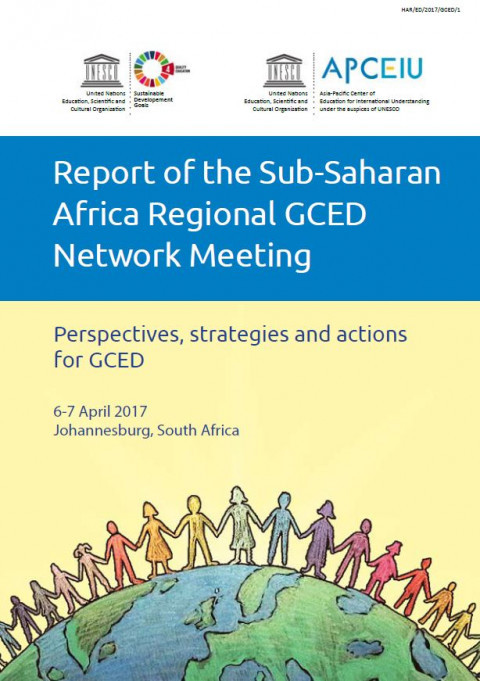 Report of the Sub-Saharan Africa Regional GCED Network Meeting: Perspectives, Strategies and Actions for GCED 발행 연도: 2017 저자: Gertie Steukers | Carolyn Medel-Añonuevo | Abdoul Wahab Coulibaly 단체 저자: UNESCO Harare | APCEIU An increasingly globalized world has raised questions about what constitutes meaningful citizenship as well as about its global dimensions. Global Citizenship Education (GCED) aims to empower learners to assume active roles to face and resolve global challenges and to become proactive contributors to a more peaceful, tolerant, inclusive and secure world.Education is the most important tool for equipping young people, our future generation of leaders, with the knowledge, skills and attitudes to tackle prejudice and hostility, and to build more peaceful, tolerant and equitable societies. While there are different understandings and manifestations of GCED in different countries, GCED in its various forms is fast becoming an important and necessary component of education systems in sub-Saharan Africa and across the world.The commitment of actors around the world to promoting GCED has contributed highly to the development of GCED, including raising awareness and catalysing action. Furthermore, this has led to the incorporation of GCED in the Sustainable Development Goals (SDGs) through Target 4.7, which captures the clear call for an education that addresses the needs of the twenty-first century, empowering learners to act towards a more peaceful, just, inclusive and sustainable world.GCED reflects the aim of education to go beyond just access and ‘ensure inclusive and equitable quality education and promote lifelong opportunities for all’ in the next fifteen years.UNESCO Regional Office for Southern Africa (ROSA) and the Asia-Pacific Centre of Education for International Understanding (APCEIU) invited partners across Africa for the 2017 Sub-Saharan Africa GCED Regional Network Meeting on 6–7 April 2017 in Johannesburg. The meeting was designed to jumpstart the formation of the Africa Regional GCED Network, map different GCED programmes in the region, and explore areas of possible collaboration in light of solidifying regional action on GCED.
  Global Citizenship Education: A Guide for Policymakers 발행 연도: 2017 저자: Swee-Hin Toh | Gary Shaw | Danilo Padilla 단체 저자: APCEIU In order to assist UNESCO Member States to integrate and strengthen Global Citizenship Education (GCED) in national education policies, strategies and plans to achieve SDG Target 4.7 effectively, the Asia-Pacific Centre of Education for International Understanding (APCEIU) has developed and published Global Citizenship Education: A Guide for Policymakers (hereafter referred to as the Guide).The Guide is mainly divided into two parts. Part 1 provides an overview of GCED, including the following three sections: the background to GCED; the rationale for GCED; and the concept of GCED. In Part 2, various selection strategies which allow each country to incorporate GCED into its current education system aligned with its own priorities and context, were divided and suggested into five major policy areas as follow: policy review and development; curriculum review and development; capacity building; knowledge creation; sharing and dissemination; and monitoring and assessment.The Guide was first published in English and Korean and additional translations will be available in the future in other languages, including French and Arabic to provide access to more readers worldwide. We hope that the Guide will provide an opportunity for policymakers and practitioners to share their experiences and insights. 세계시민교육 정책 개발을 위한 가이드 발행 연도: 2017 저자: Swee-Hin Toh | Gary Shaw | Danilo Padilla 단체 저자: 유네스코 아시아태평양 국제이해교육원 유네스코 아시아태평양 국제이해교육원은 유네스코 회원국이 국가 교육정책에 세계시민교육을 반영하고 이를 통해 지속가능발전목표 4.7을 효과적으로 달성하는 것을 돕기 위해 『세계시민교육 정책 개발을 위한 가이드(Global Citizenship Education: A Guide for Policymakers)』를 개발ㆍ출간하였다.본 가이드는 크게 두 부분으로 나뉜다. 첫 번째 장에서는 세계시민교육의 배경과 논리, 그리고 개념을 차례로 살펴봄으로써 세계시민교육을 개괄하고자 하였다. 그리고 두 번째 장에서는 각국이 자신의 우선적 목표와 맥락에 맞게 세계시민교육을 현행 교육 시스템에 반영할 수 있도록 하는 다양한 선별적 전략들을 정책 검토ㆍ개발, 교육과정 검토ㆍ개발, 역량 강화, 지식의 창출ㆍ공유ㆍ확산, 모니터링 및 평가 등의 5가지 주요 정책 영역으로 나누어 제시하고자 하였다.본 가이드는 영어와 한국어로 우선 출간되었으며, 향후 전 세계의 더 많은 독자들에게 접근성을 제공하기 위하여 프랑스어와 아랍어를 포함한 다른 언어로도 추가 번역될 예정이다. 모쪼록 본 가이드가 정책입안자들과 실천가들에게 서로의 경험과 통찰을 나누는 계기를 제공할 수 있기를 바란다.