
자료
세계시민교육에 대한 이해를 넓히고 연구, 옹호 활동, 교수, 학습 등을 향상시킬 수 있는 다양하고 유용한 자료를 찾아보세요.
2,768 건의 결과가 검색되었습니다
 The Elusive and Exclusive Global Citizen 발행 연도: 2015 저자: Jill Koyama 단체 저자: Mahatma Gandhi Institute of Education for Peace and Sustainable Development (MGIEP) In this paper, the author interrogate the notion of global citizenship, both as an aspiration and an improbable practice, by situating it within contemporary understandings of citizenship and globalization.It is a conceptualization that suffers from the dangers inherent in the term “citizenship” and misconceptions of the terms “global,” and it is rooted in the West’s long engagement in normative undertakings in non-Western countries. The writer refute ideas of the autonomous and agentic global citizen. he encourage a rethinking of global citizenship and global citizenship education (GCE) and offer recommendations for redirecting attention to contemporary global stratifications and issues of human rights to address the issues of social justice and inequality that, due to the problematic definition of global citizenship, are currently inadequately covered in existing GCE curricula.
  Building Citizenship from Universities; University Social Responsibility and Challenges in the XXI century 발행 연도: 2011 저자: Eduardo Gasca-Pliego | Julio César Olvera-García 단체 저자: Universidad Autónoma del Estado de México The present essay contributes with a reflection on the role universities must take as agents of transformation and consolidation of the democratic model, mainly before the challenge of building full citizens, interested in the need of the physical and social environment, in collective decision making, who think of themselves as participant citizens and not only voters with their own interests in view. Distinguishable is the primordial role of university social responsibility to promote the social management of knowledge for everyone, which has as an end the construction of informed, responsible and participant citizenship, which responds to injustice, non-sustainability, violence and corruption. Rethinking the social function of the university requires defending the values proper to public education, in the sense that every citizen has equal opportunities to develop their capabilities, eliminating obstacles of social and economic nature, as well as the cultural and political that affect and hinder said development. Construir ciudadanía desde las universidades, responsabilidad social universitaria y desafíos ante el siglo XXI 발행 연도: 2011 저자: Eduardo Gasca-Pliego | Julio César Olvera-García 단체 저자: Universidad Autónoma del Estado de México El presente ensayo aporta una reflexión respecto al rol que deben adquirir las universidades como agentes de transformación y consolidación del modelo democrático, principalmente ante al reto de construir ciudadanos completos, interesados por las necesidades del entorno físico y social, por la toma de decisiones colectivas, que se conciben a sí mismos como ciudadanos partícipes y no únicamente como votantes con miras a satisfacer sus propios intereses. Destaca el papel prioritario de la responsabilidad social universitaria que promueva la gestión social del conocimiento para todos los actores sociales, que tenga como finalidad la construcción de una ciudadanía informada, responsable y participativa, que responda ante la injusticia, la insostenibilidad, la violencia y la corrupción. Repensar la función social de la universidad pública requiere defender los valores propios de la educación pública, en el sentido de que todos los ciudadanos tengan la igualdad de oportunidades para desarrollar sus capacidades, eliminando obstáculos de carácter económico y social, así como los culturales y políticos que afectan e impiden ese desarrollo.
  Public Universities and Neoliberal Common Sense: Seven Iconoclastic Thesis 발행 연도: 2014 저자: Carlos Alberto Torres 단체 저자: Universidad Nacional de Tres de Febrero (UNTREF) Neoliberalism has utterly failed as a viable model of economic development, yet the politics of culture associated with neoliberalism is still in force, becoming the new common sense shaping the role of government and education. This ‘common sense’ has become an ideology playing a major role in constructing hegemony as moral and intellectual leadership in contemporary societies. Neoliberal globalisation, predicated on the dominance of the market over the state and on deregulatory models of governance, has deeply affected the university in the context of ‘academic capitalism’. The resulting reforms, rationalised as advancing international competitiveness, have affected public universities in four primary areas: efficiency and accountability, accreditation and universalisation, international competitiveness and privatisation. There is also growing resistance to globalisation as top-down-imposed reforms reflected in the public debates about schooling reform, curriculum and instruction, teacher training and school governance. Many question whether neoliberal reforms attempt to limit the effectiveness of universities as sites of contestation of the national and global order and thus undermine the broader goals of education. Neoliberal reforms have limited access and opportunity along class and racial lines, including limiting access to higher education through the imposition of higher tuition and reduced government support to institutions and individuals. Las universidades públicas y el sentido común neoliberal: siete tesis iconoclastas 발행 연도: 2014 저자: Carlos Alberto Torres 단체 저자: Universidad Nacional de Tres de Febrero (UNTREF) El neoliberalismo ha fracasado completamente como un modelo viable de desarrollo económico, sin embargo, la política de la cultura asociada con el neoliberalismo sigue en vigor, convirtiéndose en el nuevo sentido común definiendo el rol del gobierno y de la educación. Este “sentido común“ se ha convertido en una ideología que juega un papel importante en la construcción de un liderazgo moral e intelectual hegemónico en las sociedades contemporáneas. La globalización neoliberal, basada en el predominio del mercado sobre el Estado y en modelos desregulados de gobierno, ha afectado profundamente a la universidad en el contexto del “capitalismo académico“. Las reformas resultantes, justificadas como avances en la competitividad internacional, han afectado a las universidades públicas en cuatro áreas principales: la eficiencia y la rendición de cuentas, la acreditación y universalización, la competitividad internacional y la privatización. También hay una creciente resistencia a la globalización y a las reformas impuestas de arriba hacia abajo reflejadas en los debates públicos sobre la reforma de la escolaridad, el currículo y la instrucción, la formación de docentes y la gestión escolar. Muchos se preguntan si las reformas neoliberales intentan limitar la eficacia de las universidades como lugares de disputa del orden nacional y global y así socavar los objetivos últimos de la educación. Las reformas neoliberales brindan un acceso y oportunidades limitadas según las clases y grupos raciales, incluyendo la restricción del acceso a la educación superior a través de la imposición de matrículas más costosas y la reducción del apoyo gubernamental a instituciones e individuos.
  The Contribution of University Education to Instilling the Concept of Citizenship among Students at the Algerian University (vol.17, no.3; Journal of human resources development) 발행 연도: 2022 저자: Maarcha Dalila 단체 저자: University Mohamed Lamine Debaghine - Setif2 University education endeavors to equip students with the necessary skills and knowledge in scientific research and various disciplines, enabling them to confront the economic, social, and cultural challenges of life. The primary objective of university education is to fulfill societal needs for skilled human resources capable of contributing to societal development and keeping pace with global advancements in education and knowledge. In alignment with this, the University of Algeria aims to instill principles and values of citizenship among its students through its curricula and programs. It aims to foster a sense of belonging and patriotism, as well as to nurture national identity, thereby facilitating the holistic development of students across all dimensions. مساهمة التعليم الجامعي في غرس مفهوم المواطنة لدى الطلبة في الجامعة الجزائرية (vol.17, no.3 مجلة تنمية الملوارد البشرية) 발행 연도: 2022 저자: Maarcha Dalila 단체 저자: University Mohamed Lamine Debaghine - Setif2 يسعى التعليم الجامعي إلى إعداد الطلاب وتنمية قدراتهم في مجال البحث العلمي، وتكوينهم في مجالات التخصصات المختلفة لتحمل ومواجهة مسؤوليات الحياة الاقتصادية والاجتماعية والثقافية، فالهدف الرئيسي للتعليم الجامعي هو تلبية حاجات المجتمع من الموارد البشرية المؤهلة للقيام بدورها التنموي في المجتمع، وتساير التطورات الحديثة في القطاع أي عولمة التعليم والمعرفة، وتمثلت نتائج الدراسة الحالية في ان البرامج الجامعية المدرسة تسعى إلى زرع مبادئ وقيم المواطنة لدى طلبة الجامعة في ميدان العلوم الاجتماعية تخصص علم النفس وعلوم التربية ، والى تعميق روح الانتماء والولاء للوطن وترسيخ الهوية الوطنية في نفوسهم قصد التنمية المتكاملة لشخصياتهم في جوانبها المختلفة، ويبقى نجاحه مرهون بكفاءات طرائق التدريس ونجاعتها.
  The Sultan Qaboos Project for the Humanitarian 발행 연도: 2019 단체 저자: Al Shabiba The program deals with the Human Recombinant Project, its importance and objectives. The project came with the blessing of the late Sultan in order to gather the efforts of nations to improve human lives, and to raise human awareness of the importance of a shared global ethics system. مشروع السلطان قابوس للمؤتلف الإنساني 발행 연도: 2019 단체 저자: Al Shabiba البرنامج يتطرق لمشروع المؤتلف الإنساني وأهميته وأهدافه. المشروع جاء بمباركة من السلطان الراحل من أجل جمع جهود الأمم في تحسين حياة البشر، ولإثارة الوعي الانساني بأهمية منظومة الاخلاق العالمية المشتركة.
 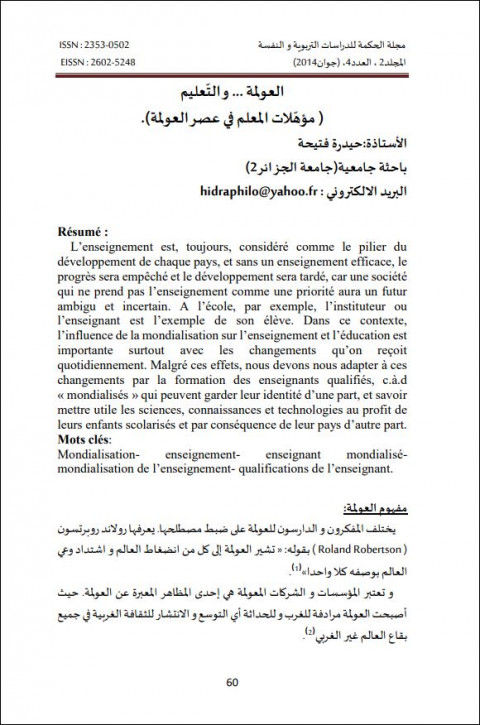 Globalization and Education (Teacher Qualifications in the Era of Globalization) 발행 연도: 2014 저자: Haidara Fatiha Education is, always, considered as the pillar of the development of every country, and without effective education, progress will be impeded and development will be delayed. This is because a society that does not take education as a priority will have an ambiguous future. In school, for example, the teacher is the model for his students. In this context, the influence of globalization on teaching and education is important especially with the changes that we receive daily. Despite these effects, we must adapt to these changes by training qualified teachers, ie "globalized" teachers who can keep their identity on the one hand, and know how to use science, knowledge and technology for the benefit of their teachers. children in school and consequently from their country on the other hand.