
자료
세계시민교육에 대한 이해를 넓히고 연구, 옹호 활동, 교수, 학습 등을 향상시킬 수 있는 다양하고 유용한 자료를 찾아보세요.
1,983 건의 결과가 검색되었습니다
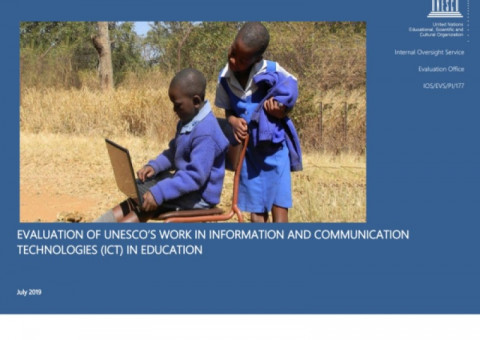 Evaluation of UNESCO's work in information and communication technologies (ICT) in education 발행 연도: 2019 저자: Seán Ó Siochru and Graham Attwell 단체 저자: UNESCO ICT in Education is a fast-growing area globally that offers many strategic opportunities. As the leader and coordinator of the SDG 4 – Education 2030 with the aim to “Ensure inclusive and equitable quality education and promote lifelong learning opportunities for all”, UNESCO has the mandate and expertise needed to strategically position itself as a world leader in this field. UNESCO’s work in ICT in Education aims at enhancing the quality and relevance of learning and at strengthening inclusion. While technology can facilitate wider access to education and bridge learning divides, can advance gender equality and inclusion as well as digital skills development, the rapidly changing technologies and work processes require the development of new pedagogies, both for the use of ICT for teaching and learning in the classroom and through open access and distance learning. Compared to other players, UNESCO leverages its comparative strengths in its ICT in Education interventions - especially its impartiality, convening power, and policy expertise - through an inclusive and humanistic approach to achieving quality education in coherence with Sustainable Development Agenda 2030. Its expertise across all levels of Education and its multidisciplinary potential of working across its Programme Sectors are also considered among UNESCO’s specific strengths. The evaluation revealed that UNESCO achieved important results, at the level of the learning environment, at the policy level and in institutional capacity building, but it also showed that UNESCO still needs to strengthen its positioning and visibility within the wider landscape of ICT in Education. For example, UNESCO has to continue positioning itself for producing forward-looking knowledge on ICT in Education and as a laboratory of ideas for future-oriented thinking. While the evaluation came across various specific interventions successfully addressing the needs of disadvantaged groups, the evaluation found that considerations of inclusion and gender equality were not consistently mainstreamed into policy-related and capacity building interventions. Other challenges are mainly linked to the current dispersion of resources and fragmentation of expertise across different entities within the Organization, which also leads to reduced visibility. While the key entities active in this area recognize that they are working within a common theme, collaboration and coordination still needs to be improved. The strategic measures proposed by the evaluation towards an overall organizational framework for ICT in Education aim at establishing an enabling environment for inter- and multidisciplinary approaches and greater coherence and collaboration.
  Her education, our future: snapshots of UNESCO's work 발행 연도: 2019 단체 저자: UNESCO This collection provides snapshots of some of UNESCO’s efforts to empower women and girls through education. It highlights core areas of work undertaken, as profiled on the next page. The aim is to give the reader a flavour of what it is that UNESCO, including its 53 field offices and specialized institutes, is doing to transform her education and our future.
 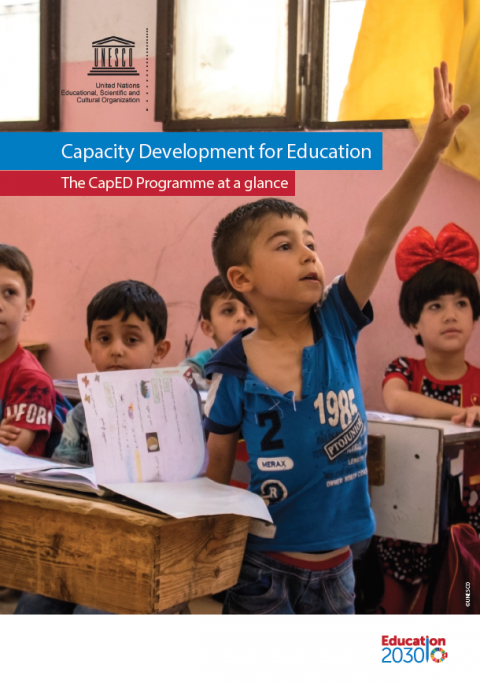 Capacity Develoment for Education: the CapED Programme at a glance 발행 연도: 2019 단체 저자: UNESCO Education has the power to transform lives and is at the heart of UNESCO’s mission to build peace, eradicate poverty and drive sustainable development. Right now, 750 million adults – two-thirds women – still lack basic literacy skills. Around 264 million children and youth are out of school and the international community must have almost 69 million new teachers to reach the 2030 education goals. These challenges can be tackled effectively through education reforms. However, these can only take place when countries have the capacities to put this change into action. As well as trained staff, countries need efficient organizational processes, functioning institutions and the tools and resources to design, implement and manage tailored education policies and plans. This is where the CapED Programme steps in. By mobilizing UNESCO’s global network, the Programme provides selected countries with a cohesive package of support. It works alongside stakeholders to reinforce national capacities to undertake evidence-based education reforms that fit into their national priorities and respond to SDG4 commitments, in order to offer quality education opportunities to all.
 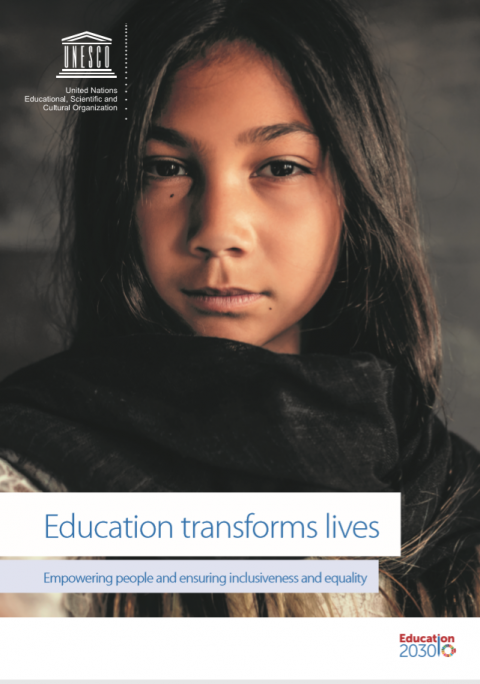 Education transforms lives: empowering people and ensuring inclusiveness and equality 발행 연도: 2019 단체 저자: UNESCO This brochure compiles the main elements of progress on Sustainable Development Goal 4 (SDG 4) highlighted in the submission by UNESCO, on behalf of the SDG-Education 2030 Steering Committee, to the Office of the Under-Secretary-General, Department of Economic and Social Affairs (DESA) on the occasion of the High-level Political Forum (HLPF) 2019 - Empowering people and ensuring inclusiveness and equality. L'éducation transforme la vie: autonomiser les individus et assurer l'inclusion et l'égalité 발행 연도: 2019 단체 저자: Organisation des Nations Unies pour l'éducation, la science et la culture (UNESCO) Cette brochure rassemble les principaux éléments des progrès accomplis dans la réalisation de l'objectif 4 du développement durable (ODD 4) mis en évidence dans la communicationprésentée par l'UNESCO, au nom du Comité directeur de l'ODD-Éducation 2030, au Bureau du Secrétaire général adjoint aux affaires économiques et sociales (DESA) à l'occasion du Forum politique de haut niveau (HLPF) 2019 –Donner aux populations les moyens d'agir et assurer l'intégration. La educación transforma vidas: empoderar a las personas y garantizar la inclusión y la igualdad 발행 연도: 2019 단체 저자: Organización de las Naciones Unidas para la Educación, la Ciencia y la Cultura (UNESCO) Este folleto recopila los principales elementos de progreso en relación con el Objetivo de Desarrollo Sostenible 4 (ODS 4) destacados en la presentación de la UNESCO, en nombre del Comité Directivo del ODS-Educación 2030, a la Oficina del Secretario General Adjunto del Departamento de Asuntos Económicos y Sociales (DESA) con motivo del Foro Político de Alto Nivel (HLPF) 2019 - Empoderar a las personas y garantizar la inclusión y la igualdad.
  LES OUTILS DU PLURALISME CULTUREL 발행 연도: 2015 단체 저자: Organisation des Nations Unies pour l'éducation, la science et la culture (UNESCO) Face aux formes persistantes de xénophobie et d’exclusion sociale, face aux actes spectaculaires d’intolérance dont nos sociétés peuvent être le théâtre, la Convention de l’UNESCO de 2005, par laquelle les États parties s’engagent à développer des politiques publiques pour la promotion et la protection de la diversité des expressions culturelles, s’avère plus que jamais actuelle : elle incite à mieux prendre en compte le rôle de la culture au profit du partage, du respect et de la reconnaissance de l’autre, au-delà des appartenances sociales et culturelles.A l’occasion du 10e anniversaire de la Convention de 2005 de l’UNESCO, désormais ratifiée par 138 États et l’Union européenne et dans le cadre de la Décennie internationale du rapprochement des cultures (2013-2022, ONU), la Commission nationale française pour l’UNESCO, en partenariat avec le Secrétariat de l’Organisation et avec le soutien du ministère français de la Culture et de la Communication, a organisé deux conférences internationales au siège de l’UNESCO.Première de ces deux conférences internationales, Les outils du pluralisme culturel, le vendredi 2 octobre 2015 à l’UNESCO, pendant la Semaine des Cultures Étrangères organisée par le Forum des Instituts Culturels Étrangers à Paris, a offert un état des lieux, à un niveau européen élargi, des initiatives de promotion de la diversité des expressions culturelles comme outils du vivre-ensemble.
  Indigenous peoples’ right to education 발행 연도: 2019 단체 저자: UNESCO This document follows a previous series of thematic mappings on the implementation of the right to education regarding specifically Girls’ and Women’s Right to Education, the Right to Education for Persons with Disabilities, and the Right to Education and the Teaching Profession. It compiles practical examples related to indigenous people’s right to education, extracted from reports submitted by Member States within the framework of the Ninth Consultation on the implementation of the 1960 Convention and Recommendation against Discrimination in Education. It is intended to serve as a practical tool for both information sharingandadvocacy.
 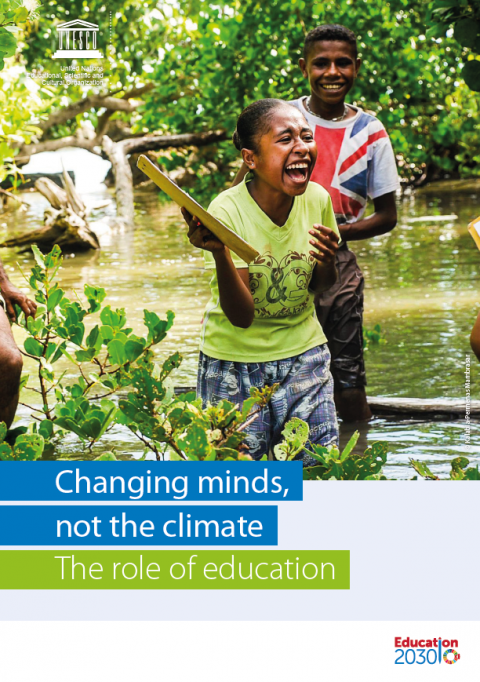 Changing minds, not the climate: the role of education 발행 연도: 2017 단체 저자: UNESCO Education is the most powerful element in preparing societies for the global challenges that climate change brings. It equips individuals, communities and the wider world with the understanding, skills and attitudes to engage in shaping green, low emission and climate-resilient societies. Education for Sustainable Development (ESD) is not an ‘extra’ but rather an integral part of any strategy to combat the effects of climate change, put into practice a global agreement and achieve the Sustainable Development Goals (SDGs). It acts to raise awareness and change behaviours and attitudes and enables people to make informed decisions about their lives. The heads of UNESCO and UNFCCC agree that “education provides the skills people need to thrive in the new sustainable economy, working in areas such as renewable energy, smart agriculture, forest rehabilitation, the design of resource-efficient cities, and sound management of healthy ecosystems. Perhaps most important, education can bring about a fundamental shift in how we think, act, and discharge our responsibilities toward one another and the planet.” ESD is increasingly recognized around the world as a key enabler for a more sustainable future. Changeons les esprits, pas le climat: le rôle de l’éducation 발행 연도: 2017 단체 저자: Organisation des Nations Unies pour l'éducation, la science et la culture (UNESCO) L’éducation est fondamentale afin de préparer les sociétés aux défis mondiaux que pose le changement climatique. Elle offre aux individus, aux communautés et au monde en général la compréhension, les compétences et les attitudes nécessaires pour construire des sociétés à faibles émissions, plus vertes et résilientes. L’éducation au développement durable (EDD) n’est pas un « supplément » mais plutôt une partie intégrante de toute stratégie visant à lutter contre les effets du changement climatique, à mettre en pratique un accord mondial et à atteindre les objectifs de développement durable (ODD). Elle permet de sensibiliser les personnes, favorise une prise de décision éclairée et donc le changement des comportements des individus.