
자료
세계시민교육에 대한 이해를 넓히고 연구, 옹호 활동, 교수, 학습 등을 향상시킬 수 있는 다양하고 유용한 자료를 찾아보세요.
948 건의 결과가 검색되었습니다
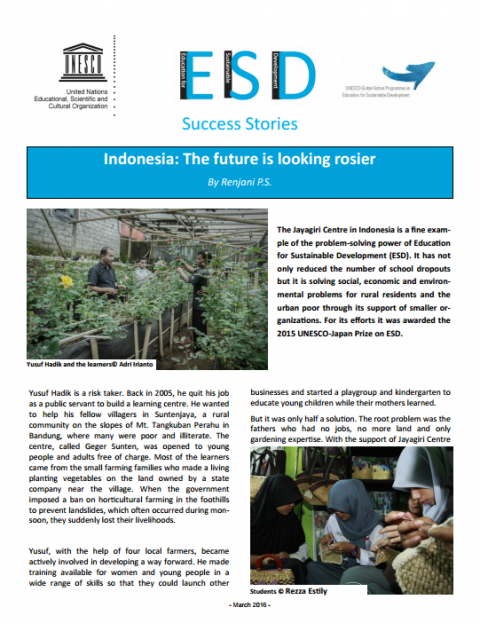 Indonesia: the future is looking rosier 발행 연도: 2016 저자: P.S. Renjani 단체 저자: UNESCO ESD Success Stories are showcasing compelling stories with a personal/human dimension from all five UNESCO regions (Africa, Arab States, Asia and Pacific, Europe & North America and Latin America & the Caribbean). The stories illustrate the wide diversity of ESD approaches and initiatives taking place in different parts of the world. They show how involvement with ESD has changed the lives of specific individual persons and how they have become more active in their community. Each story centers on one individual or a group of individuals.The Jayagiri Centre in Indonesia teaches environment-friendly business skills. It helps reduce the number of school dropouts and supports rural residents. Indonésie: l'avenir s'annonce plus rose 발행 연도: 2016 저자: P.S. Renjani 단체 저자: UNESCO ESD Success Stories are showcasing compelling stories with a personal/human dimension from all five UNESCO regions (Africa, Arab States, Asia and Pacific, Europe & North America and Latin America & the Caribbean). The stories illustrate the wide diversity of ESD approaches and initiatives taking place in different parts of the world. They show how involvement with ESD has changed the lives of specific individual persons and how they have become more active in their community. Each story centers on one individual or a group of individuals.The Jayagiri Centre in Indonesia teaches environment-friendly business skills. It helps reduce the number of school dropouts and supports rural residents. Indonesia: hacia un futuro más prometedor 발행 연도: 2016 저자: P.S. Renjani 단체 저자: UNESCO ESD Success Stories are showcasing compelling stories with a personal/human dimension from all five UNESCO regions (Africa, Arab States, Asia and Pacific, Europe & North America and Latin America & the Caribbean). The stories illustrate the wide diversity of ESD approaches and initiatives taking place in different parts of the world. They show how involvement with ESD has changed the lives of specific individual persons and how they have become more active in their community. Each story centers on one individual or a group of individuals.The Jayagiri Centre in Indonesia teaches environment-friendly business skills. It helps reduce the number of school dropouts and supports rural residents.
 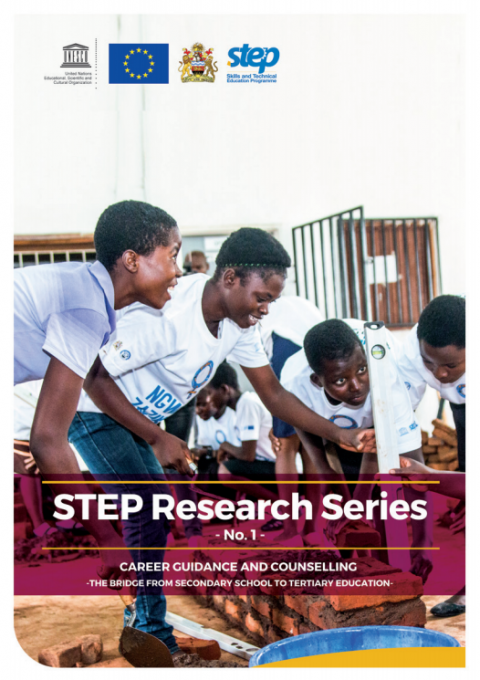 Career guidance and counselling: the bridge from secondary school to tertiary education; a review of current guidance and counselling programmes and practices in Malawi and their support in promoting technical and vocational training for girls 발행 연도: 2017 단체 저자: UNESCO The objective of this report is to identify and review existing career G&C programmes and practices in secondary schools in Malawi. The review assesses to what extent such programmes and practices create an awareness of the importance of technical careers and how graduates from the secondary schools can access TEVET. Additionally, it assesses whether any affirmative action measures or approaches are used to increase girls’ interest in and applications to enter technical colleges.
 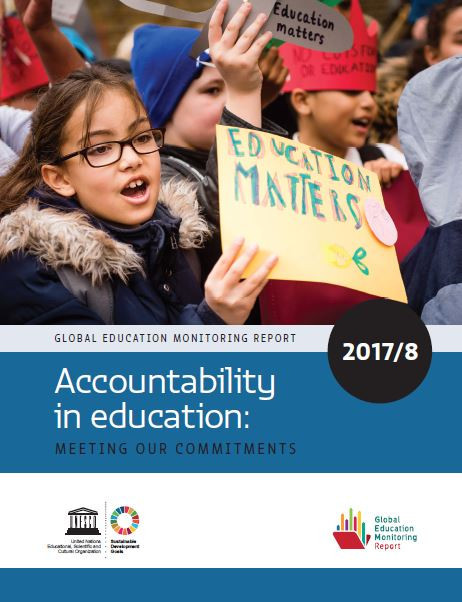 Accountability in Education: Meeting Our Commitments: Global Education Monitoring Report, 2017/8 발행 연도: 2017 단체 저자: UNESCO The second edition of the Global Education Monitoring Report (GEM Report) presents the latest evidence on global progress towards the education targets of the UN Sustainable Development Goals.With hundreds of millions of people still not going to school, and many not achieving minimum skills at school, it is clear education systems are off track to achieve global goals. The marginalized currently bear the most consequences but also stand to benefit the most if policy-makers pay sufficient attention to their needs. Faced with these challenges, along with tight budgets and increased emphasis on results-oriented value for money, countries are searching for solutions. Increased accountability often tops the list.The 2017/8 GEM Report shows the entire array of approaches to accountability in education. It ranges from countries unused to the concept, where violations of the right to education go unchallenged, to countries where accountability has become an end in itself instead of a means to inclusive, equitable and high-quality education and lifelong learning for all.The report emphasizes that education is a shared responsibility. While governments have primary responsibility, all actors – schools, teachers, parents, students, international organizations, private sector providers, civil society and the media – have a role in improving education systems.The report emphasizes the importance of transparency and availability of information but urges caution in how data are used. It makes the case for avoiding accountability systems with a disproportionate focus on narrowly defined results and punitive sanctions. In an era of multiple accountability tools, the report provides clear evidence on those that are working and those that are not.
 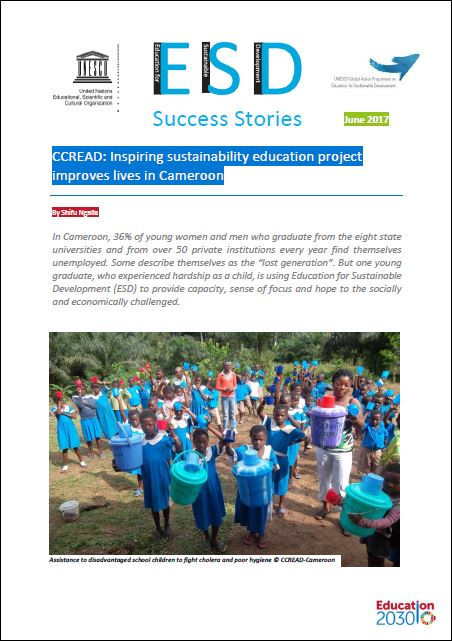 CCREAD: Inspiring Sustainability Education Project Improves Lives in Cameroon 발행 연도: 2017 저자: Shifu Ngalla 단체 저자: UNESCO This article is about sustainability education project in Cameroon. In Cameroon, 36% of young women and men who graduate from the eight state universities and from over 50 private institutions every year find themselves unemployed. Some describe themselves as the “lost generation”. But one young graduate, who experienced hardship as a child, is using Education for Sustainable Development (ESD) to provide capacity, sense of focus and hope to the socially and economically challenged. CCREAD: Un Projet d’éducation au Développement Durable Améliore des Vies au Cameroun 발행 연도: 2017 저자: Shifu Ngalla 단체 저자: UNESCO Ceci est un article sur le projet d'éducation à la durabilité au Cameroun.Chaque année au Cameroun, 36% des jeunes femmes et hommes qui obtiennent leur diplôme dans l’une des huit universités d’État et dans plus de 50 institutions privées se retrouvent sans-emploi. Certains d'entre eux se décrivent comme une « génération perdue ». Cependant, un jeune diplômé qui a vécu une expérience douloureuse pendant son enfance utilise l’Éducation au Développement Durable (EDD) afin de former et redonner de l’espoir aux jeunes défavorisés au niveau social et économique. CCREAD: Un Estimulante Proyecto Sobre Educación para la Sostenibilidad Mejora la Vida en el Camerún 발행 연도: 2017 저자: Shifu Ngalla 단체 저자: UNESCO Este es un artículo acerca de proyecto sobre el educación para la sostenibilidad en Camerún.En el Camerún, 36% de las mujeres y de los hombres jóvenes que se gradúan anualmente en alguna de las ocho universidades estatales o en alguna de las 50 instituciones privadas se encuentran sin empleo. Algunos se describen a sí mismos como la “generación perdida”. Pero un joven diplomado que experimentó dificultades cuando era niño está utilizando la educación para el desarrollo sostenible (EDS) como un medio para proporcionar capacidades, centrar mejor las prioridades y dar esperanza a las personas social y económicamente desfavorecidas.
  Collection des meilleures pratiques en éducation pour une citoyenneté mondiale en Afrique centrale 발행 연도: 2015 단체 저자: UNESCO This collection of best practices in human rights education in Central Africa and Ethiopia was prepared in order to respond to UNESCO’s demand to promote such initiatives and to ensure a multiplier effect considering human rights education in the region. The objective is to support the concept of UNESCO’s ‘Global Citizenship Education’ in the field of human rights education in identifying its best practices. In order to identify the best practices, UNESCO’s activities in the field of human rights education in the region were mapped out. This mapping out has shown big differences in implementing the initiatives focused on achieving global citizenship education through human rights education, particularly in primary and secondary education, as indicated in the first phase of the World Programme for human rights education. Nevertheless, various initiatives collected are either conducted/supported by UNESCO or not, in terms of three themes: citizenship education, intercultural dialogue, and the peace and security which are considered to be relevant to Africa in general and particularly to Central Africa, in order to address the main theme of global citizenship education. The selected best practices deal with the tertiary level and are in line with the second phase of the World Programme for human rights education, covering the period between 2009 and 2014 and focusing on higher and vocational education. The practices include 1) citizenship education which supports the principles set out in the Universal Declaration of Human Rights and which is reiterated in the two phases of the World Programme for human rights education, 2) the intercultural dialogue which supports education for understanding and evaluating unity in diversity, and which fits well with the objectives of the UN Decade of Education for Sustainable Development proclaimed by the UN General Assembly and managed by UNESCO, and 3) education for peace and security.It is obvious that many linkages exist among the three subjects mentioned above. Therefore, the examples presented in this collection can affect one or several problems. Each example is presented with the following sequence: identification, background, implementation, and results.
 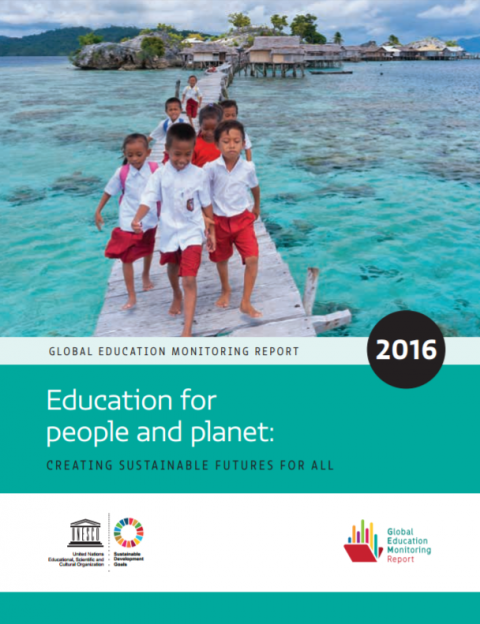 Education for People and Planet: Creating Sustainable Futures for All, Global Education Monitoring Report, 2016 발행 연도: 2016 단체 저자: UNESCO | Global Education Monitoring Report Team Education for People and Planet: Creating Sustainable Futures for All explores the complex relationship between education and the new 2030 Agenda for Sustainable Development, covering six fundamental pillars – Planet, Prosperity, People, Peace, Place and Partnerships. This report shows that education will not deliver its full potential unless participation rates increase dramatically and sustainable development guides education system reform. It also warns of the destructive impact that climate change, conflict, unsustainable consumption and the increasing gap between rich and poor have on education. A huge transformation is needed if we are to create sustainable futures for all.