
자료
세계시민교육에 대한 이해를 넓히고 연구, 옹호 활동, 교수, 학습 등을 향상시킬 수 있는 다양하고 유용한 자료를 찾아보세요.
2,255 건의 결과가 검색되었습니다
 الاستراتيجية الاتصالية ومعالجة ظاهرة اختطاف الأطفال في الجزائر 발행 연도: 2023 저자: Saeed Abdul Razzaq هدفت الدراسة إلى معرفة دور الاستراتيجية الاتصالية في معالجة احدى الظواهر الاجتماعية المتمثلة في ظاهرة اختطاف الأطفال في الجزائر، من خلال عرض الاستراتيجية الاتصالية الخاصة بالمديرية العامة للأمن الوطني في عملية حماية الأطفال، ودور الوسائل والأنشطة الاتصالية المختلفة في معالجة والحد من ظاهرة اختطاف الأطفال في الجزائر. وقد وتوصلنا من خلال دراستنا أن للاستراتيجية الاتصالية للمديرية العامة للأمن الوطني دور مهم في عملية الحد من خطورة ظاهرة اختطاف الأطفال في الجزائر عبر الاستراتيجية الاتصالية الوقائية التي تهدف لحماية الأطفال من الاختطاف.
  Beyond commitments 2019: how countries implement SDG 4 발행 연도: 2019 단체 저자: Global Education Monitoring Report Team Almost one-third of the time set to achieve the Sustainable Development Goals (SDGs) has elapsed. The 2019 High-level Political Forum (HLPF), the global SDG follow-up and review mechanism, represents a major stock-taking moment for countries, especially as regards SDG 4, the education goal, which is being reviewed for the first time. The international community relies primarily on quantitative measures to assess progress towards the SDGs. Acompanion publication by the UNESCO Institute for Statistics and the Global Education Monitoring Report for the 2019 HLPF, titled ‘Meeting commitments: Are countries on track to achieve SDG 4?’, shows that there are major challenges ahead. But increasingly, member states demand more than quantitative information. They ask for guidance on how to respond when their education systems do not reach their targets. To respond to this demand, this publication has the following purposes: Understand countries’ perceptions of SDG 4 based on responses to a questionnaire prepared for this publication, which asked countries to report on their flagship SDG 4 policies Distil those perceptions into a framework of the types of national policies that are best aligned with SDG 4 and whose implementation should be monitored Communicate the framework succinctly and provide a complementary input for the review of SDG 4 at the 2019 HLPF Provide an opportunity for countries to engage in dialogue on how they approach SDG 4. An analysis of the questionnaires submitted by 72 governments shows that most countries refer to SDG 4 as a framework in which they place their education planning. A core recommendation is that countries should align their education plans and policies with their international commitments.
 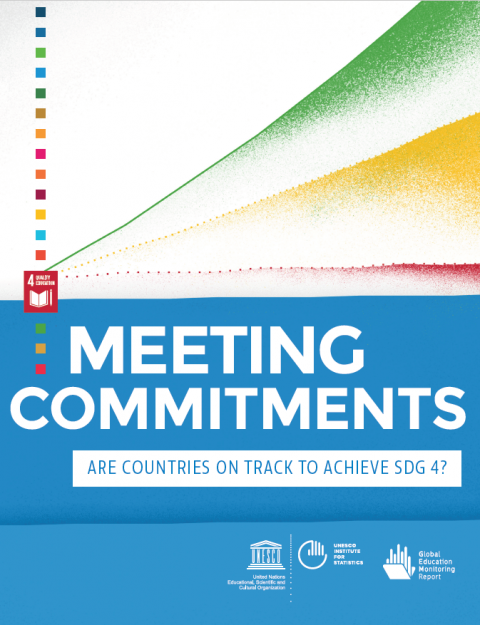 Meeting commitments: are countries on track to achieve SDG 4? 발행 연도: 2019 단체 저자: Global Education Monitoring Report Team | UNESCO Institute for Statistics (UIS) The world is a third of the way towards the deadline of the 2030 Agenda for Sustainable Development, which includes the fourth Sustainable Development Goal on education, SDG 4. But it is behind on its commitments. This joint publication by the UNESCO Institute for Statistics and the Global Education Monitoring Report for the 2019 High-level Political Forum on Sustainable Development captures concisely how far the world is from achieving its education targets. This is the year that the generation of students that should finish secondary school by 2030 should be entering school for the first time. Yet, in low-income countries, only 60% of children complete primary school, while in some regions the percentage of students who achieve minimum proficiency in reading is even falling. There is no denying that the world is off track. It is time to put an end to complacency. The international community relies on data to report on the SDG 4 monitoring framework to assess progress. While clear improvements have been made in data collection, data gaps remain a major concern. This publication makes a call for countries and their international development partners to coordinate and finance the collection of data to monitor and deliver on SDG 4. Respecter les engagements: les pays sont-ils en bonne voie d'atteindre l'ODD 4? 발행 연도: 2019 단체 저자: Global Education Monitoring Report Team | UNESCO Institute for Statistics (UIS) Le monde a parcouru un tiers du chemin vers l’échéance de l’Agenda de développement durable 2030, qui inclut le quatrième Objectif de développement durable (ODD 4), mais il est en retard sur la réalisation de ses engagements. Cette publication conjointe de l’Institut de statistique de l’UNESCO et du Rapport mondial de suivi sur l’éducation pour le Forum politique de haut niveau sur le développement durable 2019 expose de manière concise le retard dans la réalisation des cibles de l’éducation. Cette année est celle où la génération d’élèves qui terminera l’enseignement secondaire d’ici 2030 doit commencer l’école pour la toute première fois. Pourtant, dans les pays à revenu faible, seuls 60 % des enfants achèvent l’enseignement primaire, tandis que dans certaines régions, le pourcentage d’élèves qui possèdent les compétences minimales en lecture est même en baisse. On ne peut nier le fait que le monde est en retard. Il est temps de cesser ce laxisme. La communauté internationale dépend des données pour établir les rapports sur le cadre de suivi de l’ODD 4 afin d’évaluer les progrès accomplis. Des améliorations ont clairement été accomplies en matière de collecte de données mais les déficits de données demeurent une préoccupation majeure. Cette publication exhorte les pays et leurs partenaires internationaux du développement à coordonner et à financer la collecte de données pour suivre et réaliser l’ODD 4. Cumplir los compromisos: ¿van los países por el buen camino para alcanzar el ODS 4? 발행 연도: 2019 단체 저자: Global Education Monitoring Report Team | UNESCO Institute for Statistics (UIS) El mundo ya ha recorrido un tercio del camino hacia la fecha límite para el cumplimiento de la Agenda 2030 para el Desarrollo Sostenible, que incluye el Objetivo de Desarrollo Sostenible 4, relativo a la educación, pero aún está muy atrasado en el cumplimiento de sus compromisos. Esta publicación conjunta del Instituto de Estadística de la UNESCO y el Informe de Seguimiento de la Educación en el Mundo para el Foro Político de Alto Nivel sobre el Desarrollo Sostenible de 2019 refleja de manera concisa lo lejos que está el mundo de alcanzar sus objetivos en materia de educación. Este es el año en que la generación de estudiantes que debería finalizar la educación secundaria en 2030 tendría que ingresar a la escuela. Sinembargo, en los países de ingresos bajos, solo el 60% de los niños terminan la educación primaria, mientras que en algunas regiones el porcentaje de estudiantes que alcanzan un nivel mínimo de competencia en lectura está incluso en disminución. No se puede negar que el mundo no está bien encaminado. Ya es hora de que cese la apatía. La comunidad internacional se apoya en los datos para informar al marco de seguimiento del ODS 4 con el fin de evaluar los progresos realizados. Si bien se han realizado claras mejoras en la producción de datos, los faltantes de información siguen siendo motivo de gran preocupación. En esta publicación se hace un llamado a los países y a sus asociados internacionales para que coordinen y financien la producción de datos para el seguimiento y a la consecución del ODS 4.
  Let's work together: education has a key role in helping achieve the Sustainable Development Goals 발행 연도: 2019 단체 저자: Global Education Monitoring Report Team This publication has been produced on the occasion of the 2019 High-level Political Forum by the Global Eduation Monitoring Report. It draws upon findings from reports produced since 2015, showing the importance of education for the other goals in the 2030 agenda for sustainable development and calling for sectors to work together to achieve their aims.
 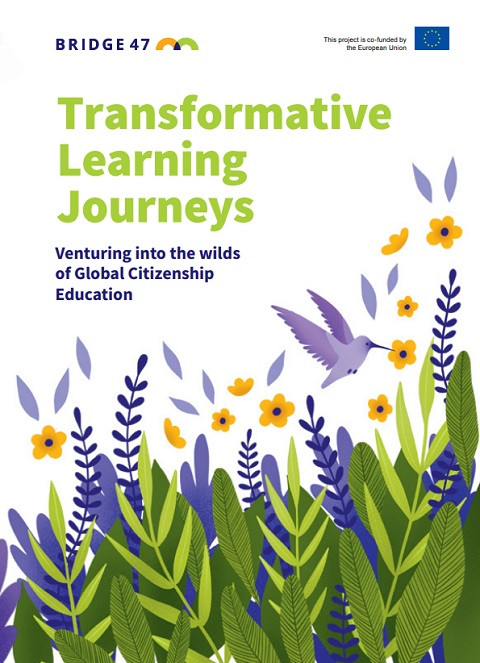 Transformative Learning Journeys: Venturing Into the Wilds of Global Citizenship Education 발행 연도: 2021 단체 저자: Bridge 47 With the intensive courses of the Transformative Learning Journey, Bridge 47 created experimental learning spaces for communities of practitioners, researchers and activists of transformative education from around the world.The courses endeavored to challenge common concepts of Global Citizenship Education, to explore questions like those below and to experiment with different, holistic and potentially more transformative, practices of learning and co-creating.What are the (cultural) root causes of the global multi-crisis?How to decolonize and transform a modern system that is broken beyond fixing?What do we have to learn, unlearn or let go of- individually and collectively - in order to allow, embrace and foster real change? What characterizes transformative learning, and how can education create holistic spaces to trigger, support and accompany such learning processes? How transformative is our own organizational and educational practice?Do we have to re-imagine education and activism and become more radical? Are we asking the right questions?Based on the positive resonance, Bridge 47 wants to share some of the learnings through this publication. The book gives insights into the design, content and methodology of the course. Featuring diverse contributions from participants, it is a mosaic of perspectives and experiences of transformation, decolonization and learning. It also comprises some tools and invitations for reflection. It is not a cohesive prescription of how to facilitate transformative learning – as there is none - but an invitation to relate to and play."This book is dedicated to all the curious people out there who are passionate about education in caring for our world and each other - the dreamers, the healers, the lovers, the teachers for a different future to emerge. It goes to the fighters who are desperate and overwhelmed in face of complex challenges and are worn out by their struggle for justice and change – to find inspiration, energy and courage to treat ourselves gently, to let go and to make space for new things to emerge."
 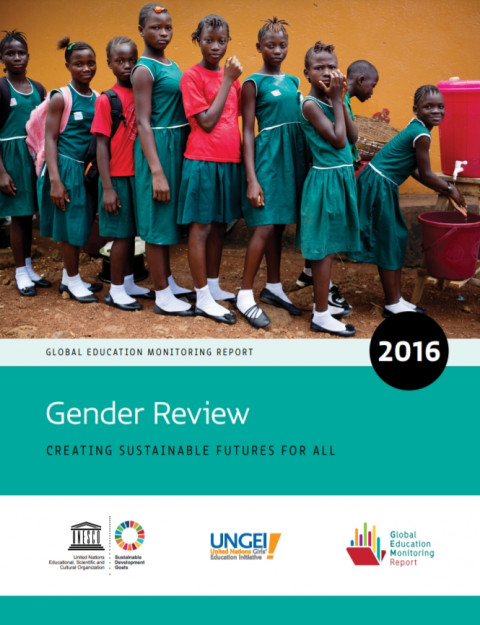 Creating sustainable futures for all; Global education monitoring report, 2016; gender review 발행 연도: 2016 저자: Sachs, Jeffrey D 단체 저자: Global Education Monitoring Report Team Education and gender equality are central concerns in the new sustainable development agenda. The Education 2030 Framework for Action, agreed by the global education community in November 2015 to accompany the SDG agenda, recognizes that gender equality is inextricably linked to the right to education for all, and that achieving gender equality requires an approach that ‘ensures that girls and boys, women and men not only gain access to and complete education cycles, but are empowered equally in and through education’ (UNESCO, 2016a, p. 8). Women, girls, boys and men all need to be given opportunities for active participation in society, for their voices to be heard and their needs met (UN Women, 2016a). To facilitate and achieve this, better evidence-based knowledge and understanding of gender issues in and through education are needed. The Gender Review of the 2016 Global Education Monitoring Report (GEM Report) recognizes and largely focuses on the challenges facing girls and women because of the disproportionate overall disadvantage they continue to experience in and beyond education. But it also understands that gender disadvantage can be experienced by boys and men, and that gender equality involves males, relationships and power. Gender inequality affects us all. Achieving gender equality must involve us all. Résumé sur l'égalité des genres: créer des avenirs durables pour tous; Rapport mondial de suivi sur l'éducation, 2016 발행 연도: 2016 저자: Sachs, Jeffrey D 단체 저자: Global Education Monitoring Report Team L’éducation et l’égalité des genres sont des préoccupations essentielles dans le nouveau programme de développement durable. Le Cadre d’action Éducation 2030, approuvé par la communauté mondiale de l’éducation en novembre 2015 en complément du Programme 2030, reconnaît que l’égalité des genres est indissociable du droit à l’éducation pour tous, et que, pour qu’elle devienne une réalité, il faut adopter une démarche « qui garantisse que les filles et les garçons, les femmes et les hommes non seulement ont le même accès aux différents cycles d’enseignement, jusqu’à leur terme, mais aussi qu’ils ont les mêmes possibilités de s’épanouir dans l’éducation et grâce à l’éducation » (UNESCO, 2016a, p. 8). Femmes, filles, hommes et garçons ont tous besoin que des possibilités leur soient données de participer activement à la vie sociale et de faire entendre leur voix et qu’il soit répondu à leurs besoins (ONU Femmes, 2016a). Faciliter et permettre la réalisation de cet objectif exige une connaissance et une compréhension mieux étayées par des données factuelles de la manière dont l’égalité des genres peut être assurée dans l’éducation et par l’éducation. Le Résumé sur l’égalité des genres de l’édition 2016 du Rapport mondial de suivi sur l’éducation (Rapport GEM) reconnaît les difficultés rencontrées par les filles et les femmes du fait du désavantage global disproportionné auquel elles continuent de se heurter dans leurs études et au-delà, et est grande partie centré sur ces difficultés. Mais il admet aussi que les garçons et les hommes peuvent eux aussi être désavantagés du fait de leur sexe et que l’égalité des genres les concerne et est affaire de relations et d’exercice du pouvoir. L’inégalité entre les genres nous touche tous. Instaurer l’égalité entre les genres est notre responsabilité à tous. Resumen sobre género: creación de futuros sostenibles para todos; Informe de seguimiento de la educación en el mundo, 2016 발행 연도: 2016 저자: Sachs, Jeffrey D 단체 저자: Global Education Monitoring Report Team Para la nueva agenda internacional de desarrollo sostenible, la educación y la igualdad de género constituyen preocupaciones básicas. El Marco de Acción Educación 2030, suscrito por la comunidad educativa mundial en noviembre del 2015, en sintonía con la agenda para los ODS, reconoce que la igualdad de género está íntimamente ligada al derecho a la educación para todos y que para alcanzar la igualdad de género se requiere un enfoque que “garantice no solo que las niñas, los niños, las mujeres y los hombres obtengan acceso a los distintos niveles de enseñanza y los cursen con éxito, sino que adquieran las mismas competencias en la educación y mediante ella” (UNESCO 2016a, p.28). Todas las mujeres, las niñas, los niños y los hombres han de tener la posibilidad de participar activamente en la sociedad, de que se oigan sus voces y se satisfagan sus necesidades (ONU-Mujeres, 2016a). Para facilitar y alcanzar estos objetivos, es necesario disponer de conocimientos basados en evidencia, acerca de los temas relacionados con el género en el ámbito de la educación y mediante ella. El Resumen sobre Género del Informe de Seguimiento de la Educación en el Mundo (Informe GEM) identifica y se centra principalmente en los desafíos a los que han de hacer frente las niñas y las mujeres a causa de las desventajas globales y desproporcionadas que siguen experimentando en su período de formación y después de él. Pero tiene presente asimismo que los niños y los hombres pueden sufrir desventajas de género, y que la igualdad de género también afecta a los varones, a sus relaciones y al poder. Por tanto, todos debemos participar en lograr la igualdad de género.