
자료
세계시민교육에 대한 이해를 넓히고 연구, 옹호 활동, 교수, 학습 등을 향상시킬 수 있는 다양하고 유용한 자료를 찾아보세요.
1,851 건의 결과가 검색되었습니다
 Education and Lifelong Learning for Sustainable Development: Asia-Pacific Regional Consultation; 12 - 13 February, 2015, Vientiane, Lao PDR 발행 연도: 2015 저자: Heribert Hinzen | Ounpheng Khammang | Somsy Southivong | Timote Masima Vaioleti The book contains all the texts which were transformed from the presentations during the consultations into written manuscripts.
  Address by Irina Bokova, Director-General of UNESCO, on the occasion of the Award Ceremony of the 2017 UNESCO-Japan Prize on Education for Sustainable Development, 39th General Conference; UNESCO, 3 November 2017 발행 연도: 2017 단체 저자: UNESCO. Director-General, 2009-2017 (Bokova, I.G.) This address was delivered by Irina Bokova, Director-General of UNESCO, on the occasion of the Award Ceremony of the 2017 UNESCO-Japan Prize on Education for Sustainable Development at UNESCO Headquarters in Paris, on 3 November.
  Climate Risk Informed Decision Analysis (CRIDA): Collaborative Water Resources Planning for an Uncertain Future 발행 연도: 2024 단체 저자: UNESCO Intergovernmental Hydrological Programme (IHP) | International Center for Integrated Water Resources Management (ICIWaRM) | Alliance for Global Water Adaptation (AGWA) | Deltares The importance of integrating climate change considerations into water resources planning is recognized on a global scale. Various frameworks, such as the Sendai Framework for Disaster Risk Reduction, the United Nations Sustainable Development Goals, and the Paris Agreement, emphasize the need for proper planning, policy-making, and adaptation strategies. The Climate Risk Informed Decision Analysis (CRIDA) methodology was launched in 2018 as a response to these international agendas, bridging the gap between climate change uncertainty and water resource planning.
 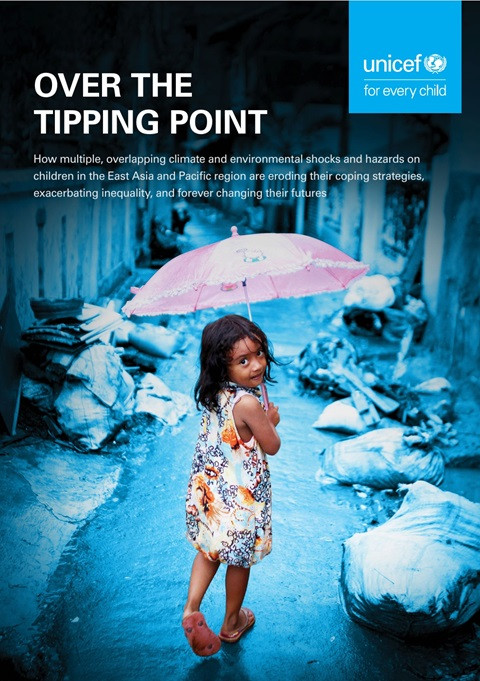 Over the Tipping Point: How Multiple, Overlapping Climate and Environmental Shocks and Hazards on Children in the East Asia and Pacific Region are Eroding their Coping Strategies, Exacerbating Inequality, and Forever Changing Their Futures 발행 연도: 2023 단체 저자: United Nations Children's Fund (UNICEF) This report unveils the intensifying frequency and compounding effects of climate-related hazards intertwined with non-climate shocks like the COVID-19 pandemic and socio-economic challenges. Given that children are already facing the impacts of climate change, adaptation and resilience measures are needed now to reduce the full force of impacts. This report recommends three areas to do so: Children have continued access to the key services they need: This requires investing in climate-smart and disaster-resilient education, health, and water, sanitation and hygiene (WASH) services for children, so that children can access these services despite the shocks they face; Child protection and social protection systems are in place and are climate-responsive; and There is understanding of what to expect and how to adjust as necessary, establishing and utilizing strong early warning, risk management and disaster preparedness systems. In all of this, children and young people must be at the forefront of our actions. Urgency demands that they take action themselves, leading the way with innovative solutions for both mitigation and adaptation. We must support their efforts, providing them with the necessary skills and resources to amplify their work. Above all, we owe them every opportunity for success as we work together to secure a better world for generations to come.
  한국의 SDGs 이행보고서 2021 발행 연도: 2021 저자: 박영실 | 홍현정 | 진유강 | 윤민희 | 이은경 단체 저자: 통계개발원 2030년 기한의 유엔 지속가능발전목표(SDGs) 이행 상황을 점검하는『한국의 SDGs 이행보고서 2021』을 발간. 동 보고서는 유엔 SDGs 지표를 근거로 성평등, 산업재해, 기후변화 등에 관한 한국의 지속가능발전 현황을 국제 비교 분석하였고, 이행과정에서 어떤 집단이 뒤처져 있는지도 보여준다. 특히, 이번 보고서에서는 코로나19의 영향을 볼 수 있는 SDGs 지표를 중심으로 분석하였다. 이를 통해, 회복을 위한 사회·환경·경제 정책의 방향성을 가늠해 볼 수 있을 것으로 기대된다. 본 저작물은 통계청 통계개발원에서 2021년작성하여 공공누리 제3유형으로 개방한 '한국의 SDGs 이행보고서 2021(작성자:박영실)'을 이용하였으며, 해당 저작물은 통계청 통계개발원 홈페이지(https://kostat.go.kr/)에서 무료로 내려받으실 수 있습니다.
  한국의 SDGs 이행보고서 2022 발행 연도: 2022 저자: 박영실 | 진유강 | 윤민희 | 김소연 단체 저자: 통계개발원 『한국의 SDGs 이행보고서 2022』는 데이터와 통계를 근거로 한국의 지송가능발전 현황을 진단하였고 고품질의 국제 비교 가능 자료와 증거 기반 분석에 기초해 이해하기 쉽게 시각화했습니다. 본 보고서가 전 세계가 목표한 SDGs 달성에 한 걸음 더 다가갈 수 있는 나침반 역할을 하기 바라며 증거 기반 정책의 핵심 지표로 이용되기를 기대합니다. 본 저작물은 통계청 통계개발원에서 2022년작성하여 공공누리 제3유형으로 개방한 '한국의 SDGs 이행보고서 2022(작성자:김석호)'을 이용하였으며, 해당 저작물은 통계청 통계개발원 홈페이지(https://kostat.go.kr/)에서 무료로 내려받으실 수 있습니다.
  우리나라 지역별 기후변화 전망과 적응정책 차원의 시사점 (환경포럼 제26권 통권 263호) 발행 연도: 2022 저자: 심창섭 | 문준기 | 한지현 | 서지현 | 송영일 | 홍재우 | 유명수 단체 저자: 한국환경연구원 지역 차원의 기후변화 적응을 위해서는 지역 차원의 기후변화 특징을 파악하고 고해상도의 미래 기후전망이 필요하다. 본고에서는 우리나라의 과거 기상관측 및 다종의 기후 시나리오 앙상블을 기반으로 지역별 기후변화 양상과 전망에 대해 논의하였다. 본 저작물은 한국환경연구원에서 2022년 작성하여 공공누리 제4유형으로 개방한 '우리나라 지역별 기후변화 전망과 적응정책 차원의 시사점(작성자: 심창섭)'을 이용하였으며, 해당 저작물은 한국환경연구원 홈페이지(https://www.kei.re.kr/)에서 무료로 내려받으실 수 있습니다.
  T-KIT 4: Intercultural Learning 발행 연도: 2018 저자: Oana Nestian Sandu | Nadine Lyamouri-Bajja 단체 저자: Council of Europe | European Commission Intercultural learning is an important topic for the priorities of both the European Commission and the Council of Europe, and of their partnership in the field of youth.Intercultural learning is an educational approach that can lead to social transformation, so that people from different cultural backgrounds can develop positive relations based on the values and principles of human rights and on seeing cultural differences as positive things. It is a form of political and social education that needs to pay attention not only to intercultural relations, but also to different understandings of culture and diversity, power relations, distribution of resources, political and social context, human rights, discrimination, history and daily interactions among different groups.This T-Kit was developed for the context of youth work and non-formal education with young people, both of which support the personal development, social integration and active citizenship of young people. Educators and youth workers have an important role in addressing intercultural learning in their work with young people. They can stimulate young people’s learning in their daily lives, so that they can question and extend their perception, develop competences to interact positively with people from different cultural backgrounds and embrace the values of diversity, equality and dignity. In today’s Europe, these values and skills are fundamental for young people and for society as a whole in order to continue building peace and mutual understanding.
  Media Literacy for All: Supporting Marginalised Groups Through Community Media 발행 연도: 2020 저자: Martina Chapman | Nadia Bellardi | Helmut Peiss 단체 저자: Council of Europe Being media literate means being able to critically understand and evaluate media content and to responsibly and safely use digital media services. Media literacy helps us engage with others in the public sphere, using the creative and participatory potential that new technologies and services can offer. Nowadays, it also includes understanding how data is used and how algorithms and AI can influence media production and choices.The importance of community media in supporting the formation of an ‘informed citizenry’ is well recognised by the Council of Europe. Community media have the ability to empower community groups with the neces- sary access and skills to create their own communica- tion channels and to foster their participation in the public sphere in a structured and professional man- ner. However, in many European countries community media still lack formal, legal recognition, fair access to distribution platforms and sustainable funding.This background paper explores how the community media sector promotes media literacy and how this work can strengthen marginalised communities’ partic- ipation in the media environment and public discourse. Comparing five models of community media from Cyprus, Ireland, Luxembourg, Spain and the United Kingdom, it seeks to inform and inspire practitioners and policy-makers, highlighting a number of findings and policy responses that can help member States fully realise the potential of community media. 모두를 위한 미디어 리터러시: 공동체 미디어를 통해 소외된 사람들 지원하기 발행 연도: 2020 저자: Martina Chapman | Nadia Bellardi | Helmut Peiss 단체 저자: Council of Europe 미디어 리터러시를 갖춘다는 것은 미디어 콘텐츠를 비판적으로 이해 하고 평가할 수 있으며, 디지털 미디어 서비스를 책임감 있고 안전하 게 이용할 수 있다는 뜻이다. 미디어 리터러시는 새로운 기술과 서비 스가 제공할 수 있는 창의적이고 참여적인 잠재력을 이용해서 공론장 에서 다른 사람들과 교류할 수 있도록 돕는다. 오늘날에는 데이터가 어떻게 사용되는지, 알고리즘과 인공지능이 미디어의 생산과 선택에 어떤 영향을 미치는지 이해하는 것도 미디어 리터러시에 포함된다.유럽평의회는 공동체 미디어가 ‘정보에 밝은 시민’의 형성을 지원하 는 데에 얼마나 중요한 역할을 하는지 잘 인식하고 있다. 공동체 미디 어는 공동체 집단들이 자체적인 커뮤니케이션 수단을 만들 때 필요한 접근과 역량을 제공하고, 체계적이고 전문적인 방법으로 공론장에 대 한참여를조성할수있는능력을갖추고있다.그러나많은유럽국가 에서 공동체 미디어는 여전히 공식적인 법률적 인정과 유통 플랫폼에 대한 공정한 접근, 지속 가능한 자금 조달이 부족한 상태다.이 배경자료는 공동체 미디어 부문이 어떻게 미디어 리터러시를 증진 하는지, 그리고 이 활동이 어떻게 미디어 환경과 공적 담론에서 소외 된 공동체의 참여를 고양하는지 탐구한다. 키프로스와 아일랜드, 룩 셈부르크, 스페인, 영국의 공동체 미디어 다섯 가지 모델을 비교해서, 회원국들이 공동체 미디어의 잠재력을 충분히 실현하는 데 도움을 줄 수 있는 일련의 연구 결과와 정책적 조치를 조명하며, 실무자와 정책 입안자에게 정보를 제공하고 영감을 줄 수 있기를 바란다.