
자료
세계시민교육에 대한 이해를 넓히고 연구, 옹호 활동, 교수, 학습 등을 향상시킬 수 있는 다양하고 유용한 자료를 찾아보세요.
1,828 건의 결과가 검색되었습니다
 Minimum Standards for Education: Preparedness, Response, Recovery 발행 연도: 2024 단체 저자: Inter-agency Network for Education in Emergencies (INEE) Since 2004, the INEE Minimum Standards for Education: Preparedness, Response, Recovery (INEE MS) have provided a framework for inclusive and equitable quality education. The purpose of the handbook is:-To improve the quality of education preparedness, response, and recovery;-To increase access to safe and relevant learning opportunities;-To ensure that the actors who provide these services are held accountable The INEE MS are designed to be applicable to crisis response in many different situations, including emergencies caused by conflict, by natural hazards such as those induced by climate change, and slow- and rapid-onset crises in both rural and urban environments.
  Governing AI for Humanity: Final Report 발행 연도: 2024 단체 저자: United Nations (UN) The United Nations Secretary-General’s High-level Advisory Body on AI’s Final Report, “Governing AI for Humanity,” builds on months of work, including extensive global consultations, and the publication of an interim report in December 2023. Proposals for Global Governance on AI This report outlines a blueprint for addressing AI-related risks and sharing its transformative potential globally, including by:• Urging the UN to lay the foundations of the first globally inclusive and distributed architecture for AI governance based on international cooperation;• Proposing seven recommendations to address gaps in current AI governance arrangements;• Calling on all governments and stakeholders to work together in governing AI to foster development and protection of all human rights. This includes light institutional mechanisms to complement existing efforts and foster inclusive global AI governance arrangements that are agile, adaptive and effective to keep pace with AI’s evolution. Extensive Global Consultations The report is the product of extensive consultations, involving more than 2,000 participants across all regions of the world, including via: • 18 deep-dive discussions on key issues with top experts• More than 50 consultation sessions across all regions• More than 250 written submissions from over 150 organizations and 100 individuals The Advisory Body also commissioned an AI Risk Global Pulse Check – the most comprehensive global horizon scanning exercise on AI risks to date – and an AI Opportunity Scan to crowdsource expert assessments of emerging AI trends.
  جهود المنظمات الدولية في تأهيل معلمي اللاجئين في تركيا ومصر: دراسة مقارنة (المشروعات الدولية نموذجاً; Vol. 1, No. 47) 발행 연도: 2023 저자: Husniah Husayn Abd al-Rahman Iwis 단체 저자: Fayoum University. Faculty of Education يتطلب تعليم الطلاب اللاجئين إتقان المعلمين مهارات مختلفة تمكنهم من التغلب على التحديات التي تواجههم في دعم الأطفال عاطفياً، ودمجهم اجتماعيًا وأكاديميًا بشكل عام؛ لذا برزت الحاجة إلى تدريب المعلمين قبل وأثناء الخدمة من أجل التدريس في فصول تتكون من أطفال من جنسيات وثقافات مختلفة؛ ومن ثم يسعى هذا البحث إلى الكشف عن طبيعة الجهود المقدمة لإعداد المعلمين القائمين على تعليم اللاجئين في كل من مصر وتركيا، ولتحقيق هذا الهدف اعتمد البحث على المدخل الوظيفى، وتوصل البحث إلى عدد من النتائج أهمها: أولت المنظمات الدولية أهمية كبرى لتنفيذ مشروعات تأهيل معلمي اللاجئين؛ وذلك من خلال المشروعات التى تمولها المفوضية الأوروبية في إطار برنامج (Erasmus + (KA2 ، كما تبين الأثر الإيجابى للمشروعات فى الجوانب العاطفية، والاجتماعية، والمهنية؛ International Organizations’ Efforts to Qualify Teachers for Refugee in Türkiye and Egypt : A Comparative Study (International Projects as Models; Vol.1, No.47) 발행 연도: 2023 저자: Husniah Husayn Abd al-Rahman Iwis 단체 저자: Fayoum University. Faculty of Education Educating refugee students requires teachers who master different skills that enable them to overcome the challenges they face in supporting children emotionally, and integrating them socially andacademically; Therefore, there was a need to train teachers before and during service in order to teach in classes consisting of children of different nationalities and cultures. This research seeks to reveal the nature of the efforts made to prepare teachers in charge ofeducating refugees in both Egypt and Turkey. To achieve this goal, theresearch relied on the functional approach and reached a number of results, the most important of which are: Internationalorganizations have attached great importance to the implementation ofteacher for refugee rehabilitation projects; this is through projectsfunded by the European Commission under the Erasmus+ (KA2)programme. It also shows the positive impact of projects on theemotional, social and professional aspects.
  유네스코 이슈 브리프 2024년 제1호: 유네스코 「인공지능 윤리 권고」 이행을 위한 한국의 ‘준비도 평가’ 및 ‘윤리 영향 평가’ 대비 현황과 전망 발행 연도: 2024 저자: 이상욱 단체 저자: 유네스코한국위원회 Ⅰ. 유네스코 「인공지능 윤리 권고」 (2021)의 의의Ⅱ. 준비도 평가의 국제 현황 및 국내 대응Ⅲ. 윤리 영향 평가의 국제 현황 및 국내 대응Ⅳ. 인공지능 국제 거버넌스 현황과 「권고」 대응 전략
  United Nations Strategy and Plan of Action on Hate Speech: Detailed Guidance on Implementation for United Nations Field Presences 발행 연도: 2020 단체 저자: United Nations (UN) The Strategy and Plan of Action acknowledges that hate speech has the potential to incite violence and undermine social unity. It recognizes that hate speech has been a precursor to atrocity crimes, including genocide, over the past 75 years. This approach to coordinating efforts across the UN system to identify, prevent and confront hate speech is grounded in international human rights standards, including the right to freedom of opinion and expression, principles of equality and non-discrimination, as well as other fundamental rights. The Strategy aims to give the United Nations the room and the resources to address hate speech, which poses a threat to UN principles, values and programmes. It guides the UN system on how to address hate speech and includes ways to support United Nations Resident Coordinators’ action in addressing and countering hate speech on the ground.
 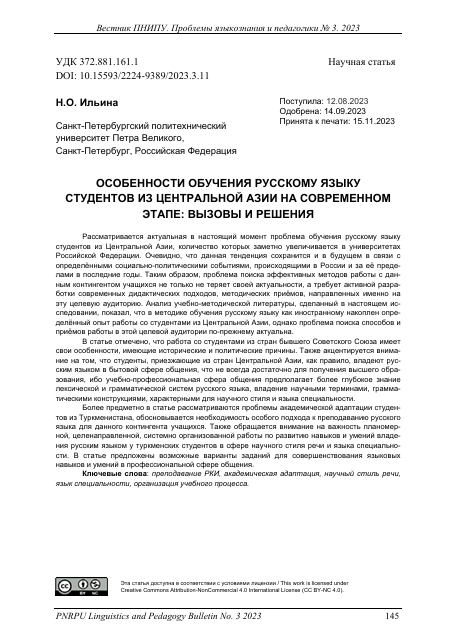 Особенности обучения русскому языку студентов из Центральной Азии на современном этапе: вызовы и решения (Вестник ПНИПУ. Проблемы языкознания и педагогики; № 3. ) 발행 연도: 2023 저자: Ильина Наталья Олеговна 단체 저자: Вестник Пермского национального исследовательского политехнического университета (ПНИПУ) Рассматривается актуальная в настоящий момент проблема обучения русскому языку студентов из Центральной Азии, количество которых заметно увеличивается в университетах Российской Федерации. Более предметно в статье рассматриваются проблемы академической адаптации студентов из Туркменистана, обосновывается необходимость особого подхода к преподаванию русского языка для данного контингента учащихся.
 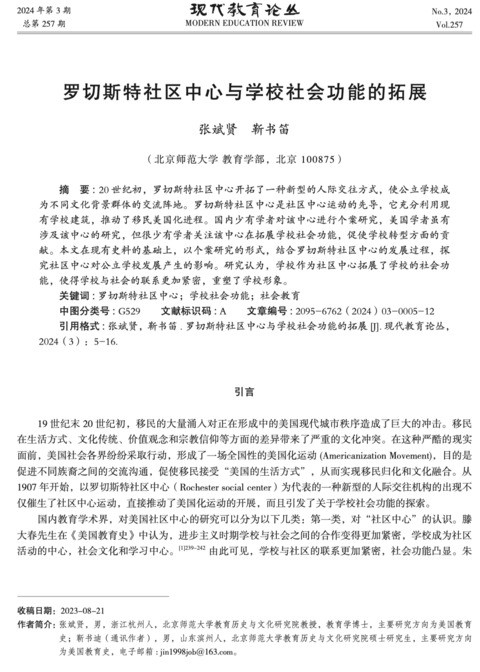 罗切斯特社区中心与学校社会功能的拓 (现代教育论丛 第256期) 발행 연도: 2024 저자: 张斌贤 | 靳书笛 단체 저자: 华南师范大学 20 世纪初,罗切斯特社区中心开拓了一种新型的人际交往方式,使公立学校成 为不同文化背景群体的交流阵地。罗切斯特社区中心是社区中心运动的先导,它充分利用现 有学校建筑,推动了移民美国化进程。国内少有学者对该中心进行个案研究,美国学者虽有 涉及该中心的研究,但很少有学者关注该中心在拓展学校社会功能,促使学校转型方面的贡 献。本文在现有史料的基础上,以个案研究的形式,结合罗切斯特社区中心的发展过程,探 究社区中心对公立学校发展产生的影响。研究认为,学校作为社区中心拓展了学校的社会功 能,使得学校与社会的联系更加紧密,重塑了学校形象。
  Toward a More Inclusive Post-COVID Recovery: A Tool to Further the Caribbean Policy Agenda 발행 연도: 2022 저자: Anna Kasafi Perkins | Stacy Richards-Kennedy | Don Marshall | R. Clive Landis 단체 저자: UNESCO Kingston | University of the West Indies The Caribbean is a grouping of islands and low-lying coastal countries of sovereign nations and dependent territories that share a history of colonialism and coloniality,1 which has shaped and continues to shape their “complex mix of political and administrative structures”. Indeed, Caribbean nations experience a “paradoxical, type of political sovereignty and experience of development”. All Caribbean nations have been classified by the United Nations as Small Island Developing States (SIDS), taking account of “the peculiar social, economic and environmental vulnerabilities” they experience. Caribbean SIDS are highly indebted and vulnerable to climate change, hurricanes and other natural hazards. At the same time, theirs is a paradoxical existence as their vulnerabilities place them alongside least developed countries, in spite of some being designated by the World Bank as high or middle-income countries. Such classification limits access to the international financing needed towards achieving the Sustainable Development Goals.
  New Challenges and Approaches to Regional and Global Security in Central Asia 발행 연도: 2020 단체 저자: Organization for Security and Co-operation in Europe (OSCE) On 26 October 2018 in Nur-Sultan, the OSCE Programme Office in Nur-Sultan jointly with the Friedrich Ebert Foundation and the Kazakhstan Council on International Relations, with support from the Institute of Diplomacy under the Academy of Public Administration and the Public Opinion Research Institute co-organized an international conference entitled “New Challenges and Approaches to Regional and Global Security in Central Asia”. This compendium, which includes presentations given at the conference by both Kazakhstan’s and foreign participants, explores main regional security threats in Central Asia and ways to address these problems, as well as regional co-operation issues in responding to contemporary challenges. The edition will be of interest to political scientists, international relations experts, civil servants, scholars, educators, university-level students, and broad sections of the public interested in the contemporary development of the region. The edition is published in Russian and English. The paper of Mr. Pal Dunay is written in the English language in the original, the rest of the reports are in Russian. All reports have been translated and edited with the support of the OSCE Program Office in Nur Sultan. Any opinions and recommendations expressed in the materials arising from the conference are those of the authors and do not necessarily reflect the views of the conference organizers.