
자료
세계시민교육에 대한 이해를 넓히고 연구, 옹호 활동, 교수, 학습 등을 향상시킬 수 있는 다양하고 유용한 자료를 찾아보세요.
1,828 건의 결과가 검색되었습니다
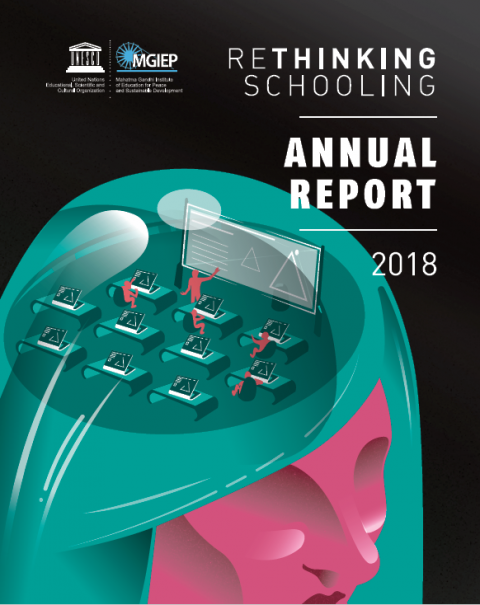 Rethinking schooling: annual report 2018 발행 연도: 2019 단체 저자: Mahatma Gandhi Institute of Education for Peace and Sustainable Development (MGIEP) Calls to gear up schools for the 21st century are ubiquitous today. Some Asian education systems are held up as models for an innovation-led utopian future. Across much of Asia, however, neither the reality of schooling nor the patterns of development with which it is associated give cause for blithe optimism. This study is informed by UNESCO’s commitment to realizing the Sustainable Development Goals (SDGs) through educational reform worldwide. Since its inception, UNESCO has championed a humanistic vision of education (UNESCO, 2015)—a vision today encapsulated in SDG 4.7. These ideals need to be strongly restated and defended in an era when educational debate has come to be framed by a narrowly economistic and instrumentalist agenda. Deriving urgent significance from this broader context, the Rethinking Schooling report analyses how far the ideals of SDG 4.7 are embodied in policies and curricula across 22 Asian countries (UNESCO MGIEP, 2017a). The report seeks to develop benchmarks against which future progress can be assessed. It also argues forcefully that the fundamental purposes of schooling need to be reconfigured, if the ideals to which the global community has subscribed are actually to be realized.
  Implementation of sustainable development goals in the SPECA region 발행 연도: 2017 단체 저자: United Nations Economic Commission for Europe (UNECE) This study is aimed at analyzing the links between the work on achieving the Sustainable Development Goals (SDGs) in the national framework of countries participating in the UN Special Program for the Economies of Central Asia (SPECA) and identifying areas in which the cooperation of these countries in the framework of SPECA will be useful. The analysis will lead to policy recommendations on how regional cooperation within SPECA can contribute to progress in the implementation of the SDGs. Осуществление целей устойчивого развития в регионе СПЕКА 발행 연도: 2017 단체 저자: United Nations Economic Commission for Europe (UNECE) Данное исследование направлено на анализ связей между работой по достижению Целей устойчивого развития (ЦУР) в национальных рамках стран, участвующих в Специальной программе ООН для экономик Центральной Азии (СПЕКА) и определение областей, в которых будет полезно сотрудничество этих стран в рамках СПЕКА. Анализ приведет к выработке политических рекомендаций относительно того, как региональное сотрудничество в рамках СПЕКА может способствовать прогрессу в реализации ЦУР.
  Violent extremism in Central Asia 2018: A preliminary survey of groups, digital dimensions and state responses 발행 연도: 2018 단체 저자: Civil Initiative on Internet Policy | SecDev This research has been produced within the framework of the “Contributing to stability and peace in Central Asia through media literacy, improved reporting and regional cooperation” Project implemented by Internews and funded by the European Union. The contents of this research are the sole responsibility of The SecDev Group, and Public Foundation Civil Initiative on Internet Policy and can not be regarded as reflecting the position of the European Union and Internews under any circumstances. Насильственный экстремизм в Центральной Азии, 2018: обзор террористических групп, законодательства стран ЦА и правоприменительной практики по противодействию насильственному экстремизму онлайн 발행 연도: 2018 단체 저자: Civil Initiative on Internet Policy | SecDev Исследование проведено совместно с общественным фондом «Гражданская инициатива интернет - политики» и организацией The SecDev Group в рамках проекта «Содействие стабильности и миру в Центральной Азии посредством повышения медиа-грамотности, эффективного освещения и регионального сотрудничества», финансируемого Европейским союзом и реализуемого Интерньюс. Содержание этого исследования является исключительной ответственностью организации The SecDev Group и общественного фонда «Гражданская инициатива интернет-политики» и ни при каких обстоятельствах не отражает позицию Европейского Союза и Интерньюс.
  Migration: la solidarité internationale contre le nationalisme xénophobe 발행 연도: 2018 저자: Tina Robiolle Moul Le sommet qui vient de se tenir à Bruxelles les 28 et 29 juin, confirme l’entêtement des dirigeant·e·s européen·ne·s dans une politique du pire qui, loin d’être le fruit de maladresses face à l’idée d’une invasion imaginaire de personnes étrangères, s’apparente à une stratégie explicite de coercition des populations en adoptant sans réserve les positions de l’extrême droite. La politique migratoire européenne, à l’image de celle des pays membres, reste aveugle à une compréhension plus globale des migrations qui est celle de la solidarité internationale.
  إستراتيجية مكافحة التصحر لتحقيق التنمية المستدامة في الوطن العربي : دراسة برنامج الجزائر الوطني لمكافحة التصحر 발행 연도: 2019 저자: Boshwait Qairouz إن البحث عن استراتيجيات مستدامة لمكافحة التصحر تحترم البيئة الطبيعية وتحقق العدالة الاجتماعية إضافة إلى تحقيق الفعالية الاقتصادية في المناطق المتضررة من العالم أصبحت من القضايا الهامة التي تخص كل الدول خاصة الدول العربية، لما لمشكلة التصحر من عواقب وخيمة تعود بالضرر على اتمعات البشرية من الناحية الاقتصادية والاجتماعية وكذا البيئية، وبالتالي عدم تحقق التنمية المستدامة التي أصبحت من متطلبات العصر والرامية إلى تحسين الجانب الاجتماعي والاقتصادي تحت إطار حماية البيئة. ومنه نطرح التساؤل التالي: هل تتبع الدول العربية إستراتيجية واحدة لمكافحة التصحر والتي تأخذ في الاعتبار مبادئ التنمية المستدامة؟ وما هو واقع ذلك في الجزائر من خلال البرنامج الوطني لمكافحة التصحر؟ Strategy to Combat Desertification to Achieve Sustainable Development in the Arab World: A Study of Algeria 's National Program to Combat Desertification 발행 연도: 2019 저자: Boshwait Qairouz Regarding to its impacts on the economic, social and environnemental levels, desertification became one of critical environnemental issue that disturbs the international community. Especially in the dry land, semi dry land and semi humid dry lands. Desertification is the great durable development challenge based on three dimensions: economical efficiency, social justice and nature protection. Viewing the international trends towards achieving durable development, the Arab countries must create new durable strategies and methods, in order to face the phenomenon, these strategies should include the following dimensions: economical, social and environnemental one. Accounting the different reasons of desertification, its intensity and considering the financing capacity, it so difficult to expect one typical strategy that suits each Arab countries. To face such problem, Algeria like the other damaged countries takes needful procedures to combat this problem following a national programme which started in the sixteenth oh last century. To sum up, now days desertification till now a global issue, but the question which rest posing, If may we remove definitely such problem?
 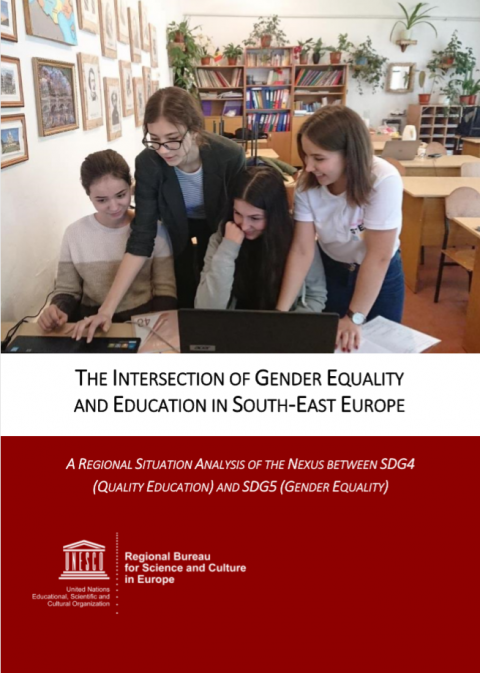 The Intersection of gender equality and education in South-East Europe: a regional situation analysis of the Nexus between SDG4 (Quality Education) and SDG5 (Gender Equality) 발행 연도: 2019 단체 저자: UNESCO Venice This report focuses on highlighting both progress and persistent challenges.It does so by analyzing the current situation of gender equality in education, including gender parity in participation, education quality, and outcomes, aswell as issues related to gender equality in which education plays an important role, suchas policies that disproportionately affect women, early and unintended pregnancy, child marriage, and human trafficking. It relies on the most recent available data from the UNESCO Institute of Statistics (UIS), as well as supplemental data including from UNICEF, UN Women, and theOrganization for Economic Cooperation and Development(OECD), to descriptively analyze the rates for females and males, considering also progress over the last decade, and to identify where progress in gender equality has been made and whereactions are needed to ensure gender equality in and through education.
 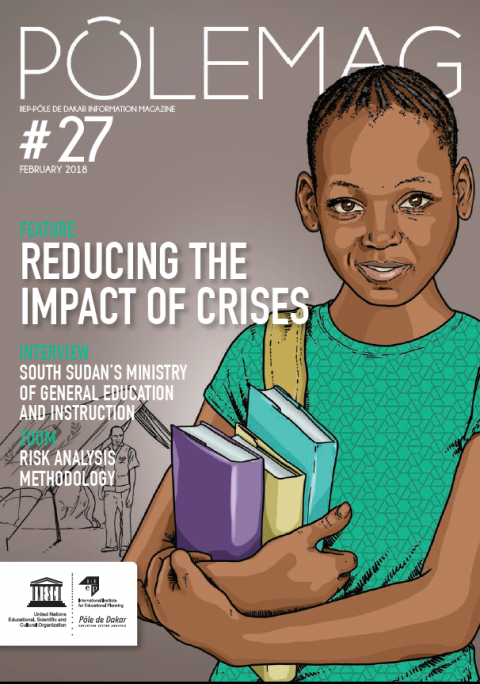 PôleMag n° 27: IIEP Pôle de Dakar information magazine, February 2018 발행 연도: 2018 단체 저자: UNESCO IIEP Regional Office for Africa Strengthening the resilience of education systems through planning that is adapted for crisis situations is a priority for IIEP. Together with our main partners, the institute has developed strategic orientations and tools dedicated to educational planning that is adapted to crisis situations. Based on our experience on this theme in Africa, we are also working with UNICEF to develop a new methodology to analyse risks and vulnerabilities. Mitigating the impact of crises calls for strengthening relationships with partners. Planning adapted to vulnerabilities should facilitate dialogue between development and humanitarian actors so that intervention plans are coordinated and aligned with government priorities. A dollar invested in risk reduction could save up to seven dollars in rebuilding costs. Taking the risks into account in the analysis and planning of education systems is therefore a wise investment.