
자료
세계시민교육에 대한 이해를 넓히고 연구, 옹호 활동, 교수, 학습 등을 향상시킬 수 있는 다양하고 유용한 자료를 찾아보세요.
1,727 건의 결과가 검색되었습니다
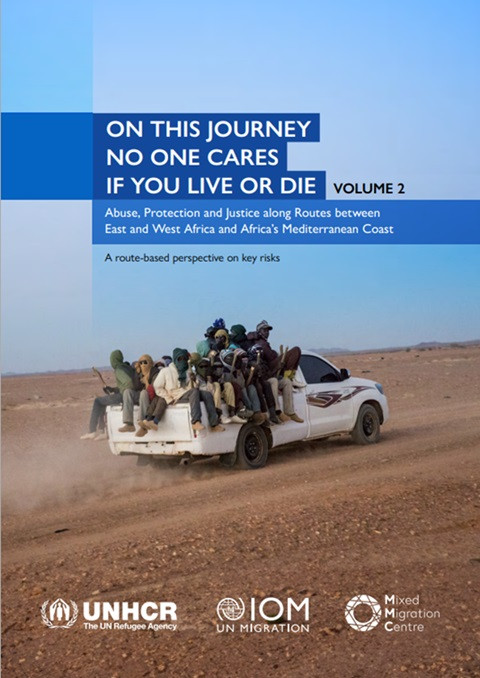 On This Journey No One Cares If You Live or Die, Volume 2: Abuse, Protection and Justice Along Routes Between East and West Africa and Africa's Mediterranean Coast 발행 연도: 2024 단체 저자: International Organization for Migration (IOM) | Mixed Migration Centre | UN. Office of the United Nations High Commissioner for Refugees (UNHCR) In the complex landscape of migration, this second volume of the report, On This Journey, No One Cares if You Live or Die, emerges as a crucial body of work that sheds light on the stark realities faced by refugees and migrants traversing the perilous Central Mediterranean route all the way from East and Horn of Africa and West Africa to the North African coast of the Mediterranean and across the sea. Jointly published by IOM, MMC and UNHCR, this report delves into the protection risks faced by refugees and migrants during these journeys. It aims to inform increased and concrete routes-based protection responses to reduce the suffering associated with the desperate journeys refugees and migrants undertake, and to serve as a call to action in addressing the root causes of displacement and drivers of irregular migration through positive action on peace, climate change, governance, inequality and social cohesion, as well as the creation of safe migration pathways.
  Towards More Gender Equality in Sport: Recommendations and Action Plan From the High Level Group on Gender Equality in Sport (2022) 발행 연도: 2022 단체 저자: European Commission | European Union (EU) Gender equality is a fundamental European Union (EU) principle. Enshrined in the Treaties, it is something the EU is actively trying to achieve – most recently through its Gender Equality Strategy 2021-2025. The Strategy aims to give women, men, girls and boys, in all their diversity, the freedom to pursue their chosen path in life and equal opportunities to thrive and to participate in and lead European society. Looking back at the steps already taken, the ‘Gender equality in sport – Proposal for strategic actions 2014-2020’ has certainly led to achievements, but the pace of reforms needs to be accelerated. Firstly, the principle of gender equality now underpins all actions funded under Erasmus+ Sport and projects supporting women’s sport are actively encouraged. Secondly, awareness raising is at the core of EU action in this field, notably through studies or discussions, such as within the Commission Expert Group on Good Governance. Finally, initiatives such as the annual #BeInclusive EU Sport Awards recognise those organisations using sport to increase social inclusion, including gender equality. In 2020, Commissioner Gabriel announced the setting up of an expert group with the aim of discussing the way forward and proposing future actions in the area of gender equality in sport to the European Commission, EU Member States and sports organisations. The work of the experts will lead to the implementation of concrete actions at local, national and European level. This report is the result of the work of the European Commission High-Level Group (HLG) on Gender Equality in Sport. The 15 members of the HLG were appointed in December 2020. Work began in February 2021 and was completed in December 2021. Meetings focused on six areas of engagement identified by the experts. Scientists and practitioners shared findings of their research and good practices. Each meeting was followed by working sessions to summarise the presentations and formulate recommendations. Vers une plus grande égalité des genres dans le sport: Recommandations et plan d'action du groupe de haut niveau sur l’égalité des genres dans le sport (2022) 발행 연도: 2022 단체 저자: European Commission | European Union (EU) L’égalité des genres est l’un des principes fondamentaux de l’Union européenne (UE). Inscrite dans les traités, elle constitue un objectif que l’UE s’efforce activement d’atteindre – notamment dans le cadre de sa stratégie en faveur de l’égalité entre les femmes et les hommes 2021-2025. Cette stratégie a pour objectif de donner aux femmes, aux hommes, aux jeunes filles et aux jeunes garçons, dans toute leur diversité, la liberté de suivre le chemin qu’ils ont choisi dans la vie et des chances égales de s’épanouir, de participer à la société européenne et de la diriger. Si l’on considère les mesures déjà prises, le rapport « Égalité des genres dans le sport – Proposition d’actions stratégiques 2014-2020 » a certes permis des avancées, mais le rythme des réformes doit être accéléré. Tout d’abord, le principe de l’égalité des genres sous-tend désormais toutes les actions financées dans le cadre du programme Erasmus+ Sport, et les projets soutenant le sport féminin sont activement encouragés. Ensuite, la sensibilisation est au coeur de l’action de l’UE dans ce domaine, notamment par le biais d’études ou de discussions, comme au sein du groupe d’experts de la Commission sur la bonne gouvernance. Enfin, des initiatives telles que les prix annuels #BeInclusive EU Sport Awards récompensent les organisations qui se servent du sport pour accroître l’inclusion sociale, notamment l’égalité des genres. En 2020, la commissaire Mariya Gabriel a annoncé la création d’un groupe d’experts chargé de déterminer la marche à suivre et de proposer des actions à implémenter dans le domaine de l’égalité des genres dans le sport à la Commission européenne, aux États membres de l’UE et aux organisations sportives. Le travail des experts permettra de mettre en oeuvre des actions concrètes aux niveaux locaux, nationaux et européen. Ce rapport est le résultat du travail du groupe de haut-niveau (GHN) de la Commission européenne sur l’égalité des genres dans le sport. Les 15 membres du groupe de haut-niveau ont été nommés en décembre 2020 Les travaux ont commencé en février 2021 et se sont terminés en décembre 2021. Les réunions ont porté sur six domaines d’engagement identifiés par les experts. Des scientifiques et des praticiens ont partagé le fruit de leurs recherches et leurs bonnes pratiques. Chaque réunion a été suivie par des sessions de travail destinées à résumer les présentations et à formuler des recommandations.
  2021年世界儿童状况:心之所想,促进、保护和关爱儿童心理健康 발행 연도: 2021 단체 저자: United Nations Children's Fund (UNICEF) 本报告关注当下世界儿童的心理健康问题,并呼吁全社会对这一议题予以关注并积极干预。
  UNICEF CHINA 2016 - 2020: FIVE YEARS OF RESULTS FOR CHILDREN IN CHINA 발행 연도: 2021 단체 저자: United Nations Children's Fund (UNICEF) This report introduces the work of UNICEF in China during 2016-2020, including children protection, education and social policies. 携手共进 造福儿童:联合国儿童基金会在华工作成果 (2016-2020年) 발행 연도: 2021 단체 저자: United Nations Children's Fund (UNICEF) 该报告介绍了联合国儿童基金会2016-2020期间在中国所进行的工作,包含儿童保护、教育、社会政策等方面内容。
  State Civic Education: Toolkit 발행 연도: 2017 저자: Elizabeth Whitehouse | Paul J. Baumann | Jan Brennan 단체 저자: Council of State Governments | Education Commission of the States This Civic Education Toolkit is intended to help stakeholders from all three branches of government, as well as other members of the civic education community in their mission to improve state civic education. There are many unique strategies stakeholders can use to effectively engage students. To effectively use this guide, the icons below denote methods and examples that may be particularly useful to leaders from each branch of government, leaders in the K-12 education community, leaders in the higher education community, and leaders working with non-governmental organizations.
  Educate All Girls and Boys in South Asia; the global out of school children initiative 발행 연도: 2015 단체 저자: UNICEF South Asia The South Asia Out-of-School Children Initiative (OOSCI) is part of the global initiative launched by UNICEF and the UNESCO Institute for Statistics (UIS) in 2010. The goal of the initiative is to make significant and sustained reduction in the number of out-of-school children around the world by 1) developing comprehensive profiles of excluded children using consistent and innovative statistical methods; 2) linking these profiles to the barriers and bottlenecks that lead to exclusion; and 3) identifying, promoting and implementing sound policies that address exclusion from a multi-sectorial perspective.
  Образование и изменение климата: Научиться действовать в интересах людей и планеты 발행 연도: 2024 단체 저자: Global Education Monitoring Report Team | Monitoring and Evaluating Climate Communication and Education Project (MECCE) | University of Sakatchewan Как образование может стимулировать деятельность в связи с изменением климата?Несмотря на убедительные факты, свидетельствующие о влиянии образования на достижение других результатов в области развития и о его роли в укреплении профессионального потенциала для перехода к устойчивому развитию, образование зачастую не учитывается при рассмотрении другими секторами вопросов, касающихся стратегических аспектов, политики, планирования и финансирования. В рамках Всемирного доклада по мониторингу образования предлагается новая серия публикаций, призванных содействовать диалогу на тему взаимосвязи образования с другими целями в области устойчивого развития.Первая публикация в этой серии посвящена изменению климата. Сначала в ней рассматривается растущее влияние изменения климата на образование, а затем – роль образования в деятельности в области климата. Вклад образования в развитие профессионального потенциала для перехода к «зеленой» экономике во многом недооценен. Принято считать, что формальное, неформальное и информальное обучение также играют важнейшую роль в создании мотивации для действий по смягчению последствий изменения климата и адаптации к ним.Однако положительная корреляция между уровнем образования и неустойчивыми моделями потребления, а также неоднозначность многих исследований на тему непосредственного влияния образования на меры по адаптации к изменению климата и смягчению его последствий, в некоторой степени способствуют тому, что образованию уделяется недостаточно внимания в глобальных и национальных программах действий в области изменения климата.В настоящей публикации показано, что для успешной реализации потенциала образования в области изменения климата его необходимо адаптировать. Парадигма образования не может быть основана только лишь на передаче знаний – она должна быть нацелена на формирование социально-эмоциональных навыков и обучение, ориентированное на действия.Значительная доля проведенных исследований посвящена влиянию уровня образования и когнитивного обучения, в связи с чем требуется проведение дополнительных исследований для оценки других факторов, позволяющих образованию оказывать воздействие на модели поведения и создавать мотивацию для деятельности в связи с изменением климата. Такие исследования необходимы для разработки эффективных пакетов образовательных реформ, направленных на совершенствование учебных программ, повышение готовности школ и систем образования к изменению климата, обеспечение вовлеченности учащихся и соответствующую подготовку педагогов.
  2024 State of Climate Services: Five-year Progress Report (2019–2024) 발행 연도: 2024 단체 저자: World Meteorological Organization (WMO) In 2018, the Conference of the Parties serving as the meeting of the Parties to the Paris Agreement at the 24th Conference of the Parties to the United Nations Framework Convention on Climate Change (UNFCCC) called on WMO, through its Global Framework for Climate Services (GFCS), to regularly report on the state of climate services. WMO has issued annual reports on the state of climate services since 2019 in response to this United Nations request for more information on the adaptation needs of countries. The information helps countries, funding agencies and development partners to identify steps needed to address climate services gaps and needs, to inform more effective investment and to enhance adaptation and development outcomes. The 2024 edition of the report describes the current state of climate services while also examining and assessing the progress that has been made during the last five years. The report explores the climate policy response to the climate challenge and advancements made by Members across numerous value chain components. This year’s edition also includes an in-depth look at how a selection of 13 countries have successfully leveraged climate services to deliver socioeconomic benefits at a national, regional or global level. The analysis draws on 113 case studies that were developed over the last five years across multiple sectors, and examines the key success factors, including showcasing the value being created by climate services.