
자료
세계시민교육에 대한 이해를 넓히고 연구, 옹호 활동, 교수, 학습 등을 향상시킬 수 있는 다양하고 유용한 자료를 찾아보세요.
2,199 건의 결과가 검색되었습니다
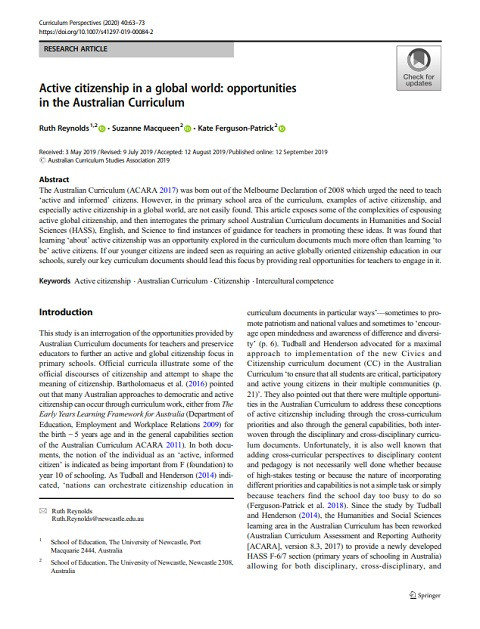 Active Citizenship in a Global World: Opportunities in the Australian Curriculum (Curriculum Perspectives; Vol. 40) 발행 연도: 2019 저자: Ruth Reynolds | Kate Ferguson-Patrick | Suzanne MacQueen 단체 저자: Australian Curriculum Studies Association (ACSA) The Australian Curriculum (ACARA 2017) was born out of the Melbourne Declaration of 2008 which urged the need to teach ‘active and informed’ citizens. However, in the primary school area of the curriculum, examples of active citizenship, and especially active citizenship in a global world, are not easily found. This article exposes some of the complexities of espousing active global citizenship, and then interrogates the primary school Australian Curriculum documents in Humanities and Social Sciences (HASS), English, and Science to find instances of guidance for teachers in promoting these ideas. It was found that learning ‘about’ active citizenship was an opportunity explored in the curriculum documents much more often than learning ‘to be’ active citizens. If our younger citizens are indeed seen as requiring an active globally oriented citizenship education in our schools, surely our key curriculum documents should lead this focus by providing real opportunities for teachers to engage in it.
 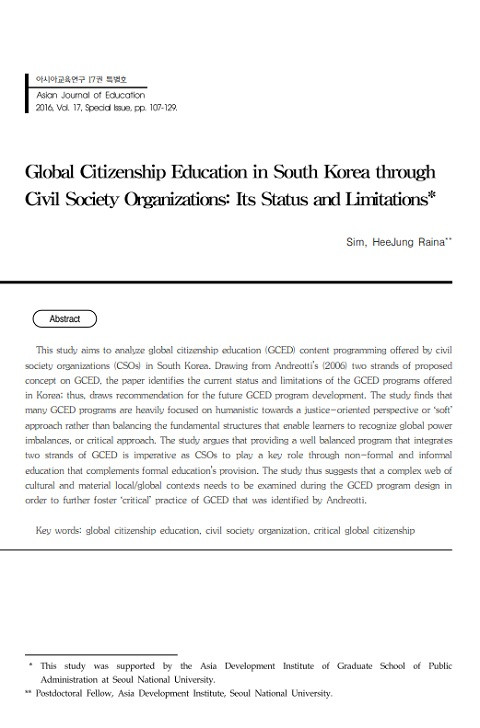 Global Citizenship Education in South Korea through Civil Society Organizations: Its Status and Limitation (Asian Journal of Education, Vol.17, Special Issue) 발행 연도: 2016 저자: HeeJung Raina Sim 단체 저자: Asia Development Institute of Seoul National University This study aims to analyze global citizenship education (GCED) content programming offered by civil society organizations (CSOs) in South Korea. Drawing from Andreotti’s (2006) two strands of proposed concept on GCED, the paper identifies the current status and limitations of the GCED programs offered in Korea; thus, draws recommendation for the future GCED program development. The study finds that many GCED programs are heavily focused on humanistic towards a justice-oriented perspective or ‘soft’ approach rather than balancing the fundamental structures that enable learners to recognize global power imbalances, or critical approach. The study argues that providing a well balanced program that integrates two strands of GCED is imperative as CSOs to play a key role through non-formal and informal education that complements formal education’s provision. The study thus suggests that a complex web of cultural and material local/global contexts needs to be examined during the GCED program design in order to further foster ‘critical’ practice of GCED that was identified by Andreotti.
 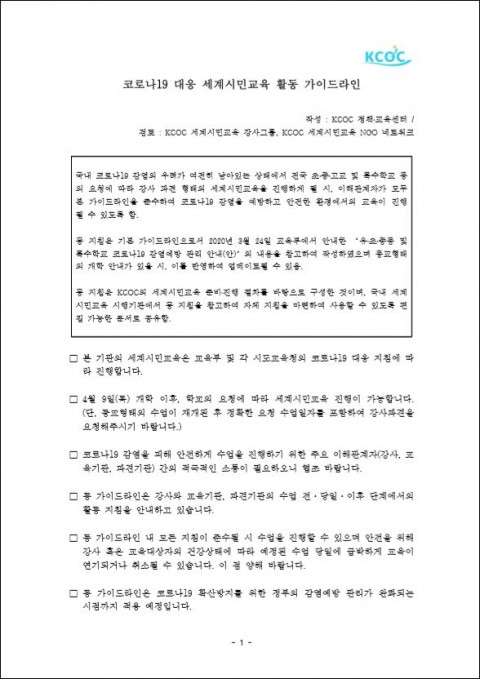 코로나19 대응 세계시민교육 활동 가이드라인 발행 연도: 2020 단체 저자: 국제개발협력민간협의회 (KCOC) 국내 코로나19 감염의 우려가 여전히 남아있는 상태에서 전국 초·중·고교 및 특수학교 등의 요청에 따라 강사 파견 형태의 세계시민교육을 재개하게 될 시 안전한 환경에서 세계시민교육을 진행할 수 있도록 작성한 세계시민교육 담당자와 강사들을 위한 활동지침서이다.
 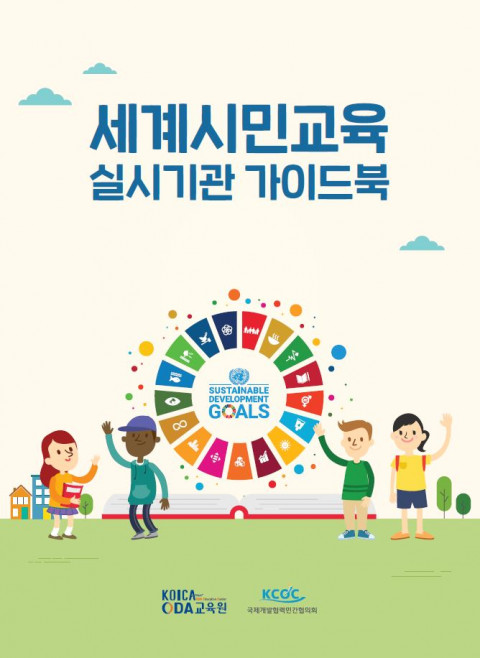 세계시민교육 실시기관 가이드북 발행 연도: 2019 단체 저자: KOICA ODA 교육원 | 국제개발협력민간협의회 다양한 기관과 NGO 등에서 운영하고 있는 다채로운 세계시민교육 프로그램과 각 기관에 대한 소개 및 교재와 교구 등 참고자료를 수록하고 있다.이 가이드북은 단순히 세계시민교육을 제공하는 기관의 리스트가 아니라 기관의 특성과 운영 프로그램 · 교육 대상을 담고 있다는 점에서 세계시민교육과 세계시민교육 프로그램에 관심 있는 이들에게 유용한 안내서가 될 것이다.
 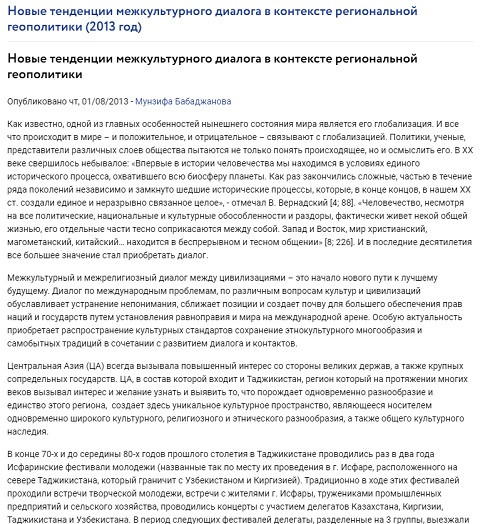 Новые тенденции межкультурного диалога в контексте региональной геополитики 발행 연도: 2013 저자: Munzifa Babadjanova Межкультурный и межрелигиозный диалог между цивилизациями – это начало нового пути к лучшему будущему. Диалог по международным проблемам, по различным вопросам культур и цивилизаций обуславливает устранение непонимания, сближает позиции и создает почву для большего обеспечения прав наций и государств путем установления равноправия и мира на международной арене. Особую актуальность приобретает распространение культурных стандартов сохранение этнокультурного многообразия и самобытных традиций в сочетании с развитием диалога и контактов.
 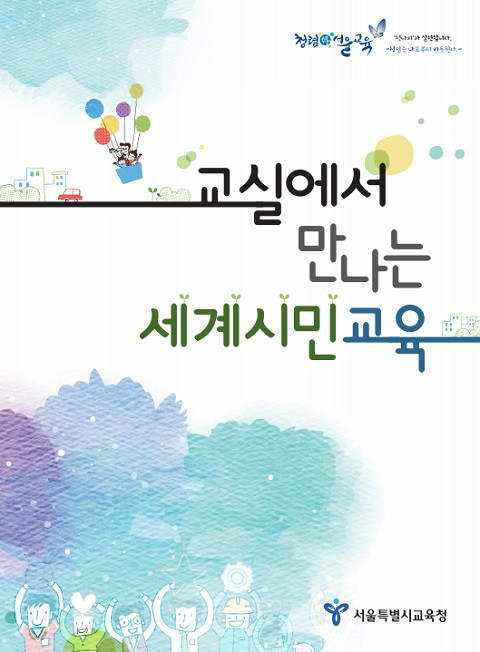 교실에서 만나는 세계시민교육 발행 연도: 2016 저자: 정애경 | 윤지아 | 정혜선 | 이근화 | 공석범 | 주예진 | 이원용 | 정용민 단체 저자: 서울특별시교육청 본 자료는 학습자로 하여금 인류가 공동으로 직면하고 있는 문제들에 대해 이해하고 지구촌 공동체에 대한 소속감과 연대감을 키워 지구촌의 문제들을 해결할 수 있는 다양한 실천적이고 협력적인 능력을 키우는데 그 목적을 두고 있으며, 직접 교실 현장에서 활용할 수 있도록 교수학습과정안의 형식으로 구성되어 있다. 학습주제로 제시된 것은 국제이해교육과 세계시민교육에서 공통으로 다루는 인권과 평화, 다문화를 비롯하여 2030년까지의 인류 공동의 목표인 지속가능발전의 환경과 사회와 경제 부분, 그리고 세계시민교육의 배경인 세계화와 미래사회의 지향점인 국제협력 다섯 영역이다.
 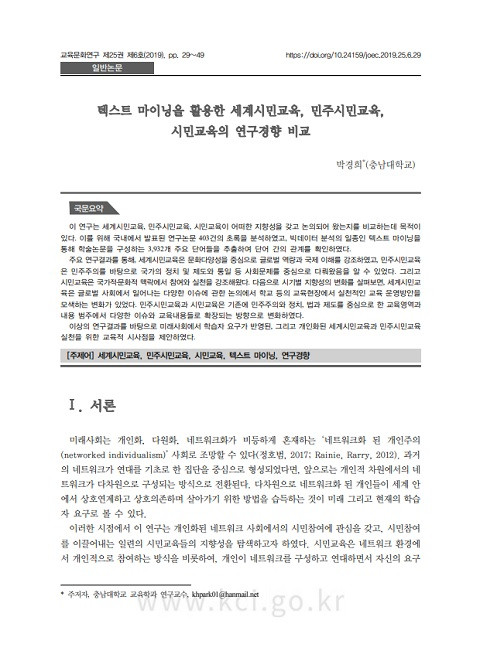 The Comparison of Research Trends on Global Citizenship Education, Democratic Civic Education, and Civic Education Using Text Mining Techniques (Journal of Education & Culture; Vol. 25, No. 6) 발행 연도: 2019 저자: Kyunghee Park 단체 저자: Education Research Institute of Inha University The purpose of this study is to compare the research trends of global citizenship education(GCED), democratic civic education(DCED), and civic education(CIED). For this purpose, it was analysed into abstracts of 403 articles, extracted 3,932 key-words through text mining analysis. The results of the study are as follows. First, GCED emphasized global competence and international understanding centering on cultural diversity. DCED was d iscussed mainly on the problems of national politics, and the unification issues on the democracy. CIED emphasized participation and practice in the national and cultural context. Second, with regard to the changes of orientation, GCED has changed to explore the practical education design. And DCED and CIED have changed to deal with various issues and contents. Based on these results, implications of this study were discussed for civic educations reflected future learner's diversity and personality.
 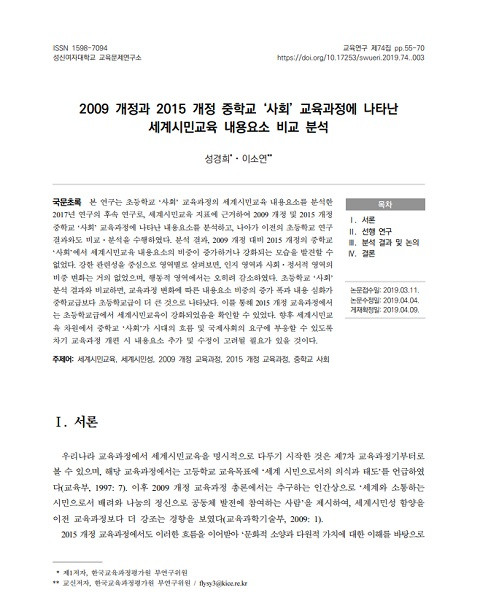 A Comparative Analysis on Content Elements of Global Citizenship Education in 2009 and 2015 Revised Middle School Social Studies Curriculum (Education Research; Vol. 74) 발행 연도: 2019 저자: Kyunghee Sung | Soyeon Lee 단체 저자: Sungshin Women's University Educational Research Institute This study is a follow-up study of the 2017 research which analyzed content elements of global citizenship education in elementary school Social Studies. Based on the global citizenship education index, the content elements of are analyzed in the 2009 and 2015 revised middle school Social Studies curriculum, and then it was compared to the results of previous research in elementary school. As a result, it can be found that the content elements of global citizenship education in the middle school Social Studies are not increased or strengthened. In terms of 'strong connection', there was almost no change in the proportion of the cognitive domain and the socio-emotional domain, but rather it decreased in the behavioral domain. Compared with the results of elementary school, it is appeared that elementary school showed a larger increase than the middle school in the proportion of content elements depending on the change of curriculum. Through this, it can be confirmed that the global citizenship education was strengthened in elementary school in the 2015 revised Social Studies curriculum. At the time of next curriculum revision, it will be necessary to consider adding and revising the content elements related to global citizenship education to meet the needs of international community. 2009 개정과 2015 개정 중학교 ‘사회’ 교육과정에 나타난 세계시민교육 내용요소 비교 분석 (교육연구; Vol. 74) 발행 연도: 2019 저자: Kyunghee Sung | Soyeon Lee 단체 저자: Sungshin Women's University Educational Research Institute 본 연구는 초등학교 ‘사회’ 교육과정의 세계시민교육 내용요소를 분석한2017년 연구의 후속 연구로, 세계시민교육 지표에 근거하여 2009 개정 및 2015 개정중학교 ‘사회’ 교육과정에 나타난 내용요소를 분석하고, 나아가 이전의 초등학교 연구결과와도 비교⋅분석을 수행하였다. 분석 결과, 2009 개정 대비 2015 개정의 중학교‘사회’에서 세계시민교육 내용요소의 비중이 증가하거나 강화되는 모습을 발견할 수없었다. 강한 관련성을 중심으로 영역별로 살펴보면, 인지 영역과 사회⋅정서적 영역의비중 변화는 거의 없었으며, 행동적 영역에서는 오히려 감소하였다. 초등학교 ‘사회’ 분석 결과와 비교하면, 교육과정 변화에 따른 내용요소 비중의 증가 폭과 내용 심화가중학교급보다 초등학교급이 더 큰 것으로 나타났다. 이를 통해 2015 개정 교육과정에서는 초등학교급에서 세계시민교육이 강화되었음을 확인할 수 있었다. 향후 세계시민교육 차원에서 중학교 ‘사회’가 시대의 흐름 및 국제사회의 요구에 부응할 수 있도록차기 교육과정 개편 시 내용요소 추가 및 수정이 고려될 필요가 있을 것이다.
  Investigation and Analysis on the Service Status of University Libraries in Digital Citizen Education (Library Work in Colleges and Universities; No. 4) 발행 연도: 2020 저자: Tangyi | Liulu 단체 저자: College library and Information Committee of Hunan Provincial This paper investigated the status of the service provided by university libraries in China to cultivate digital citizens and the cognition of responsibility of cultivating digital citizens provided by university libraries. The survey found that: firstly, the number of service in the digital citizen education provided by the university library is related to the university’s level; secondly, university libraries provide the most abundant service in the areas of digital literacy, digital access and digital communication, and less service in the areas of digital law, digital etiquette and digital power; thirdly, university libraries provide the scarcest service in the area of digital trade and most university libraries consider it is no responsible to provide this service or just hold an uncertain attitude; fourthly, there is no significant correlation between the service on digital citizen education provided by university libraries and the cognition status of responsibility.