
자료
세계시민교육에 대한 이해를 넓히고 연구, 옹호 활동, 교수, 학습 등을 향상시킬 수 있는 다양하고 유용한 자료를 찾아보세요.
1,473 건의 결과가 검색되었습니다
 L'ABC de l'éducation à la citoyenneté mondiale 발행 연도: 2016 단체 저자: UNESCO UNESO's FAQ on Global citizenship education
 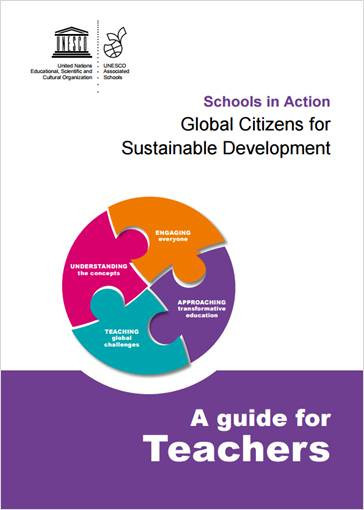 Le réSEAU en action: Citoyens du monde connectés pour le développement durable: guide à l'intention des enseignants 발행 연도: 2016 단체 저자: UNESCO The Global Citizens for Sustainable Development Teachers’ guide aims to introduce teachers to Global Citizenship Education (GCED) and Education for Sustainable Development (ESD). It provides secondary school teachers with ideas and activities to help students become global citizens and sustainable development actors. The Teachers’ guide draws on the discussions and activities of almost 1,100 participants from 104 countries, including ASPnet National Coordinators, school principals, teachers, students and experts who contributed to the Online Collaborative Platform ASPnet in Action: Global Citizens Connected for Sustainable Development in 2014 and 2015 [http://en.unesco. org/aspnet/globalcitizens] with associated activities and initiatives. The Teachers’ guide provides: An overview of what it means for learners to become global citizens and of how learners can contribute to sustainable development. Ideas for classroom activities that can help secondary school students to develop knowledge, skills, values, attitudes and behaviours that promote GCED and ESD. Selected activities on GCED and ESD from ASPnet schools around the world. Escuelas en acción, ciudadanos del mundo para el desarrollo sostenible: guía para el profesorado 발행 연도: 2016 단체 저자: UNESCO The Global Citizens for Sustainable Development Teachers’ guide aims to introduce teachers to Global Citizenship Education (GCED) and Education for Sustainable Development (ESD). It provides secondary school teachers with ideas and activities to help students become global citizens and sustainable development actors. The Teachers’ guide draws on the discussions and activities of almost 1,100 participants from 104 countries, including ASPnet National Coordinators, school principals, teachers, students and experts who contributed to the Online Collaborative Platform ASPnet in Action: Global Citizens Connected for Sustainable Development in 2014 and 2015 [http://en.unesco. org/aspnet/globalcitizens] with associated activities and initiatives. The Teachers’ guide provides: An overview of what it means for learners to become global citizens and of how learners can contribute to sustainable development. Ideas for classroom activities that can help secondary school students to develop knowledge, skills, values, attitudes and behaviours that promote GCED and ESD. Selected activities on GCED and ESD from ASPnet schools around the world.
  Contributing to peace and human development in an era of globalization 발행 연도: 2002 단체 저자: UNESCO The Medium-Term Strategy (2002-2007) for the countries of the Africa region is an essential programme axis of UNESCO’s new decentralization policy. It forms an integral part of the Organization’s overall strategic objectives defined by the Member States in the UNESCO MediumTerm Strategy for 2002-2007 (31 C/4), which aims to contribute to peace and human development through education, the sciences, culture and communication.
  Non-formal and Informal Programs and Activities that Promote the Acquisition of Knowledge and Skills in Areas of Global Citizenship Education (GCED) and Education for Sustainable Development (ESD) 발행 연도: 2016 저자: Ashley Stepanek Lockhart 단체 저자: UNESCO This study will examine the nature of, and how, non-formal and informal programs and activities contribute to the acquisition of knowledge and skills for children, adolescents, youth and adults in precise areas of Target 4.7. This will be done by highlighting different definitions, conceptual approaches and history, along with policies of GCED and ESD and non-formal education and informal learning, comparing attempts to operationalize GCED and ESD to indicators for measurement and monitoring and challenges therein, and by identifying relevant sample programs and activities from around the world to analyze and consider using as data sources. How non-formal and informal provision related to GCED and ESD links to formal education will be considered, along with its connection to the larger notion of lifelong learning.
 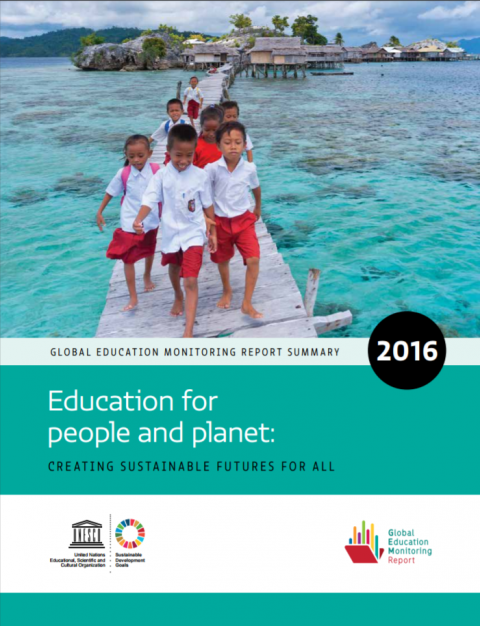 L'Education pour les peuples et la planète: créer des avenirs durables pour tous, résumé du rapport mondial de suivi sur l'éducation, 2016 발행 연도: 2016 단체 저자: UNESCO The GEM Report provides an authoritative account of how education is the most vital input for every dimension of sustainable development. Better education leads to greater prosperity, improved agriculture, better health outcomes, less violence, more gender equality, higher social capital and an improved natural environment. Education is key to helping people around the world understand why sustainable development is such a vital concept for our common future. Education gives us the key tools – economic, social, technological, even ethical – to take on the SDGs and to achieve them. These facts are spelled out in exquisite and unusual detail throughout the report. Yet the report also emphasizes the remarkable gaps between where the world stands today on education and where it has promised to arrive as of 2030. La Educación al servicio de los pueblos y el planeta: creación de futuros sostenibles para todos, resumen del informe de seguimiento de la educación en el mundo 2016; 발행 연도: 2016 단체 저자: UNESCO The GEM Report provides an authoritative account of how education is the most vital input for every dimension of sustainable development. Better education leads to greater prosperity, improved agriculture, better health outcomes, less violence, more gender equality, higher social capital and an improved natural environment. Education is key to helping people around the world understand why sustainable development is such a vital concept for our common future. Education gives us the key tools – economic, social, technological, even ethical – to take on the SDGs and to achieve them. These facts are spelled out in exquisite and unusual detail throughout the report. Yet the report also emphasizes the remarkable gaps between where the world stands today on education and where it has promised to arrive as of 2030. Образование в интересах людей и планеты: ПОСТОЕНИЕ УСТОЙЧИВОГО БУДУЩЕГО ДЛЯВСЕХ, РЕЗЮМЕ ВСЕМИРНОГО ДОКЛАДА ПО МОНИТОРИНГУ ОБРАЗОВАНИЯ, 2016 발행 연도: 2016 단체 저자: UNESCO The GEM Report provides an authoritative account of how education is the most vital input for every dimension of sustainable development. Better education leads to greater prosperity, improved agriculture, better health outcomes, less violence, more gender equality, higher social capital and an improved natural environment. Education is key to helping people around the world understand why sustainable development is such a vital concept for our common future. Education gives us the key tools – economic, social, technological, even ethical – to take on the SDGs and to achieve them. These facts are spelled out in exquisite and unusual detail throughout the report. Yet the report also emphasizes the remarkable gaps between where the world stands today on education and where it has promised to arrive as of 2030.
  Towards the development of an international module for assessing learning in Global Citizenship Education (GCE) and Education for Sustainable Development (ESD): a critical review of current measurement strategies 발행 연도: 2016 저자: Bryony Hoskins 단체 저자: UNESCO The aim of the study is to support the development of an indicator for target 4.7 of the UN sustainable development goals (STG). The study provides a conceptual framework for measuring the competences from global citizenship education (GCE) and education for sustainable development (ESD) from a review of the literature and then an audit of the different aspects of these competences. The study establishes the extent that these competences can be measured using existing data. The results of this analysis show that most dimensions of GCE can to some extent be measured by the existing IEA ICCS 2009 and 2016 datasets and an outline of how this data can be used to develop an initial indicator or set of indicators for target 4.7 is given. However, in contrast, the study finds that existing data is much more limited on measuring ESD and the existing data does not provide enough coverage for indicator development at the moment. The study recommends that in order to provide a more comprehensive measure of both these competences it would be necessary to develop a new module on GCE and ESD. After considering the options, it is concluded that the most realistic option is for this module to be attached to the existing IEA ICCS survey. The study concludes that an indicator of all citizens across the whole world is probably unrealistic considering the challenges faced, but what could be achievable is an indicator covering some countries from each region from around the world. To make this a reality considerable political effort and search for funding would be required to engage new regions to the ICCS survey, for example, from Africa and the Middle East
  Developing a Monitoring Instrument to Measure Extracurricular and Non-formal Activities which Promote Global Citizenship Education (GCED) and Education for Sustainable Development (ESD) 발행 연도: 2016 저자: Bassel Akar 단체 저자: UNESCO The goal on Education is 1 of 17 Sustainable Development Goals that comprises a target to ensure all learners around the world have an opportunity to develop the competencies to promote sustainable approaches to living, including appreciating of cultural diversity, non-violence, and gender equality. Extracurricular activities and non-formal education (ENA) provides a non-traditional space for learning global citizenship and sustainable development. Around the world, communities have organized education programs and activities for youth outside school to learn the values and practices of being global citizens. Research shows, however, that most efforts to review and improve ENA for global citizenship and sustainable development have focused on summative evaluations with little attention to formative approaches of monitoring. Drawing on basic principles of action research, sustainable professional development, and education quality enhancement, a monitoring framework emerges to support organizations around the world in measuring progress towards education for global citizenship and sustainable development. This framework also suggests (1) inclusive monitoring spaces like internal reviews and online social networking platforms, (2) roles of stakeholders like donor agencies in institutionalizing monitoring practices, (3) instruments and measurable scales to facilitate dialogues that review program objectives and action plans, and (4) challenges in inclusive and sustainable monitoring tools and approaches.