
자료
세계시민교육에 대한 이해를 넓히고 연구, 옹호 활동, 교수, 학습 등을 향상시킬 수 있는 다양하고 유용한 자료를 찾아보세요.
130 건의 결과가 검색되었습니다
 Ciudades del futuro: Por la razón y la ciencia 발행 연도: 2018 단체 저자: VTRChile La serie "Por la razón y la ciencia" tiene como objetivo acercar la ciencia y la tecnología a nuestra vida cotidiana, centrándose principalmente en el desarrollo científico local. En este video se exploran diferentes modelos de desarrollo sustentable en varias ciudades del mundo.
  Inequality and Productivity: By Reason and Science 발행 연도: 2018 단체 저자: VTRChile The series "By Reason and Science" aims to bring science and technology closer to our daily lives, focusing mainly on local scientific development. This video explores the relationship between inequality and productivity from an economic point of view as well as respect for human rights. Desigualdad y productividad: Por la razón y la ciencia 발행 연도: 2018 단체 저자: VTRChile La serie "Por la razón y la ciencia" tiene como objetivo acercar la ciencia y la tecnología a nuestra vida cotidiana, centrándose principalmente en el desarrollo científico local. En este video se exploran la relación entre la desigualdad y la productividad desde un punto de vista tanto económico como de respeto por los derechos humanos.
  Pedagogical Guides: Let's Educate With Equality 발행 연도: 2016 단체 저자: Chile. Ministry of Education This publication includes four pedagogical guides, the first seeks to generate reflection of teachers and managers about their role in gender constructions, the second one seeks critical reflection of elementary school students on how gender constructions affect decisions, the third guide looks the sdame for high school students, and the fourth guide goes around the reflection of parents / guardians on how gender roles affect the vocational decisions of boys and girls. Guías pedagógicas: Eduquemos con igualdad 발행 연도: 2016 단체 저자: Chile. Ministry of Education Esta publicación reune cuatro guías, en la primera se busca generar reflexión de docentes y directivos en torno a su rol en las construcciones de género, en la segunda se pretende la reflexión critica de los estudiantes de enseñanza básica sobre como inciden las construcciones de género en las decisiones vocacionales al igual que en la tercera guía en estudiantes de enseñanza mediay la cuarta guía gira entorno a la reflexión de padres/madres/ apoderados sobre como afectan los roles de género en las decisiones vocacionales de niños y niñas.
  12 Claves para fortalecer la educación ciudadana en Chile 발행 연도: 2021 단체 저자: Programa de las Naciones Unidas para el Desarrollo (PNUD) Conjunto de claves dirigidas a responsables de generar políticas, directivos escolares, docentes, estudiantes, padres y apoderados para implementar la educación ciudadana en sus comunidades educativas. Esta guía está pensada para promover la reflexión crítica entre los generadores de políticas y en las distintas comunidades educacionales a partir de una visión integral que enfatiza el protagonismo de las comunidades educativas en la toma de decisión relativa a los procesos de enseñanza, aprendizaje y gobernanza escolar.
 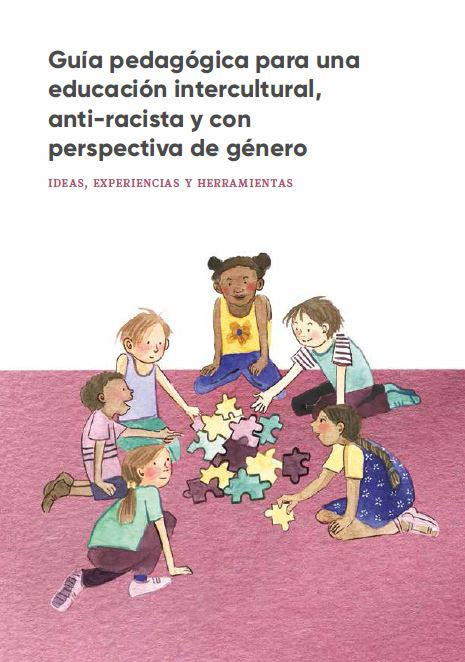 Pedagogical Guide for an Intercultural, Anti-racist and Gender Perspective Education: Ideas, Experiences and Tools 발행 연도: 2017 저자: Carolina Stefoni | Andrea Riedemann | Fernanda Stang | Andrea Guerrero | Antonia Garcés | Marta Camarena 단체 저자: Programa Interdisciplinario de Estudios Migratorios (PRIEM) | Universidad Alberto Hurtado | Fundación para la Superación de la Pobreza (FUSUPO) The main purpose of this Guide is, then, to share some ideas, tools and experiences that can help build and walk the path towards an intercultural, anti-racist and gender perspective education in various educational spaces. It is directed primarily - though not exclusively, of course - to all those people who are part of formal and informal teaching-learning processes. It is important to emphasize that the Guide does not pretend to be a recipe for a mechanical application, but a tool box that each educational community can use considering its specific context, its particular needs and its potentialities. Guía pedagógica para una educación intercultural, anti-racista y con perspectiva de género: ideas, experiencias y herramientas 발행 연도: 2017 저자: Carolina Stefoni | Andrea Riedemann | Fernanda Stang | Andrea Guerrero | Antonia Garcés | Marta Camarena 단체 저자: Programa Interdisciplinario de Estudios Migratorios (PRIEM) | Universidad Alberto Hurtado | Fundación para la Superación de la Pobreza (FUSUPO) El propósito principal de esta Guía es, entonces, compartir algunas ideas, herramientas y experiencias que puedan ayudar a construir y andar el camino hacia una educación intercultural, anti-racista y con perspectiva de género en diversos espacios educativos. Está dirigida principalmente -aunque no de manera exclusiva, por supuesto- a todas aquellas personas que sean parte de procesos de enseñanza-aprendizaje formales e informales. Es importante enfatizar que la Guía no pretende ser un recetario para una aplicación mecánica, sino una caja de herramientas que cada comunidad educativa puede usar considerando su contexto específico, sus necesidades particulares y sus potencialidades.
  Educación para el desarrollo sostenible: aportes didácticos para docentes del Caribe 발행 연도: 2008 저자: Gillian Cambers | Grace Chapman | Paul Diamond | Lorna Down | Anthony D. Griffith | Winthrop Wiltshire 단체 저자: UNESCO Santiago The publication “Teachers’ Guide for Education for Sustainable Development in the Caribbean” is geared towards regional teacher-trainers and teachers active at every level of education. Its purpose is two-fold: contribute to the integration of education for sustainable development into teaching practices through education initiatives, originally implemented in the Caribbean that may be feasible to replicate in the various classrooms, schools and communities; promote reflection, discussion and creation of innovative practices that involve all teachers in Decade activities and contribute to the making of sustainable societies. This document illustrates how different wills can come together moved by a desire to materialise common projects. Thus, this effort represents the work of regional specialists working in close cooperation with UNESCO Regional Bureau for Education in Latin America and the Caribbean, as well as the financial support of the Government of Japan.
  Gender Inequality in Learning Achievement in Primary Education: What can TERCE Tell Us? 발행 연도: 2016 단체 저자: UNESCO Santiago Existing research identifies several significant, subject-based gender inequalities in education. Male learners have significant advantages in mathematics and female learners have no less significant advantages in reading and writin. Such considerable differences in achievement may have important consequences for the future wellbeing of students. In order to shed light on this phenomenon in Latin America, this report analyzes the gender gaps in educational achievement in the Third Regional Comparative and Explanatory Study (TERCE) led by the Latin American Laboratory for Assessment of the Quality of Education (LLECE).