
자료
세계시민교육에 대한 이해를 넓히고 연구, 옹호 활동, 교수, 학습 등을 향상시킬 수 있는 다양하고 유용한 자료를 찾아보세요.
2,781 건의 결과가 검색되었습니다
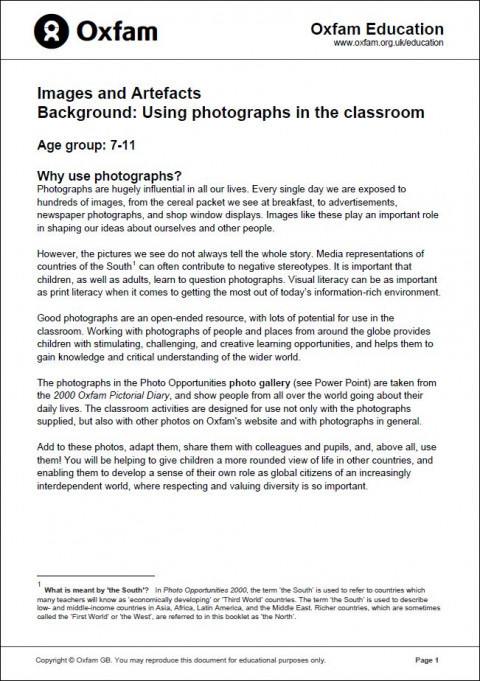 Background: Using Photographs in the Classroom 단체 저자: Oxfam GB It's a universal truth that a picture tells a thousand words. Images and artefacts can help bring your lessons to life. They can challenge stereotypes, engender empathy and increase your learners' understanding of other countries and cultures.Explore how to effectively use photographs in your lessons to foster debate and promote positive images of the countries you're learning about.
  The Critical Thinking Workbook: Games and Activities for Developing Critical Thinking Skills 단체 저자: Global Digital Citizen Foundation Critical thinking is clear, rational, logical, and independent thinking. It’s about improving thinking by analyzing, assessing, and reconstructing how we think. It also means thinking in a self-regulated and self-corrective manner. It’s thinking on purpose!The Critical Thinking Workbook helps you and your students develop mindful communication and problem-solving skills with exciting games and activities. It has activities that are adaptable to any grade level you want.The activity pages in the Critical Thinking Workbook are meant to be shared and explored. Use it as an electronic document or as worksheets.You can either print off the pages and use them as activity sheets, or you can edit them directly right in the document on your computer.There are also Answer Keys for the activities that need them provided at the back of the book.
 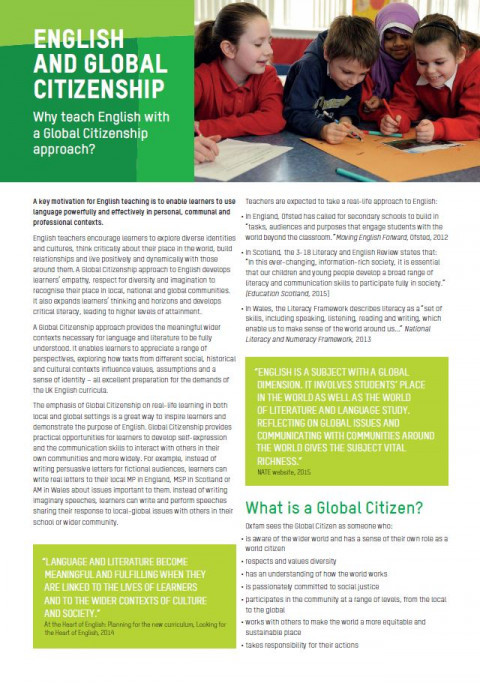 English and Global Citizenship 단체 저자: Oxfam GB English lessons are an opportunity for your learners to explore new and diverse cultures, hone their language skills and develop empathy.This guide includes ideas for learning about the world whilst improving speaking and listening, reading, writing and media literacy skills. It also contains handy links to further resources and ideas for books which can help capture your learners' imaginations.
  Global Digital Citizenship: Quick Start Guide 단체 저자: Global Digital Citizen Foundation What does it mean to be a Global Digital Citizen? Who is this person and what do they stand for? What makes them true global leaders and creators? The journey to understanding begins here, with the Global Digital Citizen Quickstart Guide.This is the final book in the GDCF's Fluency Quickstart series. This guide explores the skills and practices that make an exemplary Global Digital Citizen.With this Quickstart Guide you can: Explore the tenets of global citizenship Develop unique skills and mindsets Measure student progress Create challenging PBL lessons Become a great global digital citizen
  Project Based Learning Ideas Guide: K-12 Learners 단체 저자: Global Digital Citizen Foundation Project-based learning is a big part of today’s modern learning environments. It takes students on a cool journey of creativity, exploration, and true real-world relevance. What does PBL look like in action in your classroom?Solution Fluency provides the building blocks for PBL. It’s a way for students to learn good problem-solving skills and to become successful with any challenge.This PBL Ideas Book will help them do exactly that. Inside are classroom project ideas for years K–12. There are 9 awesome projects to choose from with choices for primary, middle, and senior grades. But wait—what if the scenario idea you like isn’t for your specific grade?No problem at all. These PBL ideas are customizable and scalable for any grade level. They’re also cross-curricular in nature, and can be adapted to other subject areas.Explore these scenarios and think creatively about how you can bring them to life for your students.
 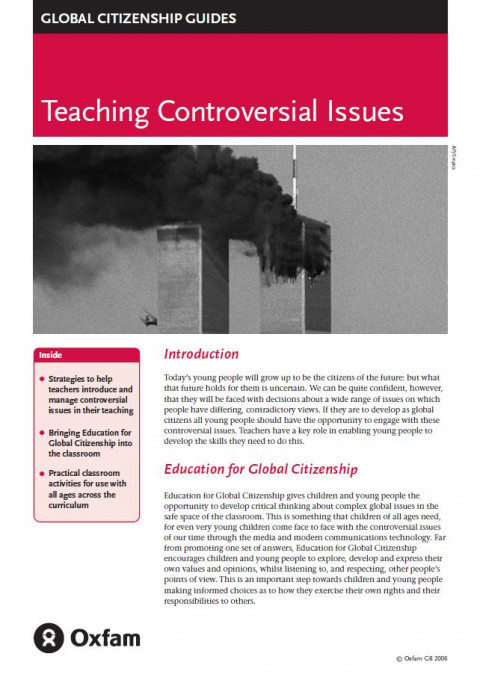 Global Citizenship Guides: Teaching Controversial Issues 발행 연도: 2006 단체 저자: Oxfam GB This guide aims to demonstrate how, by enhancing young people’s ability to handle controversial issues, teachers can support and develop them as global citizens.This guide explores:what controversial issues arewhy controversial issues should be taughtwhy some issues are, or can become, controversialwhat guidance exists for handling controversial issuesclassroom strategies for handling and exploring controversial issuessome practical activities for teaching controversial issues.
  Citizens but not Adults? Injunction to be Responsible and Citizens in Official Coming of Age Rituals in Switzerland 발행 연도: 2018 저자: Maxime Felder | Laurence Ossipow | Isabelle Csupor 단체 저자: Lien social et Politiques Swiss municipalities organize ceremonies for their residents reaching the official age of full citizenship. In the six studied municipalities, local authorities invite them to a municipal council’s meeting, offer them a dinner or an aperitif, or organize them a show and a debate with role models. Speeches are central to these ceremonies, and authority representatives encourage their audience to be “good” citizens. Call to vote is the leitmotiv, but discourses reveal broader definitions of citizenship, insisting sometimes on a local commitment and volunteering, and sometimes on the necessity to fight climate change and inequalities. Comparing officials’ speeches to statements of young people participating in these events reveals “tensions”. Indeed, authority representatives address young citizens without considering them as fully adult, and they do not consider themselves as such neither. However, some of them are already involved in forms of vernacular citizenship, and are progressively leaving the municipality to study, work or travel. Ultimately, these ceremonies allow officials to stage their interest in the youth, which they consider as both uncompleted and essential to the renewal of democracy. Citoyen·ne·s, mais pas encore adultes ? Les injonctions à la responsabilité et à la citoyenneté dans les rituels d’accession à la majorité en Suisse 발행 연도: 2018 저자: Maxime Felder | Laurence Ossipow | Isabelle Csupor 단체 저자: Lien social et Politiques Les communes suisses organisent un rituel pour célébrer l’accession à la majorité civile et civique de leurs résident·e·s qui atteignent l’âge de dix-huit ans. Dans les six communes que nous avons étudiées, les autorités invitent les jeunes à participer à une séance du conseil communal, les convient à un repas ou un apéritif, ou leur organisent une soirée de témoignages, de spectacle ou encore de jeux en plein air. Ces événements font place à des discours dans lesquels des représentant·e·s des autorités enjoignent les jeunes à être de « bonnes » et « bons » citoyens. Si l’appel au vote est toujours le leitmotiv, les discours se centrent aussi sur des définitions plus larges de la citoyenneté, insistant tantôt sur l’engagement associatif et local, tantôt sur la nécessité d’agir pour l’écologie ou contre les inégalités. Le croisement de ces analyses avec celles des entretiens menés avec de jeunes participant·e·s fait émerger des tensions. En effet, les autorités s’adressent à des jeunes qu’elles ne considèrent pas tout à fait comme des adultes (et qui ne se considèrent pas non plus comme tel·le·s), qui sont pour certain·e·s déjà engagé·e·s dans ces formes de citoyenneté vernaculaire, et qui s’apprêtent à quitter leur commune pour étudier ou voyager. Ces promotions citoyennes permettent ainsi de mettre en scène l’intérêt des élu·e·s pour les jeunes, considéré·e·s comme des citoyen·ne·s en apprentissage dont dépend le renouvellement de la démocratie.
  Religion, “Community” and Citizenship: The Case of Steiner, Muslim and Jewish Schools in Montreal 발행 연도: 2012 저자: Stéphanie Tremblay 단체 저자: Diversité urbaine Drawing on ethnographic fieldwork in Montreal, this article explores the conception of citizenship in three private schools belonging to different minority groups (Waldorf, Muslim and Jewish). After a short overview of the main critiques circulating with regards to faith-based schools in current social and political debates, I look at the theoretical concepts of school community and citizenship. These considerations help us analyze how teachers in such schools try to develop, by simultaneously different and convergent strategies, a training in citizenship as a form of “universal particularism” (Riedel 2008). These three schools attempt to transmit an open attitude toward religious and cultural diversity, and they promote the participation of their students in the wider society through a religious or spiritual particularism, which appears to be a sort of sacred ground for civic values.
  La citoyenneté des adolescents du 21e siècle dans une perspective de justice sociale : pourquoi et comment ? 발행 연도: 2018 저자: Caroline Caron 단체 저자: Lien social et Politiques Comment sait-on ce que l’on sait sur la citoyenneté des adolescents et leurs pratiques de participation civique ? Cette question épistémologique a été négligée dans les écrits traitant de l’engagement civique et de la participation politique des jeunes. Cet article utilise la perspective théorique de la justice sociale pour examiner le rôle que jouent les rapports sociaux fondés sur l’âge dans la production de connaissances qui offrent un portrait pessimiste du rapport des jeunes à la politique. L’analyse montre que l’injustice épistémique et la validation empirique déficiente des connaissances à propos de la compétence civique appellent une théorisation alternative, précisément inclusive, de la citoyenneté des jeunes. L’analyse souligne aussi que l’avènement du Web social a créé de nouveaux besoins de connaissances que les cadres de recherche établis par tradition peinent à satisfaire. Un premier pas vers la production de connaissances socialement justes au sujet des compétences civiques des adolescents à l’ère du Web social consiste à analyser les fondements épistémologiques des approches de recherche prédominantes afin de susciter des échanges fructueux au sujet des critères normatifs qui devraient guider la confection des protocoles de recherche dans le futur.