
자료
세계시민교육에 대한 이해를 넓히고 연구, 옹호 활동, 교수, 학습 등을 향상시킬 수 있는 다양하고 유용한 자료를 찾아보세요.
3,401 건의 결과가 검색되었습니다
 Transforming Systems in Times of Adversity: Education and Resilience; White Paper 발행 연도: 2019 저자: Ritesh Shah 단체 저자: United States Agency for International Development (USAID) This white paper was commissioned to provide USAID, including Missions, Regional Bureaus, Pillar Bureaus, and the Office of U.S. Foreign Disaster Assistance (OFDA), with an overview of global and Agency thinking and practice on education and resilience and a foundation and justification for positioning USAID education efforts more concretely within a resilience frame.The white paper is organized into three key sections. The first section outlines the business case for resilience, explaining how and why resilience is an important consideration for education programs to consider in contexts of crisis and conflict and how education is well poised as a sector to contribute to strengthening resilience. The second section presents a conceptual framework for understanding how resilience operates through and within the education sector and program interventions. The third section provides a series of key considerations for developing and supporting USAID education programs with a resilience lens or focus.
 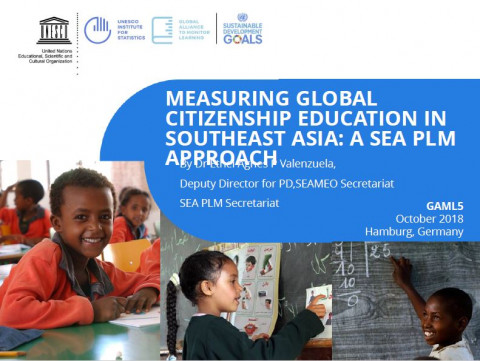 Measuring Global Citizenship Education in Southeast Asia: A SEA PLM Approach 발행 연도: 2018 저자: Ethel Agnes P. Valenzuela 단체 저자: Southeast Asian Ministers of Education Organization (SEAMEO) | UNESCO Institute for Statistics (UIS) Audit of Curricula for the Southeast Asia Primary Learning Metrics (March 2016), an early issue confronted in developing an assessment framework for SEA-PLM wasdetermining how to design and construct a single assessment program across all ASEAN member countries.The design and approach needed to take account of the similarities and differences in the curriculum frameworks in each country for the four domains that were to be assessed through SEA-PLM: Mathematics, Reading, Writing, and Global Citizenship.
 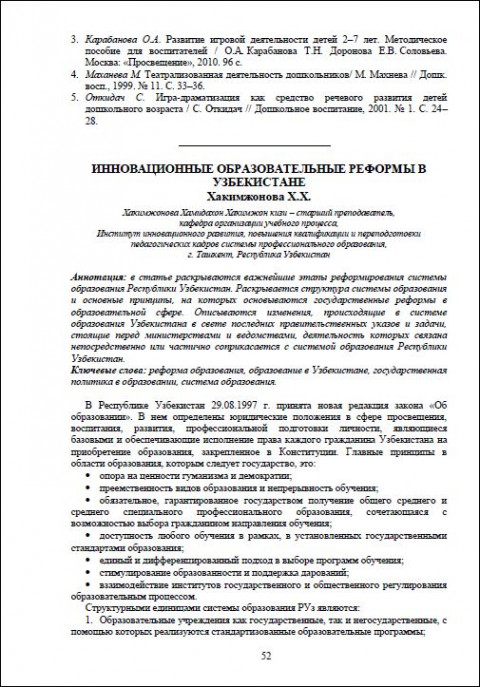 Innovative Educational Reforms in Uzbekistan 발행 연도: 2019 저자: Kh. Khakimjonova The article reveals the most important stages of reforming the education system of the Republic of Uzbekistan. The structure of the education system and the basic principles on which state reforms in the educational sphere are based are revealed. Describes the changes taking place in the education system of Uzbekistan in the light of recent government decrees and the challenges facing ministries and departments whose activities are directly or partially related to the education system of the Republic of Uzbekistan. Инновационные образовательные реформы в Узбекистане 발행 연도: 2019 저자: Kh. Khakimjonova В статье раскрываются важнейшие этапы реформирования системы образования Республики Узбекистан. Раскрывается структура системы образования и основные принципы, на которых основываются государственные реформы в образовательной сфере. Описываются изменения, происходящие в системе образования Узбекистана в свете последних правительственных указов и задачи, стоящие перед министерствами и ведомствами, деятельность которых связана непосредственно или частично соприкасается с системой образования Республики Узбекистан.
 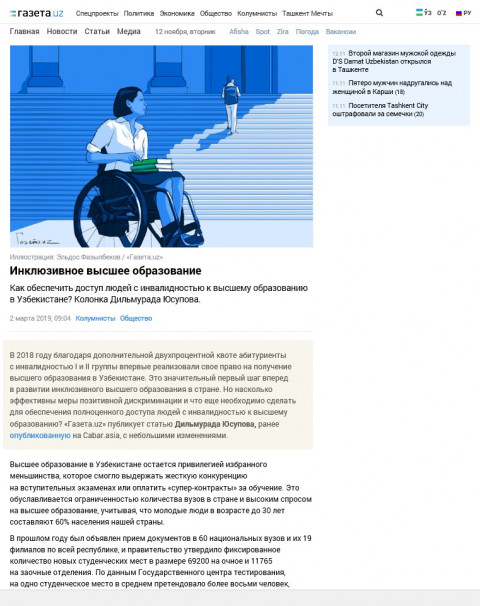 Инклюзивное высшее образование: Как обеспечить доступ людей с инвалидностью к высшему образованию в Узбекистане? 발행 연도: 2019 저자: Dilmurad Yusupov Статья посвящена анализу изменений, происходящих в системе высшего образования Узбекистана, а также мер, необходимых для обеспечения полноценного доступа людей с инвалидностью к высшему образованию.
  “Our Children Are Unique, Not 'Mentally Retarded'!” 발행 연도: 2019 저자: Dilmurad Yusupov The article analyzes the necessary measures in the field of inclusive education in Uzbekistan. The author spoke with parents of children with learning difficulties about the barriers to their children's development. «Наши дети уникальные, а не „умственно отсталые“!» 발행 연도: 2019 저자: Dilmurad Yusupov В статье проведен анализ необходимых мер в сфере инклюзивного образования в Узбекистане. Автор побеседовал с родителями детей с трудностями в обучении о барьерах для развития их детей. Inclusive Higher Education: How to Ensure Access for People with Disabilities to Higher Education in Uzbekistan? 발행 연도: 2019 저자: Dilmurad Yusupov The article is devoted to the analysis of changes occurring in the higher education system of Uzbekistan, as well as the measures necessary to ensure full access for people with disabilities to higher education.
  Accountability for Gender Equality 발행 연도: 2018 저자: Elaine Unterhulter | Amy North | Orlanda Ward The aim of this paper is to consider approaches to understanding and evaluating accountability in education from the perspective of concerns with gender equality in education. This task has a number of facets and complexities, because ‘gender’ is not one simple set of relationships, and the notion of gender equality in education can be read in a number of different ways. Thus developing adequate conceptualizations for the key terms (accountability, and gender equality and education) needs to take account of gender as a particularly fluid, contextually located and contested idea signaling processes, which link with different formulations of policy and practice to enhance gender equality and accountability in education.In this paper we look at a range of different meanings of accountability, distilled in the main GEM Report (UNESCO, 2017) and consider their implications in relation to debates about gender and gender equality in education. The aim of the paper is to develop a ‘bespoke’ interpretation of accountability and different forms of gender equality in education through which we can assess a number of research studies and country examples of forms of accountability.This paper is also background paper prepared for the 2018 Global education monitoring report gender review: Meeting our commitments to gender equality in education.
 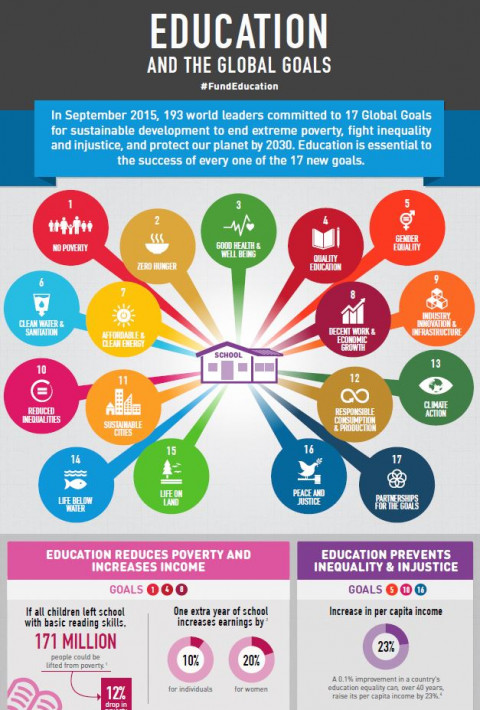 Education and the Global Goals 발행 연도: 2015 단체 저자: Global Partnership for Education (GPE) In September 2015, 193 world leaders committed to 17 Global Goals for sustainable development to end extreme poverty, fight inequality and injustice, and protect our planet by 2030. Education is essential to the success of every one of the 17 new goals.To learn more: https://www.globalpartnership.org/blog/17-ways-education-influences-new-17-global-goals