
자료
세계시민교육에 대한 이해를 넓히고 연구, 옹호 활동, 교수, 학습 등을 향상시킬 수 있는 다양하고 유용한 자료를 찾아보세요.
684 건의 결과가 검색되었습니다
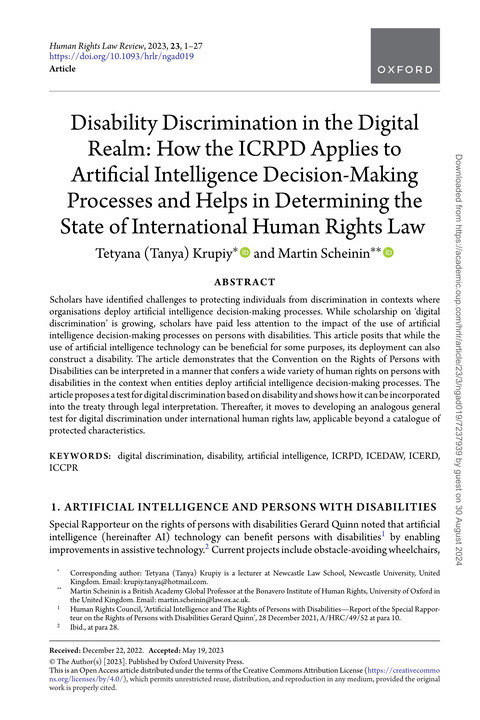 Disability Discrimination in the Digital Realm: How the ICRPD Applies to Artificial Intelligence Decision-Making Processes and Helps in Determining the State of International Human Rights Law (Human Rights Law Reivew; Volume. 23, Issue. 3) 발행 연도: 2023 저자: Tetyana Krupiy | Martin Scheinin Scholars have identified challenges to protecting individuals from discrimination in contexts where organisations deploy artificial intelligence decision-making processes. While scholarship on ‘digital discrimination’ is growing, scholars have paid less attention to the impact of the use of artificial intelligence decision-making processes on persons with disabilities. This article posits that while the use of artificial intelligence technology can be beneficial for some purposes, its deployment can also construct a disability. The article demonstrates that the Convention on the Rights of Persons with Disabilities can be interpreted in a manner that confers a wide variety of human rights on persons with disabilities in the context when entities deploy artificial intelligence decision-making processes. The article proposes a test for digital discrimination based on disability and shows how it can be incorporated into the treaty through legal interpretation. Thereafter, it moves to developing an analogous general test for digital discrimination under international human rights law, applicable beyond a catalogue of protected characteristics.
 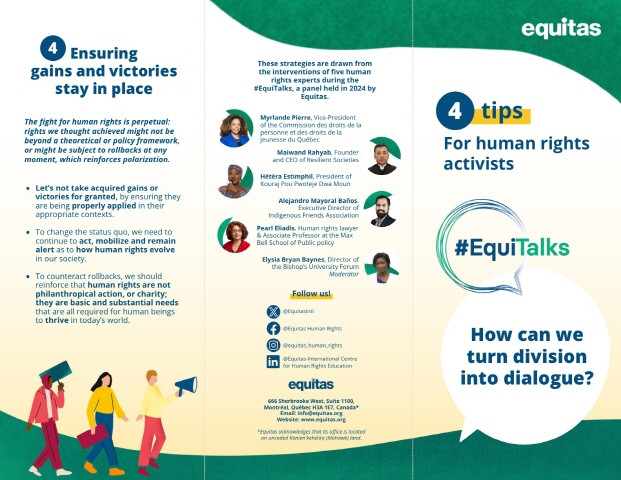 #EquiTalks: How Can We Turn Division into Dialogue? 발행 연도: 2024 단체 저자: Equitas This brochure gathers the answers of five human rights defenders during the 2024 #EquiTalks panel discussion, who attempted to answer the question: How can we turn division into dialogue? The brochure suggests potential solutions and tips to counteract the polarization of opinions on human rights. #EquiTalks: Comment transformer la division en dialogue ? 발행 연도: 2024 단체 저자: Equitas Ce document rassemble les réponses de cinq défenseurs des droits humains lors du panel de discussion #EquiTalks en 2024, qui ont tenté de répondre à la question suivante : Comment transformer la division en dialogue? Le dépliant offre des pistes de solution et des conseils pour contrer la polarisation des opinions sur les droits humains.
  A Comprehensive Methodology for Monitoring Social Media to Address and Counter Online Hate Speech 발행 연도: 2024 단체 저자: UN. Office on Genocide Prevention and the Responsibility to Protect This report introduces a standardized methodology for monitoring online hate speech, to identify, assess, and mitigate risks, including when it constitutes risks of genocide, war crimes, and crimes against humanity. This methodology is based on an extensive review of existing methodologies used for this purpose across academia, technology companies, governments, the United Nations, and NGOs, and synthesizes those approaches into a standard set of practices that best fit the use cases relevant to the UN and its partners.
  Situation Assessment: Comprehensive Sexuality Education in Digital Spaces – Opportunities for Formal Education in Thailand 발행 연도: 2021 단체 저자: UNESCO Bangkok This rapid situation assessment of comprehensive sexuality education across digital spaces in Thailand aims to understand the opportunities for using digital sexuality education spaces and content in formal education. The report analyses original data drawn from young people, teachers, education officials, and representatives of organizations engaged in young people’s health and well-being, and consolidates these with learnings from earlier studies both locally and further afield. It offers recommendations for capacity-building and other efforts to expand access to innovative teaching and learning on sexuality education by leveraging digital spaces both in and out of the classroom.
  The Debunking Handbook 2020 발행 연도: 2020 저자: Stephan Lewandowsky | John Cook 단체 저자: Center for Climate Change Communication | George Mason University The Debunking Handbook 2020 summarises the current state of the science of misinformation and its debunking. It was written by a team of 22 prominent scholars of misinformation and its debunking, and it represents the current consensus on the science of debunking for engaged citizens, policymakers, journalists, and other practitioners. Manual para desmentir la información falsa 2020 발행 연도: 2020 저자: Stephan Lewandowsky | John Cook 단체 저자: Center for Climate Change Communication | George Mason University Esta es una guía para combatir la desinformación y las noticias falsas.
  Éducation aux médias et à l’information (Édition 2021-2022) 발행 연도: 2021 단체 저자: Centre pour l’éducation aux médias et à l’information (CLEMI) | Réseau Canopé Cette édition 2021-2022 s'est enrichie de nouvelles fiches pédagogiques, pour le 1er comme pour le 2nd degré. Vous y trouverez notamment :Les informations pratiques (socle commun, textes réglementaires...) et les dispositifs du CLEMI (Semaine de la presse et des médias dans l'école, Concours Médiatiks, #ZéroCliché, Classe investigation...), afin de présenter les enjeux de l'Éducation aux médias et à l'information et les moyens proposés par le CLEMI pour la mettre en œuvre.Le focus Déclic' Critique, qui présente des exemples d'ateliers proposés en classe par le CLEMI et explique comment utiliser ces séquences pour développer l'esprit critique des élèves.Une partie est consacrée aux médias scolaires, à la fois pour encourager cette pratique mais aussi mieux la valoriser.Dans la partie 1er degré, vous trouverez deux nouvelles fiches pédagogiques organisées en séquence sur le dessin de presse et la liberté d'expression. Et toujours les ressources nécessaires pour découvrir la presse, vérifier les images sur internet ou encore analyser un journal télévisé.La partie 2nd degré va s'intéresser elle aussi à la liberté d'expression et son expérimentation en classe, ainsi qu'à la question du complotisme, mais aussi à l'évaluation des discours scientifiques sur YouTube, aux biais cognitifs, ou encore la représentation des datas en photo et vidéo.
 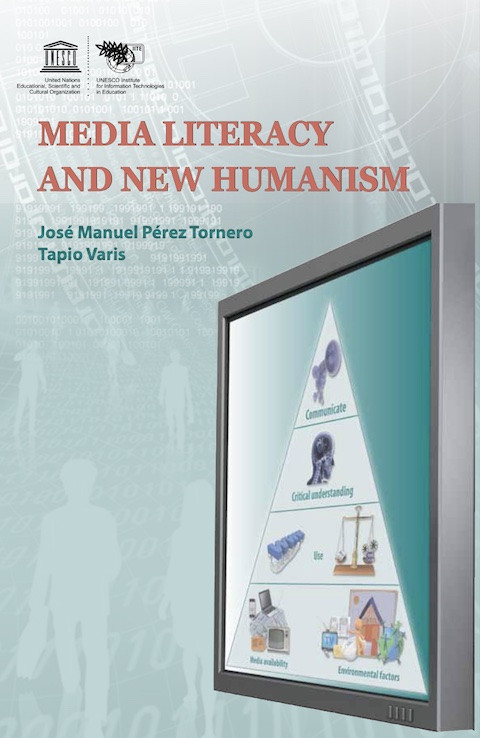 Media Literacy and New Humanism 발행 연도: 2010 저자: José Manuel Pérez Tornero | Tapio Varis 단체 저자: UNESCO Institute for Information Technologies in Education (IITE) The authors consider the opportunities that media literacy opens in the world of global education and communication in the context of new humanism.Being applied to education, the concept of new humanism, a new UNESCO credo, suggests the creation of a more inclusive society in which all humans have a chance to access knowledge and quality education and every word being heard in the universal dialogue. In the authors’ opinion, the new humanism in the global society must prioritize a new sense of respect for multiplicity and cultural diversity and must support media development with the goal of consolidating the new culture of peace.The book is aimed at educators, researchers, policy-makers, the media and civil society.
  Understanding the Impact of Artificial Intelligence on Skills Development 발행 연도: 2021 저자: Kelly Shiohira 단체 저자: UNESCO International Centre for Technical and Vocational Education and Training (UNEVOC) The era of artificial intelligence is young in years but advanced in impact. Intermediate skill jobs as we know them are fast disappearing as their tasks are systematically automated, and individuals are increasingly likely to encounter AI technology in their everyday lives. In fact, fifty percent of organizations worldwide report using some form of AI in their operations.It is clear that AI has broad implications for the whole of humanity, and therefore on the education and training institutions that equip lifelong learners with the skills to navigate both work and society. A wide range of institutions and other stakeholders have risen to the challenge through research and innovative programmes, paving the way for a better understanding of AI’s potential – and its pitfalls.This paper synthesizes research on current trends, programmes, policies and uses of AI related to technical and vocational education and training across six continents, covering developing and developed contexts, as a resource for stakeholders invested in the future of intermediate-level workers and TVET. Lecturers, students, administrators, policymakers, programme implementers and lifelong learners are invited to examine current practices, opportunities and challenges raised by AI, and recommendations to build a future-ready education and training system.