
자료
세계시민교육에 대한 이해를 넓히고 연구, 옹호 활동, 교수, 학습 등을 향상시킬 수 있는 다양하고 유용한 자료를 찾아보세요.
1,443 건의 결과가 검색되었습니다
 Souvenirs atelier technique: éducation à la citoyenneté et de la coexistence 발행 연도: 2014 단체 저자: Bogotá. Secretaría de Educación del Distrito (SED) Le présent document contient les rapports sur les travaux et les conclusions construit dans l'atelier technique sur l'éducation à la citoyenneté et de la coexistence, pour lesquels ont été soulevées les objectifs suivants: évaluer la pertinence de l'éducation pour la citoyenneté et de la coexistence proposée par le Secrétaire d'éducation de district, d'évaluer la formation matériaux de la boîte à outils produits pour la mise en œuvre de l'éducation pour la citoyenneté et la coexistence, et de renforcer et de consolider cette proposition. Memorias taller técnico: educación para la ciudadanía y la convivencia 발행 연도: 2014 단체 저자: Bogotá. Secretaría de Educación del Distrito (SED) The present document contains the reports of the work and conclusions built during the Technical Workshop on Education for Citizenship and coexistence, for which were raised the following objectives:Assess the relevance of Education for Citizenship and coexistence proposed by the District Education Secretary,assess the training materials of the Toolbox produced for the implementation of Education for Citizenship and coexistence,and strengthen and consolidate this proposal. Abu Dhabi Memorandum on Good Practices for Education and Countering Violent Extremism 발행 연도: 2014 저자: Sara Zeiger 단체 저자: Hedayah Foundation The contents of this brief are based on the discussions that occurred from 3 to 4 November 2014 at an expert workshop on Research Trends in Countering Violent Extremism hosted by Hedayah in Abu Dhabi, United Arab Emirates. The purpose of this two-day expert roundtable was to bring together researchers, policymakers and practitioners in a closed discussion of the current trends in CVE research. The goals at the meeting were to address the current research outcomes in countering violent extremism; determine the critical gaps in research on CVE; identify the new and emerging threats of violent extremism; and establish a recommended research agenda for Hedayah and CVE researchers in the coming two years. Abu Dhabi Memorandum on Good Practices for Education and Countering Violent Extremism 발행 연도: 2014 저자: Sara Zeiger 단체 저자: Hedayah Foundation Le contenu de cette note est basé sur les discussions qui ont eu lieu les 3 et 4 Novembre 2014 dans un atelier d'experts sur les orientations de la recherche dans la lutte contre l'extrémisme violent, organisé par Hedayah à Abu Dhabi aux Emirats Arabes Unis. Cette table ronde d'experts de deux jours avait comme objectif de réunir des chercheurs, des décideurs et des praticiens autour d’une discussion close sur les orientations actuelles de la recherche contre l’extrémisme violent. Ils ont examiné les résultats des recherches actuelles dans la lutte contre l'extrémisme violent (CVE) ; déterminé les lacunes importantes ; identifié les nouvelles menaces et les menaces émergentes de l'extrémisme violent ; et établi un programme recommandé de recherche à l’intention des chercheurs de Hedayah et tous les chercheurs qui travaillent sur la lutte contre l’extrémisme violent, pour les deux années à venir. Conférence internationale: réorienter la politique de l'EFTP vers l'éducation pour le développement durable: rapport final 발행 연도: 2010 단체 저자: UNESCO International Centre for Technical and Vocational Education and Training (UNEVOC) | Internationale Weiterbildung und Entwicklung | Colombo Plan Staff College for Technician Education Cette publication rend compte du programme EDD examen sensible et orienté vers l'avenir sur "Réorienter la politique d'EFTP vers l'éducation pour le développement durable», organisé conjointement par le Centre international UNESCO-UNEVOC à Bonn, Allemagne, InWEnt - Capacity Building International, Allemagne et Plan de Colombo Collège du personnel de l'éducation Technicien à Manille, Philippines. International conference: reorienting TVET policy towards education for sustainable development: final report 발행 연도: 2010 단체 저자: UNESCO International Centre for Technical and Vocational Education and Training (UNEVOC) | Internationale Weiterbildung und Entwicklung | Colombo Plan Staff College for Technician Education This publication reports on the ESD review-responsive and future-oriented programme on “Reorienting TVET Policy Towards Education for Sustainable Development”, jointly organized by the UNESCO-UNEVOC International Centre in Bonn, Germany, InWEnt – Capacity Building International, Germany and Colombo Plan Staff College for Technician Education in Manila, Philippines.
 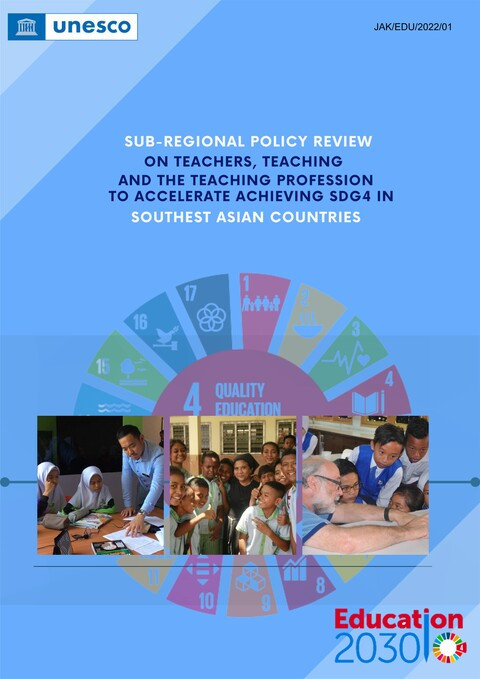 Sub-regional Policy Review on Teachers, Teaching and the Teaching Profession to Accelerate Achieving SDG4 in Southeast Asian Countries 발행 연도: 2022 저자: Azlina Abdul Aziz | Kamisah Osman | Khairul Farhah Khairuddin | Meeyoung Choi 단체 저자: UNESCO Jakarta The objectives of this report are to analyse existing national policies related to Teachers, Teaching and the Teaching Profession and examine their implementation in the five UNESCO cluster countries, namely Brunei, Indonesia, Malaysia, the Philippines and Timor-Leste. Eight themes have emerged from the systematic review of literature and they are i) Teacher Standard Competence, ii) Teacher professional Development, iii) Teacher Support, iv) Teaching Quality, v) Formative and Summative Assessment Framework on Teaching, vi) Showcasing and Rewarding Best Teaching Practices, vii) Teacher Professionalism and finally viii) Teacher Career Development. Global citizenship curriculum in higher education: evolving policy and practice and a future research agenda; proceedings of a symposium held on 9-10 December 2013 in Hong Kong 발행 연도: 2013 단체 저자: Bath Spa University | General Education Centre (Hong Kong) | Polytechnic University This symposium was an outgrowth of a UK Economic and Social Research Council (ESRC) funded International Networking Project. A collaboration between academics in the United Kingdom/Europe, North America, and Asia, this project responds to the fact that there is an increasing interest in understanding how universities can educate students to become more engaged and globally-minded citizens. The premise is that higher education should contribute to the public good by training more global citizens with cultural awareness, a strong sense of civic responsibility and skills to participate in a knowledge-based global economy. The following report documents the symposium proceedings, summarises the presentations and provides key insights drawn from presentations. Comments made by individuals are paraphrased and/or synthesized. Programme de Citoyenneté Mondiale dans l'enseignement supérieur: la politique et la pratique en évolution et un futur programme de recherche; actes d'un colloque tenu les 9-10 Décembre 2013 à Hong Kong 발행 연도: 2013 단체 저자: Bath Spa University | General Education Centre (Hong Kong) | Polytechnic University Ce symposium était une excroissance du Conseil de la recherche économique et sociale du Royaume-Uni (en. ESRC) financé Projet international de réseautage. Une collaboration entre les universitaires au Royaume-Uni / Europe, Amérique du Nord, et en Asie, ce projet répond au fait qu'il ya un intérêt croissant pour comprendre comment les universités peuvent éduquer les élèves à devenir des citoyens plus engagés et ouverts sur le monde. La prémisse est que l'enseignement supérieur doit contribuer au bien public par la formation des citoyens plus globales avec la conscience culturelle, un fort sentiment de responsabilité et les compétences civiques de participer à une économie mondiale fondée sur le savoir. Le rapport suivant documente les actes du colloque, résume les présentations et fournit des informations clés tirées des présentations. Commentaires formulés par les individus sont paraphrasés et / ou synthétisés.
  Higher Education and Democratic Culture: Citizenship, Human Rights and Civic Responsibility (Council of Europe Higher Education Series No.8) 발행 연도: 2008 저자: Josef Huber | Ira Harkavy 단체 저자: Council of Europe This book on the responsibility of higher education for a democratic culture is the 8th volume in the Council of Europe's Higher Education series. It is the direct result of a Higher Education Forum held in June 2006 on the responsibility of higher education for citizenship, human rights and sustainability. This forum was a part of the Council of Europe's long-standing commitment to work in the area of education for democratic citizenship and human rights. It complements earlier work on the public responsibility for higher education and research which led to a recommendation of the Committee of Minister to the member states of the Council of Europe in 2007. If our aim is to work for sustainable democratic societies, the responsibility of public authorities for a high-quality higher education system must go hand in hand with the responsibility of higher education institutions towards the advancement of society.