
자료
세계시민교육에 대한 이해를 넓히고 연구, 옹호 활동, 교수, 학습 등을 향상시킬 수 있는 다양하고 유용한 자료를 찾아보세요.
3,451 건의 결과가 검색되었습니다
 The United Nations world water development report 2018: nature-based solutions for water 발행 연도: 2018 단체 저자: UNESCO World Water Assessment Programme (WWAP) The 2018 edition of the World Water Development Report (WWDR 2018) seeks to inform policy and decision-makers, inside and outside the water community, about the potential of nature-based solutions (NBS) to address contemporary water management challenges across all sectors, and particularly regarding water for agriculture, sustainable cities, disaster risk reduction and water quality. NBS use or mimic natural processes to enhance water availability (e.g., soil moisture retention, groundwater recharge), improve water quality (e.g., natural and constructed wetlands, riparian buffer strips), and reduce risks associated with water-related disasters and climate change (e.g., floodplain restoration, green roofs). The WWDR2018, titled Nature-based solutions for water, demonstrates how nature-based solutions (NBS) offer a vital means of moving beyond business-as-usual to address many of the world’s water challenges while simultaneously delivering additional benefits vital to all aspects of sustainable development. Currently, water management remains heavily dominated by traditional, human-built (i.e. ‘grey’) infrastructure and the enormous potential for NBS remains under-utilized. NBS include green infrastructure that can substitute, augment or work in parallel with grey infrastructure in a cost-effective manner. The goal is to find the most appropriate blend of green and grey investments to maximize benefits and system efficiency while minimizing costs and trade-offs. NBS for water are central to achieving the 2030 Agenda for Sustainable Development because they also generate social, economic and environmental co-benefits, including human health and livelihoods, food and energy security, sustainable economic growth, decent jobs, ecosystem rehabilitation and maintenance, and biodiversity. Although NBS are not a panacea, they will play an essential role towards the circular economy and in building a more equitable future for all. Working with nature improves the management of water resources, helps achieve water security for all, and supports the core aspects of sustainable development. The World Water Development Report was presented at the 8th World Water Forum, in Brasilia (Brazil) on the 19th of March. URL: http://www.unesco.org/new/en/natural-sciences/environment/water/wwap/wwdr/2018-nature-based-solutions/ Informe Mundial sobre el Desarrollo de los Recursos Hídricos de las Naciones Unidas 2018: Soluciones Basadas En La Naturaleza Para La Gestion Del Agua 발행 연도: 2018 단체 저자: UNESCO World Water Assessment Programme (WWAP) La edición 2018 del El Informe Mundial sobre el Desarrollo de los Recursos Hídricos (WWDR) busca informar a los responsables políticos y tomadores de decisiones, dentro y fuera de la comunidad del agua, sobre el potencial de las soluciones basadas en la naturaleza para afrontar los desafíos actuales de la gestión del agua en todos los sectores, particularmente los relacionados con el agua para la agricultura, para las ciudades sostenibles, para la reducción del riesgo de desastres naturales y los de la calidad del agua. Las soluciones basadas en la naturaleza (NBS) están inspiradas y respaldadas por la naturaleza, usan o imitan los procesos naturales para contribuir al manejo mejorado del agua. La gestión del agua sigue estando fuertemente dominada por la infraestructura tradicional construida por el hombre (es decir, "gris") y el enorme potencial de NBS sigue desaprovechado. Las soluciones basadas en la naturaleza (NBS) incluyen infraestructura verde que puede sustituir, aumentar o trabajar en conjunto con la infraestructura gris de una manera rentable. El objetivo es encontrar la combinación más adecuada de inversiones verdes y grises para maximizar los beneficios y la eficiencia del sistema a la vez que se minimizan los costos y las compensaciones. Las NBS para el agua son fundamentales para alcanzar la Agenda 2030 para el Desarrollo Sostenible porque también generan beneficios colaterales sociales, económicos y ambientales, incluidos la salud humana y los medios de subsistencia, la seguridad alimentaria y energética, el crecimiento económico sostenible, empleos decentes, rehabilitación y mantenimiento de ecosistemas y biodiversidad. Si bien las NBS no son una panacea, jugarán un papel esencial en la economía circular y en la construcción de un futuro más equitativo para todos. Trabajar con la naturaleza mejora la gestión de los recursos hídricos, ayuda a lograr la seguridad del agua para todos y respalda los aspectos centrales del desarrollo sostenible. El Informe Mundial sobre el Desarrollo del Agua se presentó en el 8º Foro Mundial del Agua, en Brasilia (Brasil), el 19 de marzo. URL: http://www.unesco.org/new/en/natural-sciences/environment/water/wwap/wwdr/2018-nature-based-solutions/ Rapport mondial des Nations Unies sur la mise en valeur des ressources en eau: Les solutions fondées sur la nature pour la gestion de l’eau 발행 연도: 2018 단체 저자: UNESCO World Water Assessment Programme (WWAP) L'édition 2018 du Rapport mondial sur le développement de l'eau (WWDR 2018) vise à informer la politique et les décideurs, qu’ils soient parties prenante de la communauté de l’eau ou non, sur le potentiel des solutions fondées sur la nature (SfN) pour répondre aux défis contemporains de gestion de l'eau dans tous les secteurs, notamment en ce qui concerne l'eau pour l'agriculture, les villes durables, la réduction des risques de catastrophe liées à l'eau et la qualité de l'eau. Les SfN utilisent ou imitent les processus naturels pour améliorer la disponibilité de l'eau (par exemple, rétention de l'humidité du sol, recharge des eaux souterraines), améliorer la qualité de l'eau (par exemple, zones humides naturelles et construites, bandes riveraines tampons) et réduire les risques associés aux catastrophes liées à l’eau et au changement climatique (par exemple, restauration d'une plaine d'inondation, toits verts).Le WWDR2018, intitulé « Les solutions fondées sur la nature pour la gestion de l’eau », démontre comment les solutions basées sur la nature (SfN) offrent un moyen essentiel de répondre à de nombreux défis mondiaux liés à l'eau, tout en offrant simultanément des avantages supplémentaires essentiels à tous les aspects du développement durable.Actuellement, la gestion de l'eau reste fortement dominée par une infrastructure devenue habituelle, construite par l'homme (c'est-à-dire « grise ») et l'énorme potentiel des SfN reste sous-utilisé. Les SfN comprennent une infrastructure « verte » qui peut remplacer, compléter ou agir en parallèle avec une infrastructure grise de manière rentable. L'objectif est de trouver la combinaison la plus appropriée d'investissements verts et gris pour maximiser les avantages et l'efficacité du système tout en minimisant les coûts et les compromis.Les SfN pour l'eau sont essentielles à la réalisation du Programme de développement durable à l'horizon 2030, car elles génèrent des avantages sociaux, économiques et environnementaux, qui soutiennent notamment la santé humaine et les moyens de subsistance, la sécurité alimentaire et énergétique, la croissance économique durable, les emplois décents, la réhabilitation et l’entretien des écosystèmes, ainsi que la biodiversité. Bien que les SfN ne soient pas une panacée, elles joueront un rôle essentiel dans l'économie circulaire et dans la construction d'un futur plus équitable pour tous.Travailler avec la nature améliore la gestion des ressources en eau, contribue à la sécurité de l'eau pour tous et soutient les aspects fondamentaux du développement durable.Le Rapport mondial sur la mise en valeur des ressources en eau a été présenté lors du 8e Forum mondial de l'eau, à Brasilia (Brésil), le 19 mars. URL: http://www.unesco.org/new/en/natural-sciences/environment/water/wwap/wwdr/2018-nature-based-solutions/
  What Makes a Quality Curriculum?: In-Progress Reflection No.2 on Current and Critical Issues in Curriculum and Learning 발행 연도: 2016 저자: Philip Stabback 단체 저자: UNESCO International Bureau of Education (IBE) Sustainable Development Goal Four has to do with education in the post-2015 development agenda. It aims to “ensure inclusive and equitable quality education and promote lifelong learning opportunities for all”.Given the essential role of curriculum in enabling quality learning and in articulating and supporting education that is relevant to holistic development, our purpose in this paper is to identify what makes a quality curriculum, so as to support curricular innovation in UNESCO Member States to the end of the realization of Sustainable Development Goal Four.In this we are assuming that curriculum, given its essential role in the provision of quality learning for all children and young people, and in articulating and supporting education that is relevant to holistic development, is critical in the realization of SDG 4. It is the curriculum that determines to a large extent whether education is inclusive, thus playing a significant role in ensuring that provision is equitable. It is the curriculum that provides the structure for the provision of quality learning, especially where teachers might be under-qualified and inexperienced, their classrooms under-resourced, and their students lacking the prior frameworks within which to situate their learning. And it is the curriculum that articulates both the competencies necessary for lifelong learning and the competencies needed for holistic development.We thus argue that curriculum lies at the crossroads of these four key aspects of SDG 4: that education should be (1) inclusive and equitable, (2) characterized by quality learning, (3) promoting lifelong learning, and (4) relevant to holistic development. Curriculum, in other words, provides the bridge between education and development – and it is the competencies associated with lifelong learning and aligned with development needs, in the broadest, holistic sense of the term, that span that bridge.
  Content, Comprehensiveness and Coherence in Policies for Early Childhood: How the Curriculum Can Contribute 발행 연도: 2016 저자: María Isabel Díaz 단체 저자: UNESCO International Bureau of Education (IBE) In the context of international agreements and commitments concerning early childhood, the purpose of this document is to review and renew the challenges that are involved in forging educational and curriculum policies for the first level of education. In the light of early childhood being increasingly included in the public agenda, countries are making sustained efforts to increase equity and quality in the design and implementation of policies for the early years.These are policies that are in the process of changing by including quality and participation criteria; fine-tuning monitoring and assessment mechanisms; going beyond the lack of sectoral and territorial coordination, among other limitations; moving from a needs-based approach to a rights-based approach; and adopting a comprehensive view. The document analyses, from a long-term public policy perspective, some of the challenges that second-generation policies face, positioning the curriculum as the articulating factor for the development of comprehensive policies for early childhood.
  One in Five Children, Adolescents and Youth is Out of School (UIS Fact Sheet No. 48) 발행 연도: 2018 단체 저자: UNESCO Institute for Statistics (UIS) This fact sheet presents the latest UIS data on education available as of February 2018.Three years after the adoption of Sustainable Development Goal 4 (SDG 4) and the promise to provide universal primary and secondary education, there has been no progress in reducing the global number of out-of-school children, adolescents and youth. As the SDG 4–Education 2030 Steering Committee meets in Paris, the UNESCO Institute for Statistics (UIS) has released this fact sheet, highlighting trends at the global and regional levels, to inform discussions and provide stakeholders with the data needed to target policies, strategies and resources to get all children, adolescents and youth in school and learning.
 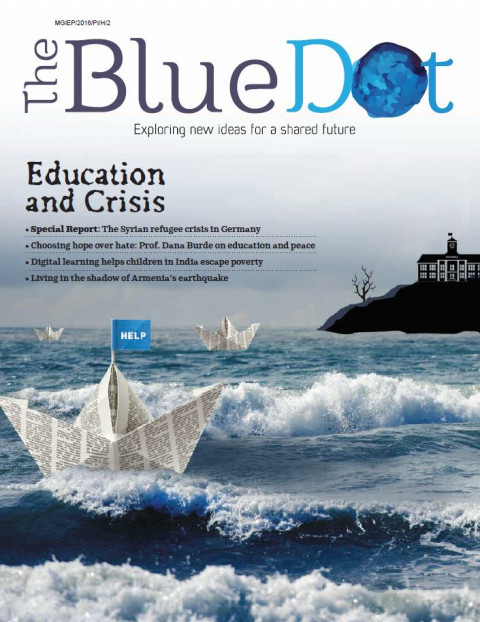 Education and Crisis (The Blue Dot Issue 3, 2016) 발행 연도: 2016 단체 저자: Mahatma Gandhi Institute of Education for Peace and Sustainable Development (MGIEP) In this third issue of The Blue Dot, we have chosen to focus on the often forgotten aspect of education in the context of crises. While relief efforts tend to focus on emergency responses such as providing food and shelter, more often than not rebuilding schools and ensuring that students continue to attend their classes are not considered priorities. At UNESCO MGIEP, we believe that when education is relegated to the side-lines, there is little hope for a country and its citizens to recover.In this issue, we have brought together expert contributors from academia and the field—from countries such as Afghanistan, Nepal and South Sudan—and have dedicated a large section to the ongoing civil conflict in Syria, which will soon enter its fifth year. With almost half of Syria’s population living as refugees or as internally displaced persons, an entire generation of young people risks losing out on stability and a better future. Our Syria Section explores how these young people, with a particular focus on those who have sought refuge in Germany, are faring and what their hopes are for the future.In other parts of the magazine, we focus on technology and on how modern information and communications technologies (ICTs) can help students access a better education. From impoverished communities in Calcutta using Skype to connect with teachers around the world, to new interactive platforms built for young people to discuss global issues, we hope the stories and experiences we have collected for our readers will give a new and fresh perspective on what it means for education when a crisis hits. We also hope that you enjoy our photo contest, which drew more than 100 entries from young people around the world on what “education and crisis” means to them.
 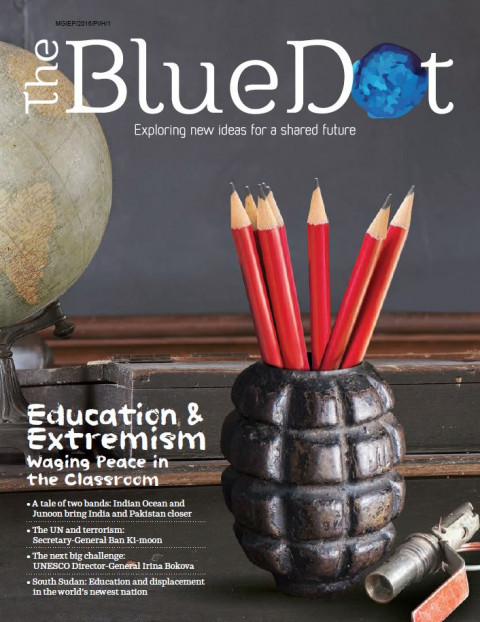 Education & Extremism: Waging Peace in the Classroom (The Blue Dot Issue 4, 2016) 발행 연도: 2016 단체 저자: Mahatma Gandhi Institute of Education for Peace and Sustainable Development (MGIEP) In this fourth issue of The Blue Dot, we have decided to focus on education as a tool for both preventing violent extremism and—sometimes—even propagating extremist ideologies. This issue reflects UNESCO MGIEP’s commitment to advancing the fundamental role of education as a means to changing mindsets and, ultimately, bringing about more peaceful societies.From an interview with award-winning social entrepreneur Prof. Sugata Mitra on the role of technology in revolutionizing education, to a foreword by Secretary-General Ban Ki-moon on the UN’s response to violent extremism, our contributors come from a host of different countries and backgrounds. What brings them together, however, is a call for changing current education systems. This is espoused even more clearly in a piece by Prof. K.P. Mohanan, who uses inquiry-driven approaches to prompt youth to question blind faith in any form of ideology or indoctrination.In this issue we also discuss UNESCO MGIEP’s activities in raising awareness of the strong link between education and radicalization and violent extremism, including our flagship Talking Across Generations (TAG) event which brought together policymakers and young people in an open discussion in Delhi this February. The outcome was a statement calling for greater inclusiveness and more space for young people to shape the policies that ultimately affect them.Just like our events, The Blue Dot is a platform for individuals from different backgrounds and walks of life who might have divergent ideologies, beliefs, and values, all of which may have prevented them from coming together to debate some of the most pressing issues of our time—including the global concern surrounding the rise in violent extremism. When individuals feel free to discuss, share ideas and question their beliefs, they can begin to think creatively and critically about the world and their surrounding environment. The challenge is to avoid lecturing or preaching to young people, but to provide youth with a safe space to discuss contentious issues in an open, inclusive and transparent manner.An open dialogue on violent extremism is a step towards providing young people with opportunities to ask questions and to reflect on their own beliefs, assumptions, and values, including animosities, prejudices, hatred and intolerance. At UNESCO MGIEP we believe that individuals who feel connected to others across political, religious or cultural divides also share a sense of responsibility for the world in which they live.
 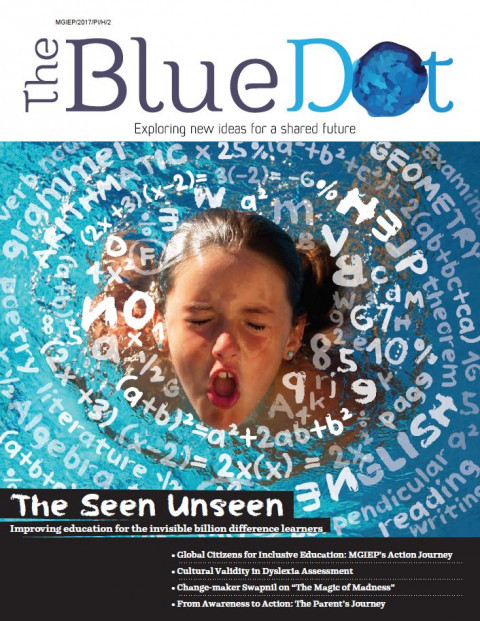 The Seen Unseen: Improving Education for the Invisible Billion Difference Learners (The Blue Dot Issue 5, 2017) 발행 연도: 2017 단체 저자: Mahatma Gandhi Institute of Education for Peace and Sustainable Development (MGIEP) MGIEP believes that addressing the needs of children with difference learning offers a unique opportunity to build the competency of understanding, respect and appreciation between the children and the rest of their peers in school.It provides the Institute favorable conditions to put in practice how inclusive education is a necessary condition for building peaceful and sustainable societies. Many of the Information Technology pedagogical tools developed by the Institute lend themselves to children with difference learning.Transforming the education system in such a manner will allow mainstream schools to provide a learning platform that breaks down barriers across learning types and provide the equitable access to education that is a fundamental Sustainable Development Goal.We are, in this issue of The Blue Dot, privileged to read from some of the world’s best experts on the subject describing the challenges at hand and suggesting ways and means of addressing the lacuna present in curricula and policy. As always, we dedicate a special section to reflecting the voices of young people in our discussion. I am especially honoured and delighted to present a foreword from a young entrepreneur who has not allowed his neurobiological dyslexic condition to prevent him from pursuing his dreams to help others.
  Resilience, violent extremism and religious education 발행 연도: 2013 저자: Joyce Miller This article is an attempt to provide an educational justification for the British Government-funded project REsilience, on addressing contentious issues through religious education (RE), which was carried out by the RE Council of England and Wales. A number of issues relating to the inclusion of religiously inspired violent extremism in the curriculum are raised – definitional, political and educational.