
자료
세계시민교육에 대한 이해를 넓히고 연구, 옹호 활동, 교수, 학습 등을 향상시킬 수 있는 다양하고 유용한 자료를 찾아보세요.
1,405 건의 결과가 검색되었습니다
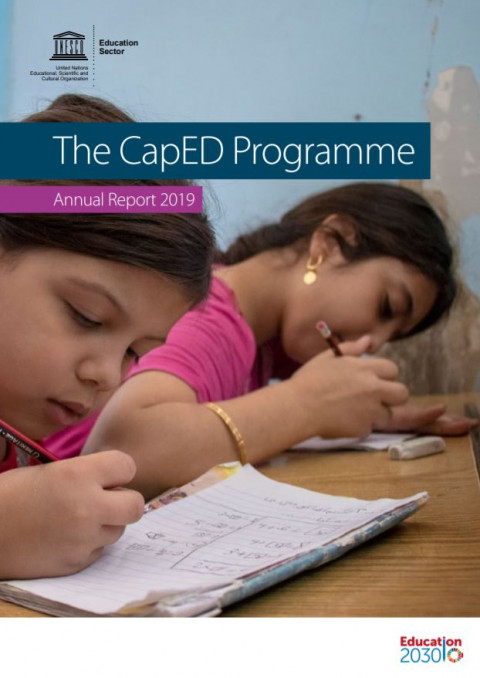 The CapED Programme: Annual Report 2019 발행 연도: 2020 단체 저자: UNESCO UNESCO is the United Nation’s specialized agency for education and is mandated to lead and coordinate progress towards Sustainable Development Goal 4 – “Ensure inclusive and equitable quality education and promote lifelong learning opportunities for all”.The CapED Programme is central to delivering on this mandate through capacity development. It mobilizes UNESCO’s worldwide network of specialized Institutes and offices and works with partners to assist countries as they develop and implement national plans to deliver on SDG4 commitments.The Annual Report 2019 provides information on achievements and progress made in the 26 countries where CapED is operational. Programme CapED: rapport annuel 2019 발행 연도: 2020 단체 저자: UNESCO Institution spécialisée des Nations Unies pour l'éducation, l'UNESCO est chargée de conduire et de coordonner les efforts entrepris pour atteindre l'Objectif de développement durable 4 : « Assurer l'accès de tous à une éducation de qualité, sur un pied d'égalité, et promouvoir les possibilités d'apprentissage tout au long de la vie ».Le Programme CapED de développement des capacités pour l'éducation joue un rôle central dans l'exercice de ce mandat. Il mobilise le réseau mondial des instituts spécialisés et des bureaux de l'UNESCO et, en collaboration avec ses partenaires, aide les pays à élaborer et mettre en oeuvre leurs plans nationaux afin d'honorer les engagements qu'ils ont pris au titre de l'ODD 4.Le Rapport annuel 2019 met en lumière les résultats obtenus et les progrès accomplis dans les 26 pays où le Programme CapED intervient.
 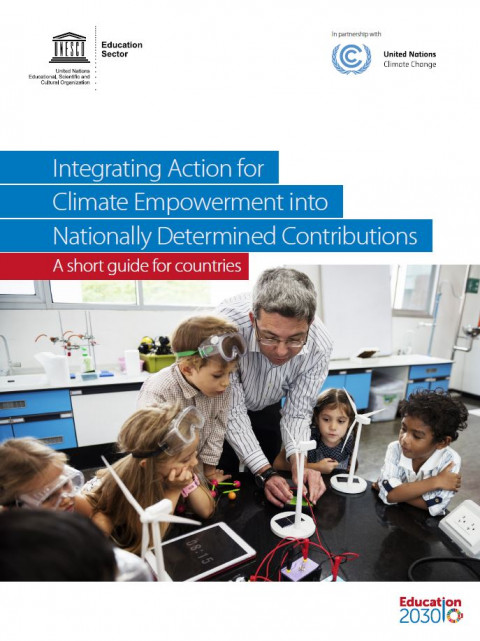 Integrating Action for Climate Empowerment into Nationally Determined Contributions: A Short Guide for Countries 발행 연도: 2020 단체 저자: UNESCO In the framework of the 2020 review of Nationally Determined Contributions (NDCs) under the Paris Agreement, this guide aims to provide countries with advice on how to enhance ambition and address the six elements of ‘Action for Climate Empowerment’ (ACE) – Education, Training, Public Awareness, Public Access to Information, Public Participation and International Cooperation – in their respective NDCs.In five simple questions and answers, it provides suggestions for elements that can be integrated into the NDCs in order to make ACE an integral part of countries’ climate responses. The guide also shows why ACE is key to achieve the goals of the Paris Agreement and its greenhouse gas emission targets.
  Using Civic Participation and Civic Reasoning to Shape Our Future and Education (Background Paper for the Futures of Education Initiative) 발행 연도: 2020 저자: Sarah M. Stitzlein 단체 저자: UNESCO Actualizing a preferred future relies on citizens who are prepared to effectively engage perhaps the most fundamental civic question: ‘What should we do?’ (Levine, 2016; Dishon & Ben-Porath, 2018). It is a question that arises when people face a problem, must reach a decision, or must figure out how to flourish together as a group. This question is closely tied to the key question posed by the International Commission on the Futures of Education: ‘What do we want to become?’ Engaging both questions is a useful way for us to envision education in the future. These questions push us to consider not only what we merely can do, but also what is right for us to do in light of our responsibilities to others.Civic reasoning is the sort of reasoning we do as we answer the question, ‘What should we do?’ Civic discourse is a means or method by which people engage in civic reasoning. Efforts to envision improved education and futures should foreground civic reasoning and discourse as both a means and ends of citizen participation. They are important for the ways in which they directly engage citizens and for their products, which lead to future civic action and better futures.
 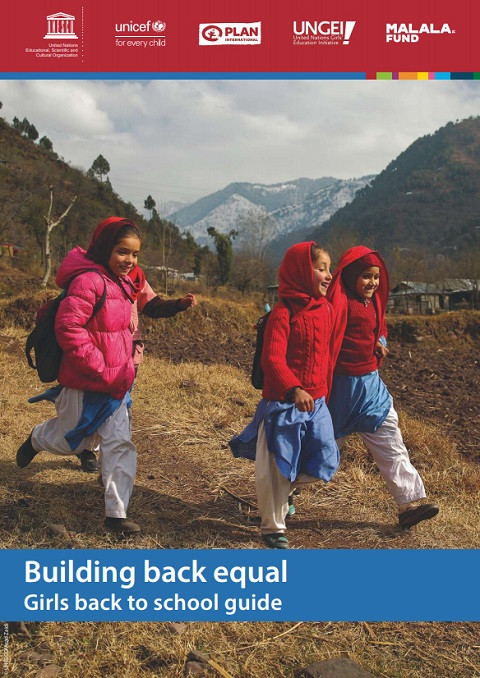 Building Back Equal: Girls Back to School Guide 발행 연도: 2020 단체 저자: UNESCO | United Nations Children's Fund (UNICEF) | Plan International | United Nations Girls' Education Initiative (UNGEI) | Malala Fund The guide provides targeted inputs to ensure continuity of learning during school closures, and comprehensive, timely and evidence-based plans for reopening schools in a way that is safe, gender-responsive and child-friendly, and meets the needs of the most marginalised girls. This guide emphasizes an approach to ‘build back equal’ through gender-responsive measures that transform education systems, prioritise resilience and address the key bottlenecks and barriers to girls’ education, including: Gender-responsive data and evidence to inform action, including data disaggregated by sex and gender-responsive monitoring to identify promising practices to promote gender equality. Policies, laws and plans to advance girls’ rights, including the removal of discriminatory practices that impede girls’ educational participation and completion, and ability to apply their learning. Sustained financing to achieve results, protecting education financing for girls’ education, alongside health, social protection and economy recovery initiatives with an equity lens. Reforzar la igualdad: Guía para el regreso de las niñas a la escuela 발행 연도: 2020 단체 저자: UNESCO | United Nations Children's Fund (UNICEF) | Plan International | United Nations Girls' Education Initiative (UNGEI) | Malala Fund La guía proporciona información específica para garantizar la continuidad del aprendizaje durante los cierres escolares, así como planes integrales, oportunos y fundados en datos empíricos para reabrir escuelas de forma segura, con perspectiva de género, adaptada a las necesidades de los niños, y que satisfaga las necesidades de las niñas más marginadas. Esta guía enfatiza un enfoque basado en “reforzar la igualdad”, a través de medidas con perspectiva de género que transformen los sistemas educativos, den prioridad a la resiliencia, y aborden los principales obstáculos y limitaciones para la educación de las niñas, incluyendo: Datos y pruebas con perspectiva de género para fundamentar las acciones, incluidos datos desglosados por sexo, y un seguimiento con perspectiva de género para identificar prácticas prometedoras para promover la igualdad de género. Políticas, leyes y planes para promover los derechos de las niñas, incluida la eliminación de las prácticas discriminatorias que impidan la participación y finalización educativa de las niñas, y la posibilidad de aplicar los conocimientos adquiridos. Financiamiento sostenido para lograr resultados, protegiendo el financiamiento educativo para las niñas, junto con iniciativas de salud, protección social y recuperación económica, con una perspectiva de igualdad de género. Reconstruire l’égalité: Guide de rescolarisation des filles 발행 연도: 2020 단체 저자: UNESCO | United Nations Children's Fund (UNICEF) | Plan International | United Nations Girls' Education Initiative (UNGEI) | Malala Fund Le guide fournit des contributions ciblées pour assurer la continuité de l’apprentissage pendant les fermetures d’écoles ainsi que des plans complets et opportuns basés sur les données pour rouvrir les écoles de manière sûre, en tenant compte des questions de genre, ainsi qu’en répondant aux besoins des enfants et des filles les plus marginalisées. Ce guide met l’accent sur une approche visant à « reconstruire l’égalité », à travers des mesures tenant compte des questions de genre afin de transformer les systèmes éducatifs, de favoriser la résilience et de résoudre les principaux freins et obstacles à l’éducation des filles, dont : des données et des preuves tenant compte des questions de genre pour éclairer les actions, y compris des données ventilées par sexe et un suivi visant à identifier les pratiques prometteuses pour l’égalité des genres ; des politiques, des lois et des plans pour faire avancer les droits des filles, y compris l’élimination des pratiques discriminatoires qui entravent la participation des filles à l’éducation et leur capacité à mettre leur savoir en pratique ; des financements pérennes pour obtenir des résultats, qui protègent le financement de l’éducation des filles, ainsi que les initiatives en matière de santé, de protection sociale et de redressement économique sur un principe d’équité.
 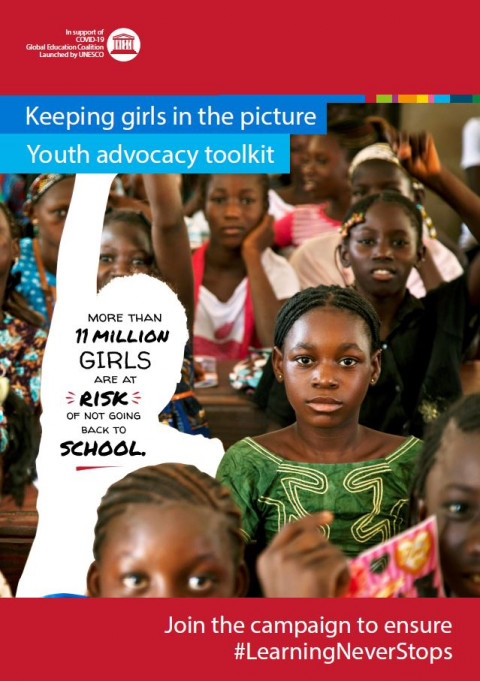 Keeping Girls in the Picture: Youth Advocacy Toolkit 발행 연도: 2020 단체 저자: UNESCO | Global Education Coalition The COVID-19 pandemic has caused the largest school closures and education disruption in history, with more than 1.5 billion students affected at the height of the crisis. Over 767 million of these students were girls.Now, another major challenge is looming. Over 11 million girls – from pre-primary to tertiary education - may not return to school in 2020. This alarming number not only threatens decades of progress made towards gender equality, but also puts girls around the world at risk of adolescent pregnancy, early and forced marriage, and violence. For many girls, school is more than just a key to a better future. It’s a lifeline.This is why UNESCO and members of the Global Education Coalition’s Gender Flagship are launching a new #LearningNeverStops campaign focusing on ‘keeping girls in the picture.’The campaign calls for efforts to safeguard progress made on girls’ education, ensure girls’ learning continuity during school closures, and promote girls’ safe return to school once these reopen. It also sheds light on the 130 million girls who were already out of school before the pandemic, and calls on the international community to urgently work together to guarantee their right to education.
 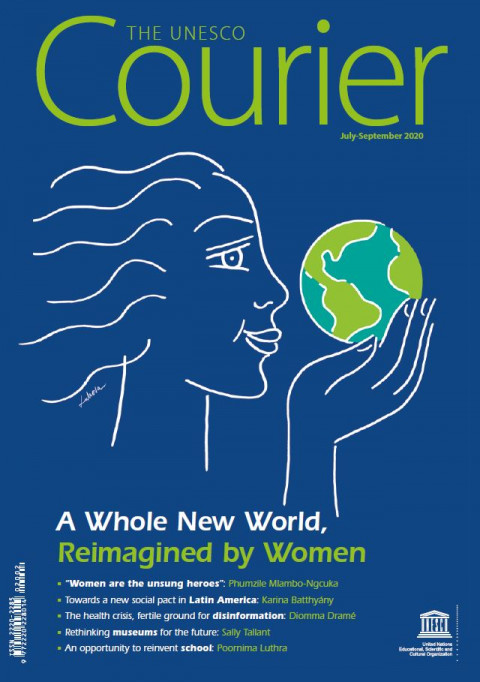 Les femmes prennent la parole (Le Courrier de l’UNESCO no. 2, Juillet-septembre 2020) 발행 연도: 2020 단체 저자: UNESCO Politologues, journalistes, sociologues, chercheuses, écrivaines ou enseignantes dessinent les contours de l’après-pandémie, qu’il s’agisse de l’avenir des musées, des mutations de l’école, des dérives de l’information ou encore des enjeux de la recherche.Ce numéro trace un portrait en creux de notre époque, souligne les lignes de fracture que la crise sanitaire a mises à nu et montre l’ampleur des défis à relever. Il souligne aussi le potentiel de coopération scientifique, culturelle, éducative que cet événement inédit a révélé. Si les réflexions, le désir de changement et les mouvements d’entraide qui se sont manifestés ne restent pas sans lendemain, le monde pourrait réellement devenir plus solidaire, plus durable et plus égalitaire.
  Textbooks and Inclusive Education: Background Paper Prepared for the 2020 Global Education Monitoring Report, Inclusion and Education 발행 연도: 2020 저자: Eckhardt Fuchs | Marcus Otto | Simiao Yu 단체 저자: UNESCO | Global Education Monitoring Report Team This report, based on an analysis of a sample of textbooks from 28 countries, shows that the subject of inclusion has become increasingly significant in terms of both structure and subject matter, and particularly in the contexts of human rights and citizenship. Social diversity is also increasingly taken into account and reflected upon, albeit with varying emphasis on the differing dimensions of diversity, given that genuinely intersectional perspectives via which these are linked only occur in isolated and rudimentary cases. With regard to inclusiveness in the gender-related dimension, the overall picture of the textbook sample under analysis here is a heterogeneous one; further, the incorporation of LGTBQIA+ perspectives remains insufficient. Nevertheless, the textbooks examined here do show increasing critical reflection on the social discrimination of different groups, and, ultimately, we do observe a significant trend towards a more pronounced consideration and representation of different social groups and minorities.