
자료
세계시민교육에 대한 이해를 넓히고 연구, 옹호 활동, 교수, 학습 등을 향상시킬 수 있는 다양하고 유용한 자료를 찾아보세요.
1,180 건의 결과가 검색되었습니다
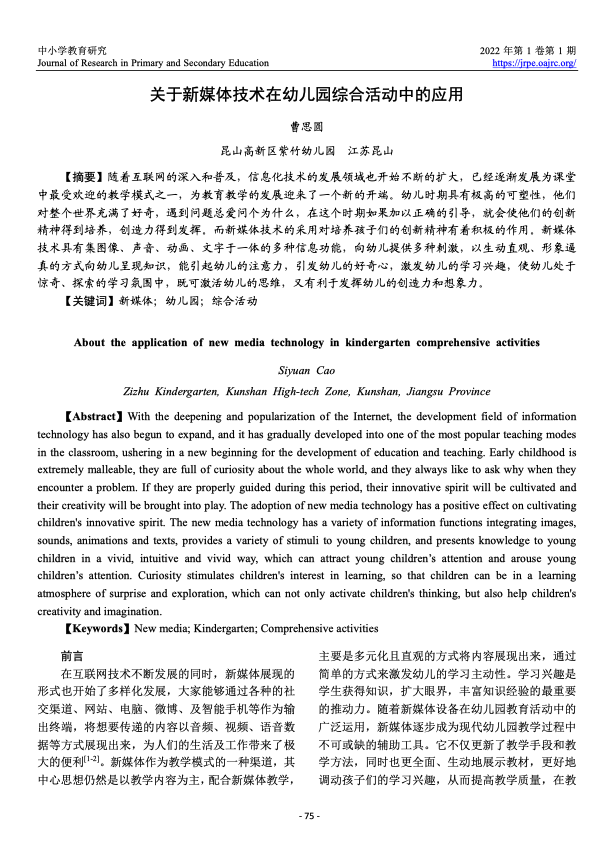 关于新媒体技术在幼儿园综合活动中的应用 발행 연도: 2022 저자: 曹思圆 随着互联网的深入和普及,信息化技术的发展领域也开始不断的扩大,已经逐渐发展为课堂中最受欢迎的教学模式之一,为教育教学的发展迎来了一个新的开端。幼儿时期具有极高的可塑性,他们对整个世界充满了好奇,遇到问题总爱问个为什么,在这个时期如果加以正确的引导,就会使他们的创新精神得到培养,创造力得到发挥。而新媒体技术的采用对培养孩子们的创新精神有着积极的作用。新媒体技术具有集图像、声音、动画、文字于一体的多种信息功能,向幼儿提供多种刺激,以生动直观、形象逼真的方式向幼儿呈现知识,能引起幼儿的注意力,引发幼儿的好奇心,激发幼儿的学习兴趣,使幼儿处于惊奇、探索的学习氛围中,既可激活幼儿的思维,又有利于发挥幼儿的创造力和想象力。
  미래교육시대의 인간교사와 인공지능(AI) 교사의 역할 및 기능 정립 방향 탐색 연구 발행 연도: 2021 저자: 전제상 단체 저자: 한국교육정책연구소 이 연구는 인공지능의 급격한 발전과 사회의 변화로 교육 현장에 점차 도입될 인공지능이 어떤 모습으로 존재해야 하는지 그리고 어떤 방식으로 학생들에게 도움을 줄 수 있는지 길을 찾고자 하였다. 이를 위하여 인공지능의 현재 상황과 선행연구를 분석하는 것으로 시작하여 인공지능(AI) 교사에 대한 현장 교사들의 인식을 양적, 질적으로 살펴보았다. 이를 토대로 미래교육시대의 교사와 인공지능(AI) 교사의 역할과 기능을 정립하고 상호보완적인 협업 방안을 모색한 후 인공지능(AI) 교사 도입에 따른 제도적, 법적, 윤리적 기준을 확인하였다.인공지능 기반의 미래 사회가 도래했다고 하여 인간교사의 역할이 크게 바뀌지는 않는다. 기존의 해오던 여러 수업과 업무 중에 우선순위의 변화가 생길 수 있고, 수업보다 행정에 할애했던 시간을 수업과 학생지도, 상담 등에 집중할 수 있게 될 것으로 기대한다. 다만 인공지능(AI) 교사 도입에 따라 야기될 윤리적 문제를 해결하기 위해서는 도입 단계부터 준비하여 지속적인 확인과 점검, 성찰을 통해 협업 과정이 목적에 알맞게 기능하도록 모든 요소에 대해 철저하게 대비하고 점검하여야 한다.
  Empowering Minds: A Round Table on Generative AI and Education in Asia-Pacific 발행 연도: 2023 단체 저자: UNESCO Bangkok The emergence of generative AI, a recent groundbreaking artificial intelligence (AI) technology capable of producing sophisticated content from text and images to simulations and audiovisuals, has become a transformative force across multiple sectors. Popular applications like OpenAI’s ChatGPT and Anthropic’s Claude are prime examples of the rapidly expanding range of generative AI tools that are having an impact in education across the Asia-Pacific. These tools offer unprecedented opportunities for enabling personalized learning experiences at scale and expanding access to high-quality learning resources. However, as generative AI increasingly reshapes classrooms, critical questions remain unanswered, such as:- How can generative AI be ethically and responsibly integrated into educational settings?- What policies and safeguards are needed to address issues like misinformation, algorithmic bias and threats to academic integrity?- What challenges do Asia-Pacific countries face in harnessing generative AI in education, given the region’s unique context?- What are the strategies for Asia-Pacific countries to take up opportunities offered by generative AI, while mitigating the risks? In response to these questions and emerging challenges in the region, the UNESCO Regional Office in Bangkok (UNESCO Bangkok), in collaboration with The Southeast Asian Ministers of Education Organization (SEAMEO), organized the regional experts meeting on 7-9 November 2023 in Bangkok, Thailand. This hybrid meeting, titled ‘Empowering Minds: A Round Table on Generative AI and Education in Asia-Pacific’, explored the implications of generative AI for teacher training and development. It served as an important platform to leverage opportunities and mitigate risks of generative AI in education across the Asia-Pacific region.
  Tools for a More Inclusive Education 발행 연도: 2020 단체 저자: Chile. Ministry of Education This document presents a conceptual framework to help the different educational teams deployed at the national level to devise and implement inclusive practices in their daily management, in their ways of living together and in their teaching-learning processes. This, within the framework of the promulgation of Law 20,845, modifies the General Education Law (N°20,370/2009) in its article 4, adding that “It is the duty of the State to strive to ensure quality inclusive education for all people. Herramientas para una educación más inclusiva 발행 연도: 2020 단체 저자: Chile. Ministry of Education En este documento se presenta un marco técnico conceptual para contribuir a que los distintos equipos educativos desplegados a nivel nacional puedan idear e implementar prácticas inclusivas en su gestión cotidiana, en sus modos de convivir y en sus procesos de enseñanza – aprendizaje. Esto, en el marco de la promulgación de la Ley 20.845 modifica la Ley General de Educación (N°20.370/2009) en su artículo 4° agregando que “Es deber del Estado propender a asegurar a todas las personas una educación inclusiva de calidad.”
  Glocal Education in Practice: Teaching, Researching, and Citizenship (BCES Conference Books; Vol. 17) 발행 연도: 2019 저자: Nikolay Popov | Charl Wolhuter | Louw de Beer | Gillian Hilton | James Ogunleye | Elizabeth Achinewhu-Nworgu | Ewelina Niemczyk 단체 저자: Bulgarian Comparative Education Society (BCES) This volume contains selected papers submitted to the XVII Annual International Conference of the Bulgarian Comparative Education Society (BCES) held in June 2019 in Pomorie, Bulgaria. The XVII BCES Conference theme is Glocal Education in Practice: Teaching, Researching, and Citizenship. The book includes 34 papers written by 69 authors from 20 countries.
  The Role of Education in Addressing Future Challenges 발행 연도: 2020 단체 저자: Bridge 47 In response to UNESCO’s Futures of Education consultation, Bridge 47 has released the following report on the power that transformative education has to address future challenges, including those linked to inequalities, climate change and health.Through the consultation process UNESCO raises questions about the importance and purpose of education by 2050. In a fast-evolving world, Bridge 47 supports the idea that education should foster the kind of education that helps learners of all ages to become active global citizens and thus contribute to building a more just and sustainable report world for all.The report, ‘The Role of Education in Addressing Future Challenges’, further emphasises the importance of measuring and monitoring the progress towards achieving the transformative vision of education as outlined in Sustainable Development Goal Target 4.7. It is hoped that the overall Future of Education report will encourage a measuring framework for SDG 4.7 that acknowledges the connection between non-formal and formal education as well as supporting dialogue between key actors that the reflect any conceptual shifts within the fields of Education for Sustainable Development and Global Citizenship Education.
  The Global Citizen's Journey: A Resource for Global Citizenship Education 발행 연도: 2021 단체 저자: GOAL Global This resource for Global Citizenship Education is designed by our Global Youth Programme for educators and leaders of 14–18-year-olds all over the world. Centring on the themes of interconnectedness, development, power and inequality this free, downloadable booklet of activities encourages critical thinking, reflection, and empower the pursuit of positive change.To find out more, watch our introductory video here.
  The prospects of development education in African countries: building a critical mass of citizenry for civic engagement 발행 연도: 2015 저자: Simon Eten 단체 저자: Centre for Global Education (CGE) This article argues that development education is often framed in an African context within notions of national citizenship designed to engender support for public institutions and policies rather than develop critical thinking skills. This limited concept and application of development education often results in public apathy and disengagement from participation in community, national and global development initiatives. The author argues that recourse to the more radical, Freirean conception of development education practice in African states could potentially support more engaged public activism in issues underpinning poverty and injustice locally and globally. The author draws upon his knowledge and experience of the public sector in Ghana and general trends across Africa to propose potentially fertile areas of research that could support more effective DE practice that nurtures enhanced civic engagement. Les perspectives de l'éducation au développement dans les pays africains: la construction d'une masse critique de citoyens pour l'engagement civique 발행 연도: 2015 저자: Simon Eten 단체 저자: Centre for Global Education (CGE) Cet article soutient que l'éducation au développement est souvent encadrée dans un contexte africain dans les notions de citoyenneté nationale visant à susciter le soutien des institutions et des politiques publiques plutôt que de développer la pensée critique. Ce concept limité et l'application de l'éducation au développement se traduit souvent par l'apathie du public et le désengagement de la participation à la communauté, les initiatives nationales et mondiales de développement. L'auteur fait valoir que le recours à la plus radicale, la conception freirienne de la pratique de l'éducation au développement dans les pays africains pourrait soutenir l'activisme public plus engagé dans les questions qui sous-tendent la pauvreté et de l'injustice localement et globalement. L'auteur puise dans ses connaissances et de l'expérience du secteur public au Ghana et les tendances générales à travers l'Afrique pour proposer des zones potentiellement fertiles de la recherche qui pourrait soutenir la pratique DE plus efficace qui favorise l'engagement civique renforcée.