
자료
세계시민교육에 대한 이해를 넓히고 연구, 옹호 활동, 교수, 학습 등을 향상시킬 수 있는 다양하고 유용한 자료를 찾아보세요.
2,668 건의 결과가 검색되었습니다
 L’éducation antiraciste, inclusive et aux droits dans le développement des compétences professionnelles du personnel scolaire et des capabilités des élèves 발행 연도: 2017 저자: Maryse Potvin 단체 저자: Éthique en éducation et en formation Cet article porte un regard sur les différences et convergences qui se dégagent des grands courants théoriques dans le champ de l’éducation à la diversité ethnoculturelle (inter/multiculturel, antiraciste /critique, civique, inclusif) quant aux compétences professionnelles à développer par le personnel scolaire pour atteindre les grandes finalités de l’équité, de l’effectivité des droits, du vivre-ensemble et du développement des capabilités des élèves. L’article s’appuie sur une revue de la littérature nationale et internationale, qui visait à dégager les éléments de compétences (savoirs, savoir-faire, savoir-être essentiels) pour savoir-agir en contexte de diversité, et qui, selon les théoriciens, devraient être développés dans tous les programmes de formation à l’enseignement. Il n’aborde pas ces enjeux sous un angle disciplinaire, lié au curriculum québécois (éthique et culture religieuse, histoire et éducation à la citoyenneté), mais dans une perspective transversale. L’article présente d’abord quelques fondements de ces courants afin de dégager leurs objectifs communs et leur convergence vers une approche globale et inclusive intégrée. Il porte ensuite une attention particulière aux deux finalités centrales qui font consensus parmi les théoriciens et qui sont au coeur des compétences professionnelles du personnel scolaire pour développer les capabilités des élèves : 1) prendre en compte les réalités, besoins et droits des élèves, particulièrement ceux des groupes minoritaires ou vulnérables, pour développer leurs capabilités, et 2) les préparer à vivre ensemble dans une société pluraliste et démocratique. Il dégage aussi les principaux défis liés à la prise en compte et à la mise en oeuvre de ces deux finalités.
  The Ideology of the Rights of Children and the Reality in Sub-Saharan Africa: What Are the Mobilizing Paradigms? 발행 연도: 2017 저자: Étienne Kola 단체 저자: Éthique en éducation et en formation Human rights are a heritage of humanity. The ideology that underpins it is based on a humanist presupposition that makes a constant imprescriptible human dignity. The rights of the child which are a specific application of the human rights are often massive violations that offend the common sense. The situation in sub-saharian Africa is still disturbing that poverty, armed conflict and certain socio-cultural heaviness are stumbling blocks to the effective enjoyment of rights by children. The consequences of the violations all azimuths of these rights are so heavy to amount to a human and social tragedy in this continent. Strategies for eradication of this phenomenon require activation of the legal mechanisms and operational law enforcement but also the integration of the humanistic, personalistic and Existentialist rationalities in the African educational systems. Ethical and humanistic thoughts could influence even the most rigid minds. Idéologie des droits de l’enfant et réalité en Afrique subsaharienne, quels paradigmes mobilisateurs? 발행 연도: 2017 저자: Étienne Kola 단체 저자: Éthique en éducation et en formation Les droits de l’homme sont un patrimoine de l’humanité. L’idéologie qui les sous-tend repose sur un présupposé humaniste qui fait de la dignité humaine une constante imprescriptible. Les droits de l’enfant qui sont une application particulière des droits de l’homme connaissent des violations souvent massives qui heurtent le bon sens. La situation en Afrique subsaharienne est d’autant préoccupante que la précarité, les conflits armés et certaines pesanteurs socioculturelles constituent des pierres d’achoppement à la jouissance effective des droits par les enfants. Les conséquences des violations tous azimuts de ces droits sont si pesantes au point de constituer un drame humain et social dans ce continent. Les stratégies d’éradication de ce phénomène exigent non seulement l’activation des mécanismes juridiques et répressifs opérationnels mais aussi l’intégration des rationalités humaniste, personnaliste et existentialiste dans les systèmes éducatifs africains. La teneur éthique et humaniste de ces pensées pourrait infléchir même les esprits les plus rigides.
  Éducation à la citoyenneté 단체 저자: Vedura La citoyenneté est le lien social qui réunit une personne et l'Etat, et qui permet à cette personne d'accomplir ses droits civiques et politiques. Être citoyen, c'est accomplir ses droits et devoirs civiques, mais également être responsable, individuellement et collectivement. Le citoyen contribue à donner un sens à la société dans laquelle il vit. L'éducation à la citoyenneté s'inscrit pleinement dans l'éducation au développement durable : c'est l'apprentissage de connaissances, de comportements, et de gestes citoyens à accomplir au quotidien qui vont dans le sens des valeurs du développement durable. De nombreuses thématiques intègrent l'éducation à la citoyenneté : la démocratie la paix les droits de l'homme les devoirs citoyens l'éco-citoyenneté l'éducation à la santé la prévention des conduites à risque l'égalité homme-femme la lutte contre les discriminations le développement durable l'éco-citoyenneté ... L'éducation à la citoyenneté concerne tous les publics, et fait l'objet d'une attention particulière de l'Education Nationale : "les compétences sociales et civiques inscrites dans le socle commun de connaissances et de compétences, défini par le décret n°2006-830 du 11 juillet 2006 doivent pouvoir s’appuyer sur le développement d’un "parcours civique" qui permet à l’élève de prendre conscience de son statut de citoyen, de ses droits et devoirs et du lien indissociable entre la liberté et la responsabilité. Ce parcours se fonde, entre autres, sur les événements et activités qui permettent de mettre en œuvre dans les écoles et les établissements scolaires un ensemble d'itinéraires de citoyenneté."
  L’éducation à la citoyenneté à l’école 발행 연도: 2016 저자: Nathalie Mons 단체 저자: Communication publique Il souffle comme un vent nouveau sur l’apprentissage de la citoyenneté à l’école, alors que notre pays connaît une succession d’attentats, jetant le trouble sur ses capacités de cohésion nationale et l’adhésion de tous aux valeurs de notre société, enseignées historiquement dans les classes.C’est ce que montrent les travaux que le Conseil national d’évaluation du système scolaire (Cnesco) a publié à l’occasion du Comité interministériel Égalité et Citoyenneté du 13 avril 2016 afin d’éclairer l’état des réflexions, des avancées et des difficultés encore à surmonter.
 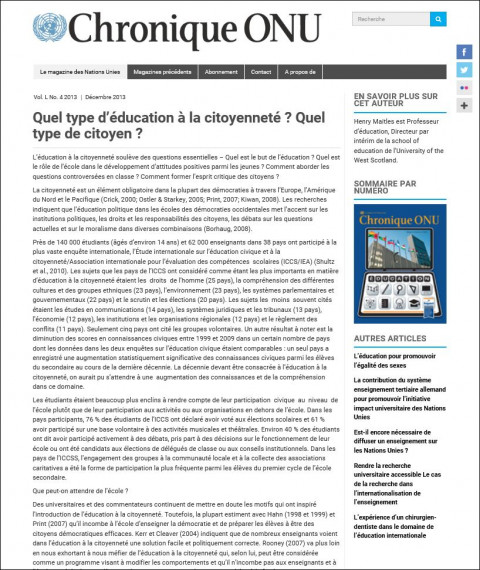 Quel type d'éducation à la citoyenneté ? Quel type de citoyen ? 발행 연도: 2013 저자: Henry Maitles 단체 저자: Chronique ONU L’éducation à la citoyenneté soulève des questions essentielles – Quel est le but de l’éducation ? Quel est le rôle de l’école dans le développement d’attitudes positives parmi les jeunes ? Comment aborder les questions controversées en classe ? Comment former l’esprit critique des citoyens ?
 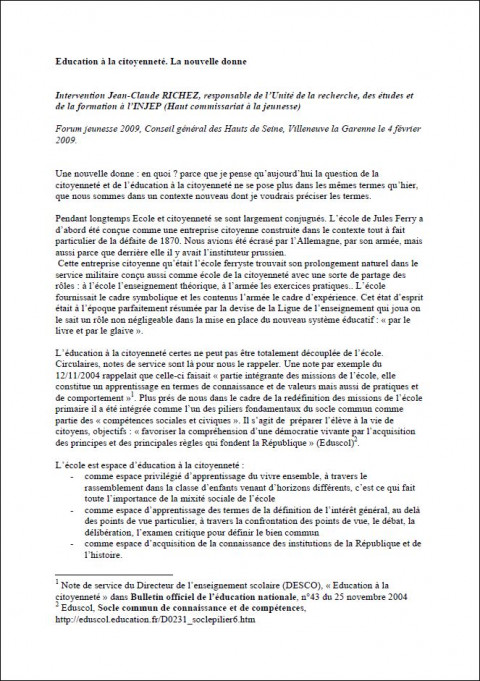 Éducation à la citoyenneté. La nouvelle donne 발행 연도: 2009 저자: Jean-Claude Richez 단체 저자: Haut commissariat à la jeunesse «Je pense qu'aujourd'hui, la question de la citoyenneté et de l'éducation à la citoyenneté ne se pose plus dans les mêmes termes qu'hier. (...) Nous sommes dans un contexte nouveau dont je voudais préciser les termes.»Selon Jean-Claude Richez1, la prise en compte de la dimension non formelle de l'éducation à la citoyenneté est un enjeu fondamenal dans la société d'aujourd'hui. Il a précisé pourquoi lors d'une intervention au forum jeunesse organisé par le conseil général des Hauts-de-Seine.
 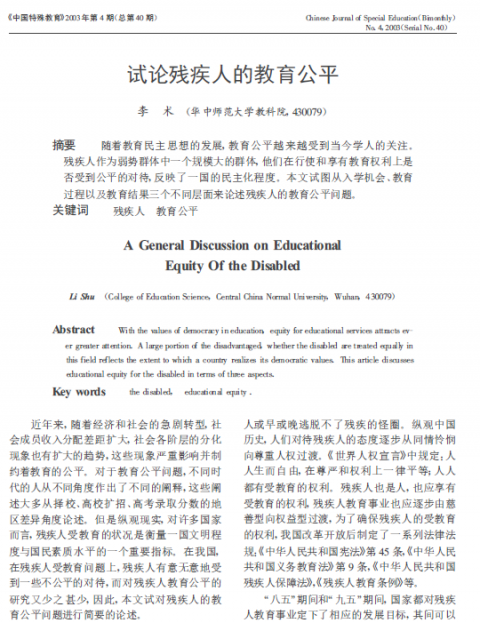 A General Discussion on Educational Equity Of the Disabled 발행 연도: 2003 저자: Li Shu With the values of democracy in education, equity for educational services attracts ever greater attention. A large portion of the disadvantaged, whether the disabled are treated equally inthis field reflects the extent to which a country realizes its democratic values. This article discusses educational equity for the disabled in terms of three aspects. 试论残疾人的教育公平 발행 연도: 2003 저자: Li Shu 随着教育民主思想的发展,教育公平越来越受到当今学人的关注。残疾人作为弱势群体中一个规模大的群体,他们在行使和享有教育权利上是否受到公平的对待,反映了一国的民主化程度。本文试图从入学机会、教育过程以及教育结果三个不同层面来论述残疾人的教育公平问题。
 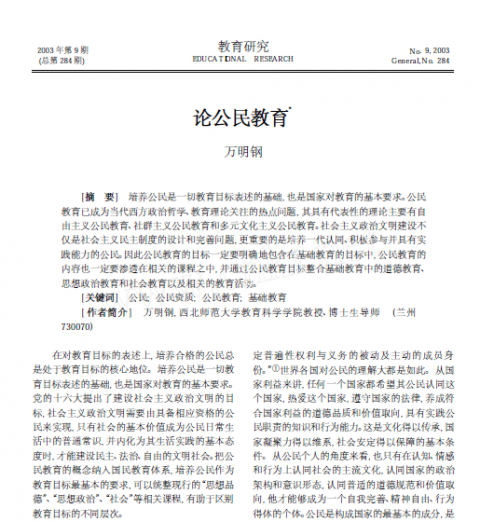 On Citizenship Education 발행 연도: 2003 저자: Wan Minggang Cultivation of citizens is the basis of all educational objectives and the State's basic requirement for eductaion. Citizenship education has become a hot issue at tracting the solicitude of modern Western political philosophy and educational theories. The citizenship education is characterized by its representative theories of liberalist citizenship education, corporatist citizenship education and muticulturalist citizenship eduction. The construction of socialist politics and civilization not only involves the designing and optimization of socialist democratic system, but also concerns the cultivation of citizens with strong sense of participation and practical ability. Therefore, the aim of citizenship eduction must be clearly included in the objectives of basic education and the content of citizenship education must be reflected in relevant courses. The objectives of citizenship education should be used to integrate moral education, ideological and political education, social education and relevant educational activities in basic education.